Professional Mini-Master in Community Accountability and Response in Humanitarian Action
Professional Mini-Master in Community Accountability and Response in Humanitarian Action is a free program on ARPS, the Arab Platform for Professional Studies. Design community accountability that turns participation and feedback into verifiable humanitarian decisions and responses. Build an integrated pathway starting with information people understand before a service decision, participation that reveals who attended and who was absent, and feedback.
Apply decision register and accountability to a fictional humanitarian case and justify the decision, limits and observable output.
From lesson 1, readable now without an account: Decision register and accountability
Community accountability is more than a complaints box at the end of a project. It is a relationship around decisions: who can influence the choice and conditions of a service, what information enables that choice, how people can see the effect of their input, and where they can turn when a programme gets something wrong. The 2024 Core Humanitarian Standard connects participation, safe complaints and learning from feedback. The standard does not, by itself, make every community proposal binding. A professional response states which decisions are open, weighs safety, equity and resources, and explains the reasons for the eventual choice. A promise to listen without a decision owner or a response date leaves people unable to distinguish consequential participation from data collection.
A free account saves your progress and takes you straight to lesson 1.
Program facts
Study fee
Free
subjects
9
lessons
50
Estimated time
165 hours
Content last reviewed
Access period
60 days
Study language
Arabic and English
About the program
Build an integrated pathway starting with information people understand before a service decision, participation that reveals who attended and who was absent, and feedback channels people can use safely. Trace a case from intake to response and check whether closure means an understood outcome rather than a system label. Keep sensitive allegations separate from general work and refer them to qualified people within role boundaries. Finally, compare access, comprehension and resolution measures and test whether a repair itself caused new harm. Cases and figures are fictional; no personal story or confidential workplace data is needed.
Practical relevance
Exercises produce a decision register, access test, minimum-data intake form, referral pathway, closure measures and improvement plan. Apply the method to a current service only after reviewing organisational policy and local context. All exercises can instead be completed from the included fictional cases without using real personal data.
Why this program
An organisation may receive many messages and report a high closure rate while some people remain outside its channels or cannot understand its replies. The programme connects design, operation and governance in decisions that can be reviewed. It also practises explaining proposals that were not adopted and protecting a person making a sensitive disclosure from unqualified investigation or unnecessary publication.
Career relevance
The material fits humanitarian programme management, community accountability, partnerships, feedback and safeguarding coordination. It develops professional judgement in trade-offs, follow-up and communication. It does not confer a safeguarding licence, academic degree or authority to investigate individual allegations.
Career paths this program serves
This program is a step on the paths of the following occupations. Open a path to see its other programs in study order.
Define decision rights, participation risks and management obligations in an accountable programme.
Make programme information usable and participation consequential for diverse groups.
Route ordinary feedback safely from intake to verified closure without losing ownership or confidentiality.
Recognise sensitive disclosures, protect information and route to qualified mechanisms without undertaking unauthorised investigation.
Use feedback evidence to change programme decisions and verify whether response is equitable and effective.
Learning outcomes (9)
Define decision rights, participation risks and management obligations in an accountable programme.
Make programme information usable and participation consequential for diverse groups.
Route ordinary feedback safely from intake to verified closure without losing ownership or confidentiality.
Recognise sensitive disclosures, protect information and route to qualified mechanisms without undertaking unauthorised investigation.
Use feedback evidence to change programme decisions and verify whether response is equitable and effective.
Design equitable access, budgets and representation decisions accounting for user burden, resources and eligibility.
Design owned, permission-aware response through outages, staff changes, demand growth and project exit.
Develop decision-relevant evidence through message tests, sampling, indicators, survey review and bounded uncertainty communication.
Defend a conditional launch decision linking access, handoffs, capacity, measurement and failure testing through reviewable evidence.
Who it is for
For people leading a humanitarian programme or supervising community accountability, complaint channels or an implementing partnership, with foundational experience of services for crisis-affected people. Monitoring and evaluation staff who need to connect response measures to real operating decisions will also benefit. Learners should be ready to consider access differences, privacy and coordination across teams; the course does not prepare them to investigate allegations or provide specialist protection services.
Prerequisites
Some initial experience of a humanitarian programme or service cycle and a basic understanding of affected users, implementing partners and decision ownership. Learners should be able to read simple proportions, identify a numerator and denominator, and distinguish general service information from a sensitive personal account. Those new to field work can use fictional cases but should first review foundational humanitarian principles and role boundaries before applying decisions in practice.
Accountability begins with a decision that people can understand and challenge, not with a feedback box detached from management.
5 lessons · 9 hours
Decision register and accountability2 hours
Diagnose participation and representation2 hours
Participation charter and boundaries2 hours
Balance fairness and capacity2 hours
Governance cadence and corrective action2 hours
Subject 2
Accessible information and inclusive participation
This module places information at each decision point in a service journey: what must a person know before travelling, enrolling or challenging an outcome? It compares phone, messages and direct explanation by actual reach and comprehension, not the number of published channels.
5 lessons · 9 hours
Information needs across the service journey2 hours
Test channel accessibility2 hours
Inclusive consultation without disclosure pressure2 hours
Turn participation into a traceable decision2 hours
Identify who remains unheard2 hours
Subject 3
Feedback channels and case management
The module moves from channel design to case handling from intake through outcome verification.
5 lessons · 9 hours
Safe, reachable channel mix2 hours
Minimum data for intake2 hours
Triage by urgency and competence2 hours
Partner handoff without identity leakage2 hours
Verify resolution and reopen cases2 hours
Subject 4
Safeguarding and sensitive complaints
This module examines the boundary of a general worker’s role when a safeguarding allegation or sensitive disclosure appears.
5 lessons · 9 hours
Separate feedback from safeguarding allegations2 hours
Consent, confidentiality and need to know2 hours
Survivor-centred referral boundaries2 hours
Child-sensitive access to a safe channel2 hours
Audit mechanism safety after an incident2 hours
Subject 5
Response, measurement and adaptation
The final module combines response, measurement and adaptation into a reviewable decision.
5 lessons · 9 hours
Define response and closure indicators2 hours
Interpret biased feedback data2 hours
Prioritise changes from evidence2 hours
Community response without case disclosure2 hours
Integrated mechanism review2 hours
Subject 6
Equity decisions under resource constraints
This module extends access decisions to household spending, time and accompaniment alongside organisational operating cost. Learners compare routes completing the same task and check whom cheaper channels exclude. They examine disability participation and local-language differences through user-chosen service tests and workable adjustments. Budget decisions separate fixed from variable spending and savings from transferred burden. A later lesson considers changed eligibility after registration has opened, including affected users within existing decision authority. The module ends with representative selection amid potential personal benefit. Activities produce cost and equity memos, practical access plans and reasoned representation decisions. Fictional calculations and worked feedback identify inference limits and the additional evidence worth gathering before expansion.
6 lessons · 27.5 hours
Household costs of reaching assistance4.5 hours
Disability-inclusive service testing4.5 hours
Facilitating decisions across two local languages4.5 hours
Allocating an accountability budget4.5 hours
Changing eligibility after registration opens4.5 hours
Choosing representatives amid conflicts of interest4.5 hours
Subject 7
Response continuity during operational change
This module preserves usable response when operations change. Learners start with network failure, designing temporary intake that protects privacy and identifiers before synchronising without duplicates. Staff turnover then raises permission revocation and open-work handover. Joint-service cases distinguish consistent partner replies from transferring decision authority. Rumour correction is scoped to its audience without amplification or exposure. Further lessons protect older cases during demand surges and plan project exit while work remains unresolved. Practice produces handover records, fallback and response plans and responsibility maps, using deliberate failures and worked correction criteria. Promises remain tied to actual authority and capacity, with partner acceptance and management decisions made explicit.
6 lessons · 27.5 hours
Temporary intake after a network outage4.5 hours
Case handover during staff turnover4.5 hours
Consistent partner replies in a joint response4.5 hours
Correcting a rumour without amplifying it4.5 hours
Demand surges without abandoning old cases4.5 hours
Closing a service with unresolved cases4.5 hours
Subject 8
Designing evidence that can change a decision
This module develops evidence that changes service decisions rather than merely enlarging reports. Learners test two versions of one message while preserving comparable tasks and participants. They then sample closed cases with attention to small groups and unreachable users. Indicator-definition changes are examined before differences are called improvement. Executive memos communicate uncertainty, immediate action and the value of additional information. The final lesson checks leading, double-purpose and misunderstood survey questions before use. Activities produce tests, sample plans, indicator comparisons, decision memos and repaired questions through fictional data, calculations and explicit inference limits. Each output contributes to measurement design and outcome review in the capstone.
5 lessons · 22.5 hours
Testing two versions of one message4.5 hours
Sampling closed cases for review4.5 hours
Distinguishing improvement from a changed definition4.5 hours
Showing uncertainty in an executive memo4.5 hours
Checking a survey before field use4.5 hours
Subject 9
Capstone: an implementable accountability mechanism
This capstone builds an accountability mechanism for a fictional winter-voucher programme, from project mandate to launch decision. Learners define scope, outcomes and authority, then map influential and missing stakeholders. The service map specifies owned handoffs and receipts before synthetic channel tasks test a prototype. Workload, staffing and budget connect promises with real capacity. A baseline and outcome measurement plan specify denominators, sources and data protection. Deliberate failure then tests consequences across the mechanism. The final defence supports limited launch or a specifically justified delay. Outputs accumulate into a reviewable operating package, with worked feedback and correction criteria for every practical task and an evidence-linked review decision.
8 lessons · 36.5 hours
Defining capstone scope and success4.5 hours
Stakeholder mapping and exclusion risks4.5 hours
Capstone service and referral mapping4.5 hours
Testing a channel prototype4.5 hours
Response staffing and budget plan4.5 hours
Capstone measurement and baseline4.5 hours
Stress-testing the capstone plan4.5 hours
Defending a conditional launch decision4.5 hours
Subjects unlock in sequence as you progress.
Strengths
A decision chain connecting participation to real service change
Observable exercises with worked answers explaining evidence limits and alternatives
The existing integrated final covers the original five modules; new lessons add linked formative questions and an evidence-bounded capstone launch decision.
Evidence basis
Participation and feedback principles draw on CHS 2024 and IFRC guidance; sensitive-reporting boundaries draw on IASC standards and specialist child-protection guidance. These publishers do not endorse this programme, and fictional case figures are not sector rates.
Reference organizations
CHS Alliance
IFRC
IASC
Alliance for Child Protection in Humanitarian Action
Methodology
Participation and feedback principles draw on CHS 2024 and IFRC guidance; sensitive-reporting boundaries draw on IASC standards and specialist child-protection guidance. These publishers do not endorse this programme, and fictional case figures are not sector rates.
Program questions
Must I share real people’s stories?
No. Every training case is fictional, and exercises use the information supplied. Do not place names or sensitive details in answers or external tools.
How is record closure different from problem resolution?
Record closure is an administrative status. Resolution needs an appropriate check of the outcome and the person’s understanding of the response, with a reopening rule when the repair fails.
Will I learn to investigate sensitive complaints?
No. You learn role boundaries, a safe initial response, minimum information sharing and referral to a qualified specialist under organisational policy.
How do the modules connect?
Original modules cover governance, access, operations, safeguarding and measurement. Extensions add equity, continuity, evidence design and a capstone. The existing final retains its original-module scope, with new formative questions supporting additional lessons.
What do the exercises produce?
Each lesson asks for a timed written output such as an alternatives register, access matrix, referral plan or indicator. Compare it with a separate worked answer explaining the decision and what might change it.
Show all (8)
What do module results with the certificate mean?
They break down performance on each module’s questions within the same designated completed integrated-final attempt. They are not separate module exams or a comprehensive diagnosis of field mastery.
Is Professional Mini-Master in Community Accountability and Response in Humanitarian Action free, and do I get a certificate?
Yes. Professional Mini-Master in Community Accountability and Response in Humanitarian Action is free on ARPS: every lesson, exercise and assessment is free, the first subject is open to read without an account, and the program is available in Arabic and English. Issuing a certificate is optional and has a published fee; it is a training completion certificate showing you passed the program's assessments, recognised by most private-sector organisations in the Gulf states and most Arab countries, and it strengthens your CV; confirming that a specific organisation accepts it remains your responsibility.
What other names is Professional Mini-Master in Community Accountability and Response in Humanitarian Action known by?
The subject of this program is also known as: accountability to affected populations, AAP, community engagement in humanitarian action. Learners usually find it by searching for: accountability to affected populations training, humanitarian accountability course, community feedback mechanisms, free humanitarian course.
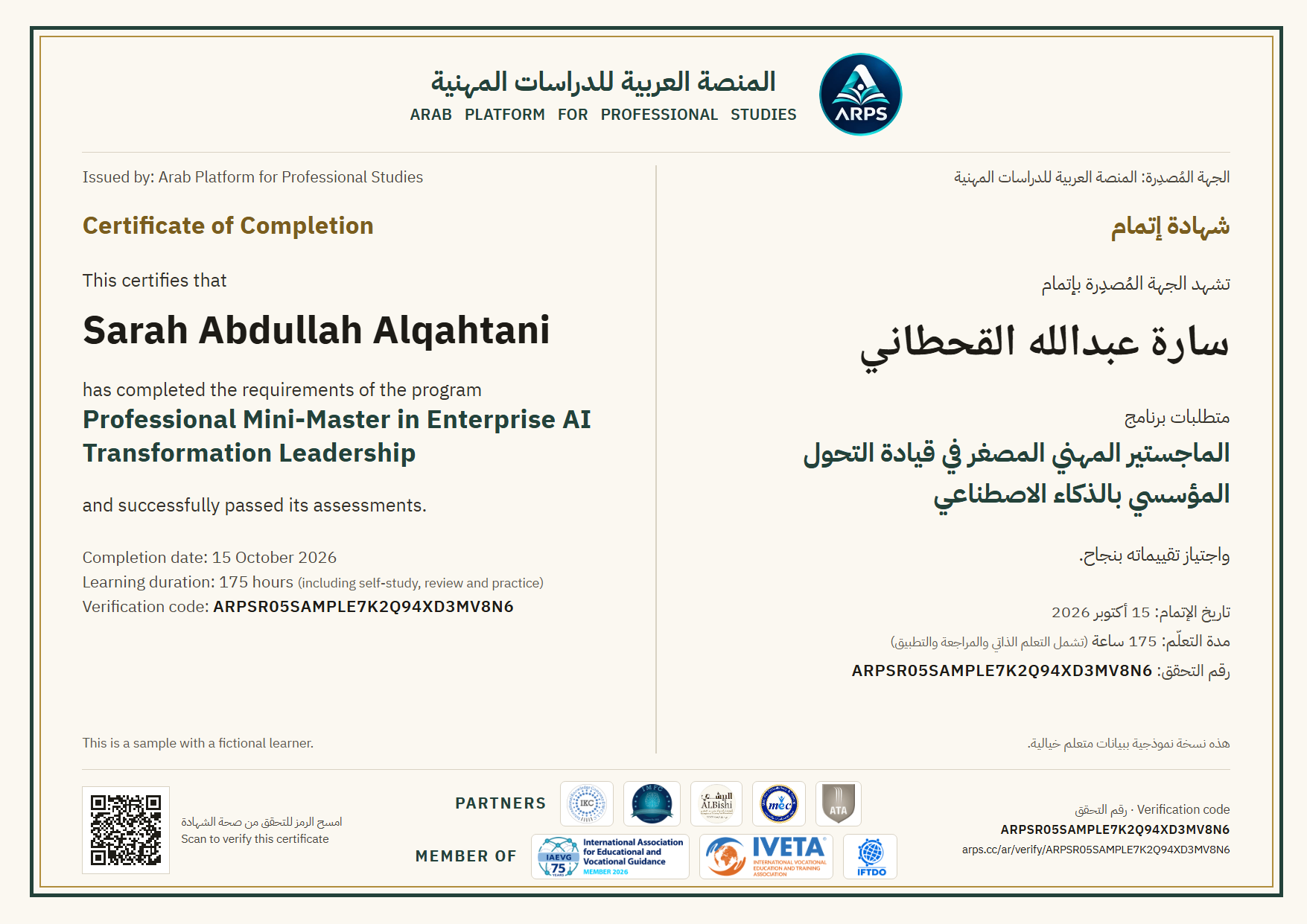
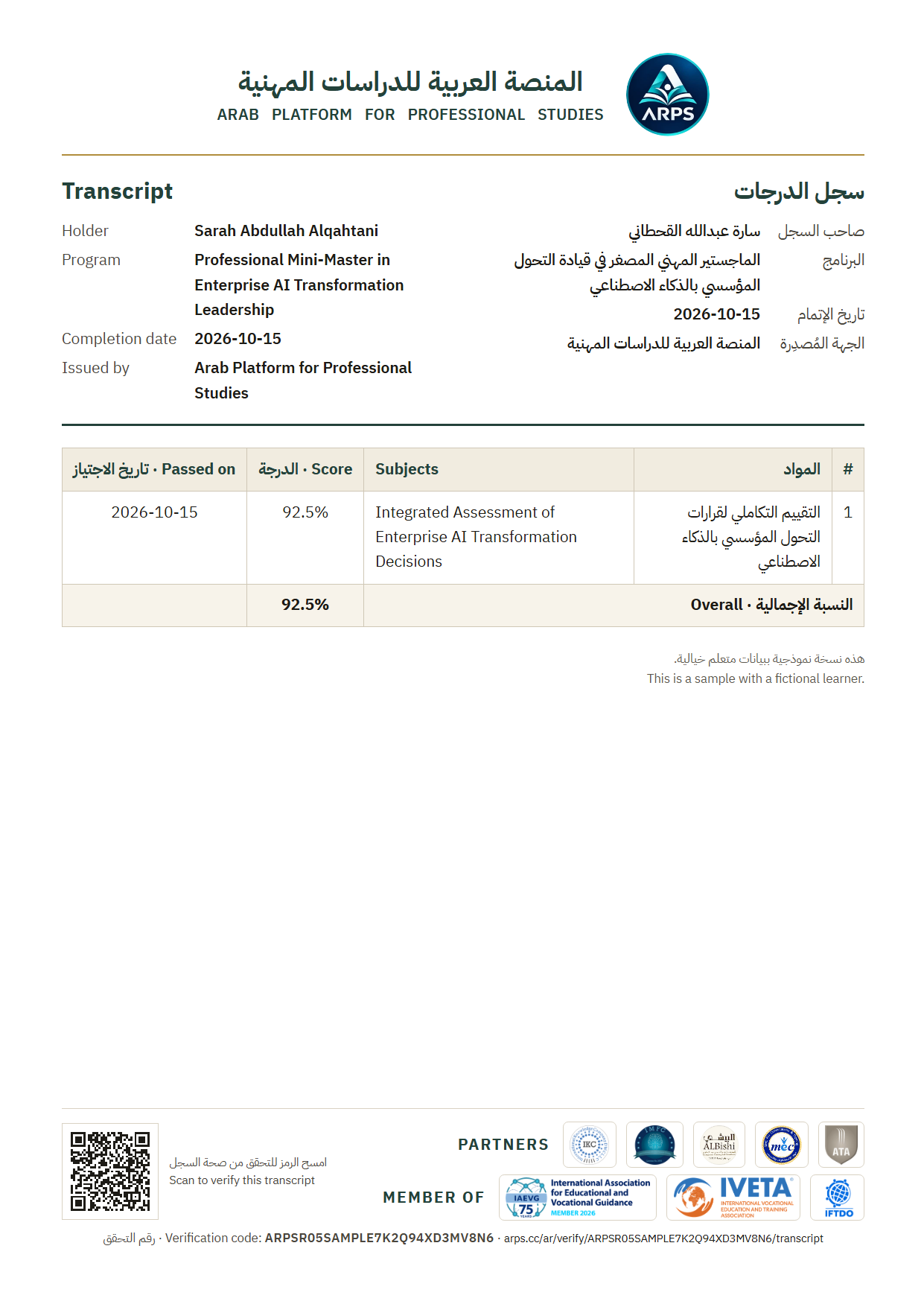
A sample from a real program in this track: Professional Mini-Master in Enterprise AI Transformation Leadership. The learner, scores and dates are fictional; opens in a new window.
Practice turning a program need into an evidence-based ask, then qualifying donors, handling gifts, stewarding relationships and interpreting fundraising performance.
An applied short diploma in volunteer management across role design, recruitment and induction, supervision, safety, and measurement and improvement. Seven subjects use fictional cases, decision exercises and a subject assessment each.
7 subjects
25 lessons
71 hours
Free
Professional Mini-Master
Career Development, Personal Skills & Productivity
An honest note: the professional mini-master is an intensive professional program; it is not an academic degree or a licence and is not equivalent to a university master's or MBA. The optional ARPS certificate is a training completion certificate showing you passed the program's assessments.