Short Diploma in Volunteer Management is a free program on ARPS, the Arab Platform for Professional Studies. An applied short diploma in volunteer management across role design, recruitment and induction, supervision, safety, and measurement and improvement. Seven subjects use fictional cases, decision exercises and a subject assessment each.
Important notice: Educational completion only; no professional licence or external endorsement.
From demand to volunteer capacity: apply the decision, produce an output and check its limits.
From lesson 1, readable now without an account: When is a task a suitable volunteer opportunity?
Imagine a community centre opening a weekly desk to help visitors use a library catalogue. Its manager suggests three tasks: welcome visitors and explain the search screen, resolve formal complaints, and open the building alone after staff leave. Someone may volunteer for all three, yet willingness alone does not make each task a sound volunteer role. Role design starts with two questions: what value does the volunteer add, and what authority, risk boundaries and support will the organisation provide? Volunteering Australia's standards call for meaningful, documented roles shaped with volunteer interests. They are a voluntary Australian practice framework, not universal law.
A free account saves your progress and takes you straight to lesson 1.
Program facts
Study fee
Free
subjects
7
lessons
25
Estimated time
71 hours
Content last reviewed
Access period
60 days
Study language
Arabic and English
About the program
Design a volunteer role and its boundaries, test selection, induction, support and safety, then measure a bounded result. Participation journeys and remote work add practical tools integrated through a capstone. Exercises produce checkable tables and memos using fictional data. The credential is educational, without professional licensing or local legal determinations.
Practical relevance
Fictional welcome, guidance and kit-preparation activities let learners calculate capacity, draft roles, respond to exceptions and measure bounded results. Real use still needs the organisation's data, authority and local policies.
Why this program
Connect role, roster, safety and measurement decisions through defined practices and a capstone.
Career relevance
Supports volunteer coordinators and small-team leaders with decisions, records and communication, without promising employment or independent professional authority.
Career paths this program serves
This program is a step on the paths of the following occupations. Open a path to see its other programs in study order.
Design role boundaries and calculate shift coverage
Select and induct volunteers against proportionate role evidence
Support volunteers, resolve role friction and close participation respectfully
Recognise risk or a concern and handle data within organisational authority
Define measures, test improvements and decide on a limited launch
Learning outcomes (25)
When is a task a suitable volunteer opportunity?: apply the decision, produce an output and check its limits.
From demand to volunteer capacity: apply the decision, produce an output and check its limits.
A meaningful, accessible role card: apply the decision, produce an output and check its limits.
Who decides and who holds the record?: apply the decision, produce an output and check its limits.
Outreach that reaches suitable volunteers: apply the decision, produce an output and check its limits.
Fair selection that matches person and role: apply the decision, produce an output and check its limits.
Screening proportionate to role risk: apply the decision, produce an output and check its limits.
Induction that demonstrates readiness: apply the decision, produce an output and check its limits.
A roster that covers service and respects people: apply the decision, produce an output and check its limits.
Useful briefings and actionable feedback: apply the decision, produce an output and check its limits.
Resolving role friction without silencing volunteers: apply the decision, produce an output and check its limits.
Recognising contribution and ending well: apply the decision, produce an output and check its limits.
From hazard to practical task control: apply the decision, produce an output and check its limits.
First response to a safeguarding concern: apply the decision, produce an output and check its limits.
Less data and clearer access: apply the decision, produce an output and check its limits.
Incident response and learning afterward: apply the decision, produce an output and check its limits.
Measures that say what happened, not more: apply the decision, produce an output and check its limits.
Reading retention and volunteer experience: apply the decision, produce an output and check its limits.
A small improvement test with a stop rule: apply the decision, produce an output and check its limits.
An integrated launch decision for a bounded volunteer programme: apply the decision, produce an output and check its limits.
Designing an accessible participation journey: create a justified output with explicit limits.
Coordinating and handing over remote volunteer tasks: create a justified output with explicit limits.
Capstone: negotiating the scope of a shared service: create a justified output with explicit limits.
Capstone: testing a shift under unexpected changes: create a justified output with explicit limits.
Capstone: delivering a learning dossier and transition plan: create a justified output with explicit limits.
Who it is for
The diploma suits early community-initiative coordinators, nonprofit or centre staff welcoming volunteers and planning shifts, small-team leaders seeking better induction and support, and learners moving into a bounded supervisory role. It can also help someone review an existing programme. It is not a substitute for specialist safeguarding training, a local legal decision or licensed professional preparation.
Prerequisites
Advanced volunteer-management experience is not required. Learners should be able to read a simple shift table, multiply and divide small quantities, calculate an elementary percentage, and write a short note about a work situation. They need willingness to revisit assumptions, distinguish an observed fact from an interpretation, and use fictional case data without entering real people's private details into exercises.
What it does not offer
Not a professional licence or external endorsement, and not a source of universal legal screening rules.
Design a volunteer opportunity useful to participants and volunteers, distinguishing volunteer tasks from employee authority. Start with a role card, calculate demand, coverage and supervision, then examine time and space constraints. Separate essential requirements from adaptable arrangements and assign decisions and records across host and coordinator. Numerical cases reveal why total minutes differ from coverage in every interval. Exercises produce a role card, resource matrix and bounded partnership decision. Figures are fictional; local application needs organisational policy and authorised approval. Finish with assumptions and a plan that can be tested before advertising the service.
4 lessons · 9.5 hours
When is a task a suitable volunteer opportunity?2 hours
From demand to volunteer capacity2 hours
A meaningful, accessible role card2 hours
Who decides and who holds the record?3.5 hours
Subject 2
Recruitment, selection and onboarding
Connect recruitment to actual role requirements, then test selection and induction through observable performance. Correct an advert or application barrier and build fair criteria distinguishing skill, availability and training needs. Compare roles with different exposure before proposing proportionate screening, keeping sensitive details with their authorised owner. Attendance at induction differs from demonstrated readiness in a simulation. Activities produce a selection matrix, readiness record and support plan, adapting learning methods while retaining task boundaries. Cases are fictional; legal requirements and sensitive checks need an organisational decision in context, followed by review when the role changes.
4 lessons · 9.5 hours
Outreach that reaches suitable volunteers2 hours
Fair selection that matches person and role2 hours
Screening proportionate to role risk2 hours
Induction that demonstrates readiness3.5 hours
Subject 3
Coordination, supervision and volunteer experience
Build rosters from service needs, confirmed availability and readiness, then test handovers and replacements in each interval. Distinguish fair allocation from numerical equality that ignores skill or preference. Practise short briefings announcing changes and feedback identifying behaviour, effect and an improvement step. In role disputes, separate events from each party’s interpretation and repair referral or support routes. Close with evidence-based recognition and a respectful exit protecting choice and continuity. Activities produce coverage grids, feedback notes and decision records. Cases are fictional; actual assignments require the organisation’s authority, resources and appropriate local safeguards.
4 lessons · 9.5 hours
A roster that covers service and respects people3.5 hours
Useful briefings and actionable feedback2 hours
Resolving role friction without silencing volunteers2 hours
Recognising contribution and ending well2 hours
Subject 4
Safety, safeguarding and incident response
Examine tasks, people and places to identify an exposure route and a practical control. Compare removing exposure with relying on instructions, and test controls before restarting. Learn first response to safeguarding concerns: listen, record facts and refer without conducting an investigation. Map data purpose, access and retention, protecting sensitive screening and concern details from unnecessary sharing. In incidents, distinguish urgent assistance, causal interpretation and learning review. Exercises produce a risk record, data route and response plan. Examples establish no local law or universal load limit and replace neither specialist safeguarding training nor authorised safety decisions.
4 lessons · 9.5 hours
From hazard to practical task control2 hours
First response to a safeguarding concern2 hours
Less data and clearer access2 hours
Incident response and learning afterward3.5 hours
Subject 5
Measurement, improvement and programme continuity
Choose measures for a defined decision, separating volunteer time, service outputs and beneficiary outcomes. State numerator, denominator and period, exposing unknowns before comparison. Review retention using starter cohorts and equal observation windows, and hear volunteer experience without generalising one opinion. Design a small improvement trial with measures and a stop condition, examining side effects. The final activity integrates role, coverage, induction, safety and support in a bounded launch decision. Exercises yield tables and minutes with explicit calculations and criteria. Figures remain fictional, while limited local observations differ from lasting impact or established causation.
4 lessons · 9.5 hours
Measures that say what happened, not more2 hours
Reading retention and volunteer experience2 hours
A small improvement test with a stop rule2 hours
An integrated launch decision for a bounded volunteer programme3.5 hours
Subject 6
Accessible participation and remote volunteering
Examine participation from registration through experience review with the volunteer, identifying the actual barrier before selecting an adjustment. Balance format, timing and support resources while retaining task quality and privacy. Then coordinate remote work across different schedules using a task package with output and receipt criteria. Distinguish versions, resolve conflicting edits and preserve confirmed portions during transfer to a replacement. Three practices in each lesson produce maps, comparisons and records with separate feedback. Cases are fictional. Practical arrangements combine understandable independence, human communication and access permissions tested from the receiver’s role.
2 lessons · 10 hours
Designing an accessible participation journey4.5 hours
Coordinating and handing over remote volunteer tasks4.5 hours
Subject 7
Capstone: a shared service from design to handover
Negotiate a shared-service scope supported by confirmed resources and clear authority, producing commitments, a trade-off memo and a change request. Test the plan through sequential tabletop events, recording evidence, decisions and effects on scope and people. Distinguish one restored resource from satisfaction of every restart requirement. Review counts, feedback and effort to write an evidence-bounded recommendation, then test knowledge and access transfer to a successor. Nine practices support three connected capstone outputs. Simulation is fictional and grants no operating permission; real approval remains with authorised owners after appropriate contextual checks.
3 lessons · 14.5 hours
Capstone: negotiating the scope of a shared service4.5 hours
Capstone: testing a shift under unexpected changes4.5 hours
Capstone: delivering a learning dossier and transition plan4.5 hours
Subjects unlock in sequence as you progress.
Strengths
Worked numerical cases and exercises with observable outputs and checks
Volunteer safety and experience connected to service continuity
Fictional facts separated from practice guidance and local legal claims
A separate assessment for each subject and a results transcript
Evidence basis
Concepts draw within stated scope on primary guidance from Volunteering Australia, NCVO, IFRC, ILO, UNV, Volunteer Canada and NIST. Examples and questions are original; citation does not imply endorsement or partnership.
Reference organizations
Volunteering Australia
NCVO
IFRC
ILO
UNV
Volunteer Canada
NIST
Frameworks used
National Standards for Volunteer Involvement; voluntary Australian practice framework — 2024
Twenty-five lessons connect volunteer design, support, safety and measurement, adding accessible participation, remote work and a three-stage capstone. Review is author self-review and time is an editorial estimate for defined activities, without learner-trial or external-endorsement claims.
How the route works
Short Diplomas are relatively comprehensive learning pathways that cover a major subject through five connected learning subjects and structured assessments, with a diploma transcript available with the credential.
Self-paced sequential study. Content unlocks progressively and each subject combines reading, examples, exercises, knowledge checks, and assessment.
Build integrated knowledge in a major subject.
Study through five clear, connected learning subjects.
Complete a defined assessment for each subject.
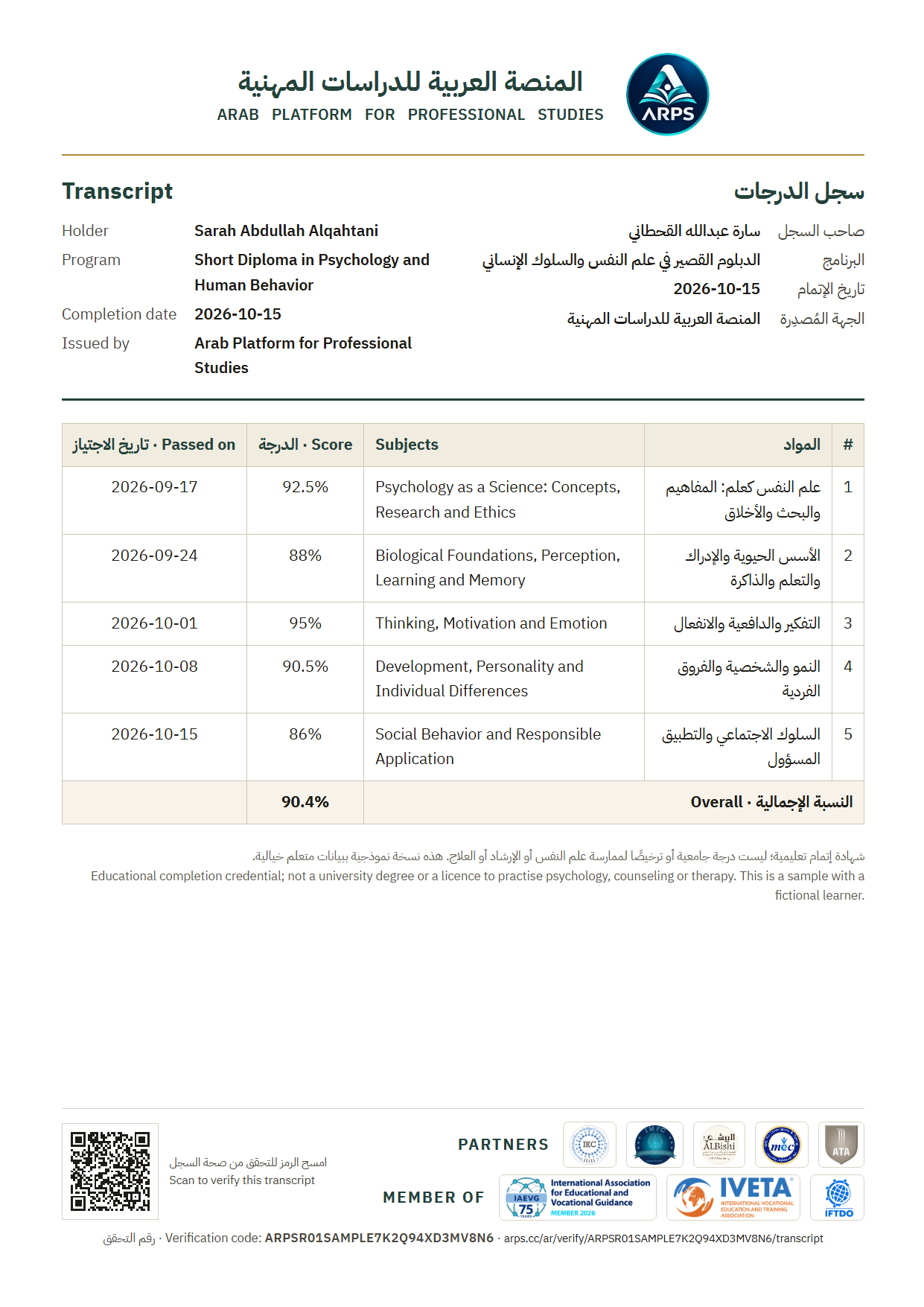
Receive a diploma transcript showing subjects and results when the credential is issued.
Assessment
Each Short Diploma contains five subjects, each with an approved assessment. A sixth final exam is not required when the five assessments adequately cover the learning outcomes.
Assessment attempts: 2 per assessment, 7 days apart
The pass mark is announced before the program is published.
Certificate
Successful completion makes the learner eligible for the Short Diploma certificate and Diploma Transcript under the credential policy.
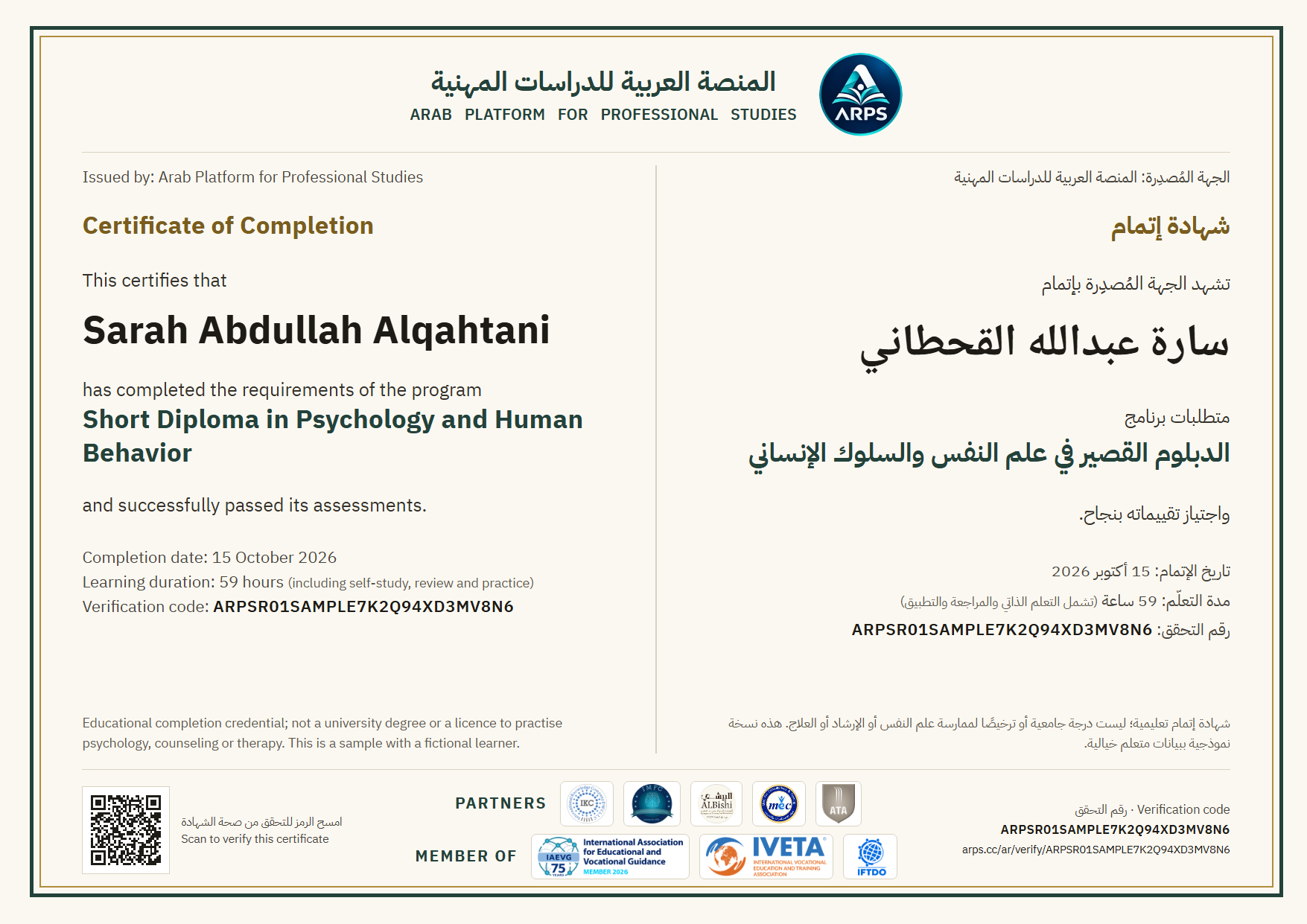
A sample from a real program in this track: Short Diploma in Psychology and Human Behavior. The learner, scores and dates are fictional; opens in a new window.
Disclaimer: Training completion, not a university degree or professional licence.
Program questions
Does the credential grant a professional licence?
No. It records educational completion only.
Are case figures real data?
No. They are labelled training assumptions; actual practice needs local checks.
How are subjects assessed?
Each subject has lesson checks and a separate summative assessment under route policy.
Do I need prior experience?
Reading a simple roster, calculating a basic percentage and writing a short observation are sufficient; advanced supervision experience is not required.
Does this replace specialist safeguarding training?
No. The subject teaches recognition and referral within organisational authority, not a local safeguarding procedure or specialist qualification.
Show all (10)
Do exercises require real personal data?
No. Use only fictional case data; do not enter actual volunteer records or personal details.
How long is access?
The central route specifies a sixty-day access window and thirty nominal days; official learning hours are not declared.
How can I apply the tools locally?
Start with a bounded pilot and review your organisation’s policy, authority and data before adapting a role card or incident route.
Is Short Diploma in Volunteer Management free, and do I get a certificate?
Yes. Short Diploma in Volunteer Management is free on ARPS: every lesson, exercise and assessment is free, the first subject is open to read without an account, and the program is available in Arabic and English. Issuing a certificate is optional and has a published fee; it is a training completion certificate showing you passed the program's assessments, recognised by most private-sector organisations in the Gulf states and most Arab countries, and it strengthens your CV; confirming that a specific organisation accepts it remains your responsibility.
What other names is Short Diploma in Volunteer Management known by?
The subject of this program is also known as: volunteer management, volunteer coordination, volunteer program management. Learners usually find it by searching for: volunteer management course free, volunteer management systems, volunteer coordinator skills, volunteer recruitment and retention, volunteer program design.
Practice turning a program need into an evidence-based ask, then qualifying donors, handling gifts, stewarding relationships and interpreting fundraising performance.
This short diploma connects market-research design with consumer-behavior interpretation and evidence-bounded decisions. Six subjects progress from the research question through sampling, measurement, analysis, choice journeys, testing, and recommendation, ending with an applied market-research capstone.