Short Diploma in Market Research and Consumer Behavior
Short Diploma in Market Research and Consumer Behavior is a free program on ARPS, the Arab Platform for Professional Studies. This short diploma connects market-research design with consumer-behavior interpretation and evidence-bounded decisions. Six subjects progress from the research question through sampling, measurement, analysis, choice journeys, testing, and recommendation, ending with an applied market-research capstone.
Distinguish a business decision from a research question, construct, and indicator, then write a testable decision brief.
From lesson 1, readable now without an account: From business decision to research question
A problem worth researching
A manager of a fictional delivery service says, 'Repeat orders fell; send a satisfaction survey.' That jumps from a symptom to a tool before identifying the decision. The apparent fall could come from a new active-customer definition, the end of a discount campaign, late deliveries, or an influx of first-time customers who rarely return. Start with the decision management faces: change delivery fees, improve arrival-time reliability, or hold action while checking the evidence. Research reduces uncertainty around that choice. It neither replaces management judgment nor turns an association into a cause. State the alternatives, timing, and decision owner, then ask which missing information could change the comparison.
A free account saves your progress and takes you straight to lesson 1.
Program facts
Study fee
Free
subjects
6
lessons
24
Estimated time
62.5 hours
Content last reviewed
Access period
60 days
Study language
Arabic and English
About the program
How can a team tell whether exits at a booking page reflect price, fee clarity, or payment failure? The diploma begins by separating a business decision from the research question and choosing a design that can collect suitable evidence. Learners build a sampling frame, write neutral questions, pilot Arabic and English wording, clean a small dataset, and calculate rates with stated denominators. They then read the consumer journey, distinguish stated preference from observed purchase, and review how display order and defaults may influence choice under a transparency guardrail. In the fifth subject, learners triangulate sources, prioritize a reversible intervention, draft a two-version protocol, and hand off a decision memo. A capstone then applies this to a fictional order-pickup service: coded interviews, choice cards, demand bounds when some buyers are missing, and a bounded operational pilot with an executable recommendation. Regional cases are explicitly hypothetical and supply neither real local market rates nor country-specific legal rules.
Practical relevance
Learners produce a source matrix, piloted measure, brief numerical report, comparison protocol, and handoff memo using fictional cases that can be adapted to a real brief.
Why this program
Survey answers and purchase logs can appear to conflict because they cover different people and events. This course teaches a repeatable way to reconcile them and identify what must be tested before spending or changing a customer experience.
Career relevance
It fits entry-level market research, marketing, product, and customer-experience work that requires reading findings and discussing their limits with decision teams. Educational completion is not a professional licence or regulated title.
Career paths this program serves
This program is a step on the paths of the following occupations. Open a path to see its other programs in study order.
Turn a business decision into a research question and indicator.
Choose a design, sample, and measure without unsupported representativeness claims.
Clean data and calculate rates on declared bases.
Separate intent from observed behavior and assess choice design.
Triangulate sources, specify a test and harm guardrails, and hand off a memo.
Carry a market-research project from interviews, choice cards and demand bounds to a bounded operational pilot with a stopping rule.
Learning outcomes (6)
Frame a business decision, research question, construct, and measurable indicator.
Choose exploratory, descriptive, or test evidence with appropriate inference limits.
Define a population, sample, measure, and ethical fieldwork record.
Clean a small dataset and calculate rates with appropriate bases and windows.
Interpret a consumer journey, separating statement from action and cause from association.
Triangulate evidence, rank an intervention, test it, and hand off an evidence-bounded decision.
Who it is for
Beginning market researchers who need to frame a question and read sampling limits.
Product, marketing, and customer-experience teams comparing user statements with usage records.
Decision owners who need a bounded recommendation rather than an unsupported marketing certainty.
Service teams facing apparent conflicts between customer comments and transaction records who want to test a small change before generalizing it to different users.
Prerequisites
Comfort reading simple tables and calculating a basic percentage; worked arithmetic is provided and advanced statistics is not required.
Ability to write a short note about a consumer-service decision and willingness to examine sampling and behavioral assumptions.
Everyday familiarity with a purchase page or survey is useful, together with willingness to separate what was actually observed from an assumed reason for behavior.
What it does not offer
A professional practice licence or endorsement from organizations cited as references.
Country-specific legal advice or advanced causal claims without a suitable design and data.
Start with the business decision, then turn it into a research question, construct, and observable indicator. Separate management's wish from a claim about consumer motives and identify evidence capable of answering the question. Audit existing data in a source matrix that records collection date, population, and inference limits. Interviews explore candidate explanations, descriptive measurement estimates answers within a sampling frame, and a controlled test compares a specific change. Before collecting new data, define the population, study unit, eligibility, recruitment, and consented contact.
4 lessons · 7 hours
From business decision to research question2 hours
Audit existing evidence before new collection2 hours
Match research design to the uncertainty2 hours
Population, unit of observation, and responsible contact2 hours
Subject 2
Sampling, measurement, and fieldwork
A sampling design determines whose voices are present and whose are absent. Name the recruitment frame and its coverage gaps; do not present a convenience sample as representing every customer. Write neutral questions that measure one construct, use answer choices that are as distinct as possible, and set a sensible recall period. Pilot Arabic and English versions with appropriate speakers: meaning must align, not merely word order. Record misunderstandings and revise before fieldwork. During collection, track invitations, responses, missing items, duplicates, deviations, and exclusions; distinguish nonresponse from ineligibility.
4 lessons · 7 hours
Sampling frame and coverage gap2 hours
Neutral questions and analyzable response options2 hours
Pilot the bilingual instrument before launch2 hours
Fieldwork quality before analysis2 hours
Subject 3
Market data analysis and interpretation
Begin analysis with a codebook that distinguishes ineligible records, duplicates, missing items, and incomplete orders; merging these states to improve a headline destroys the base. Show the count flow from raw rows to the valid denominator for each indicator. If segments are represented unevenly, distinguish a raw rate from a weighted summary, state the target mix and assumptions, and avoid implying that weighting removes all bias. Compare segments on consistent bases and flag how one changed case affects a thin cell.
4 lessons · 7 hours
A codebook before the results table2 hours
Rates, denominators, and weights2 hours
Compare segments without inventing a cause2 hours
A results brief that shows evidence limits2 hours
Subject 4
Consumer behavior and the decision journey
Consumer behavior is not identical to what a survey respondent says. Map the journey from information exposure through choice, payment, and return, naming each event's source and base. A default or display order may shift acceptance, but do not attribute a gap to a feature that was not isolated from price or visitor mix. Define repeat purchase as a completed second order within a stated window among a first-buyer cohort; one return is not enduring loyalty. Check contact permission before proposing a reminder.
4 lessons · 7 hours
The decision journey between stated and observed behavior2 hours
Competing explanations, not ready-made motives2 hours
Behavioral segments fit for a decision2 hours
Clear choice design that respects consumer autonomy2 hours
Subject 5
Evidence synthesis, recommendation, and testing
Synthesize survey, interview, and transaction evidence in one matrix with population, base, timing, and inference limit. Agreement is not independent confirmation when sources draw on the same people. When findings conflict, inspect differences in measurement and coverage before selecting a convenient story. Compare interventions by hypothetical effect, evidence strength, effort, reversibility, and possible harm, then test whether one changed assumption reverses the ranking. Exclude options that hide required costs or obstruct exit. Before a two-version test, fix the assignment unit, primary outcome, window, guardrails, contamination rules, and stopping rule.
4 lessons · 7 hours
Triangulating consumer evidence when it conflicts2 hours
Testing two versions without overstating the result2 hours
The decision memo and research handoff2 hours
Subject 6
Market-research capstone for an order pickup service
A market-research capstone for a fictional order-pickup service that moves from coded interviews, choice cards and demand bounds to a bounded operational pilot and an executable recommendation.
4 lessons · 13 hours
Coding pickup interviews and reasoning from discrepant cases3.5 hours
Choice cards for pickup-service trade-offs3 hours
Demand bounds when some buyers are missing3 hours
A bounded operational pilot and executable recommendation3.5 hours
Subjects unlock in sequence as you progress.
Strengths
A six-subject path from research brief to handoff memo and an applied capstone, with an assessment in each of the five core subjects.
Worked practice on denominators, coverage, causality, and consumer-harm guardrails.
Parallel Arabic and English text with clearly fictional regional cases.
Evidence basis
Survey and disclosure principles draw on AAPOR and Pew, research ethics on ICC/ESOMAR, and choice-design discussion on FTC, OECD, and CMA within each source's scope. These institutions neither authored nor endorsed this diploma.
Reference organizations
American Association for Public Opinion Research
Pew Research Center
ICC and ESOMAR
US Federal Trade Commission
OECD
UK Competition and Markets Authority
Methodology
Each lesson connects a concept to a decision through a case and two solved exercises, followed by a check and subject assessment. Review is assisted self-review, not independent learner validation.
How the route works
Short Diplomas are relatively comprehensive learning pathways that cover a major subject through five connected learning subjects and structured assessments, with a diploma transcript available with the credential.
Self-paced sequential study. Content unlocks progressively and each subject combines reading, examples, exercises, knowledge checks, and assessment.
Build integrated knowledge in a major subject.
Study through five clear, connected learning subjects.
Complete a defined assessment for each subject.
Receive a diploma transcript showing subjects and results when the credential is issued.
Assessment
Each Short Diploma contains five subjects, each with an approved assessment. A sixth final exam is not required when the five assessments adequately cover the learning outcomes.
Assessment attempts: 2 per assessment, 7 days apart
The pass mark is announced before the program is published.
Certificate
Successful completion makes the learner eligible for the Short Diploma certificate and Diploma Transcript under the credential policy.
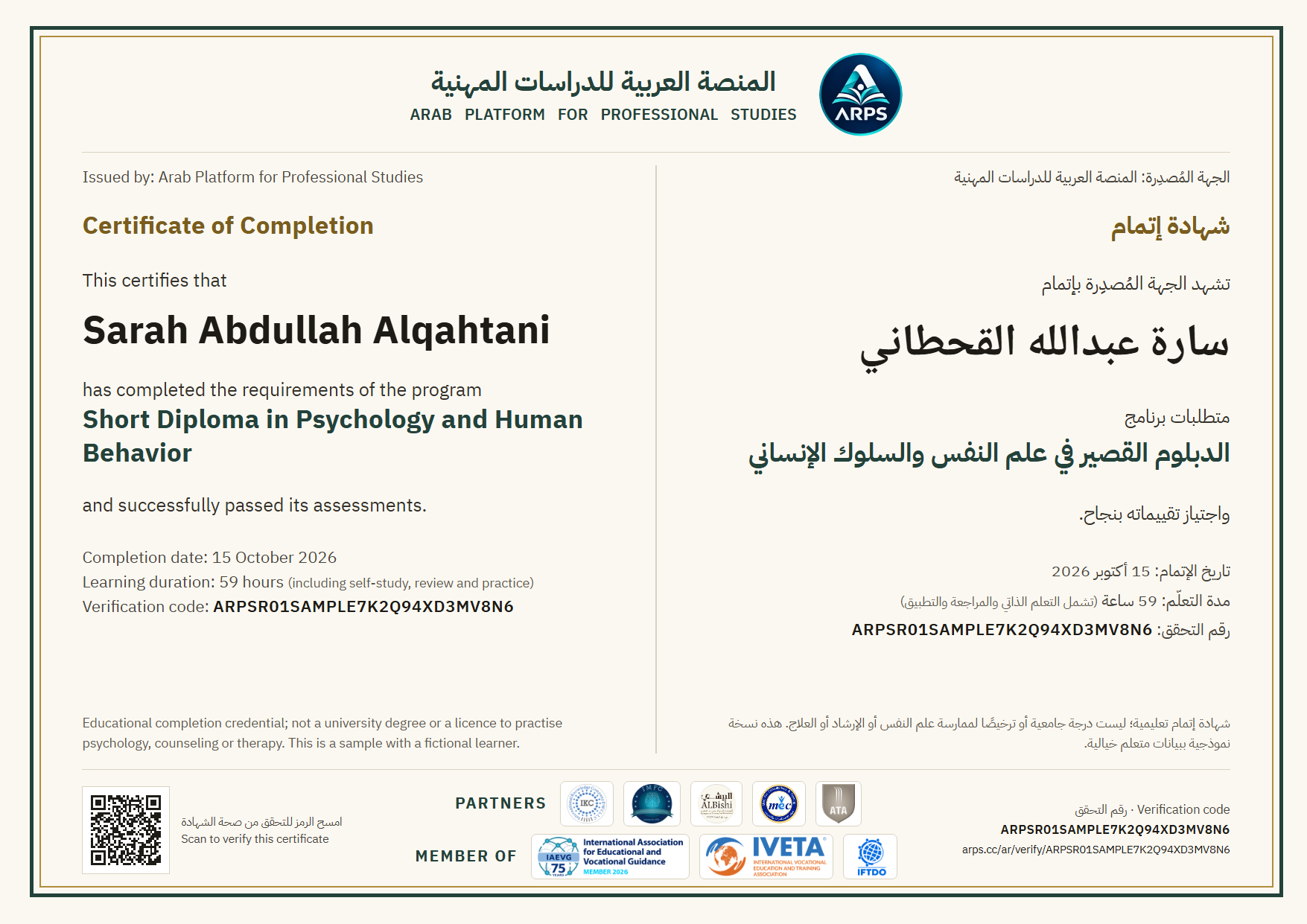
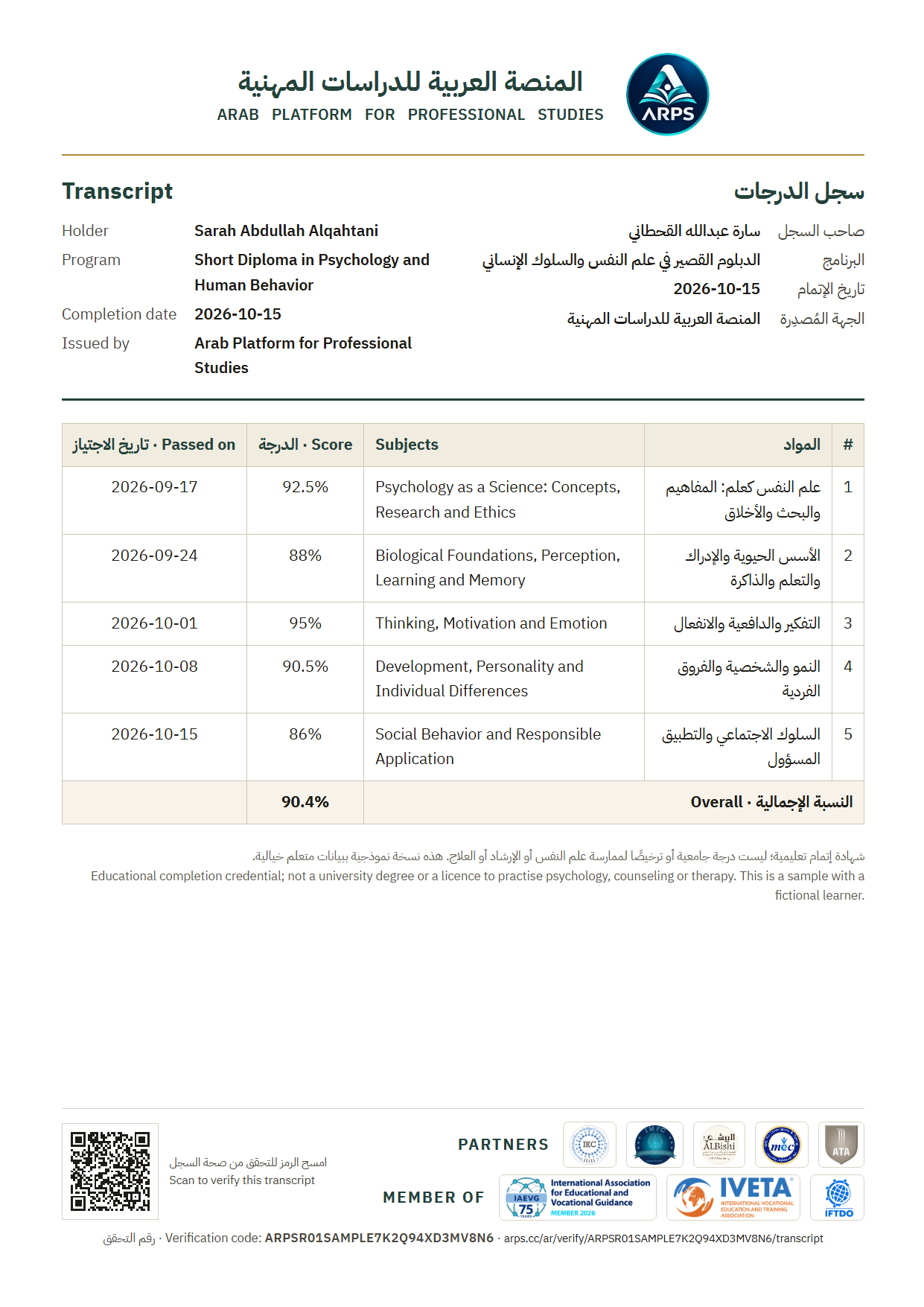
A sample from a real program in this track: Short Diploma in Psychology and Human Behavior. The learner, scores and dates are fictional; opens in a new window.
Disclaimer: Independent education; not a university degree, professional licence, or endorsement by cited organizations.
Program questions
Is this only a survey course?
The subjects cover questions, designs, samples, interviews, transaction logs, analysis, choice behavior, and intervention tests. A survey is one source, not the whole course.
Are the city examples real market data?
No. Cities locate explicitly hypothetical exercises, and the invented counts teach calculation and interpretation, not local estimates.
Does completion permit regulated professional practice?
No. This is independent education; completion grants no professional licence, university degree, or endorsement by cited organizations.
When should a test result shape a decision?
After checking the outcome, denominator, assignment, guardrails, and sample limits, then documenting an action proportionate to the evidence.
Can a few interviews estimate a market percentage?
Interviews can reveal language and possible mechanisms; a rate needs a suitable sample design and denominator.
Show all (10)
Why does each rate show its base?
Forty of a hundred starters is not the same rate among all visitors or all buyers; the base gives the figure meaning.
Does the subject teach advanced statistical testing?
It focuses on disciplined comparisons, outcomes, guardrails, and inference limits; advanced statistical planning may need specialist support.
What is handed to a decision team?
A short memo with decision, count, base, limit, rival explanation, next action, owner, and review trigger.
Is Short Diploma in Market Research and Consumer Behavior free, and do I get a certificate?
Yes. Short Diploma in Market Research and Consumer Behavior is free on ARPS: every lesson, exercise and assessment is free, the first subject is open to read without an account, and the program is available in Arabic and English. Issuing a certificate is optional and has a published fee; it is a training completion certificate showing you passed the program's assessments, recognised by most private-sector organisations in the Gulf states and most Arab countries, and it strengthens your CV; confirming that a specific organisation accepts it remains your responsibility.
What other names is Short Diploma in Market Research and Consumer Behavior known by?
The subject of this program is also known as: market research, consumer behavior, marketing research. Learners usually find it by searching for: market research course, consumer behavior course online, how to do market research, marketing research methods, free market research course.
A foundational short diploma that connects digital-marketing strategy, audience and value proposition with content, paid channels, measurement, experimentation and privacy.
A foundational diploma that connects customer experience and customer service from journey and expectation understanding through service design, complaints, measurement and continuous improvement.
A foundational, applied diploma that connects market and account selection to value proposition, then turns opportunities into a trackable pipeline and covers qualification, partnerships, negotiation, growth economics and deal learning. It separates forward-looking opportunity indicators from realized revenue and uses fictional cases without growth promises or spam playbooks.
A practical foundation in how search engines work, how to interpret search intent, and how content, technical structure, links and measurement support sustainable organic growth without manipulation or ranking guarantees.
6 subjects
25 lessons
59 hours
Free
Next step: a professional certification or a mini-master
Programs in the same domain that prepare you for an international certification exam or form a professional mini-master, also free.