Short Diploma in Community Development and Initiatives
Short Diploma in Community Development and Initiatives is a free program on ARPS, the Arab Platform for Professional Studies. Learn to diagnose needs and design, deliver and evaluate community initiatives across five assessed subjects, worked cases and a capstone. This short diploma begins with the population affected and a need supported by bounded evidence, then shows how people can influence.
Important notice: Independent foundation education and completion credential only; no professional licence or practice authority.
Define a community and distinguish a stated request from an evidenced, bounded need; output a need statement with population, place and evidence limits.
Map stakeholders by influence, affectedness and access barriers; output an inclusion and consultation map.
From lesson 1, readable now without an account: Defining a community and a need
When an initiative coordinator says, “This neighbourhood needs another centre,” the proposed solution has arrived before the problem is established. Some residents may need a place to learn. The obstacle might instead be opening hours at an existing room, travel to it, or a programme that does not fit. A useful diagnosis separates three questions: who is within the decision, what observable condition affects them, and what evidence supports that description. A “community” is not automatically everyone in a city. Define it by a place, shared relationship or common interest, then ask who the definition leaves out. If the available register covers only people who already use a facility, those kept away by opening hours or transport are missing from the register. The community affected by a decision is wider than the people visible in its records.
A free account saves your progress and takes you straight to lesson 1.
Program facts
Study fee
Free
subjects
6
lessons
25
Estimated time
88 hours
Content last reviewed
Access period
60 days
Study language
Arabic and English
About the program
This short diploma begins with the population affected and a need supported by bounded evidence, then shows how people can influence an initiative choice. It moves through a change hypothesis, alternatives and a testable brief. Delivery lessons sequence resources, partners, feedback and accountable adaptation. Measurement lessons define numerators, denominators, baselines and inference limits before judging whether to continue, adapt or stop. The fifth subject tests sustained benefit, responsible handover and honest public results, and a capstone builds an operational decision file for a community initiative. Each subject has a summative assessment. Fictional city cases are teaching scenarios rather than local factual claims. The completion credential offers no professional licence or accredited hours.
Practical relevance
Learners produce a need record, stakeholder map, initiative brief, delivery plan, indicator cards and final decision dossier. Every exercise supplies data, steps, a worked result and limits for self-checking.
Why this program
The five assessed subjects connect diagnosis, participation, initiative design, accountable delivery, measurement and handover. Worked cases show how a changed fact can properly change a decision.
Career relevance
These skills help people coordinating initiatives, volunteering or working in community services interpret evidence and document bounded decisions. The diploma does not confer regulated practice or consultant status.
Career paths this program serves
This program is a step on the paths of the following occupations. Open a path to see its other programs in study order.
Diagnose a community need with bounded evidence, identify absent stakeholders and prioritise transparently.
Design meaningful participation and an initiative with a testable change hypothesis, alternatives and indicators.
Organise delivery, resources, partnerships and feedback, adapting the plan accountably.
Measure results with indicator definitions, baseline and inference limits, then make a defensible adaptation decision.
Test sustainability, hand over or close responsibly, and communicate findings in an integrated decision dossier.
Build and test an operational dossier for a community initiative covering fair deliberation, referrals, procurement, equity and service continuity within explicit authority.
Learning outcomes (6)
Diagnose a community need with bounded evidence, identify absent stakeholders and prioritise transparently.
Design meaningful participation and an initiative with a testable change hypothesis, alternatives and indicators.
Organise delivery, resources, partnerships and feedback, adapting the plan accountably.
Measure results with indicator definitions, baseline and inference limits, then make a defensible adaptation decision.
Test sustainability, hand over or close responsibly, and communicate findings in an integrated decision dossier.
Build and test an operational community-project dossier covering fair deliberation, referrals, procurement, equity and continuity within explicit authority.
Who it is for
This diploma is for new initiative coordinators, volunteers, staff of community organisations and services, and people who want to turn a general idea into a responsible measurable trial. It offers a multi-subject foundation in diagnosis, participation, design, delivery, evaluation and handover, using fictional cases that do not assume any single country's legal system or confer practice authority.
Prerequisites
No specialist experience or professional licence is required. Learners should be able to read short cases, calculate or check simple percentages with a calculator, and write a brief decision explaining its reason and limit. Familiarity with volunteering or community organisations can help, but it is neither an entry condition nor a substitute for the evidence taught in the lessons.
What it does not offer
It does not replace professional qualification, licensing or country-specific legal training.
Community development starts by defining who is affected before choosing a building or campaign. This subject teaches a bounded need statement drawn from an observable condition rather than a requested solution. You map stakeholders, including non-users invisible in a service register, and compare request records, distinct people, interviews and observation by the claims each can support. You then prioritise needs against severity, reach, feasibility and affected people's preferences and test how a changed fact alters the choice. The outputs are a diagnosis record, stakeholder map, evidence matrix and reasoned priority. Every percentage keeps its own counting unit and every inference states its limits. Fictional city cases are teaching scenarios, not descriptions of real local conditions.
4 lessons · 8.5 hours
Defining a community and a need2 hours
Stakeholders and fair access2 hours
Triangulating evidence and counting units2 hours
Transparent prioritisation2 hours
Subject 2
Participation and initiative design
This subject turns a diagnosed need into a small initiative whose design can genuinely be influenced by affected people. You identify an open decision and non-negotiable constraints, select channels that reach users and non-users, and report back what their input changed. A problem tree separates an observed condition from possible causes and consequences, leading to a falsifiable change hypothesis. You compare alternatives with different mechanisms, running costs and side effects, including improvement of the current service and a bounded trial. Finally, a brief links activity, controlled output, near outcome, indicator and stopping condition. Producing an app or holding a meeting is not by itself evidence that access or capability improved.
4 lessons · 8.5 hours
Participation that can change a decision2 hours
From a problem tree to a testable change hypothesis2 hours
Comparing options and unintended effects2 hours
A testable initiative brief2 hours
Subject 3
Delivery, partnerships and accountability
The third subject moves from design to delivery that honours promises, resources and accountability. Sequence tasks by actual dependency and count cash, in-kind inputs and volunteer time so an invitation is not sent before a venue and access are confirmed. Separate a partner's control of a room from residents' knowledge of whether the choice suits them, assigning a closure owner and data-sharing limit to every commitment. Build a feedback route that distinguishes an ordinary suggestion from a safety or data exposure report needing urgent containment. When timing, staffing or resources change, record the new fact, alternatives, authority, participant notice and verification. The outputs are a reviewable delivery baseline, partner record, response route and change log.
4 lessons · 8.5 hours
Delivery sequence and resource baseline2 hours
Partners and responsibility boundaries2 hours
Feedback, complaints and response2 hours
Risk and accountable adaptation2 hours
Subject 4
Measurement, learning and adaptation
This subject measures what happened without turning coincidence into a causal claim. You define an indicator's numerator, denominator, unit, period and source, separating sessions, repeat attendances, distinct people and task completion. You design comparable baseline and follow-up measures, disclose attrition and show how unknown outcomes could change the finding. A results note distinguishes delivered outputs, observed near results and rival explanations. You then use relevance, effectiveness, efficiency and sustainability questions to decide whether to continue, adapt or stop. A short trial cannot establish distant impact merely because a rate improved, and an access complaint cannot be hidden by a favourable average. The output is a learning memo with measurable indicators, inference limits and a review decision.
4 lessons · 8.5 hours
Indicators with a defined numerator and denominator2 hours
Baseline, follow-up and responsible data2 hours
Findings without unsupported attribution2 hours
Continue, adapt or stop2 hours
Subject 5
Sustainability and integrated practice
The final subject brings the initiative cycle into one accountable decision. Test whether benefits can continue after the team leaves, with a named owner, maintenance resources and a fallback, rather than promising an ownerless activity indefinitely. Prepare a handover or closure record covering open cases, limited data transfer and a clear message to participants. Communicate figures honestly to the public and operating partners without confusing page views with people or completion with long-term impact. In the integrated case, begin with a bounded need and missing voices, compare two responses, contain a confirmed data exposure before expansion, and set a test, indicators and conditional next decision. The output is a reviewable initiative dossier, not a claim to professional authorisation.
4 lessons · 8.5 hours
Testing sustainability and local ownership2 hours
Responsible handover and closure2 hours
Honest results for different audiences2 hours
Integrated initiative decision under constraints2 hours
Subject 6
Capstone: operational decisions for a community initiative
A capstone that builds an operational decision file for a community initiative: deliberation amid conflicting interests, a referral journey, procuring and accepting a deliverable, finding unequal benefit, and stress-testing service continuity.
5 lessons · 29.5 hours
Deliberation when community interests conflict6 hours
A referral journey that does not lose the service user6 hours
Procuring and accepting a community deliverable6 hours
Finding unequal benefit behind the overall average6 hours
Stress-testing service continuity through a final decision simulation6 hours
Subjects unlock in sequence as you progress.
Strengths
Diagnosis that separates people from requests and needs from proposed solutions.
Participation designed to reach voices absent from routine service records.
Worked applications and decisions revised when a concrete fact changes.
Honest measurement of outputs, outcomes and attribution limits.
Handover or closure that protects benefits, data and responsibility.
Evidence basis
Material claims draw on UNICEF community engagement standards, the IFRC accountability toolkit, OECD evaluation criteria and a UNDP local-governance framework. All case figures are fictional, and no organisation's guidance is presented as universal law.
Reference organizations
UNICEF
IFRC
OECD
UNDP
Frameworks used
OECD DAC evaluation criteria — Current page checked 2026-10-23
Methodology
Each skill has a worked case, independent practice and bilingual assessment; the review is assisted self-review, not external endorsement.
How the route works
Short Diplomas are relatively comprehensive learning pathways that cover a major subject through five connected learning subjects and structured assessments, with a diploma transcript available with the credential.
Self-paced sequential study. Content unlocks progressively and each subject combines reading, examples, exercises, knowledge checks, and assessment.
Build integrated knowledge in a major subject.
Study through five clear, connected learning subjects.
Complete a defined assessment for each subject.
Receive a diploma transcript showing subjects and results when the credential is issued.
Assessment
Each Short Diploma contains five subjects, each with an approved assessment. A sixth final exam is not required when the five assessments adequately cover the learning outcomes.
Assessment attempts: 2 per assessment, 7 days apart
The pass mark is announced before the program is published.
Certificate
Successful completion makes the learner eligible for the Short Diploma certificate and Diploma Transcript under the credential policy.
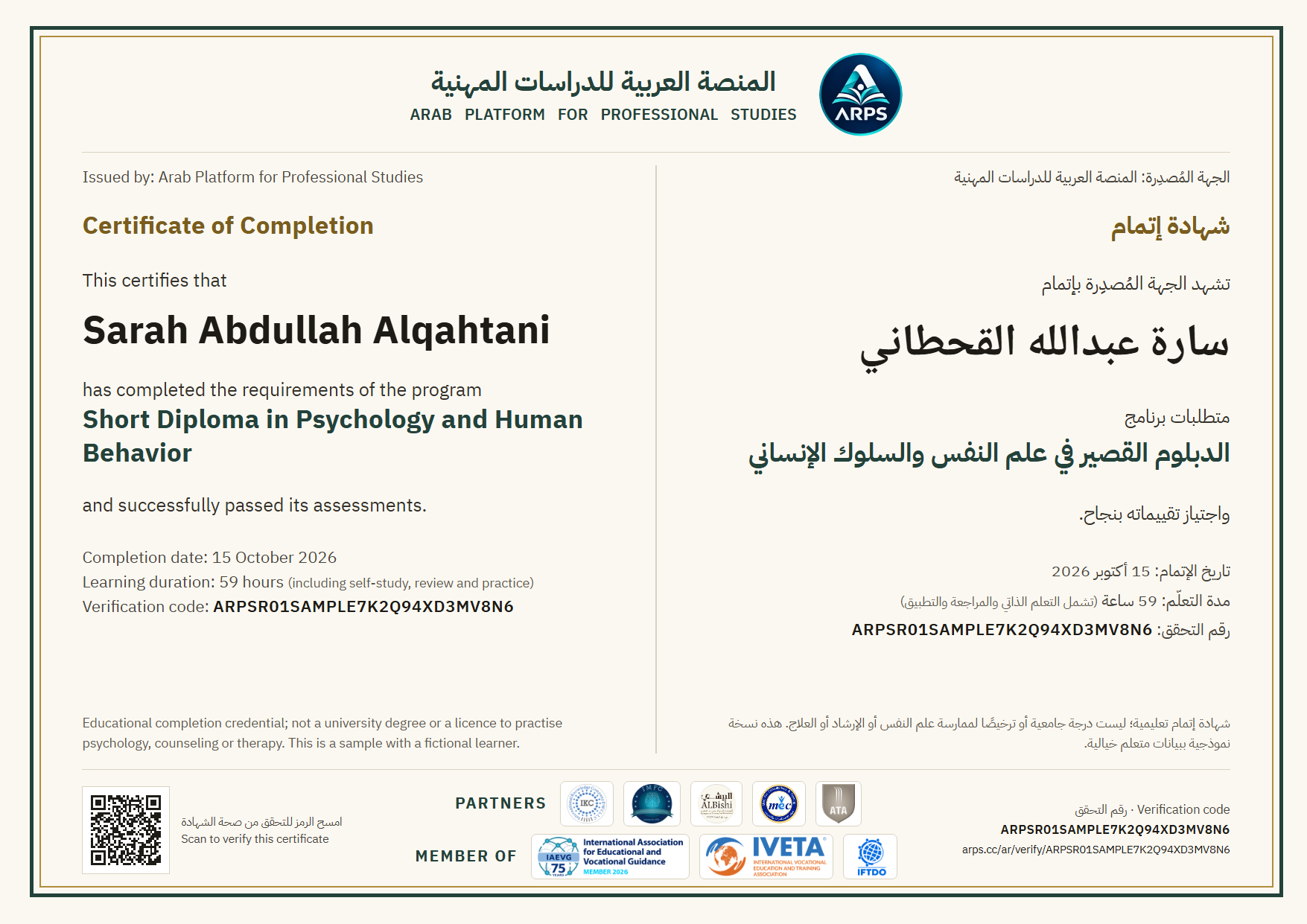
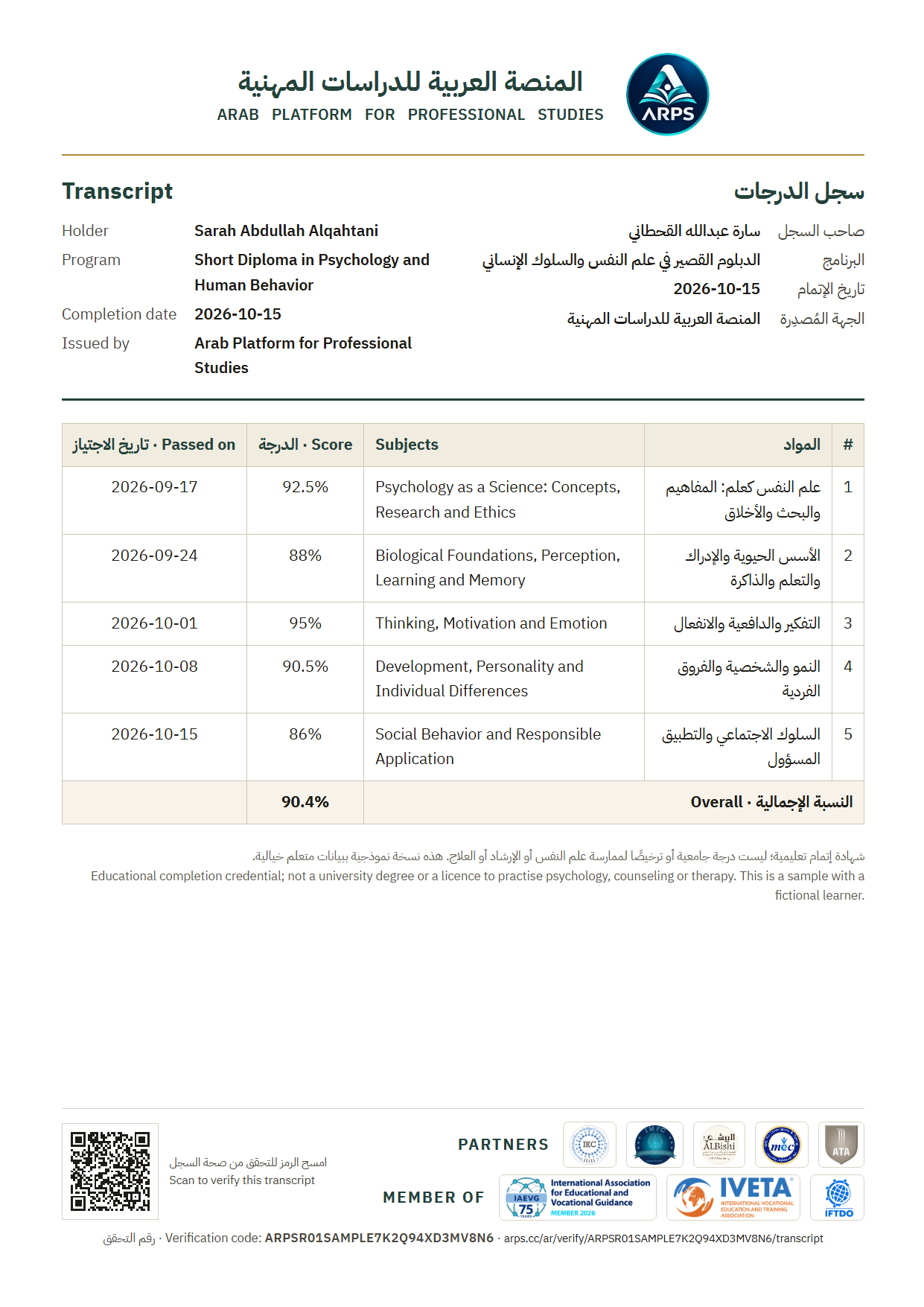
A sample from a real program in this track: Short Diploma in Psychology and Human Behavior. The learner, scores and dates are fictional; opens in a new window.
Disclaimer: Learning completion credential; not a university degree or professional licence.
Program questions
Does the diploma grant a professional licence?
No. It is a foundation-learning completion credential only.
Do the cases describe real city services?
No. Named cities appear only in explicitly hypothetical teaching scenarios with invented data.
How is learning time estimated?
From reading in one language, completing applied tasks and one assessment attempt per subject; it is not accredited hours.
Do I need prior work in an association?
No. The subjects begin with foundational diagnosis and participation and provide worked cases.
How do I revise a decision when evidence changes?
Exercises introduce a concrete changed fact, recompute where needed, and explain its effect on the option and decision limits.
Show all (7)
Is Short Diploma in Community Development and Initiatives free, and do I get a certificate?
Yes. Short Diploma in Community Development and Initiatives is free on ARPS: every lesson, exercise and assessment is free, the first subject is open to read without an account, and the program is available in Arabic and English. Issuing a certificate is optional and has a published fee; it is a training completion certificate showing you passed the program's assessments, recognised by most private-sector organisations in the Gulf states and most Arab countries, and it strengthens your CV; confirming that a specific organisation accepts it remains your responsibility.
What other names is Short Diploma in Community Development and Initiatives known by?
The subject of this program is also known as: community development, community initiatives, grassroots development. Learners usually find it by searching for: community development course, how to start a community initiative, community engagement training, free community development course.
An applied short diploma in volunteer management across role design, recruitment and induction, supervision, safety, and measurement and improvement. Seven subjects use fictional cases, decision exercises and a subject assessment each.
Practice turning a program need into an evidence-based ask, then qualifying donors, handling gifts, stewarding relationships and interpreting fundraising performance.
This short diploma connects market-research design with consumer-behavior interpretation and evidence-bounded decisions. Six subjects progress from the research question through sampling, measurement, analysis, choice journeys, testing, and recommendation, ending with an applied market-research capstone.