Professional Mini-Master in Newsroom Governance and Multimodal Verification
Professional Mini-Master in Newsroom Governance and Multimodal Verification is a free program on ARPS, the Arab Platform for Professional Studies. An advanced professional program for auditable release decisions, text, image, video, and audio verification, and correction governance in a newsroom.
Separate headline claims and assign each a source-, scope-, and time-bounded release decision.
Build a claim–evidence–decision record with approval ownership and a review trigger.
From lesson 1, readable now without an account: Claim-specific Evidence Gate and Release Authority
An editor receives a message saying, “The whole city's rail service has stopped.” The apparent decision is whether to publish immediately. The sentence actually contains several different claims: some service stopped, all lines stopped, and this happened now. A crowded-platform image might be genuine yet say nothing about whether a train is moving elsewhere. The first move is to break a headline into propositions that can be checked separately. A release decision can then be attached to each proposition instead of to the emotional force of the package.
A free account saves your progress and takes you straight to lesson 1.
Program facts
Study fee
Free
subjects
11
lessons
56
Estimated time
162.5 hours
Content last reviewed
Access period
60 days
Study language
Arabic and English
About the program
Learners move from decision rights and evidence gates to checking the origin and limits of images, video, and audio. They connect independent signals and state uncertainty precisely, then operate a deadline queue while protecting sources and bystanders and managing conflicts of interest. The final work is a release packet, correction and audit path, and an integrated decision that identifies what is established, withheld, and capable of changing the conclusion. Named-city scenarios are fictional teaching cases. The extended edition contains eleven units and fifty-six lessons, adding resource and measurement decisions, source relationships, accessibility, and a connected ten-stage capstone.
Practical relevance
Learners produce evidence, decision, resource, text-review, measurement, and correction records, with a self-check for every lesson. The existing integrated final for the five core areas is retained, alongside extended practice, self-check banks, and a connected capstone. Credential and transcript rules remain governed by the existing route policy.
Why this program
Many newsroom errors occur when a partially supported detail becomes an oversized headline, no one owns a hold, or a stale preview survives an article edit. The program connects evidence, approval, monitoring, and correction in one operating workflow, with a worked exercise in each lesson.
Career relevance
Designed for verification leads, picture editors, duty editors, and publication operations leaders coordinating several roles. The output is a reviewable newsroom protocol, not an academic degree or a professional licence.
Career paths this program serves
This program is a step on the paths of the following occupations. Open a path to see its other programs in study order.
Design auditable evidence conditions, decision rights, and holds for a fast newsroom.
Examine image, video, and audio origins and the limits of place, time, and editing.
Reconcile independent text and media evidence and state revisable uncertainty.
Operate a safe verification queue with conflict, escalation, and deadline approval controls.
Build a release, correction, and audit packet and defend a bounded integrated decision.
Show all (8)
Design a sustainable verification system and edit numbers, charts and quotations accurately with clear claim limits.
Apply advanced origin and context tests and manage access, partnerships and compound risks.
Measure and improve institutional learning, and apply it in a capstone on redesigning a developing coverage operation.
Learning outcomes (5)
Design auditable evidence gates, decision rights, and holds for a fast newsroom.
Examine image, video, and audio origins and the limits of place, time, and editing.
Reconcile independent text and media evidence and state revisable uncertainty.
Operate a safe verification queue with conflict, escalation, and deadline approval controls.
Build a release, correction, and audit packet and defend a bounded integrated decision.
Who it is for
Editors in chief, duty editors, verification and visual desks, audio reviewers, and publishing operations leads with foundational working experience in sourcing and attribution. It also suits people responsible for headline review, preview approval, and correction management. Learners should be comfortable reading conflicting evidence and defending a written professional decision; coding experience and a previous professional certificate are not required.
Prerequisites
A working grasp of primary sources, attribution, date and place checks, and reading short visual records in a news context is expected. Prior participation in editing or reviewing an item is helpful, as is knowing the difference between a direct observation, an organizational statement, and a repost. The program builds on these basics rather than reteaching introductory search techniques, then requires reasoned limits for every material claim.
Editorial Decision Architecture and Accountability
The module begins by splitting a headline into bounded claims, each with a source, time range, and allowable wording.
4 lessons · 9 hours
Claim-specific Evidence Gate and Release Authority2.5 hours
Separating Verification from Publication Approval2.5 hours
Harm Tiers and Proportionate Evidence Gates2.5 hours
Material Provenance and Decision Revision2.5 hours
Subject 2
Image, Video, and Audio Examination
The module starts by separating a technically genuine image from a caption that may misstate time, place, or the event's scope.
4 lessons · 9 hours
Image Origin and Caption Validity2.5 hours
Triangulating Place and Time in a Visual2.5 hours
Video Sequence and the Limits of a Clip2.5 hours
Speaker Identity and Transcript Uncertainty2.5 hours
Subject 3
Cross-Modal Reasoning and Uncertainty
The module first maps source dependence, showing why several copied posts do not create several witnesses.
4 lessons · 9 hours
Source Independence and Claim Decomposition2.5 hours
Reconciling Text, Image, Video, and Audio2.5 hours
Provenance Credentials and Synthetic-Media Alerts2.5 hours
Calibrated Uncertainty and Testable Alternatives2.5 hours
Subject 4
Verification Operations Under Deadline
This module turns individual verification into an accountable newsroom operation under time and claim pressure.
4 lessons · 9 hours
Triage of a Mixed Claim Queue2.5 hours
Protecting Sources, Bystanders, and Private Data2.5 hours
Conflicts, Escalation, and Independent Review2.5 hours
Deadline Approval with Explicit Conditions2.5 hours
Subject 5
Publication, Correction, and Integrated Audit
The final module assembles a release packet that links every audience-facing sentence to its primary support and limits of time, place, and independence.
4 lessons · 9 hours
Publication Evidence Packet and Precise Attribution2.5 hours
Correction, Clarification, and Withdrawal2.5 hours
Auditing Verification Quality and Feedback Loops2.5 hours
Integrated Release Decision and Correction Contingency2.5 hours
Subject 6
Designing Sustainable Verification
Designs a sustainable verification system, from locating the team bottleneck and delegating decisions to piloting procedures, procuring verification services and allocating the budget.
6 lessons · 18.5 hours
Locating the Verification Bottleneck3 hours
Delegating Decisions without Losing Ownership3 hours
Piloting an Editorial Procedure3 hours
Procuring Verification Services3 hours
Reviewing Exceptions before They Become Routine3 hours
Allocating the Verification Budget3 hours
Subject 7
Editing Numbers, Charts and Quotations
Covers editing numbers, charts and quotations: views versus people, choosing the denominator, chart claim scope and accuracy of translated quotations.
5 lessons · 15.5 hours
Views Are Not People3 hours
Choosing the Denominator across Two Weeks3 hours
Chart Height and Claim Scope3 hours
Editing Translated Quotations3 hours
Reading an Audience Poll3 hours
Subject 8
Advanced Origin and Context Tests
Deepens origin and context tests, such as comparing two claimed originals, time zones, disconfirming a location hypothesis, ordering audio versions and preserving withdrawn material.
5 lessons · 15.5 hours
Comparing Two Claimed Originals3 hours
Time Zones across Two News Days3 hours
Disconfirming a Location Hypothesis3 hours
Ordering Audio Versions before Enhancement3 hours
Preserving Withdrawn Material3 hours
Subject 9
Access, Partnerships and Compound Risks
Addresses access, partnerships and compound risks, from source consent and partner material review to accessible descriptions, protecting the verification team and fallback plans.
5 lessons · 15.5 hours
Consent When the Audience Changes3 hours
Reviewing Partner Material3 hours
Accessible Descriptions without Added Claims3 hours
Reducing Exposure to Distressing Footage3 hours
Continuing When a Search Tool Fails3 hours
Subject 10
Measuring Institutional Learning
Measures institutional learning and improvement through audit samples, time to correction, rule tests, learning reviews and evidence-bounded leadership reports.
5 lessons · 15.5 hours
Sampling for Undetected Errors3 hours
Measuring Time to Correction3 hours
Testing a Headline Correction Rule3 hours
Learning Reviews with Accountability3 hours
Reporting Improvement with Limits3 hours
Subject 11
Capstone: Redesigning a Developing Coverage Operation
A connected ten-stage capstone on redesigning a developing coverage operation, from scoping the file and intake register to defending the decision, auditing the correction trail and delivery.
10 lessons · 31 hours
Scoping the Capstone Coverage File3 hours
Constructing the Capstone Intake Register3 hours
Testing Capstone Source Independence3 hours
Scheduling Capstone Checks under Constraint3 hours
Writing the First Capstone Release3 hours
Testing Capstone Privacy and Accessibility3 hours
Defending the Capstone Decision3 hours
Responding to a Capstone Scenario Change3 hours
Auditing the Capstone Correction Trail3 hours
Delivering the Capstone and Learning Plan3 hours
Subjects unlock in sequence as you progress.
Strengths
An integrated decision joining evidence, release rights, and correction.
Image, video, and audio cases with worked practical responses.
Module results from one completed integrated final attempt.
Evidence basis
The program uses published Reuters and AP editorial guidance, the foundational UNESCO handbook, C2PA 2.4 provenance specification, and WITNESS guidance on person protection. Each source is presented within its scope; an organization’s practice is not universal law. Extensions also use bounded Pew methodology, W3C image-accessibility guidance, and CPJ sensitive-material workflow guidance, with original fictional cases and calculations.
Reference organizations
Reuters
Associated Press
UNESCO
C2PA
WITNESS
Frameworks used
UNESCO journalism verification training — 2018
Methodology
Separate a claim from its asset and source, then make a timed revisable release decision.
Program questions
Is this an academic master’s degree?
No. Professional Mini-Master is an internal program title with an optional internal completion credential, not a university degree or professional licence.
Do I need specialist verification software?
Exercises use the provided records and cases. The goal is auditable editorial judgment before relying on any single tool result.
Is each module passed separately?
One integrated final covers the five core areas, with self-checks across fifty-six lessons and a ten-stage capstone. Practice does not award separate credentials; transcript results follow the existing final-attempt policy.
Are named-city incidents real?
No. City references in teaching cases are fictional and do not describe a particular real event or organization.
Does the program guarantee a publication decision?
No. It teaches ways to bound and document evidence, rights, and review; the newsroom remains responsible for its decision.
Show all (8)
Does it teach political persuasion?
No. Its scope is editorial workflow, prepublication verification, and correction.
Is Professional Mini-Master in Newsroom Governance and Multimodal Verification free, and do I get a certificate?
Yes. Professional Mini-Master in Newsroom Governance and Multimodal Verification is free on ARPS: every lesson, exercise and assessment is free, the first subject is open to read without an account, and the program is available in Arabic and English. Issuing a certificate is optional and has a published fee; it is a training completion certificate showing you passed the program's assessments, recognised by most private-sector organisations in the Gulf states and most Arab countries, and it strengthens your CV; confirming that a specific organisation accepts it remains your responsibility.
What other names is Professional Mini-Master in Newsroom Governance and Multimodal Verification known by?
The subject of this program is also known as: fact-checking, newsroom management, digital verification, OSINT verification. Learners usually find it by searching for: fact checking course, news verification training, newsroom management course, image and video verification, free fact checking course.
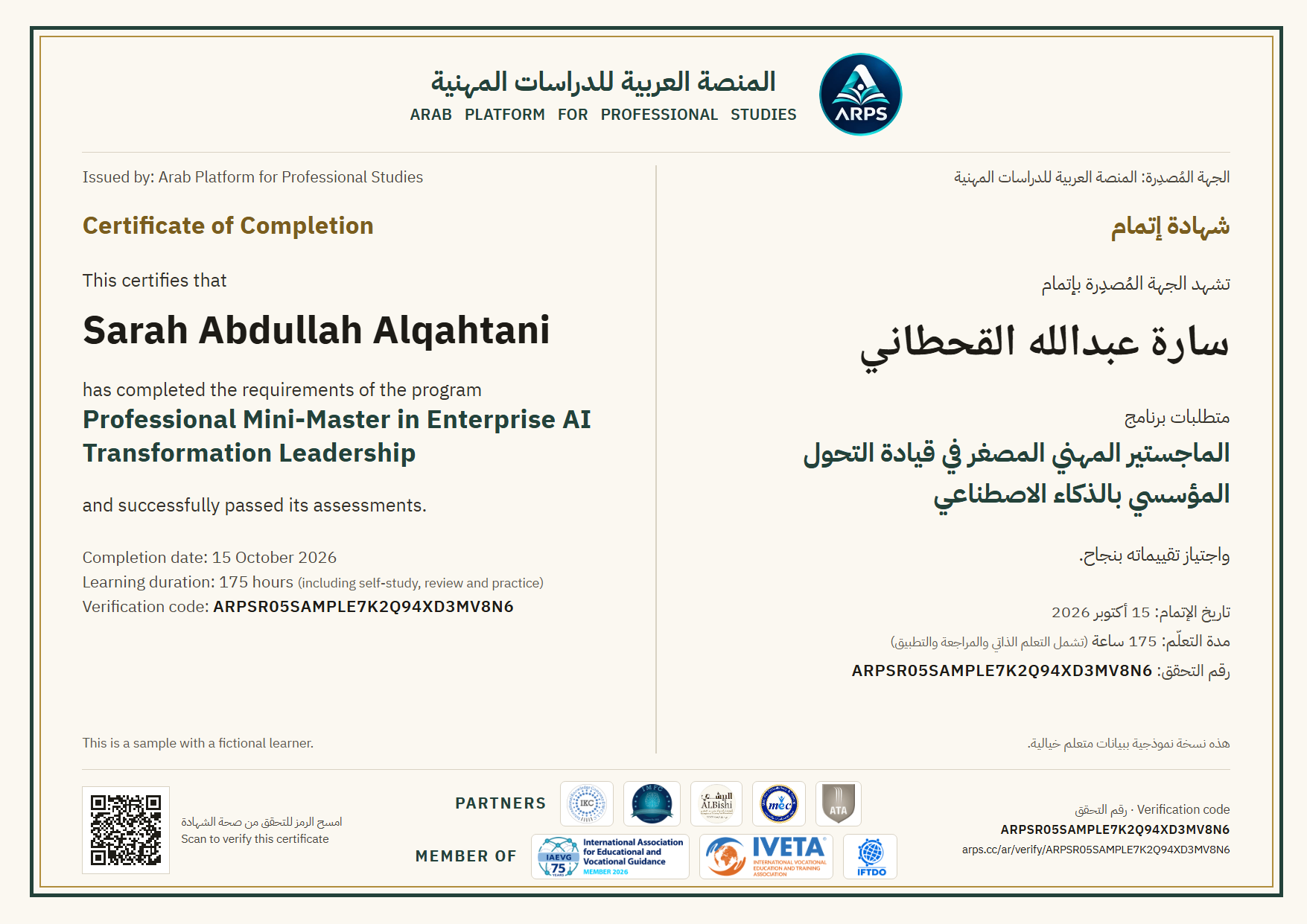
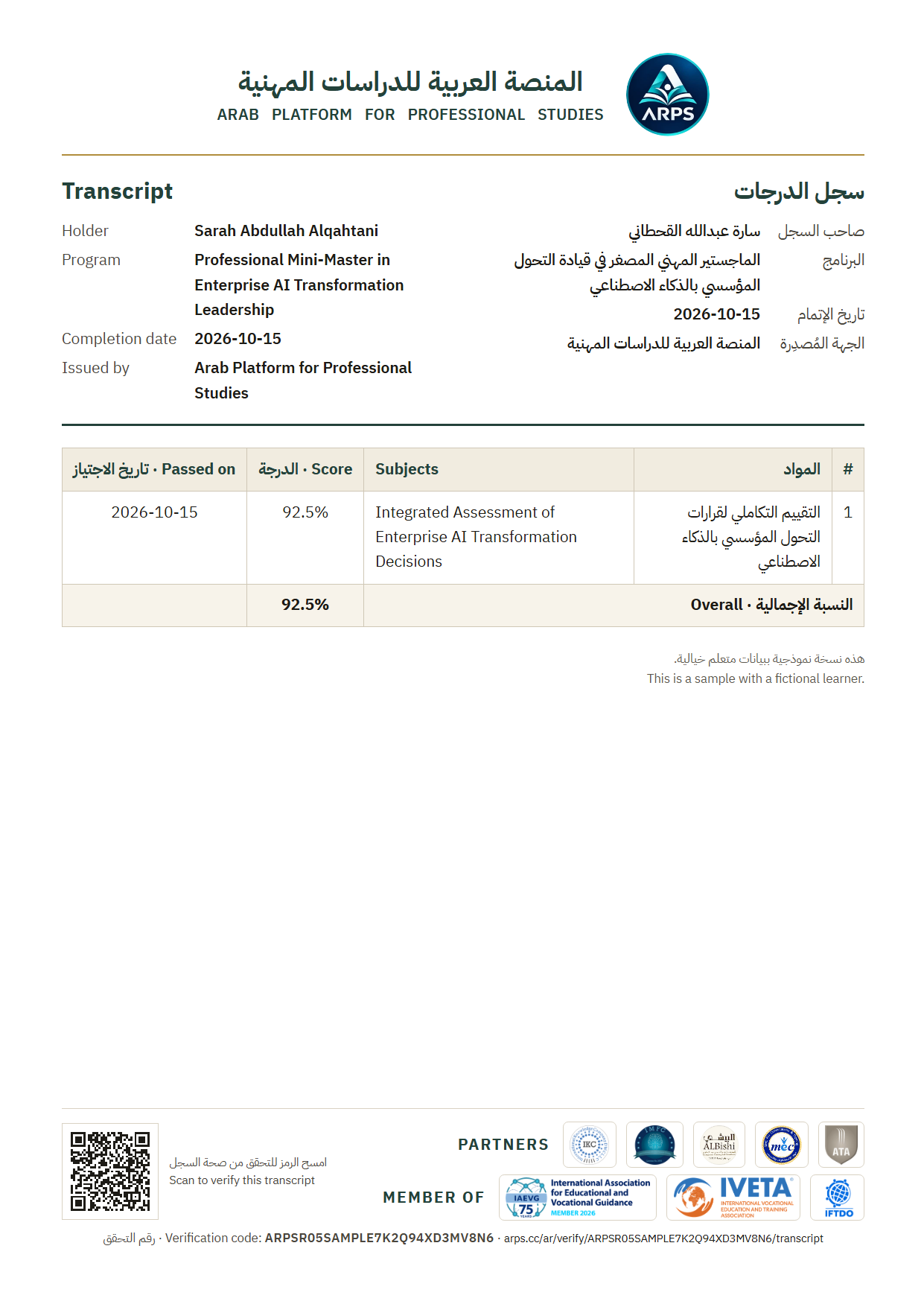
A sample from a real program in this track: Professional Mini-Master in Enterprise AI Transformation Leadership. The learner, scores and dates are fictional; opens in a new window.
Turn product or process evidence into documentation that helps a defined reader complete a task. Build a reader brief and source ledger, write procedures, examples, and change notes, then check accuracy, accessibility, and limits before handoff.
An honest note: the professional mini-master is an intensive professional program; it is not an academic degree or a licence and is not equivalent to a university master's or MBA. The optional ARPS certificate is a training completion certificate showing you passed the program's assessments.