Specialist Preparation Program in Technical and Professional Writing
Specialist Preparation Program in Technical and Professional Writing is a free program on ARPS, the Arab Platform for Professional Studies. Turn product or process evidence into documentation that helps a defined reader complete a task. Build a reader brief and source ledger, write procedures, examples, and change notes, then check accuracy, accessibility, and limits before handoff.
Map audience knowledge, reading situation, and consequential errors.
From lesson 1, readable now without an account: From an unclear request to a reader-task brief
A professional assignment may begin with “improve the help page.” That is an aspiration, not a deliverable or a reader task. Before drafting a title, identify who reaches the page, what they are trying to do at that moment, which product or process evidence is available, and what they should be able to do after reading. Without those answers, “good writing” becomes a matter of taste and the document cannot be tested against its purpose. We call the result a reader-task brief. It is a working artifact, not a professional licensing standard.
Record six connected fields: intended reader, situation, task to complete, authorized source of truth, document boundary, and observable acceptance criterion. “Users” is too broad to guide a writer. “A reception worker submitting a first record-correction request through the organization’s portal” reveals likely prior knowledge, vocabulary, and required steps. Separate the organization’s goal, such as reducing calls, from the reader’s task, such as choosing an attachment. A page may contribute to fewer calls, but a successful attachment task does not by itself prove call volume fell. Measure that organizational outcome separately. Do not promise an effect that the brief cannot establish.
Collect source materials before fixing claims. A product owner may hold an approved release specification, the support team may have an old article, and a colleague may describe a change that has not shipped. Combining all three into one page would create a misleading hybrid. Record each source’s version, date, and the claims it can support. Where they conflict, put a bounded question to the decision owner: “Which version will readers actually use, and is the proposed change released?” You can design the page structure and write stable sections while the answer is pending. You cannot responsibly publish a procedure that depends on the disputed detail. The writer identifies and escalates the conflict rather than making a guess look official.
Make acceptance criteria observable.“A clear page” tells a reviewer little. “A reception worker finds the attachments field, selects the document for their case, and recognizes from the confirmation message that the request was sent” describes a test. Add a factual check: every field name and document state must match the interface version that will accompany publication. Include at least one failure case when the task has exceptions. A happy path may work while a reader with no attachment gets stranded. Test task completion with a person using a comparable interface; verify factual accuracy against the authorized source. These checks answer different questions.
In the handoff, distinguish facts, assumptions, and open decisions. For example: “Reader: new reception worker; basis: team request; confirm with service owner.” Do not silently promote an audience assumption into a settled fact. Rank unresolved questions by consequence. Uncertainty about a decorative button differs from uncertainty about an eligibility rule that could lead readers to submit the wrong request. If a high-impact question blocks a truthful instruction, hold that instruction while finishing the verifiable parts. The brief then defines both the work and the boundary of the writer’s authority.
A free account saves your progress and takes you straight to lesson 1.
Program facts
Study fee
Free
subjects
9
lessons
36
Estimated time
52 hours
Content last reviewed
Access period
30 days
Study language
Arabic and English
About the program
This program focuses on the specialist writer’s work when an assignment is vague or source materials conflict across releases. Define a reader, task, and acceptance check; build a claim-to-source ledger; and choose a procedure, reference, explanation, or fault path according to reader action. Practice on supplied hypothetical cases with worked solutions rather than workplace data.
Then write steps with recognizable results, examples showing inputs, outputs, and limits, status notices without guessed cause or timing, and decision and release notes that preserve change impact. Check numbers, units, links, and terminology in Arabic and English, and distinguish a textual review from a user test that did not occur. At handoff, connect pages to their source and release, maintenance owner, and unresolved questions. Two further modules cover field references, shared content, redaction and converted documents, then analytical editing and localization of tables, numbers and requirements; a capstone produces a submission guide for a fictional archive.
The program prepares defined writing and review tasks. It grants no professional licence or authority to approve service policy or product publication. Activities require no paid account or access to an employer system.
Practical relevance
Apply the method to help pages, internal procedures, field references, release notes, and status notices. Each case has a draftable output, worked answer, and criterion. Learn when verified copy can proceed and when a claim needs an authorized decision.
Why this program
A page can be fluent yet send readers to an unavailable control or mistake a receipt for approval. The program trains a writer to find that defect from task brief through review and handoff, using deliverables that can be checked.
Career paths this program serves
This program is a step on the paths of the following occupations. Open a path to see its other programs in study order.
Turn a vague request into a reader-task brief with evidence and acceptance tests.
Create a task-based outline and a navigation path.
Draft prerequisites and one-action procedural steps with observable results.
Write a decision brief that separates evidence, recommendation, and uncertainty.
Run a source-backed factual and numerical review.
Show all (9)
Set review ownership, approvals, and version boundaries.
Write field references that separate field presence from value, manage shared content across versions, redact examples while keeping diagnostic value, and check converted documents.
Edit comparison tables with explicit measures and units, localize numbers, dates and mixed text, and turn ambiguity into acceptance examples.
Complete an archive submission guide from source triage through submission steps, recovery guidance and test-reader review to release handoff.
Learning outcomes (36)
Turn a vague request into a reader-task brief with evidence and acceptance tests.
Map audience knowledge, reading situation, and consequential errors.
Build a source ledger with authority, version, and claim boundaries.
Choose a documentation type and define done criteria.
Create a task-based outline and a navigation path.
Write informative headings, leads, and links.
Choose tables, lists, diagrams, and prose by comparison or sequence need.
Control terminology and bilingual equivalence without false literalism.
Draft prerequisites and one-action procedural steps with observable results.
Separate conceptual explanation from reference facts and task steps.
Write safe examples with inputs, outputs, placeholders, and limits.
Document failure states and recovery branches.
Write a decision brief that separates evidence, recommendation, and uncertainty.
Prepare release notes with user impact and required actions.
Write incidents and status updates without unsupported causes or promises.
Adapt a technical finding for executive and operator readers.
Run a source-backed factual and numerical review.
Test a task with a realistic reader path and observable success criteria.
Review headings, links, instructions, tables, and alternatives for accessibility.
Edit for clarity, tone, localization, and claim strength.
Set review ownership, approvals, and version boundaries.
Build a traceable change log and maintenance trigger.
Measure findability and task success with appropriately limited evidence.
Integrate brief, procedure, change notice, and review into a release handoff.
Produce and check the professional artifact taught in field references and optional values.
Produce and check the professional artifact taught in shared content and concurrent versions.
Produce and check the professional artifact taught in redacting examples and work captures.
Produce and check the professional artifact taught in checking converted documents.
Produce and check the professional artifact taught in comparison tables and numerical notes.
Produce and check the professional artifact taught in numbers dates and mixed text.
Produce and check the professional artifact taught in turning ambiguity into acceptance examples.
Produce and check the professional artifact taught in triage sources and plan the guide.
Produce and check the professional artifact taught in build submission steps and file reference.
Produce and check the professional artifact taught in prepare recovery and support guidance.
Produce and check the professional artifact taught in review the guide with a test reader.
Produce and check the professional artifact taught in hand over the release and maintenance plan.
Who it is for
This program serves technical content writers, knowledge editors, product staff, and support staff who turn approved specifications and procedures into usable instructions. It also serves practitioners reviewing help pages or preparing change and decision notes who need to separate facts from assumptions, keep terminology aligned across languages, and report what their checks actually established. Advanced programming experience and authority to approve organizational policy are not assumed.
Prerequisites
Learners should be able to read a work document and a simple table, distinguish an approved source from a draft or proposal, and write a clear paragraph in their chosen study language. Experience with web forms or document editing helps but is not a technical prerequisite. The exercises supply fictional data and interface behavior; no paid service, real organizational data, or permission to publish or change production settings is needed.
Technical writing begins with the reader’s task rather than a general wish to improve copy. The writer turns a vague request into a brief naming reader, situation, action, source of truth, and acceptance check.
4 lessons · 3 hours
From an unclear request to a reader-task brief48 min
Reader and task analysis48 min
Source ledger and claim boundaries50 min
Select document form and done criteria48 min
Subject 2
Design information for retrieval
Information is organized around the route from a reader’s question to an observable result. The outline starts with tasks such as submitting or tracking a request, not department labels that readers may not recognize.
4 lessons · 3 hours
Task-based outline and navigation48 min
Headings, leads, and links46 min
Choose prose, lists, tables, and diagrams48 min
Terminology and bilingual meaning48 min
Subject 3
Write executable technical content
The specialist writes a procedure that begins with release, role, and input prerequisites, then separates each action from its visible result. When confirmation disappears, the reader checks records before repeating an action that may create a duplicate.
4 lessons · 3 hours
Procedures with prerequisites and results48 min
Separate explanation, reference, and procedure48 min
Examples with inputs, outputs, and limits48 min
Troubleshooting and safe recovery46 min
Subject 4
Write professional decisions and changes
Professional writing supports different decisions without changing facts. A decision brief separates observation, inference, and recommendation, compares credible options, states sample limits, and names the authorized decision owner.
4 lessons · 3 hours
Decision brief under uncertainty46 min
Release notes and migration actions46 min
Incident and status communication48 min
Audience-specific technical summaries48 min
Subject 5
Review usability and accessibility
Real review tests factual claims, reader action, and output structure. Factual checking starts with conditions, numbers, units, and releases: 5 MB per file does not mean five files are allowed.
4 lessons · 3 hours
Factual and numerical review46 min
Task-based usability review46 min
Accessible writing and structure48 min
Clarity, tone, and calibrated claims46 min
Subject 6
Release and maintain a documentation set
Documentation handoff joins ownership, change control, and measurement. A review matrix names the owner and state of each claim: accepted for a specific release, requiring a located repair, or held for a bounded question.
4 lessons · 3 hours
Review ownership and release gates46 min
Change impact and maintenance46 min
Measure findability and task success46 min
Integrated documentation handoff48 min
Subject 7
Specialized documentation for change
A unit on specialized documentation that changes with the product: field references and optional values, shared content across versions, redacted examples and work captures, and checks on converted documents.
4 lessons · 8 hours
Field references and optional values2 hours
Shared content and concurrent versions2 hours
Redacting examples and work captures2 hours
Checking converted documents2 hours
Subject 8
Analytical editing and localization
A unit on editing where language, numbers and product behavior meet: comparison tables and numerical notes, numbers, dates and mixed text, and turning ambiguity into acceptance examples.
3 lessons · 6 hours
Comparison tables and numerical notes2 hours
Numbers dates and mixed text2 hours
Turning ambiguity into acceptance examples2 hours
Subject 9
Archive submission guide capstone
A capstone that produces a submission guide for a fictional archive, from source triage and planning to submission steps, recovery guidance, test-reader review and release handoff.
5 lessons · 14 hours
Triage sources and plan the guide3 hours
Build submission steps and file reference3 hours
Prepare recovery and support guidance3 hours
Review the guide with a test reader3 hours
Hand over the release and maintenance plan3 hours
Subjects unlock in sequence as you progress.
Strengths
Reader-task brief with evidence and acceptance check
Procedures and examples with solved normal and failure paths
Bilingual accuracy, accessibility, and maintenance review
Evidence basis
Procedure, heading, accessibility, and comprehension-testing methods draw on primary guidance from Google, Microsoft, W3C, and Digital.gov. City and product cases are explicitly fictional; their field names and codes are training inputs, not assertions about any actual local service or those publishers’ products.
Methodology
A page can be fluent yet send readers to an unavailable control or mistake a receipt for approval. The program trains a writer to find that defect from task brief through review and handoff, using deliverables that can be checked.
Assessment
Assessments follow the program blueprint and may use module assessments, a final assessment, or a combination, under the approved attempt policy.
Assessment attempts: 2 per assessment, 7 days apart
The pass mark is announced before the program is published.
Certificate
The credential confirms completion and successful assessment; it does not represent professional licensure unless explicitly and lawfully stated.
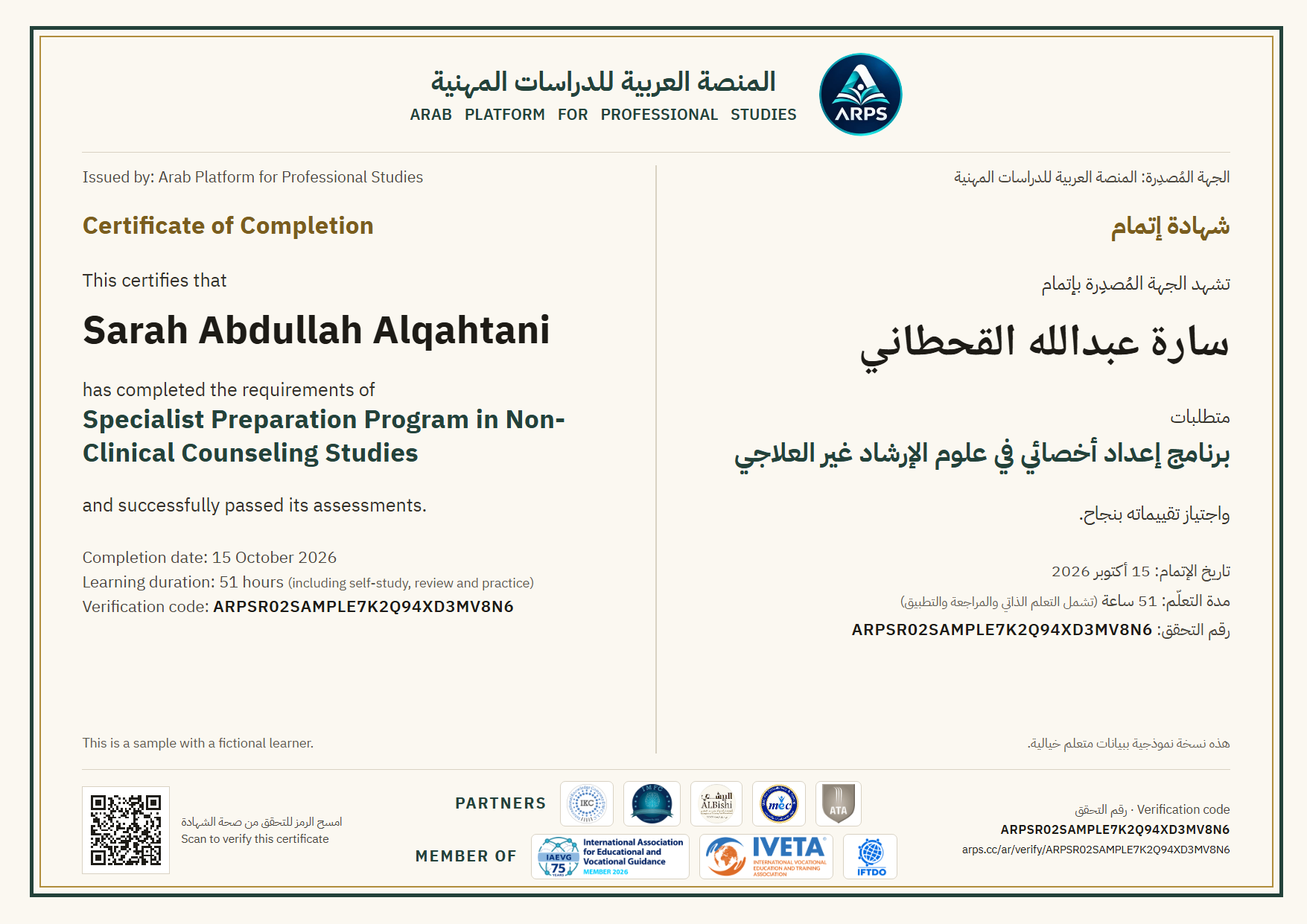
A sample from a real program in this track: Specialist Preparation Program in Non-Clinical Counseling Studies. The learner, scores and dates are fictional; opens in a new window.
No. The exercises supply enough fictional behavior and data to solve and compare against the criteria. Work on a real system requires your organization’s permission.
Does the program grant a specialist licence?
No. It teaches defined writing and review tasks and grants neither independent professional authority nor an external certification.
Are practical exercises automatically graded?
Exercises have worked solutions and self-check criteria. Separate question assessments are automated and do not alone prove workplace execution skill.
May I use my employer's documents in the exercises?
Use the supplied fictional inputs. Do not put organizational or personal information in shared work unless your organization's permissions and policy allow it.
Does the program prescribe one style for every organization?
No. It teaches how to connect copy to readers, sources, and checks. Apply your organization's approved style guide and policies in actual work.
Show all (7)
Is Specialist Preparation Program in Technical and Professional Writing free, and do I get a certificate?
Yes. Specialist Preparation Program in Technical and Professional Writing is free on ARPS: every lesson, exercise and assessment is free, the first subject is open to read without an account, and the program is available in Arabic and English. Issuing a certificate is optional and has a published fee; it is a training completion certificate showing you passed the program's assessments, recognised by most private-sector organisations in the Gulf states and most Arab countries, and it strengthens your CV; confirming that a specific organisation accepts it remains your responsibility.
What other names is Specialist Preparation Program in Technical and Professional Writing known by?
The subject of this program is also known as: technical writing, professional writing, technical communication. Learners usually find it by searching for: technical writing course, how to become a technical writer, professional writing course, technical writing for beginners, free technical writing course.
A short diploma in English for work, built around real professional tasks: writing clear messages, participating in meetings, summarising information, giving presentations and negotiating with accurate, respectful language. The focus is workplace use, not an external certificate exam.
Learn the specialist tasks of innovation management, from an evidenced opportunity to a bounded experiment, decision and operating handover. Produce job aids, evidence logs, calculations and decision briefs using fictional bilingual cases.
Turn software requirements into checkable acceptance conditions and reproducible tests. Record execution and defects, then write an evidence bounded release recommendation. The program covers design, risk, accessibility, authorization, performance and automation.
10 subjects
40 lessons
53.5 hours
Free
Next step: a professional certification or a mini-master
Programs in the same domain that prepare you for an international certification exam or form a professional mini-master, also free.