Professional Mini-Master in Practical Experiment Design for Decision Making
Professional Mini-Master in Practical Experiment Design for Decision Making is a free program on ARPS, the Arab Platform for Professional Studies. Design workable comparisons, test evidence integrity, and turn bounded effects into responsible decisions. The program starts with a decision question that has a population, comparator, outcome and guardrail.
Frame an experiment that links the alternative, comparator, denominator and guardrail to a defined expansion decision.
From lesson 1, readable now without an account: A testable decision
“Test reminders” leaves the decision underspecified. The sponsor might want to buy a messaging service, change appointment times, reduce missed visits, or learn whether any attendance gain is worth the operating cost. Start with feasible choices: retain current confirmation, add a defined reminder, or improve the booking page instead. A comparison cannot answer the sponsor if the alternatives remain vague. State the decision rule before outcomes are visible: adopt reminders if attendance among eligible bookings rises by a useful amount without breaching a harm limit; otherwise revise or retain current service. The useful increase and harm limit belong to the decision owner and need an operational rationale. They are not universal constants.
A free account saves your progress and takes you straight to lesson 1.
Program facts
Study fee
Free
subjects
6
lessons
50
Estimated time
139 hours
Content last reviewed
Access period
60 days
Study language
Arabic and English
About the program
The program starts with a decision question that has a population, comparator, outcome and guardrail. Five connected core modules build a protocol, assignment design, measurement dictionary and analysis plan, then diagnose delivery defects, missingness and contamination before interpreting an effect. The final dossier weighs benefit, cost, harm and transport to a proposed audience. A capstone then applies the whole sequence to a training seat-allocation trial where demand exceeds available seats. Regional cases are fictional teaching settings, not real service data. Learners calculate and write reviewable outputs while stating what the comparison cannot establish.
Practical relevance
Learners produce an estimand card, allocation specification, metric dictionary, sample-size calculation, deviation register and decision memo. They diagnose an identifier ledger whose counts cannot be reconciled and decline an apparently beneficial version that breaches a harm cap. Each lesson has an independent worked solution and review criteria.
Why this program
A service dashboard can improve after a change without proving that the change caused a useful improvement. This program joins comparison design to delivery and deviation analysis. It does not stop at choosing randomization on paper. Learners practice deciding when evidence is too weak for broad launch and when to repair measurement or run a verification trial instead of changing the success rule after results.
Career relevance
It suits product, service and policy analysts involved in testing an operational change before funding its scale. They learn to explain an assignment-policy effect and uncertainty to a sponsor and reconcile operational logs to a reproducible result. The internal completion credential is not an academic master's degree or professional license.
Career paths this program serves
This program is a step on the paths of the following occupations. Open a path to see its other programs in study order.
Frame an experiment decision with an estimand, comparator and ethical gate.
Choose assignment unit, randomization, blocking, cluster or factorial structure.
Build metric, useful threshold, sample-size and prior analysis plans.
Detect display failure, attrition, contamination, allocation defects and deviations.
Interpret effect, uncertainty, cost and transport in an auditable dossier.
Build an integrated seat-allocation trial from decision charter, spillover and data dictionary to log repair, a conflicting-evidence decision and independent review.
Learning outcomes (5)
Frame a testable experiment decision with estimand, comparator, guardrails and ethical feasibility.
Choose assignment unit, allocation, blocking, cluster or factorial structure that protects the comparison.
Specify primary metric, sample size and prior analysis plan aligned with useful benefit and evidence.
Diagnose delivery failure, missingness, contamination and deviations before effect interpretation.
Interpret effect, uncertainty, benefit, harm and transport in a bounded scale decision.
Who it is for
For analysts and managers in products, public services and businesses who help test an operational change before funding expansion. The program suits people who can read rates and averages, use a spreadsheet, and explain a trade-off to a decision owner. It moves beyond dashboard monitoring toward a comparison with an explicit denominator and safety guardrail. Prior causal-inference training is not assumed, but willingness to inspect assumptions and records is essential.
Prerequisites
Practical ability to read percentages and averages and build a simple spreadsheet, including denominator checks and rounding a displayed result.
Basic experience describing a service or product workflow and operational decision, with willingness to distinguish observed records from fictional training cases.
Turn a sponsor request into a testable decision with estimand, comparator, guardrail and dated protocol.
9 lessons · 24 hours
A testable decision2 hours
Defining the estimand2 hours
Choosing the comparator2 hours
Ethical and privacy feasibility2 hours
Freezing a protocol2 hours
Separating learning questions from investment choices4 hours
Involving users in defining the outcome4 hours
A pilot that tests the procedure4 hours
A working agreement between sponsor, analyst and operator4 hours
Subject 2
Assignment and design structure
Choose allocation unit, blocking, cluster or factorial structure while diagnosing spillovers.
9 lessons · 24 hours
Unit of assignment versus analysis2 hours
Randomization and sequence concealment2 hours
Blocking nuisance variation2 hours
Cluster and staged designs2 hours
Factorial design and interactions2 hours
Time switching in a shared service4 hours
Pairing sites before allocation4 hours
Testing three operational intensities4 hours
Two experiments sharing an audience4 hours
Subject 3
Measurement, sample size and analysis plan
Define metric, useful threshold, sample and analysis plan before results are opened.
9 lessons · 24 hours
Primary metric and guardrails2 hours
Minimum useful effect2 hours
Power and sample size2 hours
Pre-specified analysis2 hours
Multiplicity and repeated looks2 hours
Time to completion when follow-up ends4 hours
A rate per user or per visit4 hours
Reducing noise with baseline information4 hours
Practical equivalence and noninferiority4 hours
Subject 4
Execution and evidence integrity
Dry-run delivery and diagnose compliance, missingness, leakage and deviations before inference.
10 lessons · 28 hours
Pre-launch dry run2 hours
Compliance and contamination2 hours
Attrition and missing data2 hours
Allocation and leakage diagnostics2 hours
Protocol deviations2 hours
Late-arriving events and mature follow-up4 hours
A negative-control outcome that detects measurement faults4 hours
Adjudicating outcomes with arm masking4 hours
Protecting allocation records during staff changes4 hours
Restarting a trial after a system outage4 hours
Subject 5
Inference, decision and responsible scale
Interpret effect, uncertainty, cost and transport in a reviewable decision dossier.
5 lessons · 9 hours
Effect and uncertainty2 hours
Benefit, harm and cost2 hours
Heterogeneity and transportability2 hours
Launch, revise or stop2 hours
Auditable integrated dossier2 hours
Subject 6
Capstone: a training seat-allocation trial
A capstone that builds an integrated trial for a training booking service whose demand exceeds its seats, from decision charter and spillover map to execution log, a conflicting-evidence decision and independent review.
8 lessons · 30.5 hours
Capstone: choosing a seat-allocation decision4 hours
Capstone: eligibility and spillover map4 hours
Capstone: an operational comparison4 hours
Capstone: data dictionary and data freeze4 hours
Capstone: budgeting evidence before allocation4 hours
Capstone: execution log and repair attempt4 hours
Capstone: a decision with conflicting evidence4 hours
Capstone: presentation, challenge and bounded transfer4 hours
Subjects unlock in sequence as you progress.
Strengths
Five connected modules build one experiment dossier from question to inference, and a capstone applies it to a seat-allocation trial.
Numerical cases and independently solved exercises expose delivery defects.
A decision rule separates useful benefit from service harm and transport limits.
Evidence basis
Design and analysis methods draw on university statistics lessons, government evaluation guidance and J-PAL research resources. UK privacy guidance is used only as a scoped illustration and is under review; it is not asserted as a universal legal rule. Sources support methods, not the invented numerical cases.
Reference organizations
Penn State Department of Statistics
UK Government Evaluation Task Force
J-PAL
Methodology
Design and analysis methods draw on university statistics lessons, government evaluation guidance and J-PAL research resources. UK privacy guidance is used only as a scoped illustration and is under review; it is not asserted as a universal legal rule. Sources support methods, not the invented numerical cases.
Program questions
Do I need advanced statistics?
Rates, averages and a spreadsheet are enough to start. Lessons explain interval and sample-size assumptions and require calculations with limits; complex institutional applications may need specialist statistical review.
Does any test prove a causal effect?
The material trains valid comparisons and diagnosis of their limits. A changed dashboard metric alone does not establish causation, and an interval cannot repair contamination or lost outcomes.
What will I produce?
An experiment dossier linking protocol, assignment, measurement, analysis and deviations to a decision memo, with calculations reproducible from the educational records.
How does integrated assessment work?
One final assesses decisions across the five core modules. Module results in the certificate transcript come from the same qualifying final attempt; lesson checks support practice and do not create separate module pass decisions.
Are regional cases real service data?
No. Named cities frame fictional teaching examples. Their numbers, sites and imagined organizations do not describe actual services or local legal requirements.
Show all (8)
When should a test be revised rather than launched?
Repair and retest a breached harm gate or delivery defect. If effect looks promising but useful benefit remains uncertain, consider verification without rewriting the original decision rule.
Is Professional Mini-Master in Practical Experiment Design for Decision Making free, and do I get a certificate?
Yes. Professional Mini-Master in Practical Experiment Design for Decision Making is free on ARPS: every lesson, exercise and assessment is free, the first subject is open to read without an account, and the program is available in Arabic and English. Issuing a certificate is optional and has a published fee; it is a training completion certificate showing you passed the program's assessments, recognised by most private-sector organisations in the Gulf states and most Arab countries, and it strengthens your CV; confirming that a specific organisation accepts it remains your responsibility.
What other names is Professional Mini-Master in Practical Experiment Design for Decision Making known by?
The subject of this program is also known as: experiment design, A/B testing, causal inference. Learners usually find it by searching for: A/B testing course, design of experiments course, causal inference course, experimentation for decision making, free A/B testing course.
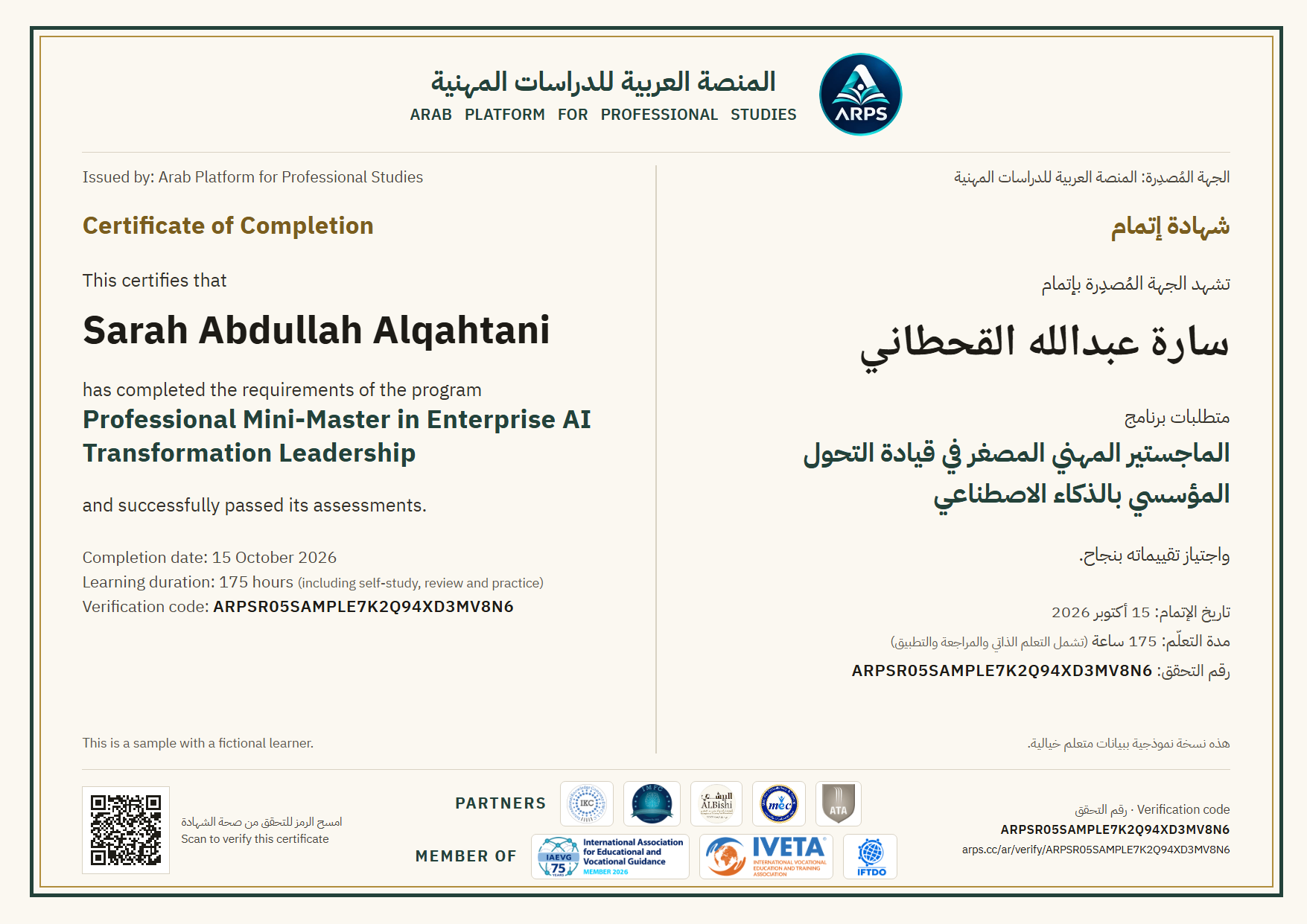
A sample from a real program in this track: Professional Mini-Master in Enterprise AI Transformation Leadership. The learner, scores and dates are fictional; opens in a new window.
Turn a defined work question into a reproducible quantitative calculation and a bounded recommendation. Practice bases, rates, models, distributions, probability and choices under capacity and budget constraints.
An honest note: the professional mini-master is an intensive professional program; it is not an academic degree or a licence and is not equivalent to a university master's or MBA. The optional ARPS certificate is a training completion certificate showing you passed the program's assessments.