Short Diploma in Astronomy and Space Science is a free program on ARPS, the Arab Platform for Professional Studies. A bilingual applied course in reading basic astronomical evidence and stating the limits of inference across five connected subjects and a capstone.
Important notice: Independent learning in astronomy and space science; no university degree or professional licence is granted.
Explain from sky coordinates to an observing decision and its evidence-bound distinction.
Apply from sky coordinates to an observing decision to a new case and justify its inferential limit.
From lesson 1, readable now without an account: From Sky Coordinates to an Observing Decision
Altitude is the angle between the horizon and a target: zero at the horizon and 90 degrees overhead. Azimuth specifies direction along the horizon, so altitude alone does not tell us where to point an instrument. Right ascension and declination provide a reference grid on the sky. Right ascension is commonly expressed in hours: 24 hours correspond to 360 degrees, hence one hour equals 15 degrees. This grid differs from the local horizon grid. A target's place relative to an observer's horizon changes with Earth's rotation and the observing site, while its reference equatorial coordinates remain useful for identifying it. Do not confuse the observer's terrestrial latitude with the target's celestial declination. A practical observing decision needs the site, the target, date and time, horizon obstruction, surrounding light or Moon, and an instrument able to measure the desired signal. Declination alone cannot establish visibility on a particular night.
A free account saves your progress and takes you straight to lesson 1.
Program facts
Study fee
Free
subjects
6
lessons
24
Estimated time
73 hours
Content last reviewed
Access period
60 days
Study language
Arabic and English
About the program
The learning path moves from sky observation and light to the Solar System, stars and exoplanets, galaxies and the universe, and spacecraft data, ending with an auditable variable-star observing capstone. Each subject has explanation, a worked case, exercises with model solutions and questions that separate direct measurement from hypothesis. Named Arab city settings are fictional training scenarios, not actual observations or local policies.
Practical relevance
Practice transit altitude, orbital ratios, exoplanet transit depth and redshift, then examine image quality and spacecraft resources under explicit assumptions.
Why this program
The program connects astronomy and space science foundations in one path that turns information into bounded calculations or decisions and shows what a small data sample cannot establish.
Career relevance
Science educators, interested adults and early technical staff can use these methods to explain models and discuss uncertainty. Completion does not authorize operational mission design or certify a scientific measurement.
What you will learn
Plan a site-and-time-specific observation and distinguish lunar phase from eclipse geometry.
Classify Solar System bodies and compare orbits around a common primary.
Interpret stellar diagrams and a candidate transit light curve with limits.
Calculate redshift and weigh evidence about galaxies and the early universe.
Link a mission objective to payload, data, resources and end-of-service choices.
Build an auditable variable-star dossier: separate stellar change from site effects, extract differential measurements with an error budget, test timing and gaps, and deliver work a colleague can recompute.
Learning outcomes (24)
Apply from sky coordinates to an observing decision to a case and explain the evidence and its limits.
Apply phases and eclipses: geometry rather than date labels to a case and explain the evidence and its limits.
Apply light and instruments: choosing the right measurement to a case and explain the evidence and its limits.
Apply from detector counts to an interpretable light curve to a case and explain the evidence and its limits.
Apply solar system bodies: classify from orbit and evidence to a case and explain the evidence and its limits.
Apply orbit and period: when is scaling valid? to a case and explain the evidence and its limits.
Apply axial tilt and the distribution of sunlight to a case and explain the evidence and its limits.
Apply encountering a body: flyby versus orbit to a case and explain the evidence and its limits.
Apply reading stellar temperature and luminosity to a case and explain the evidence and its limits.
Apply spectrum and distance: measurement versus inference to a case and explain the evidence and its limits.
Apply planet transit: light-curve depth and recurrence to a case and explain the evidence and its limits.
Apply testing alternatives to an exoplanet signal to a case and explain the evidence and its limits.
Apply galaxy shapes and the limits of one image to a case and explain the evidence and its limits.
Apply galaxy line shifts: calculate before explaining to a case and explain the evidence and its limits.
Apply distance-redshift pattern in a galaxy sample to a case and explain the evidence and its limits.
Apply background radiation: from map to cosmic claim to a case and explain the evidence and its limits.
Apply from science question to orbit, payload and product to a case and explain the evidence and its limits.
Apply power, data and contact budgets to a case and explain the evidence and its limits.
Apply space image data: provenance, calibration and limits to a case and explain the evidence and its limits.
Apply mission end and orbital debris: a scoped decision to a case and explain the evidence and its limits.
Design observations that separate stellar change from site effects with reproducible calculations and explicit inferential limits.
Extract differential measurements with an explicit error budget with reproducible calculations and explicit inferential limits.
Test timing and gap effects on signal periodicity with reproducible calculations and explicit inferential limits.
Deliver a scientific dossier a colleague can recompute with reproducible calculations and explicit inferential limits.
Who it is for
Adult learners or science educators seeking an applied foundation.
Early technical staff who need to interpret a measurement and its limits.
It also suits readers who want to assess astronomy news carefully, build a classroom activity from small datasets, or review an initial decision about an image or light curve. The cases emphasize evidence and limits over memorized names.
Prerequisites
Basic percentages and ability to read a small chart are sufficient.
No telescope, calculus or spacecraft operations background is assumed.
Learners should be able to compare two values in a table, distinguish a measured quantity from an assumption, and write a short reason for a choice. Each required simple equation and its units are introduced before use.
What it does not offer
Professional accreditation or operational spaceflight planning.
Claiming a discovery from hypothetical exercise data alone.
Observation begins by specifying site, time and coordinate frame before interpreting where a target appears. Latitude and declination give an upper transit altitude in a simplified model, while local horizon and timing still govern practical visibility. Lunar phase describes the illuminated portion we see; an eclipse additionally requires the appropriate alignment and node geometry, so a phase name alone is insufficient. Instrument choice follows wavelength
4 lessons · 10 hours
From Sky Coordinates to an Observing Decision2 hours
Phases and Eclipses: Geometry Rather Than Date Labels2 hours
Light and Instruments: Choosing the Right Measurement2 hours
From Detector Counts to an Interpretable Light Curve2 hours
Subject 2
Solar System and Orbits
Solar System classification separates the body an object orbits from its appearance or reflected brightness. A simplified Kepler relation compares period and distance when bodies share the same central mass and unit system; ratios cannot simply move between different primaries. Phases, seasons and eclipses depend on illumination geometry, axial tilt and alignment rather than distance alone. An encounter plan compares travel time, energy, viewing geometry
4 lessons · 10 hours
Solar System Bodies: Classify from Orbit and Evidence2 hours
Orbit and Period: When Is Scaling Valid?2 hours
Axial Tilt and the Distribution of Sunlight2 hours
Encountering a Body: Flyby versus Orbit2 hours
Subject 3
Stars and Exoplanets
An H-R diagram uses stellar temperature and intrinsic luminosity as distinct axes; apparent brightness alone is not luminosity. Spectrum, parallax and observed flux support bounded stellar inferences only when distance and extinction assumptions are stated. During an exoplanet transit, flux loss gives a first estimate of disk-area ratio and repeated events suggest a period. This step does not yield planet mass or habitability. Test the
4 lessons · 9.5 hours
Reading Stellar Temperature and Luminosity2 hours
Spectrum and Distance: Measurement versus Inference2 hours
Planet Transit: Light-Curve Depth and Recurrence2 hours
Testing Alternatives to an Exoplanet Signal2 hours
Subject 4
Galaxies and the Universe
Galaxy images support morphological classification while orientation, resolution and selection can hide arms or change apparent structure. Redshift is calculated from observed and rest wavelengths, then interpreted in an appropriate cosmological context; one value does not supply a precise distance or local velocity in every case. The cosmic microwave background is independent evidence about early-universe history, interpreted through calibrated measurement and models. Combine morphology, spectra
4 lessons · 9.5 hours
Galaxy Shapes and the Limits of One Image2 hours
Galaxy Line Shifts: Calculate Before Explaining2 hours
Distance-Redshift Pattern in a Galaxy Sample2 hours
Background Radiation: From Map to Cosmic Claim2 hours
Subject 5
Space Missions and Their Data
A space mission starts with a measurable science question, then chooses orbit, payload and data product to answer it. Power, storage and downlink must balance over time while distinguishing average rate from peak load; a resource table with no margin does not establish feasibility. Scientific images require timing, location, calibration, resolution and missing-pixel metadata before claiming a real change. End-of-mission and debris options must be
4 lessons · 9.5 hours
From Science Question to Orbit, Payload and Product2 hours
Power, Data and Contact Budgets2 hours
Space Image Data: Provenance, Calibration and Limits2 hours
Mission End and Orbital Debris: A Scoped Decision2 hours
Subject 6
Capstone: an auditable variable-star observing dossier
This capstone assembles an educational variable-star dossier, beginning with a testable question and measurement controls. Learners design an observing window, extract ratios from explicitly invented inputs, and examine background, aperture, and saturation sensitivity. They analyze timestamps and coverage gaps before choosing follow-up that distinguishes candidate periods. The final products are a calculation notebook, bounded conclusion, and evidence index. Practice includes checking rows, correcting errors, and specifying another observation. Earlier expectations and rules remain visible with reasons for changes. Photometry and archive guidance supports the principles; invented tables support the exercises. Success means another reader can reproduce the arithmetic and understand its limitations. Any actual independent review is attributed only to its real performer.
4 lessons · 23.5 hours
Design observations that separate stellar change from site effects6 hours
Extract differential measurements with an explicit error budget6 hours
Test timing and gap effects on signal periodicity6 hours
Deliver a scientific dossier a colleague can recompute6 hours
Subjects unlock in sequence as you progress.
Strengths
Five sequenced subjects with worked cases, plus an observing capstone.
Three applied exercises and a model solution in every lesson.
Separate questions testing transfer to a new case.
Original-source links with explicit scope limits.
Evidence basis
Core principles link to NASA and OpenStax pages; numbers and training scenarios are original and hypothetical.
Reference organizations
NASA
OpenStax
Methodology
Explanation, worked cases, justified calculations and a subject assessment.
How the route works
Short Diplomas are relatively comprehensive learning pathways that cover a major subject through five connected learning subjects and structured assessments, with a diploma transcript available with the credential.
Self-paced sequential study. Content unlocks progressively and each subject combines reading, examples, exercises, knowledge checks, and assessment.
Build integrated knowledge in a major subject.
Study through five clear, connected learning subjects.
Complete a defined assessment for each subject.
Receive a diploma transcript showing subjects and results when the credential is issued.
Assessment
Each Short Diploma contains five subjects, each with an approved assessment. A sixth final exam is not required when the five assessments adequately cover the learning outcomes.
Assessment attempts: 2 per assessment, 7 days apart
The pass mark is announced before the program is published.
Certificate
Successful completion makes the learner eligible for the Short Diploma certificate and Diploma Transcript under the credential policy.
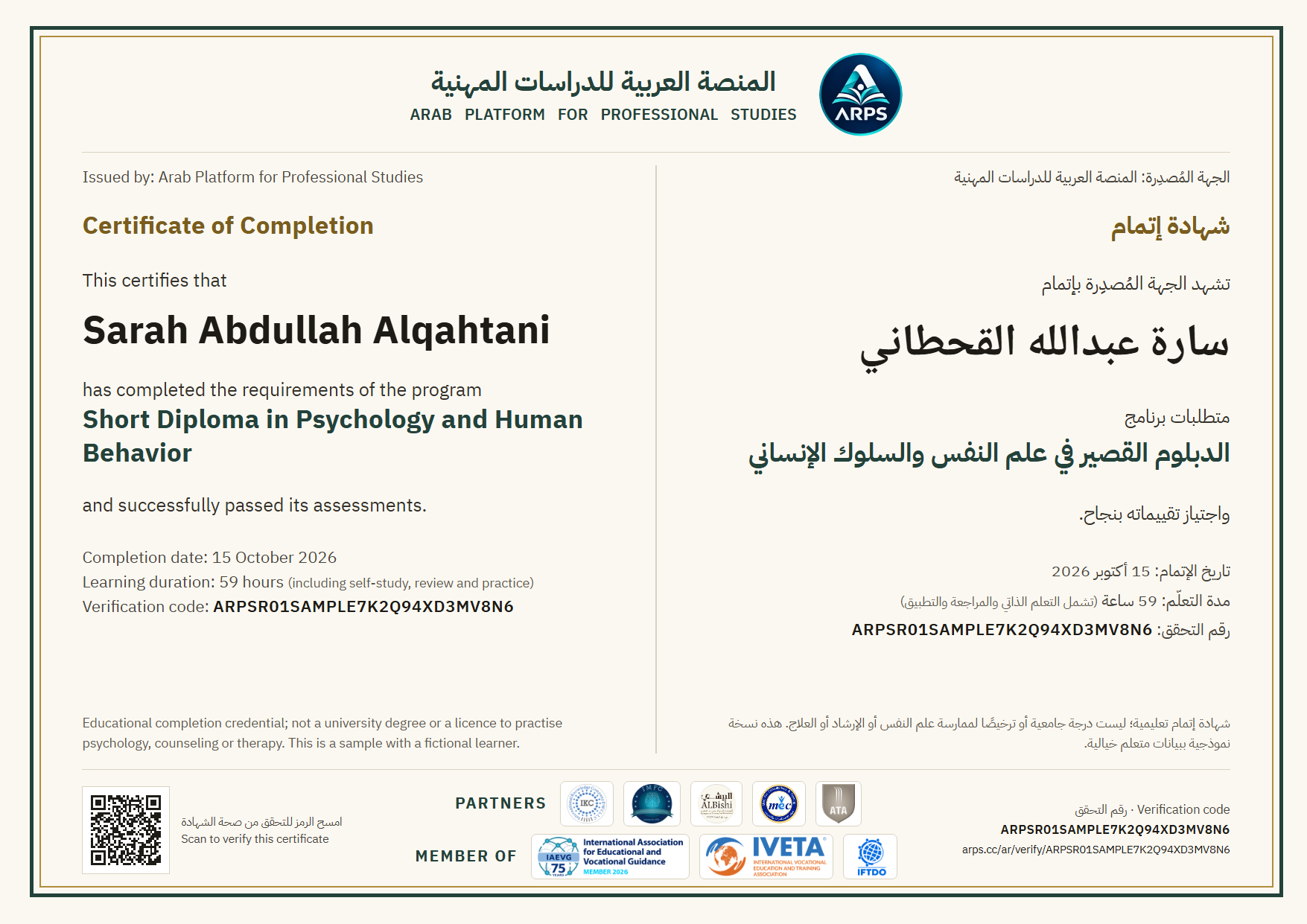
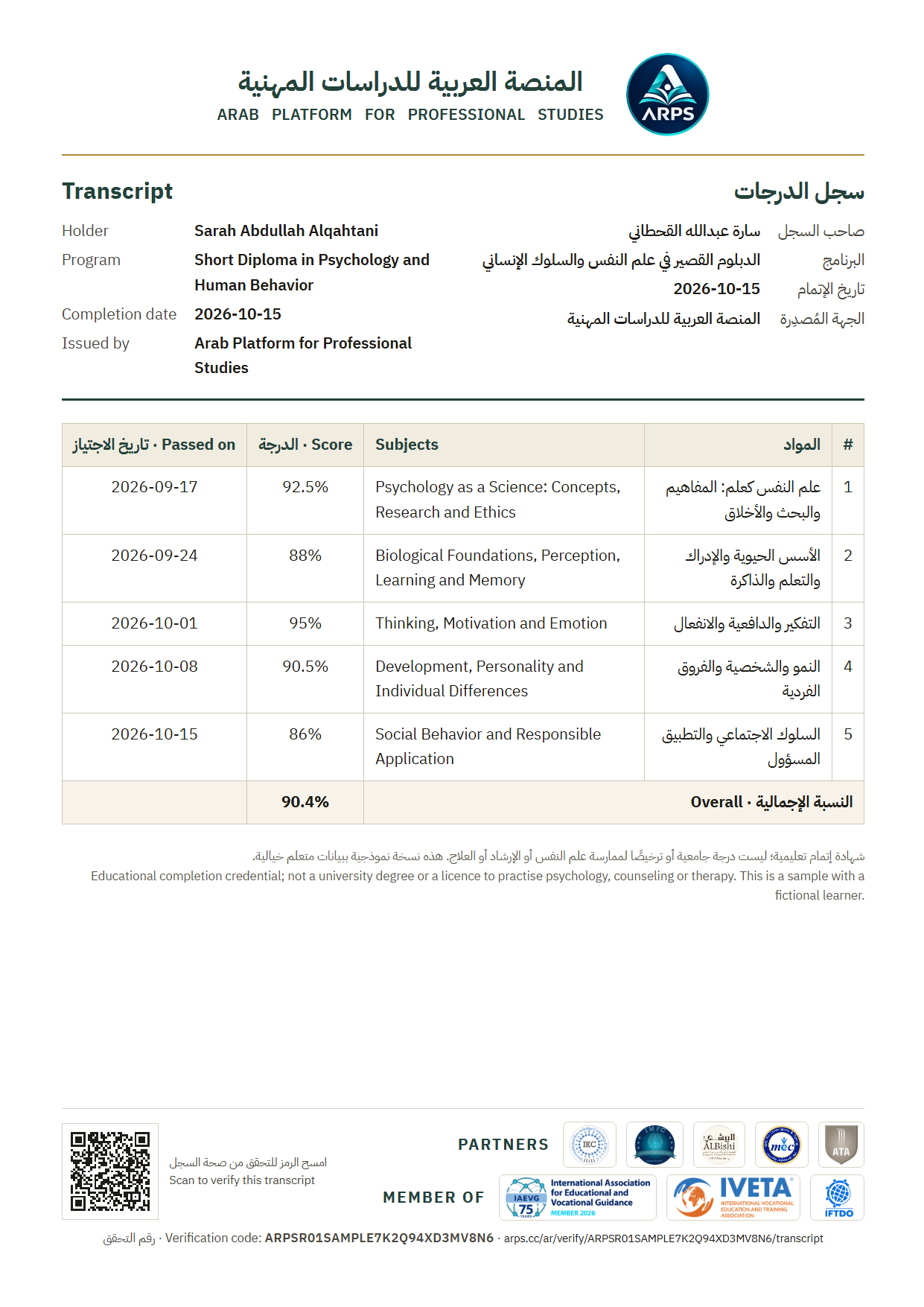
A sample from a real program in this track: Short Diploma in Psychology and Human Behavior. The learner, scores and dates are fictional; opens in a new window.
Disclaimer: Internal learning completion; no university degree or professional licence.
Program questions
Is a telescope required?
No. The cases use small tables and data supplied in the lessons.
Are the calculations an operational mission design?
No. They are simplified teaching models with stated missing constraints.
Do exercises prove a planet discovery?
No. A candidate transit requires independent validation and adequate data quality.
What is the status of named locations?
Each named city is a fictional training setting, not a real observation or local policy.
How should a calculation be reviewed?
Check units, assumptions and solution steps, then vary one input to test sensitivity.
Show all (7)
Is Short Diploma in Astronomy and Space Science free, and do I get a certificate?
Yes. Short Diploma in Astronomy and Space Science is free on ARPS: every lesson, exercise and assessment is free, the first subject is open to read without an account, and the program is available in Arabic and English. Issuing a certificate is optional and has a published fee; it is a training completion certificate showing you passed the program's assessments, recognised by most private-sector organisations in the Gulf states and most Arab countries, and it strengthens your CV; confirming that a specific organisation accepts it remains your responsibility.
What other names is Short Diploma in Astronomy and Space Science known by?
The subject of this program is also known as: astronomy, space science, astrophysics basics, planetary science. Learners usually find it by searching for: astronomy courses online, astronomy courses online free, space science course, astronomy for beginners, introduction to astrophysics.
A seven-subject foundation, ending in a capstone project, in cells, genetic information, inheritance and evolution, with practice in reading biological data and experimental limits.
Turn a defined work question into a reproducible quantitative calculation and a bounded recommendation. Practice bases, rates, models, distributions, probability and choices under capacity and budget constraints.
This short diploma connects market-research design with consumer-behavior interpretation and evidence-bounded decisions. Six subjects progress from the research question through sampling, measurement, analysis, choice journeys, testing, and recommendation, ending with an applied market-research capstone.