Short Diploma in Biology and Genetics is a free program on ARPS, the Arab Platform for Professional Studies. A seven-subject foundation, ending in a capstone project, in cells, genetic information, inheritance and evolution, with practice in reading biological data and experimental limits.
Important notice: Independent foundational education; not a university degree, professional licence, laboratory authorization or genetic counselling credential.
Choose a plausible transport mechanism from permeability, concentration direction and energy source.
From lesson 1, readable now without an account: Reasoning from a cell image
Imagine a micrograph of onion epidermis. You see adjacent compartments and a dark region in some of them. The first scientific question is not “What is every spot called?” but “What can I observe directly, and what am I inferring?” A visible boundary is an observation. Calling a dark region a nucleus depends on the preparation and stain and may require comparison with a reference image. Keeping observation apart from interpretation prevents a single image from carrying more weight than it can support.
A free account saves your progress and takes you straight to lesson 1.
Program facts
Study fee
Free
subjects
7
lessons
26
Estimated time
70 hours
Content last reviewed
Access period
60 days
Study language
Arabic and English
About the program
How does a cell image connect with a DNA sequence, an inherited trait and change in a population? The program begins with microscopy and membrane transport, then explains DNA copying and gene expression. Teaching crosses and pedigrees build probability skills without turning them into diagnosis. Later subjects distinguish mutation, recombination, selection, drift and gene flow and calculate allele frequencies from genotype counts. The final subject designs a controlled experiment, reads results and examines the scope and uncertainty of a genetic test. Each subject has lessons, worked cases, exercises and a summative assessment. Scenarios are fictional learning material and confer neither laboratory practice authorization nor genetic counselling competence.
Practical relevance
Fictional seed, plant-cell and genetics cases support scale conversion, probability calculation, experimental controls and careful reading of test limitations.
Why this program
The program connects levels often taught separately: cell structure, information flow, trait inheritance and allele-frequency change. Each level includes concrete data, a calculation or reasoning path, and a clear boundary so learners can examine what biological evidence actually supports.
Career relevance
A knowledge foundation for people who read biology and genetics in study or general work; it does not establish laboratory competency or authorization for a licensed profession.
What you will learn
Convert image pixels to physical cell size and separate observation from interpretation.
Predict water and solute movement using permeability and gradients.
Distinguish DNA, gene and chromosome and work from a short template to RNA and codons.
Calculate single-trait cross probabilities and interpret pedigree limits.
Calculate allele frequency and distinguish selection, drift and gene flow.
Show all (8)
Design an experimental comparison and read test scope and uncertain findings.
Use linkage maps, enzyme assays and strain-by-environment interaction with reproducible calculations.
Design a fermentation experiment, analyse its data and report weighed explanations with stated limits.
Learning outcomes (7)
Interpret a cell image, membrane transport, organelles and division with evidence and measurement limits.
Trace DNA organization, copying and expression from a specified sequence to a possible product.
Calculate inheritance probabilities and interpret dominance models and pedigrees with their conditions.
Distinguish sources of variation, selection, drift and gene flow, and calculate allele frequencies.
Design a biological comparison and interpret results and genetic-test limits in an integrated case.
Apply tools for experimental and genetic inference with reproducible calculations and stated limits.
Apply capstone: evaluating yeast fermentation with reproducible calculations and stated limits.
Who it is for
Upper-secondary and early university learners, teachers and independent learners seeking a foundation before specialized biology or genetics study.
Beginners and broadly experienced staff who read general biological data in education or science communication can practice assessing measurements, probabilities and evidence limits.
This educational program does not provide laboratory licensure, clinical qualification or interpretation of an individual’s genetic result.
Prerequisites
An initial school-level understanding of cells and inherited traits is enough. Lessons define genes, alleles and membrane transport before using them; laboratory experience or advanced genetics is not required.
Learners should read a short scientific passage, table or scaled image and follow fractions and percentages. Conversions and probabilities are explained step by step, and exercises can be completed on paper.
What it does not offer
Not licensed laboratory training or a genetic counselling program.
No diagnosis, treatment decision or individual risk estimate.
This subject connects four skills in Cells and biological organization with worked cases, exercises and a summative assessment.
4 lessons · 6.5 hours
Reasoning from a cell image2 hours
Cell boundaries and transport2 hours
Organelles and division of labor1.5 hours
Division and cell renewal1.5 hours
Subject 2
Molecular information and gene expression
This subject connects four skills in Molecular information and gene expression with worked cases, exercises and a summative assessment.
4 lessons · 6 hours
DNA, genes and chromosomes1.5 hours
DNA replication and fidelity1.5 hours
From gene to protein1.5 hours
Regulation and cell differences1.5 hours
Subject 3
Inheritance and probability
This subject connects four skills in Inheritance and probability with worked cases, exercises and a summative assessment.
4 lessons · 6.5 hours
Alleles and meiosis2 hours
Single-trait inheritance1.5 hours
Beyond simple dominance1.5 hours
Pedigrees and inference limits2 hours
Subject 4
Variation, evolution and populations
This subject connects four skills in Variation, evolution and populations with worked cases, exercises and a summative assessment.
4 lessons · 7 hours
Sources of genetic variation2 hours
Natural selection and fitness2 hours
Drift and gene flow2 hours
Interpreting population data1.5 hours
Subject 5
Biological inquiry and genetics applications
This subject connects four skills in Biological inquiry and genetics applications with worked cases, exercises and a summative assessment.
4 lessons · 6.5 hours
Questions, experiments and controls2 hours
Reading biological results1.5 hours
Genetic testing and interpretation2 hours
Integrating biology and genetics1.5 hours
Subject 6
Tools for experimental and genetic inference
The sixth subject adds tools for experimental and genetic inference: mapping linked loci from testcross offspring, comparing enzyme activity under assay conditions, and analysing strain-by-temperature interaction in a quantitative trait.
3 lessons · 13.5 hours
Mapping linked loci from testcross offspring4.5 hours
Comparing enzyme activity under assay conditions4.5 hours
Strain by temperature interaction in a quantitative trait4.5 hours
Subject 7
Capstone: evaluating yeast fermentation
The capstone evaluates yeast fermentation by designing a strain-by-sugar experiment, calibrating gas measurement and analysing time courses, then weighing explanations and delivering a report with stated limits.
3 lessons · 14 hours
Yeast project: designing a strain by sugar experiment4.5 hours
Yeast project: calibrating gas and analysing time courses4.5 hours
Yeast project: weighing explanations and delivering the report4.5 hours
Subjects unlock in sequence as you progress.
Strengths
Seven connected subjects from cells to population data and an experimental capstone.
Worked numerical examples and exercises with explicit answers and limits.
One internal summative assessment per subject with original bilingual items.
An integrated salt-plant case linking cells, alleles and experimental design.
Evidence basis
Instruction draws on OpenStax Biology 2e sections, NHGRI definitions and MedlinePlus Genetics guidance on interpreting test results; it uses original fictional examples with stated source scope.
Reference organizations
OpenStax
NHGRI
MedlinePlus Genetics
Methodology
Original instruction, fictional applications, inspected public sources and explicit claim limits.
How the route works
Short Diplomas are relatively comprehensive learning pathways that cover a major subject through five connected learning subjects and structured assessments, with a diploma transcript available with the credential.
Self-paced sequential study. Content unlocks progressively and each subject combines reading, examples, exercises, knowledge checks, and assessment.
Build integrated knowledge in a major subject.
Study through five clear, connected learning subjects.
Complete a defined assessment for each subject.
Receive a diploma transcript showing subjects and results when the credential is issued.
Assessment
Each Short Diploma contains five subjects, each with an approved assessment. A sixth final exam is not required when the five assessments adequately cover the learning outcomes.
Assessment attempts: 2 per assessment, 7 days apart
The pass mark is announced before the program is published.
Certificate
Successful completion makes the learner eligible for the Short Diploma certificate and Diploma Transcript under the credential policy.
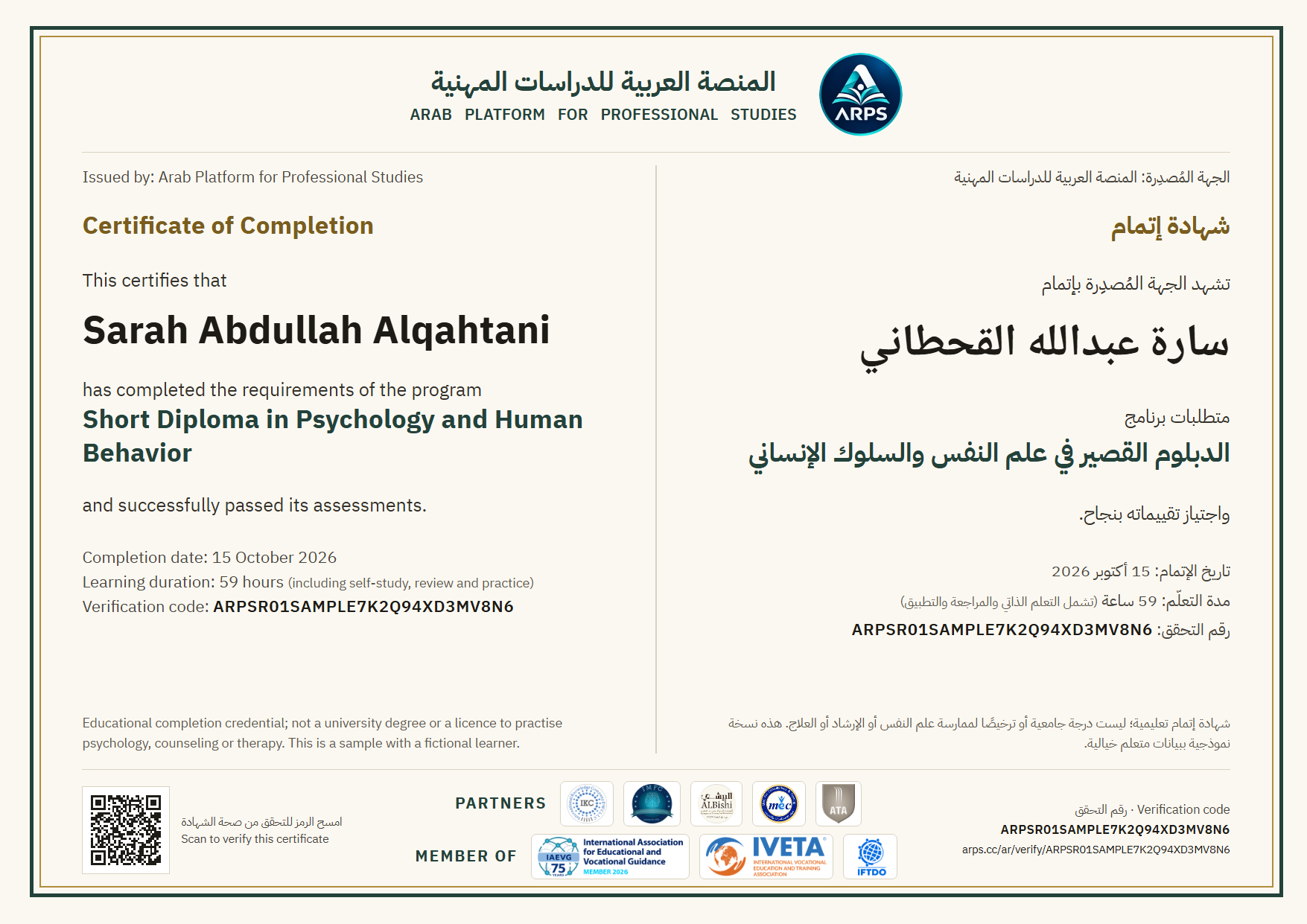
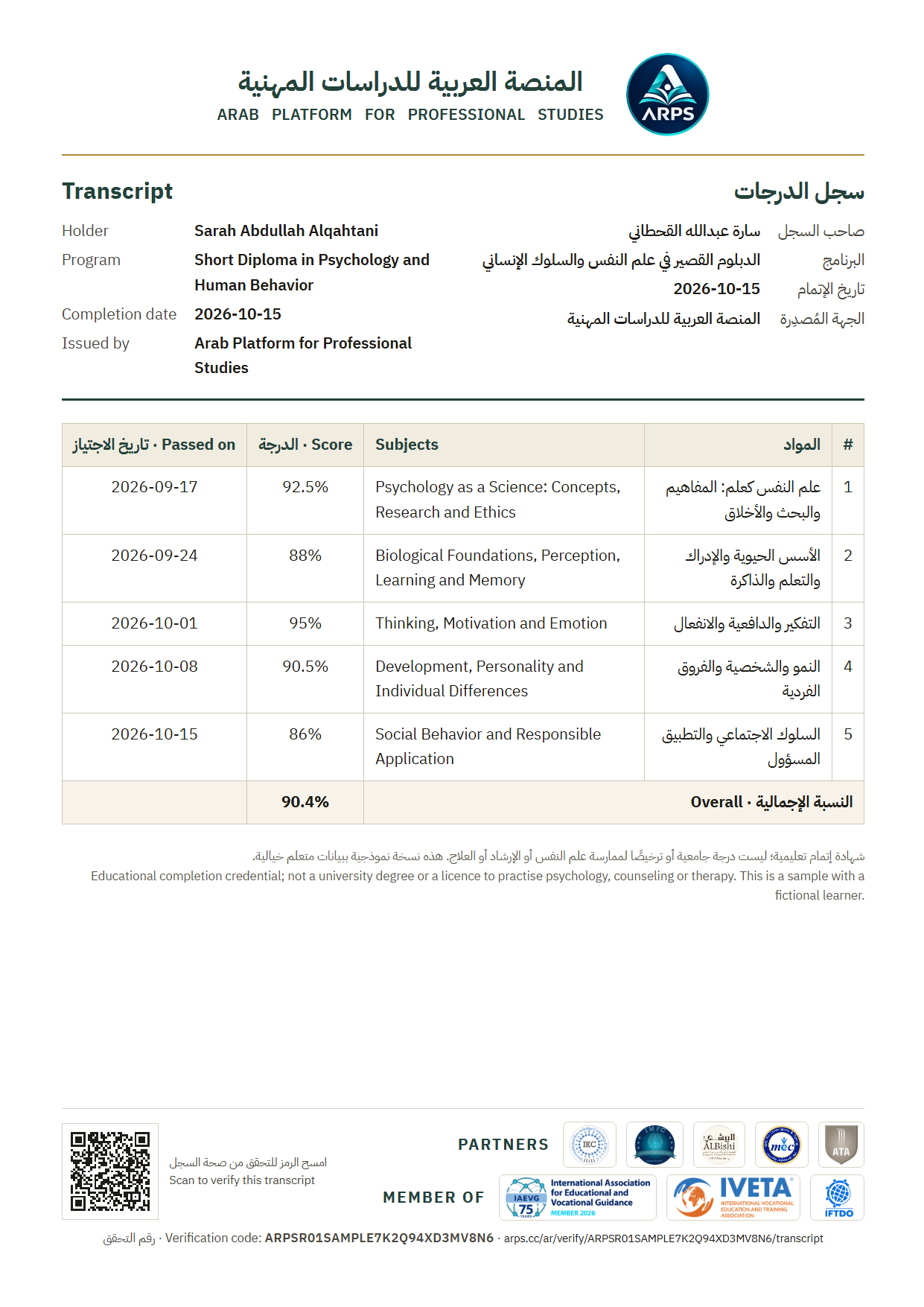
A sample from a real program in this track: Short Diploma in Psychology and Human Behavior. The learner, scores and dates are fictional; opens in a new window.
Disclaimer: Training completion; no laboratory licence, genetic counselling authorization or university degree.
Program questions
Do I need advanced biology first?
No. The sequence begins with cells, scale and membranes, and defines needed terms before DNA and inheritance problems.
Are there numerical problems?
Yes. Cross probabilities, allele frequencies and experimental differences are worked with clear denominators and solutions.
Will it interpret a person’s genetic test?
It teaches scope, quality and uncertainty in fictional reports; it does not assess a person or replace a qualified professional.
How does this differ from neuroscience?
This foundation spans cells, genetics and populations; neuroscience focuses on the nervous system and its evidence.
Is each subject assessed?
Yes. Each subject has an internal summative assessment aligned to its lessons, with subject results recorded under the route policy.
Show all (7)
Is Short Diploma in Biology and Genetics free, and do I get a certificate?
Yes. Short Diploma in Biology and Genetics is free on ARPS: every lesson, exercise and assessment is free, the first subject is open to read without an account, and the program is available in Arabic and English. Issuing a certificate is optional and has a published fee; it is a training completion certificate showing you passed the program's assessments, recognised by most private-sector organisations in the Gulf states and most Arab countries, and it strengthens your CV; confirming that a specific organisation accepts it remains your responsibility.
What other names is Short Diploma in Biology and Genetics known by?
The subject of this program is also known as: biology, genetics, molecular biology. Learners usually find it by searching for: genetics course online, biology course for beginners, introduction to genetics, free biology course.
Turn a defined work question into a reproducible quantitative calculation and a bounded recommendation. Practice bases, rates, models, distributions, probability and choices under capacity and budget constraints.
This short diploma connects market-research design with consumer-behavior interpretation and evidence-bounded decisions. Six subjects progress from the research question through sampling, measurement, analysis, choice journeys, testing, and recommendation, ending with an applied market-research capstone.