Professional Mini-Master in Sports Organization Governance and Sustainable Performance
Professional Mini-Master in Sports Organization Governance and Sustainable Performance is a free program on ARPS, the Arab Platform for Professional Studies. Design sport-governance decisions linking authority, money, integrity and participation to sustainable performance. This professional mini-master develops decisions across five connected domains: mandate and accountability, financial stewardship, integrity and welfare, participation and sustainability, and finally performance interpretation and continuity.
Distinguish the body's binding rules from comparative governance guidance, then assign decision owner, evidence and escalation boundary in three contested cases.
From lesson 1, readable now without an account: From mandate to an accountable decision-rights map
Governance is more than a diagram of committees. It specifies who can authorize a particular decision, to whom that person explains it, what evidence makes it reviewable, and who examines a challenge when interests collide. Start with the sport body's own constitution, membership rules, contracts and effective delegations. The IOC's Basic Universal Principles of Good Governance can inform checks on strategy, structures, accountability and athletes' participation; they do not turn every international example into local law. Sport England and UK Sport's governance code imposes specified requirements on organizations seeking or receiving their funding. Elsewhere its separation of board oversight and executive operation is a comparative professional model, not a binding rule. The first field in a decision register therefore records the authority's source, date and application. If the source is unavailable, do not award a power to someone merely because that person normally performs the work.
A free account saves your progress and takes you straight to lesson 1.
Program facts
Study fee
Free
subjects
6
lessons
50
Estimated time
163.5 hours
Content last reviewed
Access period
60 days
Study language
Arabic and English
About the program
This professional mini-master develops decisions across five connected domains: mandate and accountability, financial stewardship, integrity and welfare, participation and sustainability, and finally performance interpretation and continuity. Learners work through fictional cases with stated numbers and constraints, producing reviewable decisions instead of governance slogans. Exercises connect athletes, members and sponsors to cash, safety and operational capacity. The completion credential is internal to the route and is neither an academic degree nor a professional license. A seven-lesson capstone integrates an accountable season decision and handover.
Practical relevance
Fictional cases suffice; no real athlete or employee data are needed. Learners produce a rights register, cash note, integrity map, portfolio choice and review charter.
Why this program
On-field success can coexist with weak authority, liquidity or participant protection. Learn to expose these conflicts before scaling and separate attractive numbers from evidenced outcomes.
Career relevance
For club, federation and sport-program managers with foundational experience; no employment, promotion or regulated professional authorization is promised.
Career paths this program serves
This program is a step on the paths of the following occupations. Open a path to see its other programs in study order.
Design an accountable sport-body charter with tested delegation, conflicts and challenge routes.
Evaluate liquidity, unit costs, procurement and reserves while protecting restricted funds and mission.
Design testable integrity and welfare controls and review reports and selection without unsupported findings.
Compare participation and sustainability programs under access, safety, environmental and capacity constraints.
Interpret performance evidence and continuity options to issue a revisable institutional decision.
Learning outcomes (5)
Design an accountable sport-body charter with tested delegation, conflicts and challenge routes.
Evaluate liquidity, unit costs, procurement and reserves while protecting restricted funds and mission.
Design testable integrity and welfare controls and review reports and selection without unsupported findings.
Compare participation and sustainability programs under access, safety, environmental and capacity constraints.
Interpret performance evidence and continuity options to issue a revisable institutional decision.
Who it is for
Club, federation and sport-program managers who prepare or implement board decisions, along with governance, finance, integrity and participation staff with foundational operations experience. It suits people who must justify institutional trade-offs under cash, safety, member and athlete-voice constraints. It assumes no clinical or legal authority.
Prerequisites
Foundational experience managing a sport team, program or process, including an understanding of who approves commitments, who implements them and how an organization records a decision. A board position is not required.
Ability to read a simple budget and cash view, calculate a rate with the correct denominator, and compare two options under a safety or capacity constraint. The fictional lesson data suffice; organizational records and coding experience are unnecessary.
Sport governance starts with the body's actual rules rather than committee names. This module maps member, board and management rights, then tests value, term and impact thresholds before a commitment is signed. You build a board capability and athlete-voice matrix and examine interests, recusal and quorum in a related-supplier decision. The output is a minute recording alternatives, reasons and a challenge route while protecting personal information. Fictional cases separate valid procedure from a good result: an attractive project may lack authorization, while an authorized one may still need stronger evidence before expansion. Learners also specify which new rule or evidence would reopen an earlier decision.
9 lessons · 27 hours
From mandate to an accountable decision-rights map1.5 hours
Board delegation and reserved decisions1.5 hours
Board composition and athlete voice1.5 hours
Conflicts of interest and decision integrity1.5 hours
Decision transparency, challenge and review1.5 hours
Membership records before an assembly vote4.5 hours
Board calendar and decision timing4.5 hours
Affiliation with retained accountability4.5 hours
Evaluating board work candidly4.5 hours
Subject 2
Financial stewardship and resource resilience
This module tests whether a sport body can fund its mission when obligations fall due. Separate unrestricted cash from purpose-bound grants and uncollected promises, then calculate participant contribution and break-even while respecting safe supervision capacity. Procurement first passes eligibility, then compares total cost and links vendor payments to acceptance and exit. Reserves face season cancellation and sponsor delay, while volume and price effects feed a rolling cash view. Your board note identifies the gap, alternatives and funding boundary. A transparent mission deficit is not automatically a failure when it is authorized and funded; restricted cash is not a general payroll reserve.
9 lessons · 27 hours
Cash flow and restricted funding1.5 hours
Sport-program unit economics and break-even1.5 hours
Total-value procurement and contract control1.5 hours
Reserves and season-cancellation scenarios1.5 hours
Board reporting, variance and rolling forecast1.5 hours
Participant deposits and refund obligations4.5 hours
Sponsor concentration and unacceptable conditions4.5 hours
Maintain or replace a facility asset4.5 hours
In-kind support and hidden replacement costs4.5 hours
Subject 3
Integrity, welfare and control effectiveness
The module moves from writing an integrity policy to testing whether it operates. Learners distinguish inherent from residual risk and do not credit a disclosure form until operation is evidenced. After a report, they protect participants, preserve records and arrange independent review while separating containment from a finding of responsibility. Youth welfare becomes specific handover, supervision and professional referral roles without medical diagnosis by administrators. Athlete selection is recalculated against dated criteria and a fair appeal route. A finding closes only after its cause has been addressed and later files show the repair working, not simply when new instructions are issued.
9 lessons · 27 hours
Integrity risk register and control effectiveness1.5 hours
Integrity reporting, containment and independent review1.5 hours
Participant welfare governance and referral boundaries1.5 hours
Selection criteria and reviewable appeals1.5 hours
Control testing and remediation closure1.5 hours
Distinguishing payment error from fraud signals4.5 hours
Independent discipline and proportional sanctions4.5 hours
Volunteers, trust and supervision responsibilities4.5 hours
Athlete images and permitted use4.5 hours
Subject 4
Participation, sustainability and program portfolio
This module asks who starts and sustains participation, not merely how many sessions were delivered. A result chain links resources, registration, first attendance and retention with comparable denominators. You locate a distant district's drop-off and test timing, transport or price without relaxing safety. Event options are compared only after electricity and travel share a consistent measurement boundary; a partial table is not a complete footprint. Partner contracts specify accepted safe service and avoid incentives to suppress reports. Finally, programs pass an eligibility gate before expected reach, cost and capacity are ranked, with any unrestricted subsidy for mission access stated openly.
8 lessons · 22.5 hours
From mission to a testable outcome model1.5 hours
Access barriers and participation choices1.5 hours
Environmental boundaries for sport-event choices1.5 hours
Partner contracts and safe service outcomes1.5 hours
Program portfolio under money, capacity and mission constraints2 hours
Sharing facility time across community groups4.5 hours
Participation access for people with disabilities4.5 hours
Venue water and event waste decisions4.5 hours
Subject 5
Performance measurement and organizational continuity
The fifth module combines board indicators into one revisable decision. Learners show participant counts with reach denominators, accounting results with cash timing, and participation gains with safety boundaries. They interpret change through a suitable comparison and prior trend, separating an observed improvement from a demonstrated causal effect when several factors move. Each signal becomes an action with an owner, date, closure test and later effect review. Sponsor delay and leadership departure then test free cash, delegated authority and controlled access to records. The module concludes in an operating charter naming who can stop and restart a program and which evidence warrants changing a target or expanding activity.
8 lessons · 22.5 hours
A balanced board dashboard with denominators and guardrails2 hours
Interpreting change, selection bias and causal alternatives2 hours
Board review from signal to closed decision2 hours
Organizational continuity under funding and leadership shocks2 hours
An integrated and revisable operating charter2 hours
Ownership of indicators and data versions4.5 hours
Cost and outcomes when cohorts change4.5 hours
Testing leadership succession in a tabletop exercise4.5 hours
Subject 6
An accountable sport-season capstone
This capstone takes a sport-season project from a bounded decision to reviewable handover. Learners map evidence, reconcile committee advice with board authority and define contract-signing conditions. They rebuild free and restricted cash after a delayed grant, preserving the liquidity floor across payment dates. Missing supervision and a reviewer relationship test protection and evidence-based restart. Six pairs of four activities are compared on money, coaching and access, followed by a defense of visit, follow-up and causal limits. Reasoned minutes identify current versions, stop conditions, delivery receipts and review dates. Cases are explicitly fictional; real rules require institutional sources and competent advice. The output is coherent when authority, resources, service and evidence agree and each recipient understands the next action and responsibility boundary.
7 lessons · 32.5 hours
Capstone: define the season decision4.5 hours
Capstone: resolve authority conflicts4.5 hours
Capstone: finance under a shock4.5 hours
Capstone: test welfare and integrity4.5 hours
Capstone: select an equitable portfolio4.5 hours
Capstone: defend outcome evidence4.5 hours
Capstone: approval and review decision4.5 hours
Subjects unlock in sequence as you progress.
Strengths
Five units connect institutional decisions to finance, integrity and outcomes
Fictional cases and exercises with outputs and worked correction
An automated integrated final and module results from the same attempt
Evidence basis
Primary and professional sources are used within their stated scope; a UK funding code is not treated as universally binding or as publisher endorsement.
Reference organizations
International Olympic Committee
Sport England
UNFCCC
Frameworks used
Sports for Climate Action Framework — 2026-10-05
Methodology
Scoped original sport and professional sources support fictional cases with stated comparison limits.
Program questions
Do I need sport-sector experience?
Cases assume foundational program or team management and basic familiarity with indicators and budgets; this is not an entry-level survey.
Does it prescribe coaching or clinical care?
No. Scope is organizational governance and welfare responsibilities and referral; there is no training prescription or medical diagnosis.
What do the exercises produce?
Rights, cash and risk records, alternatives and decision indicators, with worked self-check feedback.
How does the final assessment work?
After five module summaries, one attempt draws automatically graded cases. The transcript reports module-question results from that same attempt, not separate module exams.
Is this an academic master’s degree?
No. This is an internal professional route and optional completion certificate under platform policy, not a university degree, license or endorsement by cited publishers.
Show all (8)
Do I need my organization’s data?
No. Use the included fictional cases and do not put personal or confidential records into external tools.
Is Professional Mini-Master in Sports Organization Governance and Sustainable Performance free, and do I get a certificate?
Yes. Professional Mini-Master in Sports Organization Governance and Sustainable Performance is free on ARPS: every lesson, exercise and assessment is free, the first subject is open to read without an account, and the program is available in Arabic and English. Issuing a certificate is optional and has a published fee; it is a training completion certificate showing you passed the program's assessments, recognised by most private-sector organisations in the Gulf states and most Arab countries, and it strengthens your CV; confirming that a specific organisation accepts it remains your responsibility.
What other names is Professional Mini-Master in Sports Organization Governance and Sustainable Performance known by?
The subject of this program is also known as: sports governance, sport management, sports club governance, sports organization management. Learners usually find it by searching for: sports governance course, sports governance training, sport management course online, good governance in sport, sports club sustainability.
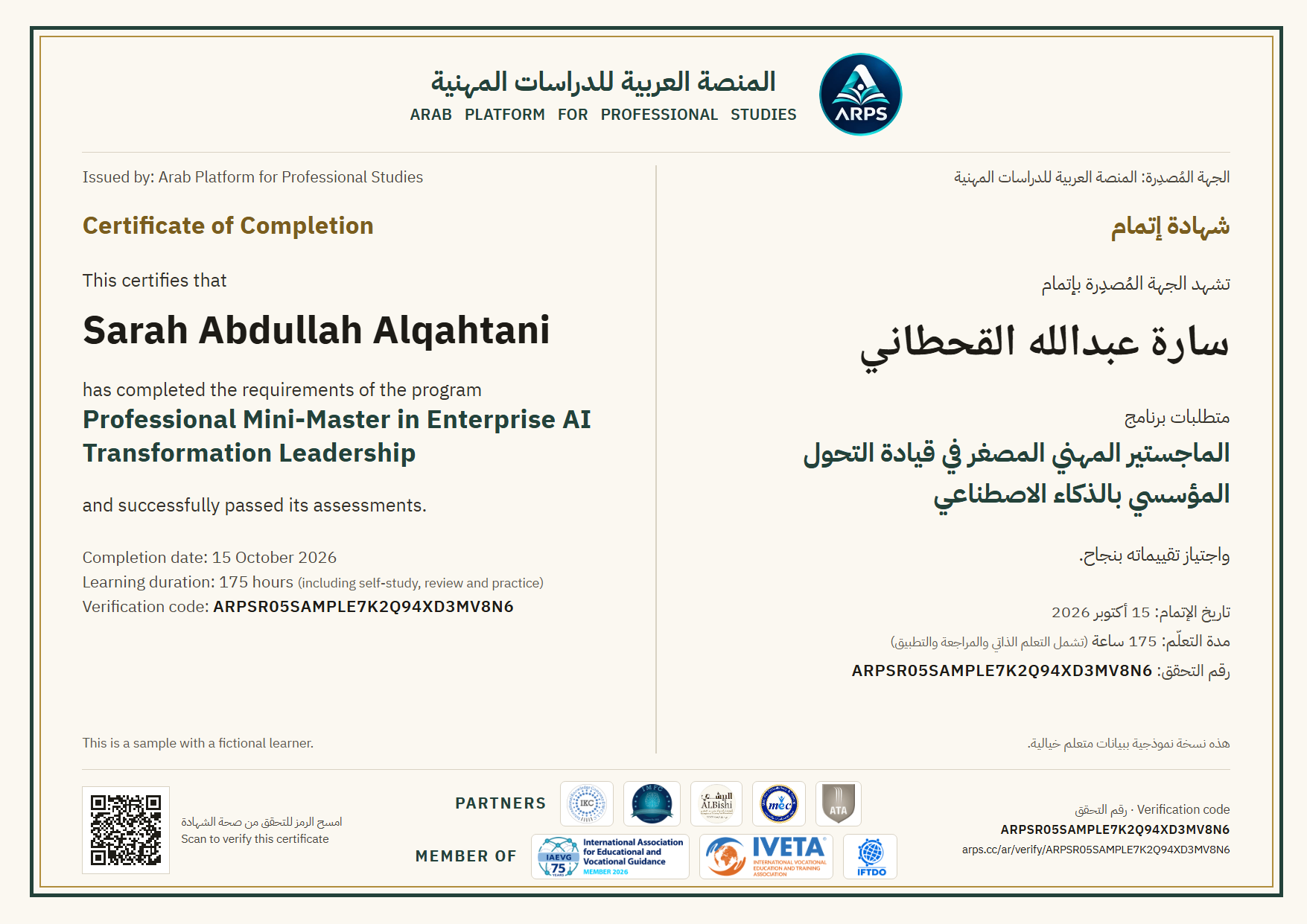
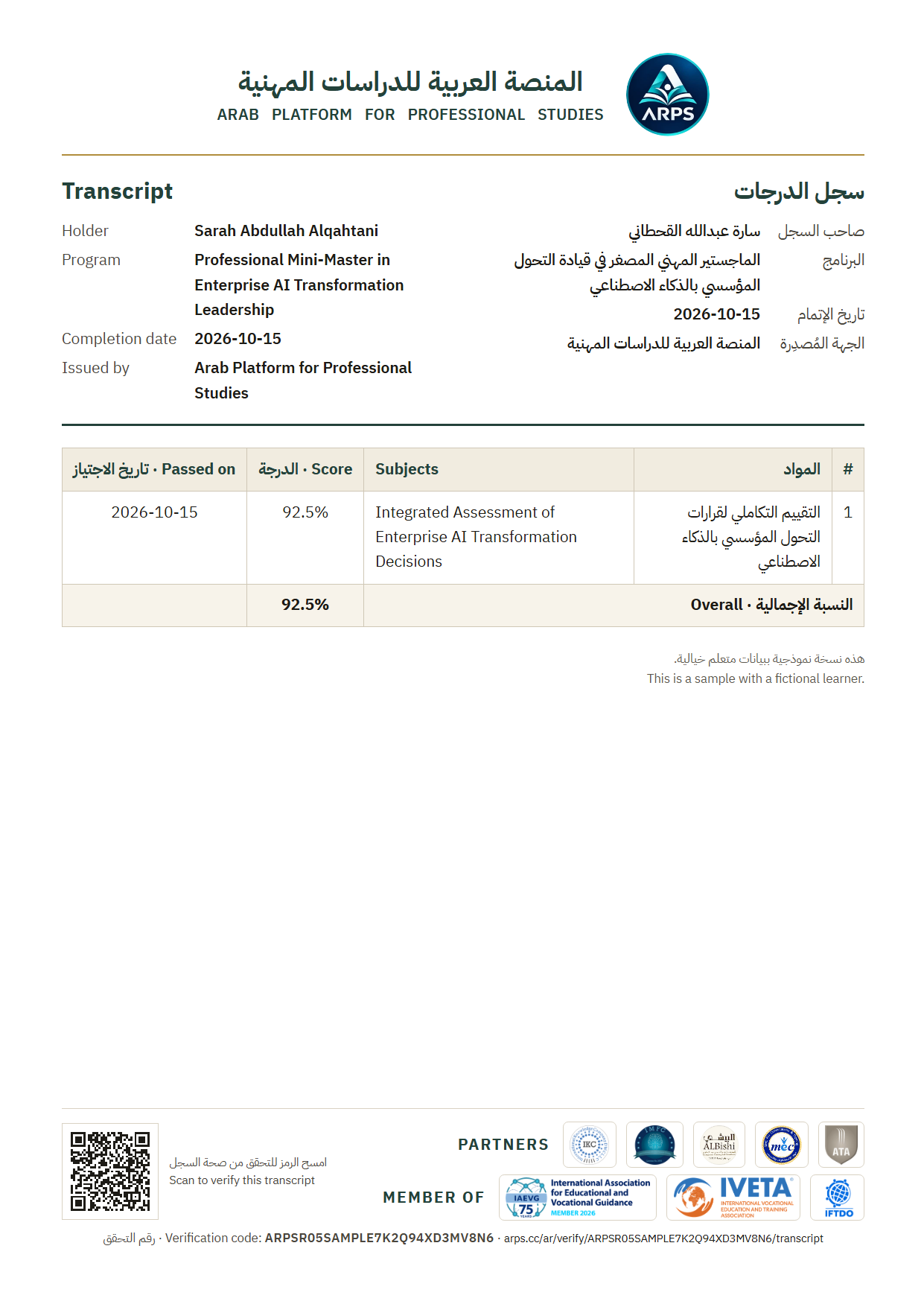
A sample from a real program in this track: Professional Mini-Master in Enterprise AI Transformation Leadership. The learner, scores and dates are fictional; opens in a new window.
Practice sports marketing work from an audience decision to a launchable campaign and an honest ticket and sponsor report. Fictional cases provide counts, rights and operational limits, leading to decision cards, measurement tables and checkable solutions.
A short diploma connecting community needs with feasible recreation design, safe delivery and honest evaluation across six subjects and fictional applied cases.
6 subjects
24 lessons
63.5 hours
Free
Professional Mini-Master
Career Development, Personal Skills & Productivity
An honest note: the professional mini-master is an intensive professional program; it is not an academic degree or a licence and is not equivalent to a university master's or MBA. The optional ARPS certificate is a training completion certificate showing you passed the program's assessments.