Short Diploma in Recreation and Leisure Management
Short Diploma in Recreation and Leisure Management is a free program on ARPS, the Arab Platform for Professional Studies. A short diploma connecting community needs with feasible recreation design, safe delivery and honest evaluation across six subjects and fictional applied cases.
Important notice: Independent education; not a university degree, professional licence or endorsement by cited organizations.
Frame a decision question, combine records, survey, conversation and observation, and distinguish a finding from its sampling limits.
From lesson 1, readable now without an account: Distinguishing recreation, activity and leisure time
Imagine a community centre advertising “two hours of activities.” One visitor hopes to meet neighbours, another wants a quiet chance to draw, and a third attends because a relative registered them. The list of things to do does not tell us whether each person will have a worthwhile recreation experience. In this course we use recreation as a chosen experience in available time that may offer enjoyment, expression, connection or restoration. An activity is the action within that experience. This is a working definition for program design, not a ranking of people’s hobbies.
A free account saves your progress and takes you straight to lesson 1.
Program facts
Study fee
Free
subjects
6
lessons
24
Estimated time
63.5 hours
Content last reviewed
Access period
60 days
Study language
Arabic and English
About the program
How do you design an activity people can choose, reach and enjoy, while the provider can operate and review it responsibly? The program begins by distinguishing an activity from a recreation experience, then examines participant needs, local assets and the limits of small samples. It moves to session sequences, adaptation, capacity, resources and piloting. The third subject follows registration and welcome, staff and volunteer roles, budget and communication. The fourth addresses safety, access, privacy, environmental stewardship and the coordinator’s role boundaries. The fifth connects attendance, self-report and other evidence with next-season decisions and an integrated plan, and a capstone builds a transferable recreation-series operating dossier. Cases and numbers are fictional teaching examples, not community statistics or promised outcomes.
Practical relevance
Apply the approach to a small workshop or event: define the need, capacity and roles, check risks and run a limited pilot before scaling. Real decisions require local site evidence and authority.
Why this program
An event may attract people while others remain excluded by time, capacity or participation format. The program teaches you to separate turnout, experience and outcome, then test a specific improvement.
Career relevance
Useful for activity coordinators and people in community centres, public agencies, nonprofits and other recreation providers. It develops planning, operations and evaluation language without promising employment, promotion or professional eligibility.
Career paths this program serves
This program is a step on the paths of the following occupations. Open a path to see its other programs in study order.
Distinguish recreation experience from an activity label and interpret community needs and access barriers without unsupported generalization.
Design an adaptable activity sequence with a clear purpose, feasible resources and capacity.
Organize registration, welcome, roles, budget and communication across the participant journey.
Check activity risks, access, privacy and environmental considerations within role boundaries.
Measure attendance and short-term outcomes and justify a next-season change in an integrated plan.
Prepare an operating dossier for a recreation series that another team can inspect and take over.
Learning outcomes (5)
Diagnose participant needs and access barriers using limited evidence.
Design inclusive recreation activities with explicit outcomes and feasible resources.
Operate a participant journey with defined roles, budget and communication.
Identify activity risks, adapt participation and respect role boundaries.
Measure participation and outcomes and justify a next-cycle change.
Who it is for
This program serves early-career activity coordinators, staff and volunteers in community centres, municipalities, nonprofits and other recreation providers. It also suits people helping choose activities, welcome participants, assign roles or review results who want a foundation before wider delivery responsibility.
It does not replace specialist field training for first aid, crowd safety or event authorization; learners study the coordinator’s role limits.
Prerequisites
No advanced recreation-management experience is required. Learners should read a short case, distinguish observations from assumptions, and calculate simple attendance rates and costs with paper or an ordinary calculator. They will write brief decisions and examine capacity and role tables; the lessons explain terms before applying them.
Exercises use fictional figures and require neither a live event nor personal data about real participants.
What it does not offer
Not a licence for first aid, crowd management or legal approval of an event.
Does not establish completed field practice, grant a university degree or award a credential from cited organizations.
This subject links four lessons through a fictional community recreation case, with justified decisions and clear evidence and authority limits.
4 lessons · 8 hours
Distinguishing recreation, activity and leisure time2 hours
Reading participant needs and local assets2 hours
Barriers, access and equitable participation2 hours
Writing a program purpose and outcomes2 hours
Subject 2
Designing Recreation Experiences
This subject links four lessons through a fictional community recreation case, with justified decisions and clear evidence and authority limits.
4 lessons · 8 hours
Building a session sequence from outcomes2 hours
Adapting activities across abilities2 hours
Selecting venues, resources and schedule2 hours
Piloting and refining a program2 hours
Subject 3
Activity Operations and Participant Experience
This subject links four lessons through a fictional community recreation case, with justified decisions and clear evidence and authority limits.
4 lessons · 8 hours
Registration, welcome and closing journey2 hours
Staff and volunteer roles2 hours
Resources and operating budget2 hours
Participant and partner communication2 hours
Subject 4
Safety, Inclusion and Sustainability
This subject links four lessons through a fictional community recreation case, with justified decisions and clear evidence and authority limits.
4 lessons · 8 hours
Activity risk assessment and controls2 hours
Incident response and role boundaries2 hours
Accessible experience and privacy2 hours
Environmental stewardship and site use2 hours
Subject 5
Evaluation and Integrated Improvement
This subject links four lessons through a fictional community recreation case, with justified decisions and clear evidence and authority limits.
4 lessons · 8 hours
Measuring reach and experience2 hours
Evaluating short-term outcomes2 hours
Prioritizing next-season decisions2 hours
Integrated community recreation plan2 hours
Subject 6
Capstone: a transferable recreation series
A capstone turning prior learning into an operating dossier for a pilot recreation series: a decision dossier, a simultaneous-change rehearsal, an evidence audit with a continuation decision, then handover and a successor-readiness test.
Auditing pilot evidence and continuation decisions3.5 hours
Handing over and testing successor readiness3.5 hours
Subjects unlock in sequence as you progress.
Strengths
Connects each design decision to an observable participant experience.
Makes evidence, sample and authority limits explicit instead of overstating impact.
Combines worked examples and feedback exercises with separate subject assessments.
Offers country-neutral cases and five integrated review summaries.
Evidence basis
Concepts draw on publicly inspected NRPA, CDC, NIST, HSE, EPA and NPS pages within the recorded access scope. Cases and questions use original wording. Citation does not imply endorsement or make foreign guidance local law.
Reference organizations
National Recreation and Park Association
Centers for Disease Control and Prevention
National Institute of Standards and Technology
UK Health and Safety Executive
US Environmental Protection Agency
US National Park Service
Methodology
The material links explanations to worked cases, guided exercises and separate assessments. Review is assisted self-review, not institutional endorsement or learner psychometric validation.
How the route works
Short Diplomas are relatively comprehensive learning pathways that cover a major subject through five connected learning subjects and structured assessments, with a diploma transcript available with the credential.
Self-paced sequential study. Content unlocks progressively and each subject combines reading, examples, exercises, knowledge checks, and assessment.
Build integrated knowledge in a major subject.
Study through five clear, connected learning subjects.
Complete a defined assessment for each subject.
Receive a diploma transcript showing subjects and results when the credential is issued.
Assessment
Each Short Diploma contains five subjects, each with an approved assessment. A sixth final exam is not required when the five assessments adequately cover the learning outcomes.
Assessment attempts: 2 per assessment, 7 days apart
The pass mark is announced before the program is published.
Certificate
Successful completion makes the learner eligible for the Short Diploma certificate and Diploma Transcript under the credential policy.
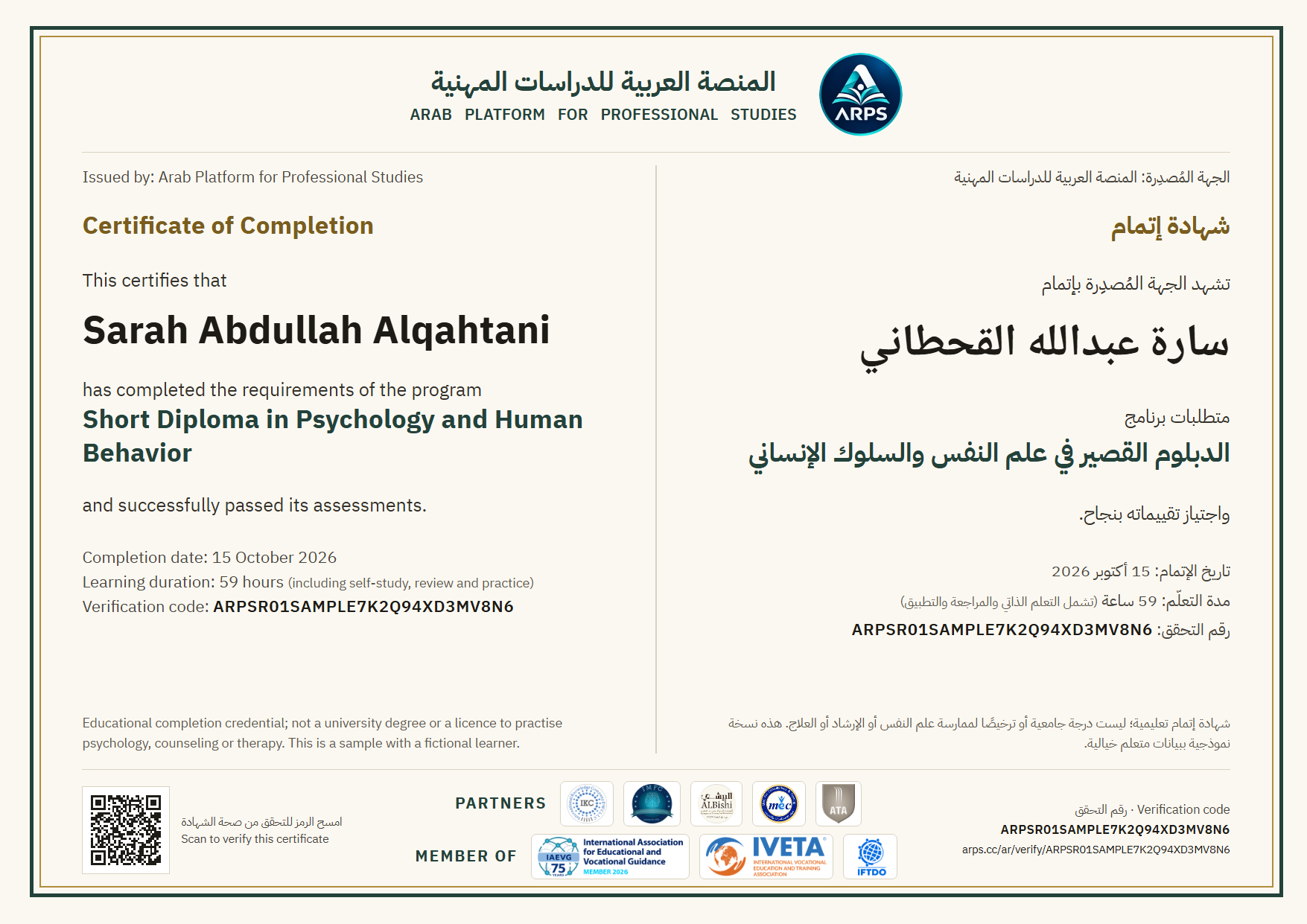
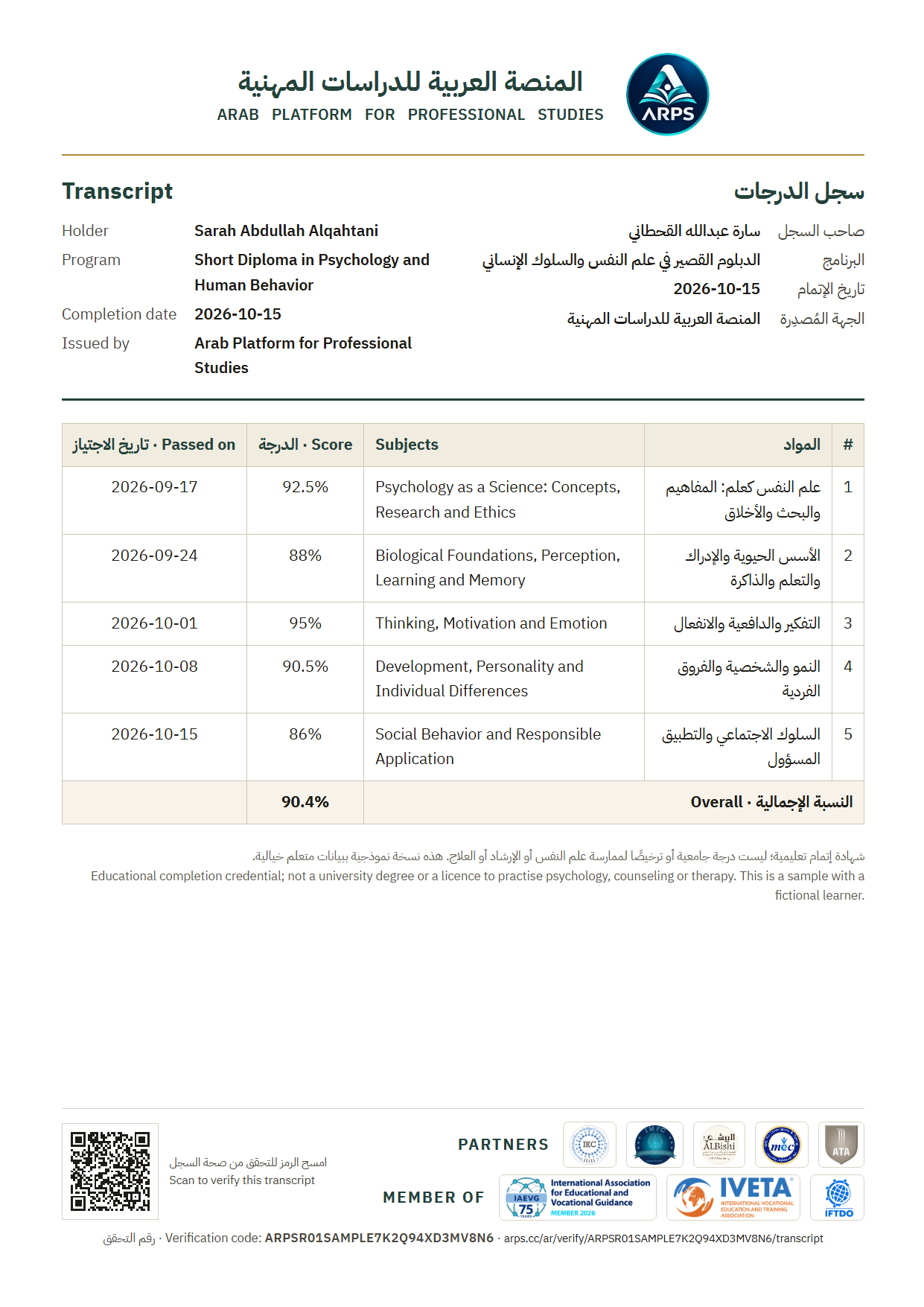
A sample from a real program in this track: Short Diploma in Psychology and Human Behavior. The learner, scores and dates are fictional; opens in a new window.
Disclaimer: Training completion, not a university degree or professional licence.
Program questions
Do I need event-organization experience?
No. The program starts with foundations before moving to design, operations and evaluation decisions.
Do the examples apply in every country?
Cases are general teaching examples; inspect local site rules and requirements before running a real activity.
Will I practice with actual participants?
The materials include exercises, fictional cases and assessments; they do not document real field practice with an audience.
How do lesson checks differ from subject assessments?
Lesson checks support learning, while each of the five core subjects has a separate assessment within the diploma requirements.
Are official learning hours stated?
Official hours await route calibration; the material shows only editorial reading and practice estimates.
Show all (7)
Is Short Diploma in Recreation and Leisure Management free, and do I get a certificate?
Yes. Short Diploma in Recreation and Leisure Management is free on ARPS: every lesson, exercise and assessment is free, the first subject is open to read without an account, and the program is available in Arabic and English. Issuing a certificate is optional and has a published fee; it is a training completion certificate showing you passed the program's assessments, recognised by most private-sector organisations in the Gulf states and most Arab countries, and it strengthens your CV; confirming that a specific organisation accepts it remains your responsibility.
What other names is Short Diploma in Recreation and Leisure Management known by?
The subject of this program is also known as: recreation management, leisure management, recreation and leisure. Learners usually find it by searching for: recreation management course, leisure management course, recreation careers, free recreation course.
A short diploma of five subjects and a capstone project in reading ticketing, audience, sponsorship, venue and income data for bounded commercial decisions. Lessons use explicitly fictional cases and checkable calculations, with a summative assessment and subject result for each. It grants no external professional authorization or accreditation.
Practice sports marketing work from an audience decision to a launchable campaign and an honest ticket and sponsor report. Fictional cases provide counts, rights and operational limits, leading to decision cards, measurement tables and checkable solutions.
This short diploma connects market-research design with consumer-behavior interpretation and evidence-bounded decisions. Six subjects progress from the research question through sampling, measurement, analysis, choice journeys, testing, and recommendation, ending with an applied market-research capstone.