Short Diploma in Sports Business Analytics is a free program on ARPS, the Arab Platform for Professional Studies. A short diploma of five subjects and a capstone project in reading ticketing, audience, sponsorship, venue and income data for bounded commercial decisions. Lessons use explicitly fictional cases and checkable calculations, with a summative assessment and subject result for each.
Important notice: Independent education; not a university degree, professional licence or endorsement by cited organizations.
Define the observation unit and occupancy numerator and denominator, then calculate unique admissions against stated operating capacity.
From lesson 1, readable now without an account: Counting attendance and seat occupancy
Imagine checking a match report. A colleague says the venue was “90% full” because 9,000 tickets left the ticketing system. The gate manager says 7,800 supporters entered. Neither number automatically replaces the other. First state the business question: do you need to know ticket demand, actual attendance, or use of available seats? Each needs a distinct measure.
A free account saves your progress and takes you straight to lesson 1.
Program facts
Study fee
Free
subjects
6
lessons
26
Estimated time
70 hours
Content last reviewed
Access period
60 days
Study language
Arabic and English
About the program
What is the difference between 9,000 distributed tickets and 7,800 supporters who actually entered? This diploma starts with a small measurement question that can change gate staffing and pricing choices. Learners define a metric before calculating it, reconcile ticket and scan ledgers, and keep people distinct from orders and sessions. They then examine net ticket yield, sell-out constraints, website conversion and return cohorts. Sponsorship work separates delivered rights from exposure, linked orders and genuinely incremental sales. Venue work addresses gate flow, concessions and fan surveys with explicit data-quality limits. The final subject combines contribution, forecasts, break-even and an executive memo across ticketing, sponsor and entry decisions. Regional cases are marked as fictional and make no claim about real local prices or rules. Assessments measure foundational understanding and application; the diploma neither licenses a profession nor establishes experience in a particular venue.
Practical relevance
Metric cards, yield bridges, flow tables and cohorts can be practiced on the supplied fictional data or authorized workplace records. Real decisions still require validated contracts, data, decision authority and venue procedures.
Why this program
Sales, admissions and visit counts often disagree because their units and denominators differ. The program teaches learners to repair definitions first, calculate the result next, and then distinguish evidence from assumption before recommending pricing, operations or a sponsorship renewal.
Career relevance
Useful to people reading commercial reports for clubs, leagues, events and venues or supporting ticket sales, partnerships and fan service. It teaches measurement and decision language without promising employment, promotion or regulated professional authority.
Career paths this program serves
This program is a step on the paths of the following occupations. Open a path to see its other programs in study order.
Define attendance and occupancy and reconcile ticket, scan and capacity ledgers.
Calculate net ticket yield, digital conversion, cohort return and discount displacement.
Separate sponsor rights and impressions from collected income and incremental effect.
Interpret gate flow, concessions and survey response with data-quality limits.
Combine contribution, forecasts and break-even into a conditional commercial decision memo.
Allocate a series-of-events budget as a fundable intervention portfolio and revise the decision when evidence changes.
Learning outcomes (26)
Define the observation unit and occupancy numerator and denominator, then calculate unique admissions against stated operating capacity.
Reconcile valid entitlements, scans and re-entries and present unresolved records as a conditional range.
Build a metric card with source, version, denominator and quality checks and diagnose a definition break.
Separate buyer share from order frequency and limit disclosure of narrow segments.
Calculate percentage-point and relative changes in a reminder test and bound causal interpretation.
Build a yield bridge from price classes to proceeds after refunds, discounts and channel fees.
Distinguish observed sell-out from unmet demand and test added inventory with a conversion range.
Define digital funnel events and reconcile distinct order IDs and refunds to the transaction ledger.
Fix cohort eligibility and observation window and calculate return bounds under missing identity linkage.
Separate code redemption from incremental sales and test contribution sensitivity to full-price displacement.
Separate contracted rights, linked visits and orders, and incremental impact on a sponsor card.
Calculate impression frequency and distinguish unique devices from people and qualifying from raw exposure.
Bridge linked orders to retained and assumed incremental orders, then subtract relevant activation cost.
Separate rate card, package consideration, collected cash and delivered rights without invented allocation.
Weigh delivery gaps, measurement quality and alternatives in a conditional renewal recommendation.
Calculate interval backlog from arrivals and capacity without inventing waiting minutes.
Separate spend per entrant, transaction value, concession contribution and the club's outside-operator share.
Calculate response rate and test how satisfaction claims depend on nonrespondent assumptions.
Define a timed threshold, action owner and stale-data state in an alert log.
Compare congestion interventions by backlog, cost, resources, accessibility and uncertainty.
Reconcile ticket, concession and sponsorship contributions before shared cost without counting operator sales as club income.
Build ticket-volume and yield scenarios under capacity limits and decompose volume versus yield variance.
Calculate whole-ticket break-even and test service-cost sensitivity against capacity.
Write a board memo separating observed after-fee change from pricing interpretation and specifying a next check.
Integrate ticket-offer contribution, gate pressure and conditional sponsor funding into a monitored recommendation.
Build a fundable, executable intervention portfolio and explain evidence-led revisions.
Who it is for
Early-career club, league, event and venue staff who prepare ticketing or audience reports or support sales, sponsorship and service. Career changers can learn the underlying decisions before specializing in a sport sector or tool.
Supervisors reviewing dashboards can ask about sources, denominators and causal claims before approving action. The diploma does not suit those seeking athlete-performance analysis, professional licensing, legal advice or guaranteed market forecasts.
Prerequisites
Read small tables, multiply, divide and use percentages; understand that sales receipts differ from costs. Lessons introduce needed sport-business and statistical terms, so advanced statistics and programming are unnecessary.
Be ready to state assumptions, check denominators and work through fictional data by hand or in a simple spreadsheet. No real club dataset, paid platform, licence or professional title is required.
What it does not offer
This is not athlete-performance analysis or preparation for medical, legal or venue-safety decisions.
It is not a federation accreditation, a route to a regulated profession or a substitute for actual partnership contracts and local venue procedures.
Measurement foundations and trustworthy sport data
Start with the observation unit and denominator for attendance and occupancy. Reconcile entitlements and scans, define a durable metric, segment audiences and state the limits of causal claims.
5 lessons · 9 hours
Counting attendance and seat occupancy1.5 hours
Reconciling ticket, scan and capacity ledgers2.5 hours
A metric dictionary that survives the next match1.5 hours
Segmenting people, visits and orders2.5 hours
Observation, uncertainty and causal claims3 hours
Subject 2
Ticketing, audiences and digital channels
Connect ticket sales with retained proceeds. Examine capacity limits, digital conversion, return cohorts and offer displacement while separating recorded activity from assumed additional sales.
5 lessons · 9 hours
Gross ticket sales and net yield1.5 hours
Comparing ticket demand when capacity binds2.5 hours
Instrumenting the view-to-purchase path1.5 hours
Retention cohorts with a common window2.5 hours
Evaluating a ticket offer beyond redemption3 hours
Subject 3
Sponsorship, partnerships and media rights
Begin with contracted rights, then track delivery, exposure quality and costs. Calculate activation contribution and test attribution claims before renewal or rights changes.
5 lessons · 9 hours
Turning a sponsor objective into measurable delivery1.5 hours
Reach, impressions and exposure quality2.5 hours
Activation cost, contribution and attribution limits1.5 hours
Rights inventory versus realized value2.5 hours
Sponsor review and renewal under uncertainty3 hours
Subject 4
Venues, events and fan experience
Compare arrivals with gate capacity, concession spend with margin and survey answers with nonresponse. Finish with an event dashboard and a conditional operating intervention.
5 lessons · 9 hours
Gate flow and queue pressure by interval1.5 hours
Concession spend, transactions and margin2.5 hours
Fan feedback and response bias1.5 hours
An event dashboard tied to action2.5 hours
Comparing event interventions3 hours
Subject 5
Integrated commercial decisions and communication
Combine commercial-line revenue and contribution, then develop forecast ranges, break-even analysis and a decision memo. The final case connects tickets, sponsors and gates without merging incompatible assumptions.
5 lessons · 9 hours
Revenue and contribution by commercial line1.5 hours
Forecasting volume and yield as a range2.5 hours
Break-even and investment sensitivity1.5 hours
Explaining a dashboard to an executive2.5 hours
Integrated ticket, sponsor and venue decision3 hours
Subject 6
Capstone: allocating a series-of-events budget
The capstone combines measurement, ticketing, sponsorship and operations in one budget decision covering three fictional events. Learners begin with an evidence register distinguishing verified quotations from demand assumptions, calculate contribution and compare intervention portfolios under a cash ceiling. They inspect shared staffing and arrival patterns, then design verification of incremental demand rather than relying on linked orders. Funding evidence and ticket margin change during the project, requiring a documented revision. The main outputs are a reproducible portfolio file and a decision memorandum with owners and dates. Eight practice stages have independent feedback. A colleague reviews units, commitments and feasibility, while qualified owners retain safety and contract authority.
1 lesson · 10.5 hours
Allocate a three-event budget and review the decision10.5 hours
Subjects unlock in sequence as you progress.
Strengths
Connected sport-business cases tied to ticket, partner and venue decisions rather than generic business text with a new title.
Every lesson has supplied data, a worked example and a practice output with a checkable solution.
Reports keep arithmetic, causal claims and missing-data limits separate.
Five assessed subjects and an assessed capstone, with a subject-results transcript.
Evidence basis
Calculations use declared fictional inputs; changing claims are linked to exact original-source locations when the bundle is assembled. Mention of a publisher is not sponsorship of this program.
Reference organizations
FIFA
Google
Information Commissioner's Office
Office for National Statistics
Interactive Advertising Bureau and Media Rating Council
Methodology
Fictional cases, metric definitions and bounded numerical comparisons.
How the route works
Short Diplomas are relatively comprehensive learning pathways that cover a major subject through five connected learning subjects and structured assessments, with a diploma transcript available with the credential.
Self-paced sequential study. Content unlocks progressively and each subject combines reading, examples, exercises, knowledge checks, and assessment.
Build integrated knowledge in a major subject.
Study through five clear, connected learning subjects.
Complete a defined assessment for each subject.
Receive a diploma transcript showing subjects and results when the credential is issued.
Assessment
Each Short Diploma contains five subjects, each with an approved assessment. A sixth final exam is not required when the five assessments adequately cover the learning outcomes.
Assessment attempts: 2 per assessment, 7 days apart
The pass mark is announced before the program is published.
Certificate
Successful completion makes the learner eligible for the Short Diploma certificate and Diploma Transcript under the credential policy.
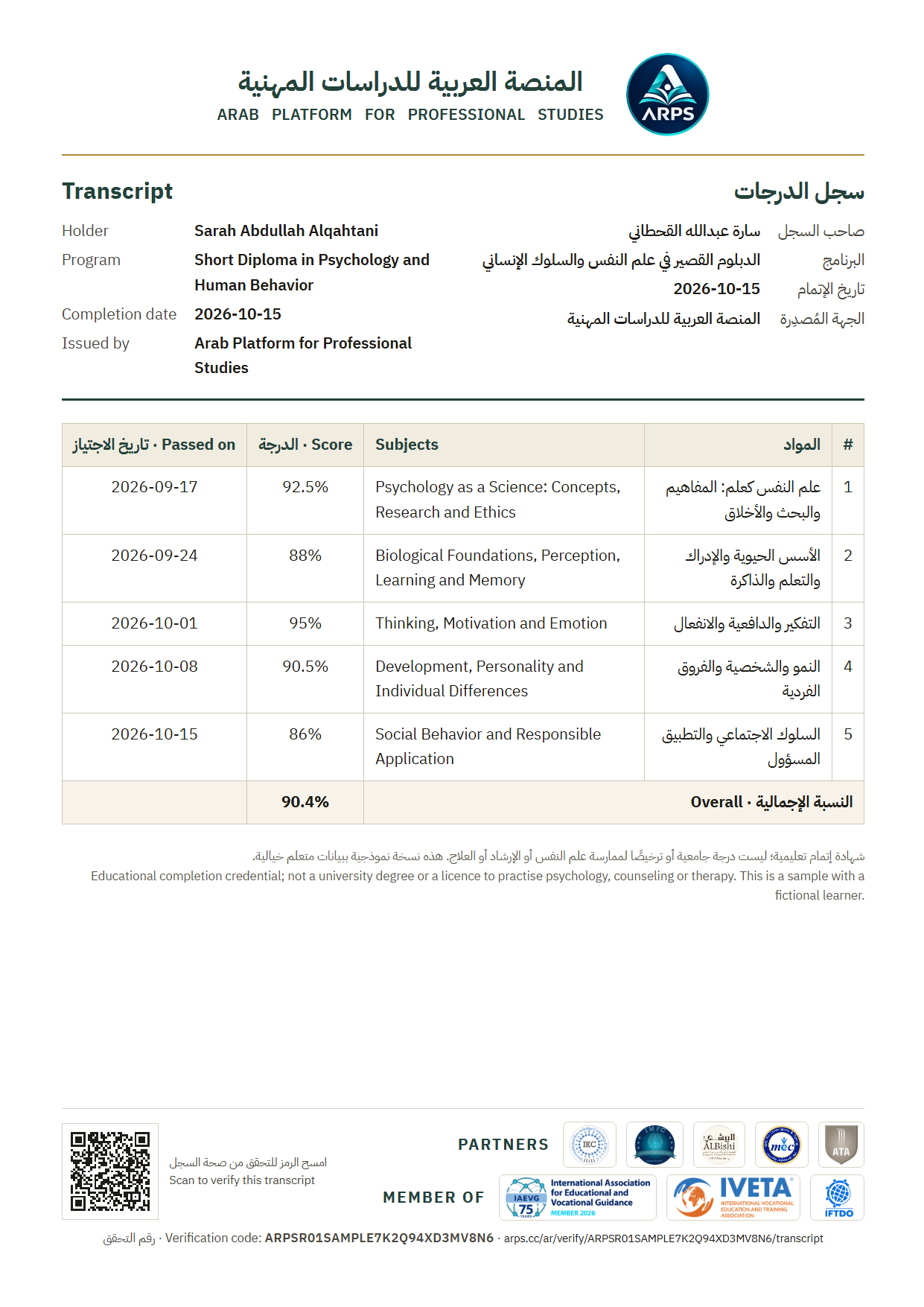
A sample from a real program in this track: Short Diploma in Psychology and Human Behavior. The learner, scores and dates are fictional; opens in a new window.
Disclaimer: Training completion, not a university degree or professional licence.
Program questions
Do I need prior analytics experience?
Basic tables and percentages are enough. The diploma starts with units and denominators and then uses applied cases; programming and real institutional data are not required.
Does this cover athlete performance?
Its scope is sports business: tickets, audiences, partnerships, venues and income. It does not teach physical-performance or medical decisions.
What does the credential mean?
It is an internal training-completion credential after subject requirements and assessments, with a record of subject results. It is neither a university degree nor an external sport-body licence or accreditation.
Can the lesson examples determine a real financial decision?
The regional cases and figures are fictional teaching material. For an actual decision, verify your own records, capacity, prices and partner rights and obtain the authorized owner’s approval.
How is progress measured?
Each lesson has a short practice check and each subject has its own final assessment. Subject results are recorded separately under the central passing policy when configured.
Show all (8)
Do I need club data or paid analytics software?
No. Exercises provide enough fictional figures for calculation and review by hand or in a simple spreadsheet, without exposing real club data.
Is Short Diploma in Sports Business Analytics free, and do I get a certificate?
Yes. Short Diploma in Sports Business Analytics is free on ARPS: every lesson, exercise and assessment is free, the first subject is open to read without an account, and the program is available in Arabic and English. Issuing a certificate is optional and has a published fee; it is a training completion certificate showing you passed the program's assessments, recognised by most private-sector organisations in the Gulf states and most Arab countries, and it strengthens your CV; confirming that a specific organisation accepts it remains your responsibility.
What other names is Short Diploma in Sports Business Analytics known by?
The subject of this program is also known as: sports analytics, sports business, sports data analysis. Learners usually find it by searching for: sports analytics course, sports business management course, sports data analysis course, free sports analytics course.
A short diploma connecting community needs with feasible recreation design, safe delivery and honest evaluation across six subjects and fictional applied cases.
Practice sports marketing work from an audience decision to a launchable campaign and an honest ticket and sponsor report. Fictional cases provide counts, rights and operational limits, leading to decision cards, measurement tables and checkable solutions.
This short diploma connects market-research design with consumer-behavior interpretation and evidence-bounded decisions. Six subjects progress from the research question through sampling, measurement, analysis, choice journeys, testing, and recommendation, ending with an applied market-research capstone.