
Professional Specialization in Legal Research and Writing

Professional Specialization in Legal Research and Writing is a free program on ARPS, the Arab Platform for Professional Studies. Learn to turn an incomplete fact file into traceable legal research and a conditional short memorandum by checking source versions, scope, decision weight, and reasoning limits.

Law library carrel: stacked legal volumes, a reading lamp, a figurine writing a brief by hand with a gold fountain pen and index tabs: cover of the ARPS program Professional Specialization in Legal Research and Writing Studying is completely free
Estimated time
58 hours
subjects
9
lessons
36
Study language
Arabic and English

Certificate issuance fee

$90

331 AED or 338 SAR

After you pay the certificate fee, you can print the certificate and transcript in both Arabic and English, or in English only.

Start the first subject now Fees by route

What you will learn in the first 10 minutes

The opening lessons of the first subject, with the reading time set for each. Approximate total time in minutes: 6

  1. Sort facts, issues and limits 6 min read
    • Sort facts, issues and limits: produce a checkable result and explain its limit.

From lesson 1, readable now without an account: Sort facts, issues and limits

from a fact file to a researchable question

A training project team in an Arab city sends you a note: “The supplier delivered two devices late; can we recover what we paid?” The file contains a purchase order dated 4 March, a receipt dated 19 March, and the supplier's message saying that “shipment was completed on 12 March.” It does not contain the complete contract, the agreed due date, or a reliable choice of governing law and forum. A broad search for “refund for late delivery” would silently assume both a breach and a jurisdiction. The first task is to sort the record before searching for a remedy.

Mark each proposition as a documented fact, a party's assertion, or an inference. The purchase order and receipt support their dates, subject to checking completeness and authenticity in actual work. The 19 March receipt does not itself prove lateness: the due date and the contractual meaning of delivery are missing. The supplier's message records its position about shipment; it does not necessarily establish contractual delivery. “We are entitled to a refund” is a proposed legal conclusion, not a fact to be copied into the chronology.

Use four columns: proposition, supporting item, confidence, and the item needed to resolve the uncertainty. For “due date,” the file is silent; request the agreed contract or accepted schedule. For “actual delivery,” the supplier points to dispatch while the buyer points to receipt. Ask how the agreement defines performance and retain both records. This table turns missing information into a precise request instead of burying it as an assumption in the memorandum.

Formulate a conditional issue: “Under the law and agreement that govern this transaction, does missing the contractual delivery date permit recovery of the payment if receipt occurred on 19 March and dispatch occurred on 12 March?” The wording deliberately leaves the governing law and due date open. It can then be divided into research questions about the obligation, proof of delay, available remedy, and possible effect of accepting the goods. Research the predicate before the remedy. A search hit about refunds is not a substitute for showing that the rule applies to the proved facts.

The team's city is the location of the training team in this scenario, not an automatic answer to the governing-law question. The agreement could point elsewhere or involve more than one place. Record the location as a scope lead to investigate. Nor should the supplier's dispatch claim be called false without resolving the difference between dispatch and receipt. If key terms remain missing, escalate the limitation to the supervising professional and present a conditional, narrower answer.

A document's presence and the truth or legal effect of its content are different. A purchase-order image shows wording and a date; it does not alone prove the other side accepted every term. A warehouse receipt might be signed by someone authorized to acknowledge a package but not to accept final conformity. Put the reason for confidence beside each item: “document exists, acceptance not shown,” or “date supported, contractual meaning unresolved.” New evidence then updates one row and the issue depending on it rather than forcing a fresh start.

Test the conditional issue by deleting a qualifier. Without “under the governing system,” the researcher may import a convenient foreign rule. Without “if the agreed deadline is established,” lateness becomes an assumed fact. Without distinguishing dispatch and receipt, one date is chosen without a reason. Each qualifier corresponds to a source to find or a document to request. In the practice file, the seller's promise to send on 10 June does not prove handoff to the carrier that day. The 11 June carrier notice and 14 June buyer receipt record different events.

Read the full lesson free
Start free

A free account saves your progress and takes you straight to lesson 1.

Program facts

Study fee
Free
subjects
9
lessons
36
Estimated time
58 hours
Content last reviewed
Access period
30 days
Study language
Arabic and English

About the program

The program begins with fact sorting and a scoped issue. Learners then build a repeatable research log, check legislation and judgments for version and applicability, and convert their findings into an analytical paragraph and cited memorandum. Fictional cases develop across nine modules, ending with an integrated service-maintenance file, with observable outputs rather than vocabulary recall alone. The program grants no professional license or external accreditation.

Practical relevance

Exercises produce a fact table, scope card, element map, search log, source cards, analysis paragraph, and reviewable memorandum package.

Why this program

It joins source retrieval to disciplined writing, testing the transition through fictional files with conflicting documents and incomplete legal scope.

Career relevance

It supports legal research assistants, contract teams, and internal memo writers who must hand off reviewable work and show decision gaps to a supervisor.

Career paths this program serves

This program is a step on the paths of the following occupations. Open a path to see its other programs in study order.

What you will learn

  • Sort a fact file into a scoped legal research question with recorded jurisdiction, time, and gaps.
  • Build a repeatable research log distinguishing legislation, decisions, and secondary explanations by role.
  • Check a text's version, commencement, scope, and a decision's weight before applying authority.
  • Connect rule elements to supported facts while addressing a contrary interpretation or missing evidence.
  • Draft a short conditional memorandum with precise citations and testable alternatives.
Show all (10)
  • Audit every material claim and hand off a research file showing checked items, gaps, and professional escalation limits.
  • Verify source copies, quotations and timestamps before relying on them in a memorandum.
  • Plan research under deadlines and update findings when a late document arrives.
  • Turn interview notes and monetary schedules into accurate communication for different audiences.
  • Complete an integrated service-maintenance file with a traced bilingual memorandum and an oral defense.
Learning outcomes (6)
  1. Sort a fact file into a scoped legal research question with recorded jurisdiction, time, and gaps.
  2. Build a repeatable research log distinguishing legislation, decisions, and secondary explanations by role.
  3. Check a text's version, commencement, scope, and a decision's weight before applying authority.
  4. Connect rule elements to supported facts while addressing a contrary interpretation or missing evidence.
  5. Draft a short conditional memorandum with precise citations and testable alternatives.
  6. Audit every material claim and hand off a research file showing checked items, gaps, and professional escalation limits.

Who it is for

  • For early-career legal researchers, assistants in contract or compliance teams, and internal memorandum writers who handle fact files under appropriate supervision. It suits learners seeking better retrieval, verification, reasoning, and drafting on defined tasks. It does not assume a practice license and does not prepare someone to represent parties or deliver a final opinion for a named legal system.

Prerequisites

  • Learners should read analytical English, distinguish a fact from an inference at a basic level, and use text search and simple tables. Litigation experience or memorized rules of a particular country are not required. Primary source, version, commencement, and scope are explained when introduced. Exercises require keeping fictional training documents separate from actual legal rules and excluding real client data.

Curriculum

  1. Subject 1 Open for free

    From fact file to research plan

    The module begins with a fictional supply file that appears to show delay, while its documents distinguish dispatch from receipt and do not establish an accepted deadline. Learners separate supported facts, party assertions, and inferences; then scope jurisdiction, time, and forum without deriving governing law from a city address. They map possible issue elements and search terms for each element, and build a research plan and log that another person can repeat. Exercises produce a fact table, scope card, element map, and search record. Requests for the accepted agreement and missing evidence are part of the deliverable. No right or governing rule is invented before its conditions and authority are checked.

    4 lessons · 4 hours
    1. Sort facts, issues and limits 1 hours
    2. Scope jurisdiction, time and forum 1 hours
    3. Map elements and search vocabulary 1 hours
    4. Build a repeatable research plan 1 hours
  2. Subject 2

    Finding and identifying sources

    This module teaches how to find and identify relevant material instead of collecting links. Learners classify official text, court decisions, and secondary explanation by the role each plays in a particular proposition. They retrieve a provision with its version, scope, and amendment alerts. Reading the full judgment, they separate issue, reasoning, and disposition from party claims or a private summary. Search rounds then vary terms and filters deliberately; the log records opened items, exclusions, and a zero result only within its actual collection. Practice yields a source matrix, provision card, case card, and auditable retrieval log. An item whose full text was not read is explicitly marked unverified rather than quietly promoted into authority.

    4 lessons · 4 hours
    1. Primary and secondary source roles 1 hours
    2. Retrieve legislation and regulations 1 hours
    3. Retrieve and read decisions 1 hours
    4. Stage searches and log negative results 1 hours
  3. Subject 3

    Testing currentness and weight

    The module moves from locating a source to deciding what it can actually support. Learners draw a timeline separating making, commencement, event, and portal-check dates. They test applicability by place, subject, party capacity, and time. For judgments, they compare the reasoning behind the outcome with material facts in the current file, keeping permission to cite distinct from binding or persuasive weight in a particular forum. When versions, explanations, or factual documents conflict, they classify the conflict and select a fitting verification method rather than choosing whichever supports a preferred result. Practice produces version cards, scope tables, a case comparison, and a conflict log with conditional branches and focused escalation. A rule from one system is never silently exported into another.

    4 lessons · 4 hours
    1. Select temporal versions 1 hours
    2. Test authority scope and jurisdiction 1 hours
    3. Weigh decisions and distinguish facts 1 hours
    4. Resolve source conflicts and gaps 1 hours
  4. Subject 4

    Building analysis and writing

    This module turns research into a reviewable argument. Learners begin with a conditional thesis and map showing the rule, its element, favorable and adverse facts, and a gap. They draft an application paragraph rather than pasting quotations. They distinguish an invoice from proof of completion, a technician's visit from finished installation, and a rule citation from a factual record citation. Each material proposition is checked against version, exact location, and what the source cannot prove. Alternatives have explicit switches such as an accepted agreement, sending record, or receipt evidence. Practice produces an argument map, rule-and-application paragraph, claim trail, and conditional recommendation. A generic caveat or numerical confidence label does not cure missing evidence or undefined governing law.

    4 lessons · 4 hours
    1. Conditional thesis and argument map 1 hours
    2. Write a rule and application paragraph 1 hours
    3. Create an auditable citation trail 1 hours
    4. Test alternatives and uncertainty 1 hours
  5. Subject 5

    Integrated memorandum and quality control

    The final module assembles a responsible memorandum and handoff. Learners choose a structure serving a defined reader's decision, leading with a conditional answer and visible facts, versions, and gaps. They edit Arabic and English so actor, event, date, and confidence remain equivalent; dispatch is not silently changed into receipt, nor a clue into proof. Review moves from each claim to its support and from each source back to omitted conditions, with simple calculations and downstream effects checked. The handoff packages the memo, fact and search logs, version cards, and unresolved conflicts with explicit status. It claims no license or binding opinion and identifies exactly when the decision needs locally qualified review.

    4 lessons · 4 hours
    1. Structure a memo for its reader 1 hours
    2. Edit legal language and terms 1 hours
    3. Audit sources and reasoning 1 hours
    4. Handoff research and escalation limits 1 hours
  6. Subject 6

    Source material and quotation integrity

    Learners inventory source copies, verify extracted text against page images, build quotation cards that keep context and reconcile timestamps across records.

    3 lessons · 6 hours
    1. Inventory copies and verify extracted text 2 hours
    2. Build a quotation card that preserves context 2 hours
    3. Reconcile timestamps across source records 2 hours
  7. Subject 7

    Research and maintenance decisions

    Learners allocate research time under a deadline, trace the impact of a late document and compare commentaries by their origins rather than by counting links.

    3 lessons · 6 hours
    1. Allocate research effort under a deadline 2 hours
    2. Trace the impact of a late document 2 hours
    3. Compare commentaries without counting links 2 hours
  8. Subject 8

    From work records to accurate communication

    Learners turn interview notes and monetary schedules into accurate communication and write two audience versions of one decision.

    3 lessons · 6 hours
    1. Separate recollection from documents in an interview note 2 hours
    2. Audit a monetary schedule before drafting 2 hours
    3. Write two audience versions of one decision 2 hours
  9. Subject 9

    Integrated service-maintenance project

    A capstone service-maintenance file in which learners scope the commission, index evidence, test the opposing argument, draft a traced bilingual memorandum and defend it orally.

    7 lessons · 16 hours
    1. Capstone: scope the service file commission 2.5 hours
    2. Capstone: index acceptance and change evidence 2.5 hours
    3. Capstone: build an applicability and alternatives matrix 2.5 hours
    4. Capstone: challenge the argument from the other side 2.5 hours
    5. Capstone: draft a fully traced bilingual memorandum 2.5 hours
    6. Capstone: defend and update the conclusion orally 2.5 hours
    7. Capstone: deliver and assess completion 2.5 hours

Subjects unlock in sequence as you progress.

Strengths

  • Repeatable research from facts to source
  • Explicit version, scope, and weight checks
  • Conditional memorandum with an auditable trail

Evidence basis

University guides and official portal explanations support bounded research methods and version display; training cases are fictional and state no country's law.

Methodology

The program teaches fact sorting and scope, then checks source, version, and weight before analysis and drafting.

Assessment

Assessments follow the program blueprint and may use module assessments, a final assessment, or a combination, under the approved attempt policy.

Assessment attempts: 2 per assessment, 7 days apart

The pass mark is announced before the program is published.

Certificate

The credential confirms completion and successful assessment; it does not represent professional licensure unless explicitly and lawfully stated.

Every certificate has a public verification code. Verify a certificate

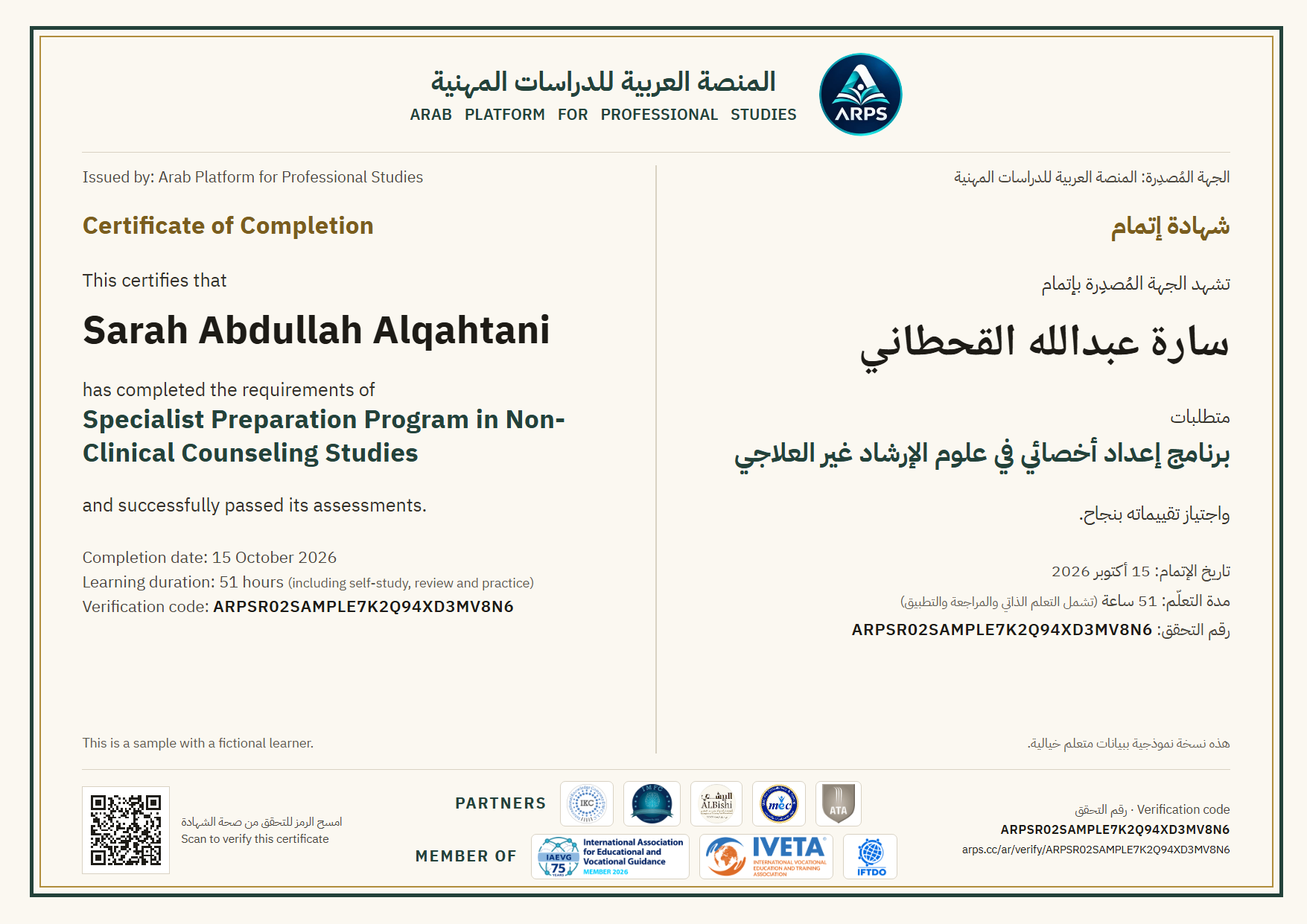
A sample from a real program in this track: Specialist Preparation Program in Non-Clinical Counseling Studies. The learner, scores and dates are fictional; opens in a new window.

Verification example: a real issued certificate

Program questions

Does this grant a practice license?

No. It assesses research and drafting under suitable supervision, not representation or a certified legal opinion.

Must I know one country's law?

No. You learn to scope and check sources; local rules remain dependent on their current primary text.

Are the cases real?

Cases, file documents, and city settings are fictional teaching scenarios, not local legal rules or statistics.

How is skill assessed?

Exercises produce tables, cards, and a memo; applied questions and a summative assessment follow each module.

May I use client data?

Use training data and keep real client information out of unauthorized spaces.

Show all (8)
When should I escalate?

For missing material authority, conflicting versions, or high-impact external steps, hand off evidence and a focused question to local qualified review.

Is Professional Specialization in Legal Research and Writing free, and do I get a certificate?

Yes. Professional Specialization in Legal Research and Writing is free on ARPS: every lesson, exercise and assessment is free, the first subject is open to read without an account, and the program is available in Arabic and English. Issuing a certificate is optional and has a published fee; it is a training completion certificate showing you passed the program's assessments, recognised by most private-sector organisations in the Gulf states and most Arab countries, and it strengthens your CV; confirming that a specific organisation accepts it remains your responsibility.

What other names is Professional Specialization in Legal Research and Writing known by?

The subject of this program is also known as: legal research, legal writing, legal drafting. Learners usually find it by searching for: legal research and writing course, legal writing course online, legal drafting course, how to write a legal memo, free legal writing course.

Professionals in this domain

Connect with certified consultants, trainers, coaches and specialists in the same domain across the ARPS communities.