Short Diploma in Digital Law and Privacy is a free program on ARPS, the Arab Platform for Professional Studies. An applied short diploma in digital law and privacy. Learn to identify a governing source and its scope, map data flows, and separate transaction, content, incident, and automated-decision questions before recording a bounded recommendation.
Important notice: Independent education for issue spotting and provisional decisions; not a university degree, practice licence, or substitute for jurisdiction-specific legal advice.
Build a matrix separating facts, binding sources, their scope, and local verification still needed before a conclusion.
From lesson 1, readable now without an account: How to locate the legal source and jurisdiction
When a digital-service team says that a practice is legal, do not accept or reject the statement at once. Ask what precise activity is taking place, who performs it, where the affected people are, and which legal system is under examination. Digital law is not a single worldwide statute. Privacy, electronic contracting, content rights, and sector rules can touch the same service flow, yet each source has its own scope and conditions. Write a fact that evidence could test: ‘The booking form collects an email address to confirm a session, and the support supplier can see it.’ This is more useful than ‘we respect privacy.’ Record what is missing: the location of people when the service is offered, the entity determining the purpose, and where the supplier operates. Missing facts prevent a firm scope conclusion; they do not authorize a guess.
A free account saves your progress and takes you straight to lesson 1.
Program facts
Study fee
Free
subjects
6
lessons
24
Estimated time
68 hours
Content last reviewed
Access period
60 days
Study language
Arabic and English
About the program
Six linked subjects move from source and jurisdiction to processing and individual rights, retention and suppliers, transactions and content incidents, and transfers and automated decisions, then close with a capstone dossier on purpose, evidence and access. Each lesson has a worked case and two observable exercises; each subject has a synthesis and assessment. Fictional cases show when evidence supports a provisional decision and when local legal review is required. This is foundational education and does not confer authority to practise law.
Practical relevance
Produce a scope matrix, actor and flow map, rights route, supplier-risk record, and integrated reviewable decision dossier.
Why this program
Digital-service teams must tell apart what a log establishes from what a policy asserts, and comparative guidance from applicable law. The diploma builds a repeatable method for asking, verifying, and escalating linked issues in one service.
Career relevance
For people involved in digital products, privacy operations, or supplier reviews who need to document the right questions before seeking qualified legal advice.
Career paths this program serves
This program is a step on the paths of the following occupations. Open a path to see its other programs in study order.
Distinguish binding sources from guidance and identify missing scope facts.
Map purposes, actors, and data and test necessity and transparency.
Handle rights, retention, and supplier risk with checkable evidence.
Separate transaction proof, content permission, and incident decisions.
Review transfers and automated refusals and build a provisional decision with restart conditions.
Prepare a capstone dossier that decides a new use of records, balances dispute preservation with erasure, delivers redacted evidence and closes access after verification.
Learning outcomes (24)
Build a matrix separating facts, binding sources, their scope, and local verification still needed before a conclusion.
Map a data flow and distinguish who determines purposes and essential means from who processes on instructions, while recording missing facts.
Convert an ambiguous digital-law question into a register of facts, assumptions, sources, provisional decisions, and escalation.
Reopen a bounded legal decision when a source, version or evidence changes while preserving each operation’s timeline.
Separate processing purposes, test whether fields are necessary, and document the legal-basis question for each purpose within a defined legal scope.
Draft a clear first and detailed notice layer, compare both with the real data flow, and catch unsupported promises.
Create a rights-request log with proportionate identity checks, scope, recipients, deadline, exceptions, and response.
Separate email purposes and test how choice and correction propagate between platform and supplier.
Select necessary fields and a retention period or criterion for each purpose, then test deletion across systems and suppliers.
Define a concrete harm event, estimate illustrative impact and likelihood, select a control, test residual risk, and decide escalation.
Compare a supplier's actual role with instructions and agreement, locating gaps in access, subcontracting, deletion, and escalation.
Distinguish source deletion from export, supplier and backup copies and bind a completion claim to a test.
Decompose an electronic transaction into offer, acceptance, identity, record integrity, timing, and the governing legal source.
Create a permission record for each digital asset covering rights holder, use, period, territory, modification, and attribution.
Build an incident chronology separating facts from possibilities, contain harm, and refer the scoped notification test to a qualified reviewer.
Contain data exposure while separating incident proof from content permission and transaction evidence.
Map exporter, recipient, access location, and purpose, then separate the law's scope test from the transfer mechanism and its conditions.
Classify an automated decision by effect and actual human role, then test inputs, challenge route, and escalation without assuming a universal ban.
Integrate legal scope, data flow, rights, supplier, content, and incident evidence into an actionable, reviewable provisional decision.
Identify release dependencies on data flow and human intervention and retest when a fact changes.
Deciding whether to reuse service records for a new purpose
Preserving a bounded dispute record while completing partial erasure
Delivering a redacted evidence copy with custody records
Closing reviewer access and verifying project commitments
Who it is for
This diploma suits digital product and service staff, content, support, procurement and entry-level compliance teams, and learners seeking a practical foundation for spotting and documenting digital-law and privacy issues before referral. It teaches bounded first decisions through comparative cases. It does not confer authority to practise law, deliver jurisdiction-specific legal opinions, or claim an external professional credential.
Prerequisites
Learners need to use a browser and read a registration screen, a short service agreement, and a small table. No prior legal qualification or programming experience is required. They should be willing to separate documented facts from assumptions, consult an official source, and calculate a percentage with a stated denominator. Exercises use invented organizations and records and require no upload of real personal data.
What it does not offer
Not a licence or litigation qualification.
Not a definitive legal opinion for every jurisdiction.
This subject starts by defining the question before judging it: what digital activity occurs, which facts are evidenced, which source might govern it, and within what scope? Learners distinguish binding text from comparative guidance and test territorial connections without equating page language or company address with application of a law. They map email and appointment data through the service and its supplier, distinguishing who determines each purpose from who follows instructions for each operation. The resulting issue register records evidence, contradictions, missing facts, an action, and a reviewer. Cases include a targeted campaign, a supplier proposing its own data use, and a marketing promise contradicted by system logs. The output is a scope matrix, party map, and decision record that refuses certainty where a fact or local source is missing. It also teaches rechecking a decision when a version or source effective date changes.
4 lessons · 8.5 hours
How to locate the legal source and jurisdiction2.5 hours
Identify data and parties in a service flow2.5 hours
An issue register with evidence and conclusion limits2.5 hours
Rechecking a changed source and fact1 hours
Subject 2
Lawful processing and individual rights
This subject moves from the data map to purposes and individual rights. Learners separate booking confirmation, optional reminders, and later marketing, testing the need for each field instead of collecting everything that might someday help. In a bounded GDPR example they examine several lawful bases and additional health-data conditions without portraying consent as a universal answer or applying EU law everywhere. They draft short and detailed notice layers that match product and supplier behavior and identify an unsupported claim about no sharing. They then manage an access, correction, or erasure request in a log, verify identity proportionately, search systems and suppliers, and state any exception and response limit. The practical outputs are a purpose matrix, truthful notice, and rights case whose execution can be tested rather than merely declared complete. It tests how offer choice and email correction propagate to the supplier.
4 lessons · 8.5 hours
Purpose, necessity, and the lawful-basis question2.5 hours
A privacy notice that matches the actual flow2.5 hours
Triage access, correction, and deletion requests2.5 hours
Operational choice and stopping offers1 hours
Subject 3
Privacy governance and design
This subject addresses design and governance decisions before processing goes live. Learners link each field to a purpose and retention-review event, then calculate the correct rate of closed accounts left in a shared export using the proper denominator. They describe a concrete harm to a person, separate severity and likelihood in a limited training scale, and select an access control tested with authorized and unauthorized accounts while recording a remaining gap. The score is never treated as a legal threshold for a formal impact assessment. Finally, they compare supplier sales claims with observed access, processing terms, subprocessors, and exit deletion. The applications yield a lifecycle table, risk register with test result, and supplier-gap table supporting a conditional release decision and referral where legal characterization is needed. A deletion trial covers exports, attachments and copies before completion is claimed.
4 lessons · 8.5 hours
Data minimization and the retention lifecycle2.5 hours
Assess privacy risk and select controls2.5 hours
Supplier governance and processing agreements2.5 hours
Testing deletion across copies and suppliers1 hours
Subject 4
Digital transactions, content and incidents
This subject separates three issues that a product can face together. For an electronic transaction, learners locate the terms shown, the actor, time, and version integrity, treating a model law as a framework for questions rather than law everywhere. For content rights, they read an image or drawing license by medium, modification, term, territory, and attribution, separating the creator's permission from a depicted person's interests. For a data incident, they close an exposed link and preserve logs, count people and records separately, and refer the notification test under the applicable law. Outputs are a transaction evidence matrix, asset permission record, and incident chronology showing what is known, unknown, and urgent. Technical strength of a log is not contract validity, and an image license does not cure exposure of learner data. It separates incident records, image permission and proof of displayed terms.
4 lessons · 8.5 hours
Electronic transactions and signature evidence2.5 hours
Digital content rights and license scope2.5 hours
Data incidents: containment, evidence, and notice decisions2.5 hours
Separating evidence in a multi-issue incident1 hours
Subject 5
Cross-border and integrated decisions
The diploma ends with an executable integrated decision instead of a general compliance slogan. Learners draw a separate arrow for each data recipient and access location, test legal scope before any transfer mechanism, and recognize that transport encryption does not settle recipient access or legal authority. They classify an automated decision by its real effect and the human's power, correct an erroneous completion date, and recalculate one eligibility condition without promising final admission. In the closing case, a campaign, image, unknown subprocessor, exposed link, and automatic refusal intersect. Learners contain immediate harm, pause unreviewed routes, identify what may continue, and set a restart condition for each part. Their dossier contains evidence, sources, dependencies, and professional referrals, while stating what facts do not prove and why completion gives no legal license. It tests when a release gate reopens after supplier access or refusal logic changes.
4 lessons · 8.5 hours
Examine cross-border data flows2.5 hours
Automated decisions and meaningful human review2.5 hours
An integrated decision dossier with referrals and limits2.5 hours
Reopening decision gates when a flow changes1 hours
Subject 6
Capstone: a purpose, evidence and access dossier
A capstone in which learners decide on reusing service records for a new purpose, separate dispute preservation from partial erasure, deliver a redacted evidence copy with custody records, then close reviewer access and verify commitments.
4 lessons · 11.5 hours
Deciding whether to reuse service records for a new purpose3 hours
Preserving a bounded dispute record while completing partial erasure3 hours
Delivering a redacted evidence copy with custody records3 hours
Closing reviewer access and verifying project commitments3 hours
Subjects unlock in sequence as you progress.
Strengths
Six subjects connected by one decision dossier.
Written exercises and separate solutions in every lesson.
Primary sources with access limits and review dates.
Equivalent Arabic and English skills and assessment intent.
Evidence basis
Defined claims are traced to publications from originating bodies, with inspected scope and version recorded; a citation does not imply endorsement of this program.
Reference organizations
European Union
OECD
NIST
UNCITRAL
EDPB
Methodology
Fictional applications tied to bounded claims and primary sources, with jurisdiction and version limits shown.
How the route works
Short Diplomas are relatively comprehensive learning pathways that cover a major subject through five connected learning subjects and structured assessments, with a diploma transcript available with the credential.
Self-paced sequential study. Content unlocks progressively and each subject combines reading, examples, exercises, knowledge checks, and assessment.
Build integrated knowledge in a major subject.
Study through five clear, connected learning subjects.
Complete a defined assessment for each subject.
Receive a diploma transcript showing subjects and results when the credential is issued.
Assessment
Each Short Diploma contains five subjects, each with an approved assessment. A sixth final exam is not required when the five assessments adequately cover the learning outcomes.
Assessment attempts: 2 per assessment, 7 days apart
The pass mark is announced before the program is published.
Certificate
Successful completion makes the learner eligible for the Short Diploma certificate and Diploma Transcript under the credential policy.
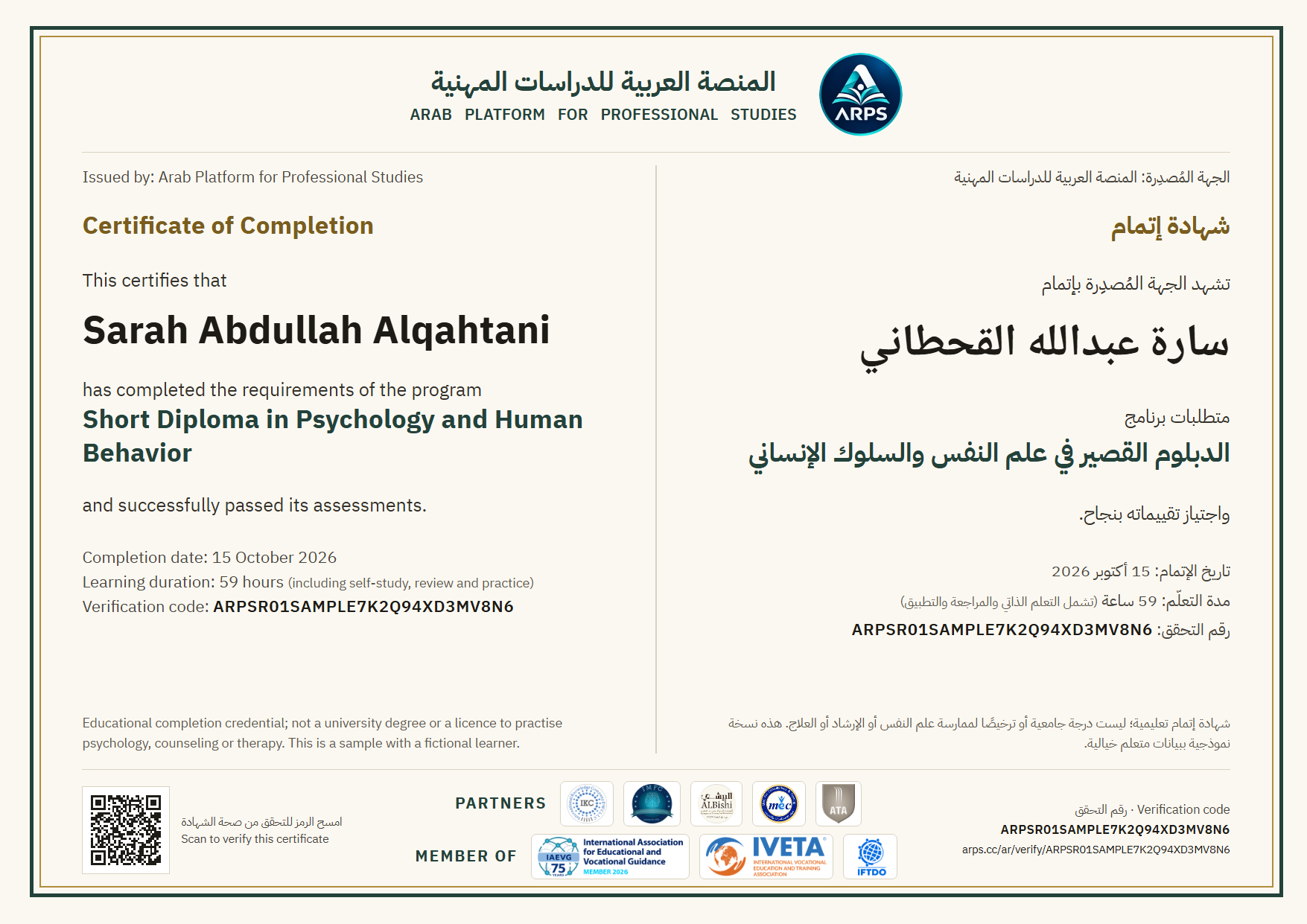
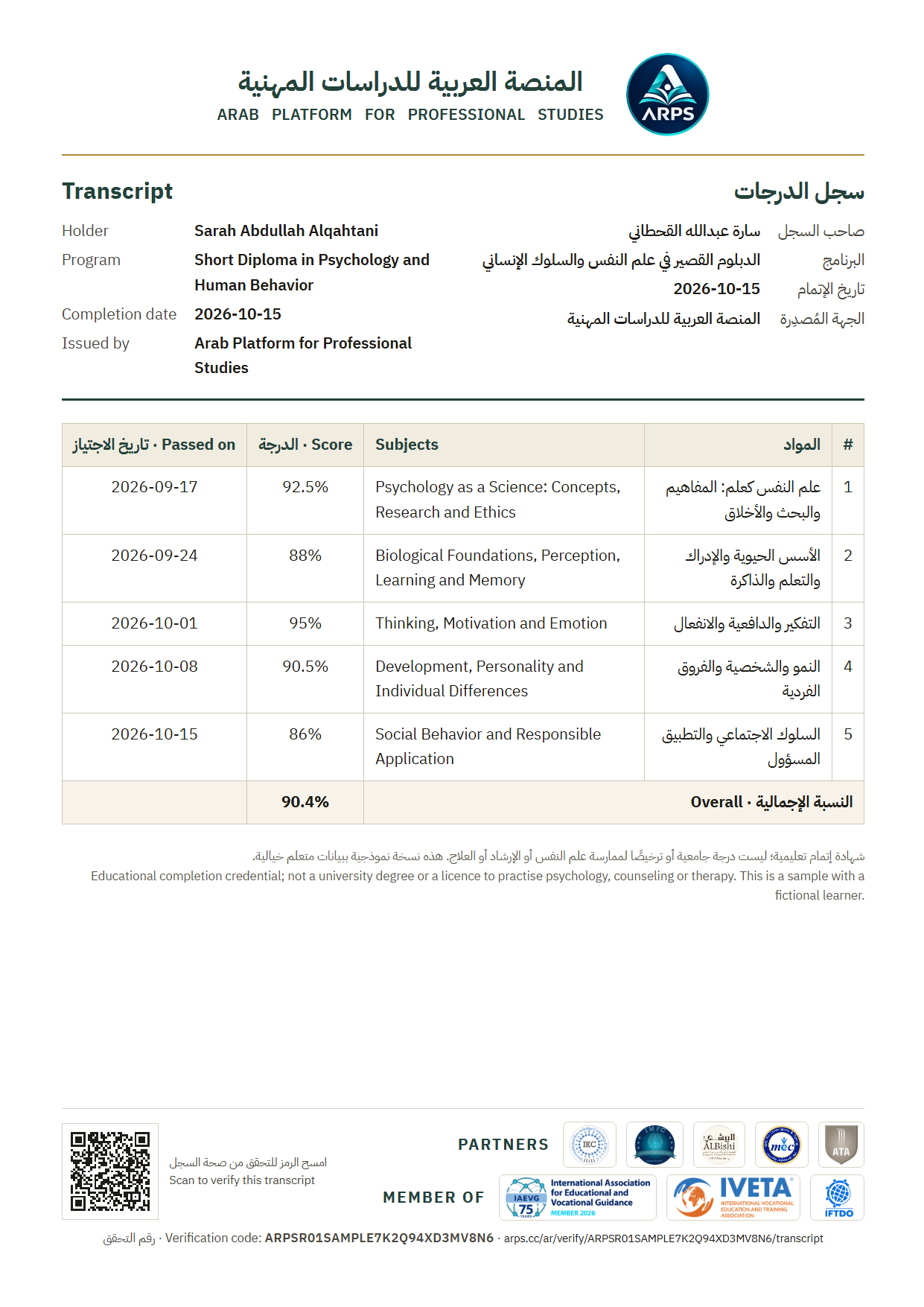
A sample from a real program in this track: Short Diploma in Psychology and Human Behavior. The learner, scores and dates are fictional; opens in a new window.
Disclaimer: Optional training completion credential, not a university degree or licence to practise law.
Program questions
Does this replace local legal advice?
No. It teaches issue spotting and provisional documentation, and identifies when to refer to counsel qualified in the applicable law.
Do I need prior legal training?
No legal qualification is assumed; basic use of a digital service and simple tables is enough.
How are different countries' laws handled?
Start with actor and flow facts and the source of each rule, then refer a defined gap to qualified counsel for the relevant jurisdiction.
Are there practical applications?
Every lesson has a worked case and two written exercises with feedback, leading to a final decision dossier.
How do I check a changing rule?
Use the claim's source, version, locator, and review date, then verify the current local text before a real decision.
Show all (7)
Is Short Diploma in Digital Law and Privacy free, and do I get a certificate?
Yes. Short Diploma in Digital Law and Privacy is free on ARPS: every lesson, exercise and assessment is free, the first subject is open to read without an account, and the program is available in Arabic and English. Issuing a certificate is optional and has a published fee; it is a training completion certificate showing you passed the program's assessments, recognised by most private-sector organisations in the Gulf states and most Arab countries, and it strengthens your CV; confirming that a specific organisation accepts it remains your responsibility.
What other names is Short Diploma in Digital Law and Privacy known by?
The subject of this program is also known as: digital law, data privacy law, data protection law, privacy law. Learners usually find it by searching for: data privacy law course, digital law course online, data protection and privacy course, GDPR and data privacy basics, free data privacy course.
A foundational diploma on how international-law instruments can affect cross-border business and how to verify their scope instead of assuming one universal business law.
An applied short diploma on classifying IP assets and checking rights and permissions before publication or launch, with seven subjects, including a capstone project, and worked cases.
Learn to turn an incomplete fact file into traceable legal research and a conditional short memorandum by checking source versions, scope, decision weight, and reasoning limits.
Analyze a regulatory problem before proposing a new rule. Work through the baseline, options, impact, participation, implementation and evaluation using fictional cases and explicit authority limits.
8 subjects
37 lessons
66 hours
Free
Next step: a professional certification or a mini-master
Programs in the same domain that prepare you for an international certification exam or form a professional mini-master, also free.