Short Diploma in Intellectual Property is a free program on ARPS, the Arab Platform for Professional Studies. An applied short diploma on classifying IP assets and checking rights and permissions before publication or launch, with seven subjects, including a capstone project, and worked cases.
Important notice: Independent training completion diploma; not a university degree, professional licence, or authority to provide legal advice.
Separate creator, rights holder and licensee, identifying the document supporting each transfer or permission.
Create a gap register distinguishing present permissions from uses awaiting an agreement or local check.
From lesson 1, readable now without an account: What are we protecting? Map assets to rights
Start with the asset, not the right's name
Imagine a team preparing a new coffee package. It has a roasting recipe, a machine that regulates heat in a new way, an illustration for the carton, and a name by which buyers should identify the product's source. Saying 'protect the idea' hides several different things. Different people may have created each one. First inventory the actual outputs and information, then describe what matters about each: particular words or images, a technical solution, the article's visible appearance, a sign identifying commercial source, or valuable confidential know-how. This description leads to the right question without pretending that ownership or protection is already established.
A free account saves your progress and takes you straight to lesson 1.
Program facts
Study fee
Free
subjects
7
lessons
26
Estimated time
72.5 hours
Content last reviewed
Access period
60 days
Study language
Arabic and English
About the program
The diploma moves from a rights map and chain of control through copyright, inventions and designs, signs and origin, then trade secrets, licensing and portfolio decisions, followed by rights in transactions, royalties and collaborative research, and a closing local-memory archive project. Learners produce evidence registers, gap logs and specialist referrals before an irreversible action. Cases and figures are fictional teaching devices; rules and outcomes depend on country and facts.
Practical relevance
Exercises produce adaptable asset and permission matrices, search logs, disclosure controls, licence term sheets and referral memos.
Why this program
Teams often assume that possessing a file, name or idea permits its use. This program organizes asset, right, market, permission and evidence questions into bounded preliminary decisions.
Career relevance
It helps product, content, purchasing and small-business teams ask useful questions and document risk. It does not prove legal-practice experience or promise employment.
Career paths this program serves
This program is a step on the paths of the following occupations. Open a path to see its other programs in study order.
Classify assets and document rights chains and markets.
Check creative rights, permissions and reuse.
Distinguish inventions, designs, protection routes and searches.
Assess marks, origin and name conflicts.
Test secrecy and design disclosure controls.
Show all (9)
Read licence terms for territory, time and volume.
Prepare an action, evidence and specialist referral memo.
Review asset transfers, royalty statements and research agreements by linking evidence to decisions.
Build rights files, participation permissions and access tests for a training archive ready for handover.
Learning outcomes (14)
Classify mixed assets, distinguishing idea, expression, function, appearance and sign while recording uncertainty.
Trace control and permission, separating possession of a file from ownership or authorized use.
Identify country, term and status, interpreting registration or its absence without global inference.
Screen protected expression, sources and third-party rights before creative reuse.
Build a permission matrix covering acts, media, territory, term, attribution and restrictions.
Describe invention, claims, search status and industrial design without asserting unverified eligibility.
Distinguish national and international protection routes and disclosure or filing decisions within their limits.
Assess sign function, similarity search, goods and market before adopting a name.
Distinguish an origin statement from a geographical indication and test a specific package claim.
Test a trade-secret candidate and design access, disclosure and evidence-preserving response controls.
Read licence scope, consideration and improvement rights and identify implementation gaps.
Integrate portfolio decisions with an evidence and referral log, separating observation from infringement findings.
Review asset transfer, royalties and research terms by linking evidence to decisions.
Build rights files, participation terms and access tests for a maintainable training archive.
Who it is for
Product, content, design and marketing teams that need to screen names, artwork, text and technical function before launch or print, and want documented rights and permission questions rather than decisions based on impressions alone.
Entrepreneurs and innovation or purchasing coordinators reviewing employee, supplier or freelance contributions who need a record of markets, versions, gaps and the person authorized to refer a question to a specialist.
Learners seeking a foundation across several IP subjects before specialization, without expecting a completion diploma to authorize legal practice or representation before an office or court.
Prerequisites
No prior legal study or professional practice is required. You should be ready to read an asset description and a permission document, compare what each actually proves, and calculate a simple percentage when a technical or licensing case needs it.
Allow time to record case assumptions, intended market and document versions before checking guided solutions. No paid patent-database account is required, and you should not upload real workplace files, personal data or confidential material to complete the exercises.
What it does not offer
Does not authorize legal advice, office representation, or litigation practice.
Does not establish protection for a specific asset in a specific country without current local review.
This subject builds a decision map for assets that can coexist in one product: written or visual expression, a technical solution, a source sign and confidential information. Learners describe each element and intended act, then seek creator and chain-of-control evidence rather than relying on possession or payment. Lessons contrast idea with expression, file custody with use permission, and a pending application with a granted right. Each asset row includes country, date, register status and search limits. The final launch memo separates actions supported now from those paused or referred for specialist review. Fictional cases support preliminary screening, not a certificate of protection in any specific market or a substitute for local legal review.
4 lessons · 8 hours
What are we protecting? Map assets to rights2 hours
Who created the asset, and who may use it?2 hours
Where and when can a right be asserted?2 hours
Make a multi-asset launch decision without overclaiming2 hours
Subject 2
Copyright and creative works
This subject studies copyright through a creative package containing text, photographs, software and third-party contributions. Learners separate an underlying idea from its expression and build a table of creator, version, permission, act, medium, market and term. The lessons compare named licences such as CC BY, CC BY-ND and MIT without applying one licence's terms to all works. A teaching case distinguishes an educational use that may require local exception review from a permission evidenced by the right holder. At release, learners inspect what the audience actually receives, including a PDF or email, and prepare an attribution and correction log recording what was already sent and what can now be changed.
4 lessons · 8 hours
The idea, its expression and its creator2 hours
The permission matrix: image, text and code2 hours
Reuse and exceptions: test the act, not the intention2 hours
Release a creative work and correct a rights error2 hours
Subject 3
Inventions and designs
This subject starts with a technical problem and a proposed solution that can be described and tested. Learners calculate defect rates and their difference, then identify a concurrent change that prevents attributing improvement solely to the mechanism. They build a prior-document search log with terms, synonyms, filters and dates, distinguishing known-technology inquiry from live third-party rights in a sales market. Next they separate product appearance from technical function in a design file, recording versions, views and earlier disclosures. Finally they map countries, deadlines and a possible filing route. The PCT is an international application route, not a worldwide patent grant. The output is a documented specialist referral rather than an unsupported entitlement finding.
4 lessons · 8 hours
From technical problem to testable disclosure2 hours
Search prior art and record its limits2 hours
Visible appearance or technical function?2 hours
Sequence disclosure, filing discussion and markets2 hours
Subject 4
Marks and geographical indications
This subject tests a name or drawing as a source sign for specified goods and buyers, distinguishing direct description from a candidate distinctive mark without assuming registration. Learners search spelling and sound variants and record database, goods, market and date; zero results are not clearance. They then separate a manufacturing-place statement from a geographical indication with a specific product-place link, testing what mixed-batch records really support. The Madrid System provides a central procedure while designated offices determine protection outcomes. A final package decision joins name, artwork permission, origin claim and print volume. It separates excess units in one country from an additional territory requiring its own permission.
4 lessons · 8 hours
Source mark or product description?2 hours
Search a mark and interpret a zero-result query2 hours
A place name: origin statement or geographical indication?2 hours
Decide the name and package before a costly commitment2 hours
Subject 5
Trade secrets and IP transactions
This subject tests possible trade secrets for restricted availability, commercial value from secrecy and reasonable protective measures. Learners design limited access, a disclosure log, departure controls and an incident response that preserves evidence without premature blame or privacy overreach. They then read a licence proposal by asset, act, medium, territory, term, volume, consideration and improvements. A password is separated from permission, and a licence from ownership transfer. The final memo joins these decisions with mark, artwork and technical assets through evidence rows, gaps and task owners. When similar use appears, learners preserve observation and check permissions and live rights before referring any external action to a local specialist.
4 lessons · 7.5 hours
Can this information qualify as a trade secret?2 hours
Control disclosure, departure, and leak response2 hours
Read a license proposal term by term1.5 hours
Portfolio decision and dispute evidence2 hours
Subject 6
IP in transactions and collaborative research
This subject reviews rights in a business acquisition, in royalty calculations and in collaborative research, linking each operation to its evidence and to the party able to grant permission.
3 lessons · 9.5 hours
IP diligence before a business acquisition3 hours
Audit a royalty statement with traceable calculations3 hours
Agree research rights before collaboration starts3 hours
Subject 7
Capstone: a responsible local-memory archive
A capstone that builds a local-memory archive prototype with fictional materials: a rights file for each collection, participation permission that respects people, and an access test with a maintenance handover plan.
3 lessons · 14 hours
Archive project: build a rights file for each collection4.5 hours
Archive project: design participation permission and safeguards4.5 hours
Archive project: test access and hand over maintenance5 hours
Subjects unlock in sequence as you progress.
Strengths
Seven subjects connect assets with evidence, permission and markets.
Worked cases and two independently corrected exercises per lesson.
Bilingual questions apply concepts to new cases.
Explicit legal limits and referral when facts remain uncertain.
Evidence basis
Concepts draw on official WIPO pages, Creative Commons and OSI licence texts, and EPO search guidance. Reading a page does not equal reviewing national law or a specific filing; no organization endorses this diploma.
Reference organizations
World Intellectual Property Organization
Creative Commons
Open Source Initiative
European Patent Office
Methodology
Case-based teaching with exercises, solutions and source-linked questions, with self-review rather than external accreditation.
How the route works
Short Diplomas are relatively comprehensive learning pathways that cover a major subject through five connected learning subjects and structured assessments, with a diploma transcript available with the credential.
Self-paced sequential study. Content unlocks progressively and each subject combines reading, examples, exercises, knowledge checks, and assessment.
Build integrated knowledge in a major subject.
Study through five clear, connected learning subjects.
Complete a defined assessment for each subject.
Receive a diploma transcript showing subjects and results when the credential is issued.
Assessment
Each Short Diploma contains five subjects, each with an approved assessment. A sixth final exam is not required when the five assessments adequately cover the learning outcomes.
Assessment attempts: 2 per assessment, 7 days apart
The pass mark is announced before the program is published.
Certificate
Successful completion makes the learner eligible for the Short Diploma certificate and Diploma Transcript under the credential policy.
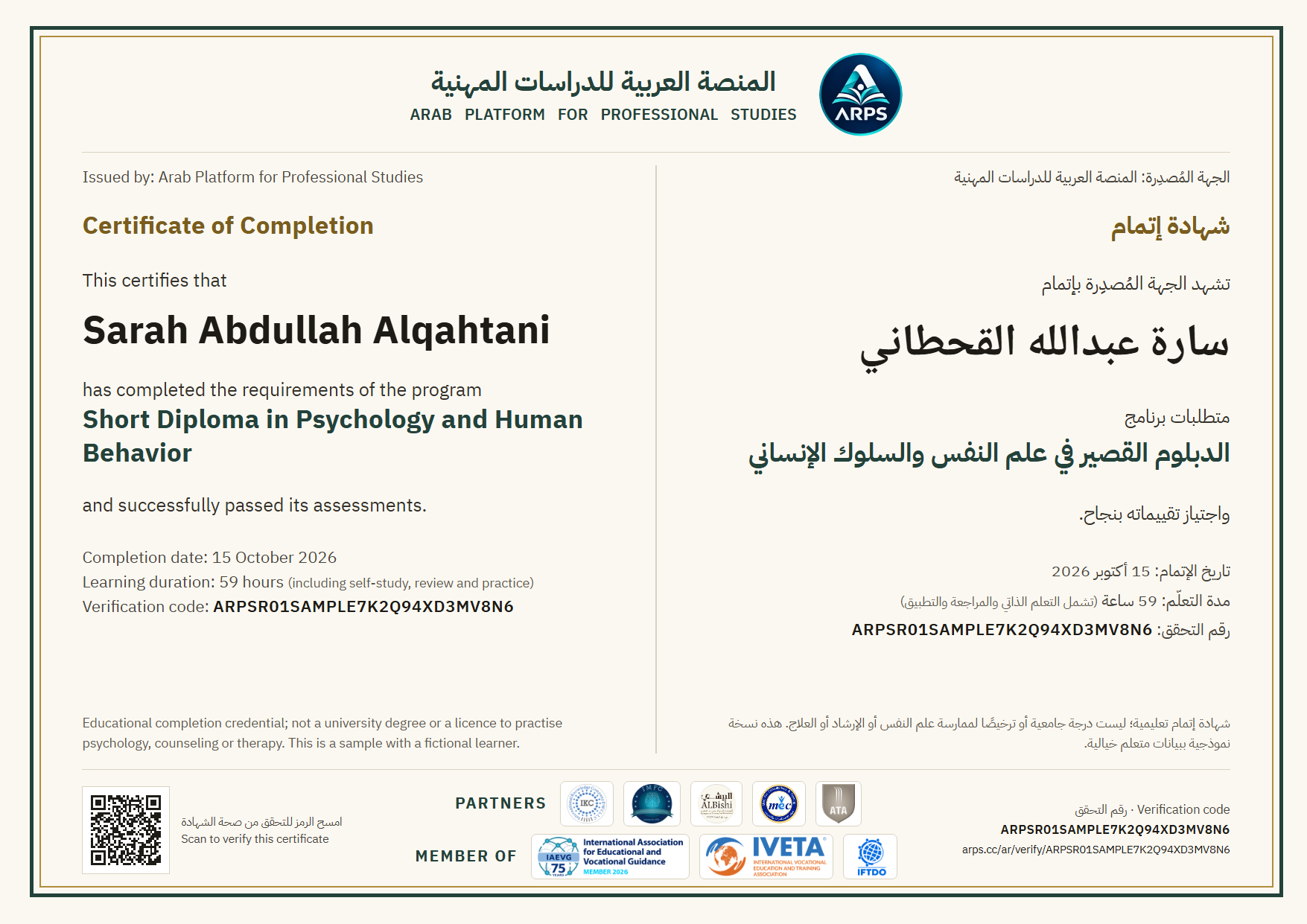
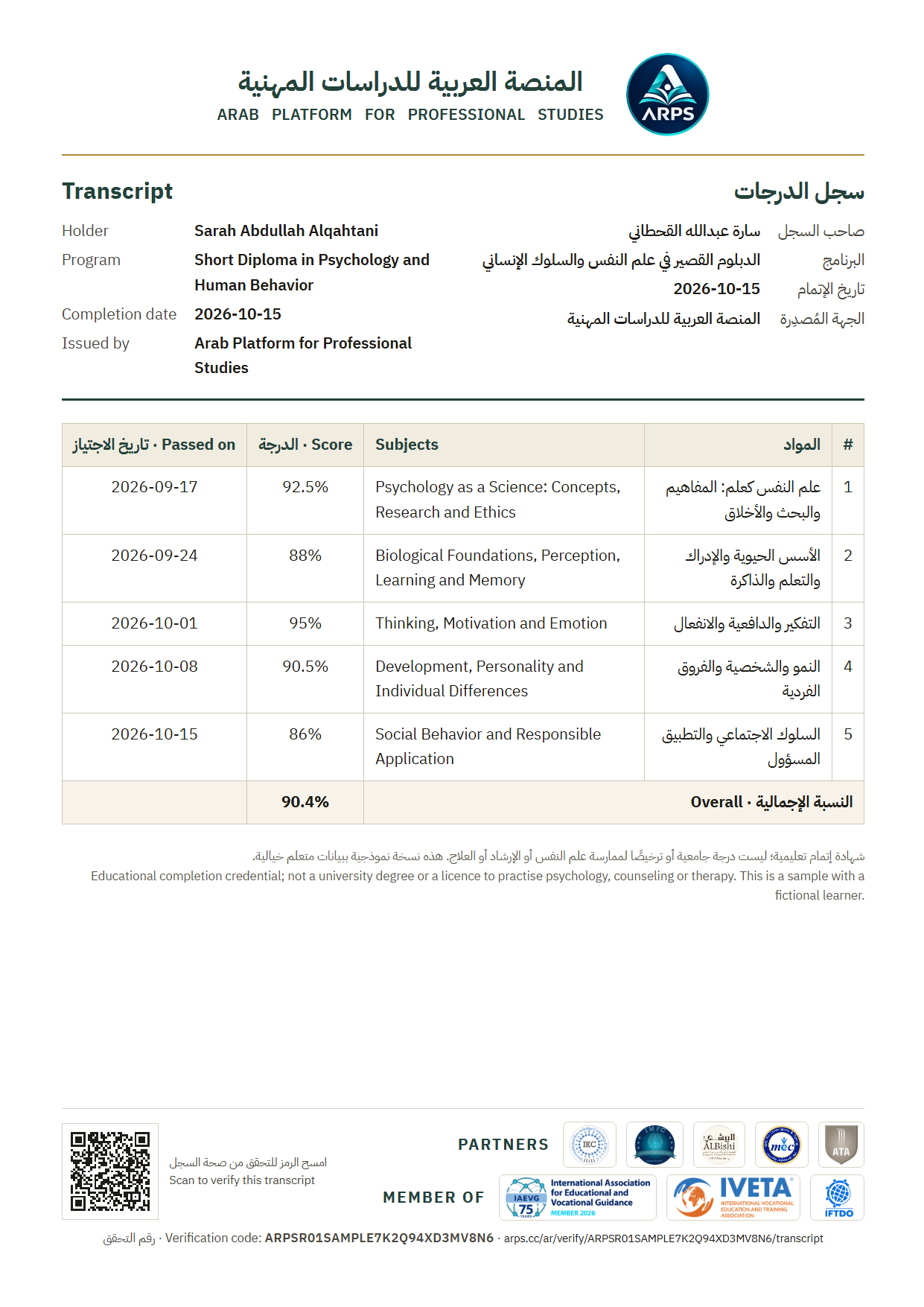
A sample from a real program in this track: Short Diploma in Psychology and Human Behavior. The learner, scores and dates are fictional; opens in a new window.
Disclaimer: Training completion, not a university degree, professional licence, or legal-advice authorization.
Program questions
Can this diploma alone qualify me to file a mark?
It teaches screening questions, evidence and search routes; a real filing needs current office rules and specialist review when appropriate.
Does an empty global database search clear a name?
No. Record query limits and check variants, goods, markets and relevant official registers.
Is there practice?
Yes. Each lesson has a worked case, two exercises and separate solutions, and each subject has an assessment.
Does completion grant a professional licence?
No. It records training completion and does not authorize legal practice or official representation.
Is a patent automatically international?
No. Check each market's right and status; international filing routes are not a worldwide grant.
Show all (8)
Does buying an image permit modification and publication?
Purchase alone does not define permissions; read the image source, agreement, medium, territory and term.
Is Short Diploma in Intellectual Property free, and do I get a certificate?
Yes. Short Diploma in Intellectual Property is free on ARPS: every lesson, exercise and assessment is free, the first subject is open to read without an account, and the program is available in Arabic and English. Issuing a certificate is optional and has a published fee; it is a training completion certificate showing you passed the program's assessments, recognised by most private-sector organisations in the Gulf states and most Arab countries, and it strengthens your CV; confirming that a specific organisation accepts it remains your responsibility.
What other names is Short Diploma in Intellectual Property known by?
The subject of this program is also known as: intellectual property, IP law, IPR. Learners usually find it by searching for: short course intellectual property, diploma courses in ipr law, intellectual property management course, free intellectual property course.
An applied short diploma in digital law and privacy. Learn to identify a governing source and its scope, map data flows, and separate transaction, content, incident, and automated-decision questions before recording a bounded recommendation.
A foundational diploma on how international-law instruments can affect cross-border business and how to verify their scope instead of assuming one universal business law.
Learn to turn an incomplete fact file into traceable legal research and a conditional short memorandum by checking source versions, scope, decision weight, and reasoning limits.
Analyze a regulatory problem before proposing a new rule. Work through the baseline, options, impact, participation, implementation and evaluation using fictional cases and explicit authority limits.
8 subjects
37 lessons
66 hours
Free
Next step: a professional certification or a mini-master
Programs in the same domain that prepare you for an international certification exam or form a professional mini-master, also free.