Short Diploma in Child Development and Childhood is a free program on ARPS, the Arab Platform for Professional Studies. An applied foundation in child development across movement, thinking, language and relationships, with responsible observation and reviewable participation plans. Seven connected subjects cover development and context, movement and everyday needs, attention and play, relationships and emotions, responsible application, more precise teaching.
Important notice: Independent education; not a university degree, professional licence or clinical diagnosis. Citing a source does not imply endorsement.
Distinguish an observed action from an inference about a child's ability or character.
Organize observations across developmental domains without reducing them to a single rank.
Choose the next piece of information needed to explain performance across settings.
From lesson 1, readable now without an account: Development is not one line
What do we mean by development?
Picture two four-year-olds in a building area. One tells a detailed story about an imaginary city but needs time to position small pieces. The other stacks the pieces precisely and moves confidently around obstacles, then gives short answers to an unfamiliar adult. Which child is 'ahead'? There is no single answer: we have seen actions in particular situations, not measured a total ability. Development describes patterned change over time in how a child moves, thinks, communicates and relates to others. These paths interact, but they need not appear at the same pace or in the same way in every child and setting. Begin with the narrower questions: What did the child do, with which materials, alongside whom and under what conditions?
A free account saves your progress and takes you straight to lesson 1.
Program facts
Study fee
Free
subjects
7
lessons
27
Estimated time
72.5 hours
Content last reviewed
Access period
60 days
Study language
Arabic and English
About the program
Seven connected subjects cover development and context, movement and everyday needs, attention and play, relationships and emotions, responsible application, more precise teaching and observation tools, and a capstone experience kit ready to run. Learners describe observations before interpreting them, analyze activity barriers, and design safe opportunities in which a child can choose how to participate. Fictional cases, worked exercises and an assessment for each subject support practice. The program does not turn a checklist or classroom observation into diagnosis or confer professional authorization.
Practical relevance
The observation and bounded-plan method can be adapted to story, building or play activities after checking safety and local context.
Why this program
It connects developmental domains to reviewable everyday decisions rather than reducing a child to one score or trait.
Career relevance
Useful to people learning or working around children for observation, communication and adaptation; it promises no job or licence.
Career paths this program serves
This program is a step on the paths of the following occupations. Open a path to see its other programs in study order.
Interpret development across domains and contexts and distinguish observation from diagnosis.
Analyze movement, daily needs, safety and access in a child's activity.
Interpret attention, communication, play and multilingualism through opportunity and response.
Respond to child cues, emotions, peer conflict and change with support and safe boundaries.
Design an inclusive experience and reviewable support plan while communicating within role limits.
Show all (7)
Select an observation or teaching tool and examine cue effects and transfer to new materials.
Build a group experience kit, rehearse it, review outcomes and hand over a bounded evidence-based decision.
Learning outcomes (7)
Interpret development across domains and contexts and distinguish observation from diagnosis.
Analyze movement, daily needs, safety and access in a child's activity.
Interpret attention, communication, play and multilingualism through opportunity and response.
Respond to child cues, emotions, peer conflict and change with support and safe boundaries.
Design an inclusive experience and reviewable support plan while communicating within role limits.
Select an observation or teaching tool and examine cue effects and transfer within described opportunities.
Build a group experience kit, rehearse implementation, review outcomes, and hand over a bounded evidence-based decision.
Who it is for
This suits beginners and people working in early childhood education, child care, community activities or family support who want to understand development and apply it in observation and participation design. It also helps learners preparing to collaborate with educators or qualified services while respecting their roles. It is unsuitable for anyone seeking authority to diagnose, provide therapy or gain a professional licence, and cannot replace specialist preparation for those roles.
Prerequisites
No prior specialization in child development or advanced professional experience is required. Learners should be ready to read a short child case, distinguish an observed action from an inference, and write brief notes about setting, materials and response. They will compare a family account with an activity observation and check worked exercise answers before moving on. The program requires neither diagnostic tools nor direct access to a particular child.
What it does not offer
Not training for diagnosis, therapy or a professional licence.
This subject begins with a practical question: what did we see a child do, and what interpretation did we add? Learners examine movement, thinking, communication and relationships as interacting perspectives rather than a single overall score. They compare performance at home and in group activity to test how setting, language, peers and choice affect participation. They practise writing a dated event that separates action from judgment and using milestone lists to open a conversation rather than diagnose. Finally, they redesign an activity where a table or response method blocks a child's involvement, keeping the play goal, child voice and safety. The result is a bounded description and a reviewable question or environmental adjustment, with qualified referral when concern persists.
4 lessons · 7 hours
Development is not one line1.5 hours
The child within contexts1.5 hours
Observation, milestones and follow-up1.5 hours
Children's rights and safe interpretation2 hours
Subject 2
Body, movement and everyday care
Learners break a movement task into posture, reach, material size and finger control instead of attributing difficulty to the child's general ability. They examine how sleep, meals and activity may accompany participation on a particular day without turning one observation into proven cause or diagnosis. In active play, they distinguish needless hazard from useful challenge: remove a sharp edge while keeping a safe opportunity to explore. They then test an adapted drawing tool or rearranged space with a concrete question: could the child reach, choose and act independently? The four lessons connect conditions, adaptation and response in a short record and show when to ask family or bring recurring concern to a qualified service.
4 lessons · 6.5 hours
From gross movement to fine control1.5 hours
Sleep, nutrition and activity in the whole picture1.5 hours
Safety and exploration1.5 hours
Different routes to motor participation2 hours
Subject 3
Thinking, language and learning through play
This subject shows that difficulty in a rules game may involve remembering the rule, stopping an old response or shifting to a new one. Learners therefore record the error type and the effect of one cue instead of labeling the child distracted. In conversation, they treat a gesture as a communicative contribution, check its meaning and then extend the child's idea. In pretend play, they help a child notice why a structure collapsed and test another support rather than build the whole answer for the child. They compare concept knowledge in a home language with the activity language label so a new word is not mistaken for absent understanding. The outcome is an adjustable response joining observation, waiting, cueing and the child's own trial without hurried diagnosis.
4 lessons · 6.5 hours
Attention, memory and flexibility1.5 hours
From gesture to conversation1.5 hours
Pretend play and problem solving1.5 hours
Multiple languages and expressive contexts1.5 hours
Subject 4
Relationships, emotions and self-regulation
This subject focuses on relationships when a child's signal admits more than one interpretation. Learners describe the signal, ask about a possible meaning and revise the adult response after seeing the child's choice; pulling away from imposed hand guidance does not prove rejection of play. During distress, they set a limit on unsafe throwing while naming the feeling and offering a workable transition, then watch for renewed participation rather than silence alone. In a dispute over a shared object, they stop unsafe pulling and hear the turn sequence and each child's wish before trying a fair solution. Finally, they document change after a family event without asserting its cause, propose supportive relationship and routine, and respect family privacy and qualified referral boundaries.
4 lessons · 6.5 hours
Adult response to a child's signal1.5 hours
Naming feelings and co-regulation1.5 hours
Friendship, conflict and fairness1.5 hours
Change, stress and protective factors2 hours
Subject 5
Integration and responsible application
The final subject combines earlier skills in one responsible decision. Learners set a visible participation goal for story or building play and design several safe routes so a child may speak, point or act without losing that goal. When home and classroom accounts differ, they classify source, context, task and response, then choose a decision-changing question instead of a misleading average. Next they practise a family conversation beginning with a child strength and specific event, listening without confirming a diagnosis or dismissing concern. The final plan names a deliverable opportunity, a follow-up indicator and review time. Learners check what was actually offered before explaining the result while protecting child voice, privacy and access to qualified evaluation when needed.
4 lessons · 6.5 hours
Designing a developmentally fitting experience1.5 hours
Reading conflicting evidence about one child1.5 hours
A respectful conversation with family1.5 hours
Support plan and ethical review2 hours
Subject 6
More precise teaching and observation
This subject adds sharper tools for observation timing, picture reading through prediction and evidence, fading assistance and transferring an idea to new materials, keeping conclusions tied to their conditions.
4 lessons · 11.5 hours
Following play without selective recording3 hours
Reading pictures through prediction and evidence3 hours
Fading assistance while keeping the challenge3 hours
Transferring an idea to new materials3 hours
Subject 7
Capstone: an experience kit ready to run
A capstone in which learners select a priority from a fictional group dossier, rehearse an experience-kit plan under operating constraints, then review results and hand over a bounded, evidence-based decision.
3 lessons · 12.5 hours
Selecting a priority from a group dossier4 hours
Rehearsing the plan under operating constraints4 hours
Reviewing results and handing over the decision4 hours
Subjects unlock in sequence as you progress.
Strengths
Seven subjects connect observation, activity design and family communication.
Worked fictional cases, exercises and a separate assessment for each subject.
Clear boundaries between everyday support and professional assessment.
Evidence basis
Concepts draw on WHO, UNICEF, CDC and other primary professional pages in original educational wording; cited bodies do not endorse this program.
Reference organizations
World Health Organization
UNICEF
Centers for Disease Control and Prevention
American Speech-Language-Hearing Association
Methodology
Lessons and questions were authored around original decisions and cases and reviewed within their bilingual parts. No learner psychometric validation is claimed.
How the route works
Short Diplomas are relatively comprehensive learning pathways that cover a major subject through five connected learning subjects and structured assessments, with a diploma transcript available with the credential.
Self-paced sequential study. Content unlocks progressively and each subject combines reading, examples, exercises, knowledge checks, and assessment.
Build integrated knowledge in a major subject.
Study through five clear, connected learning subjects.
Complete a defined assessment for each subject.
Receive a diploma transcript showing subjects and results when the credential is issued.
Assessment
Each Short Diploma contains five subjects, each with an approved assessment. A sixth final exam is not required when the five assessments adequately cover the learning outcomes.
Assessment attempts: 2 per assessment, 7 days apart
The pass mark is announced before the program is published.
Certificate
Successful completion makes the learner eligible for the Short Diploma certificate and Diploma Transcript under the credential policy.
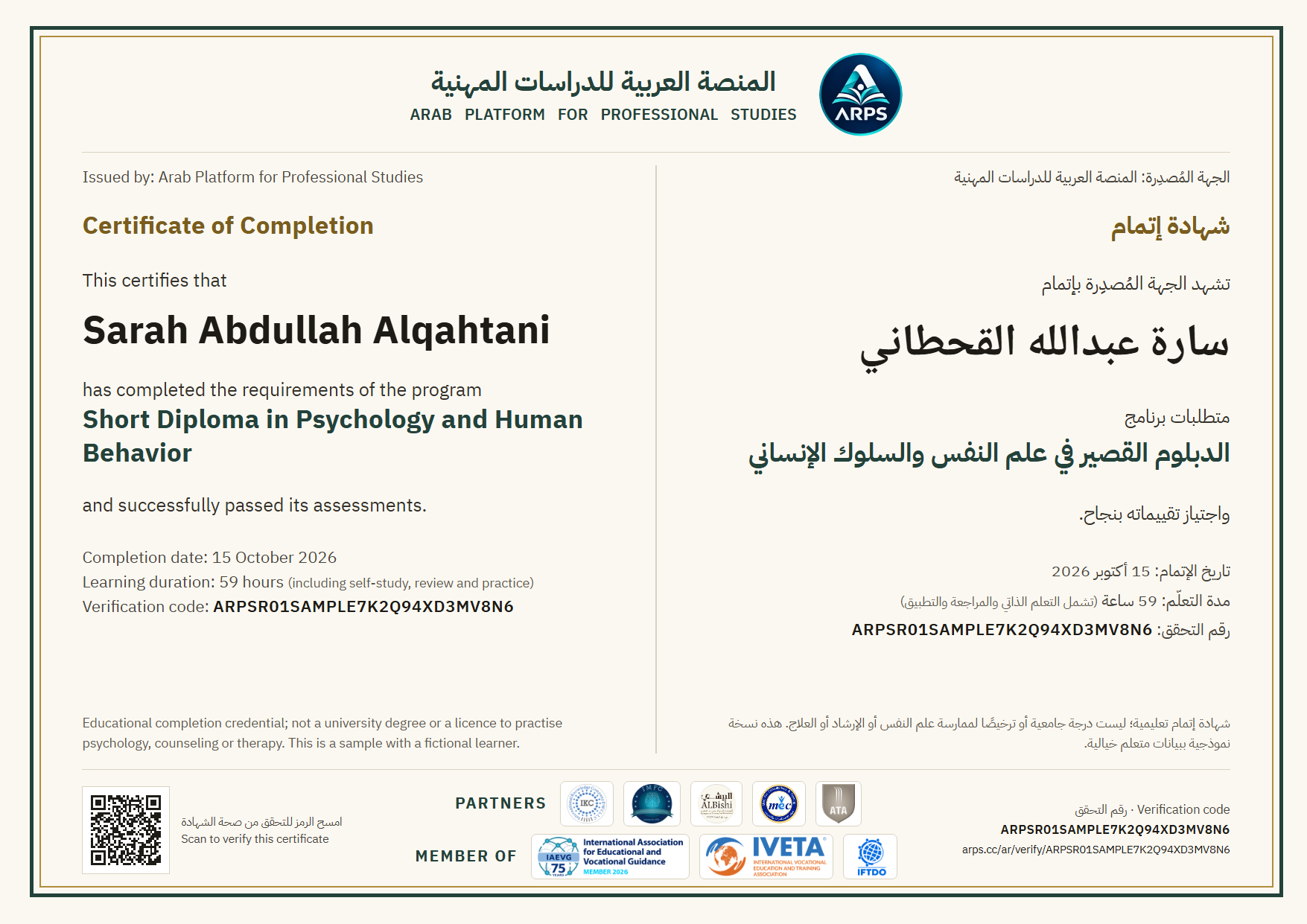
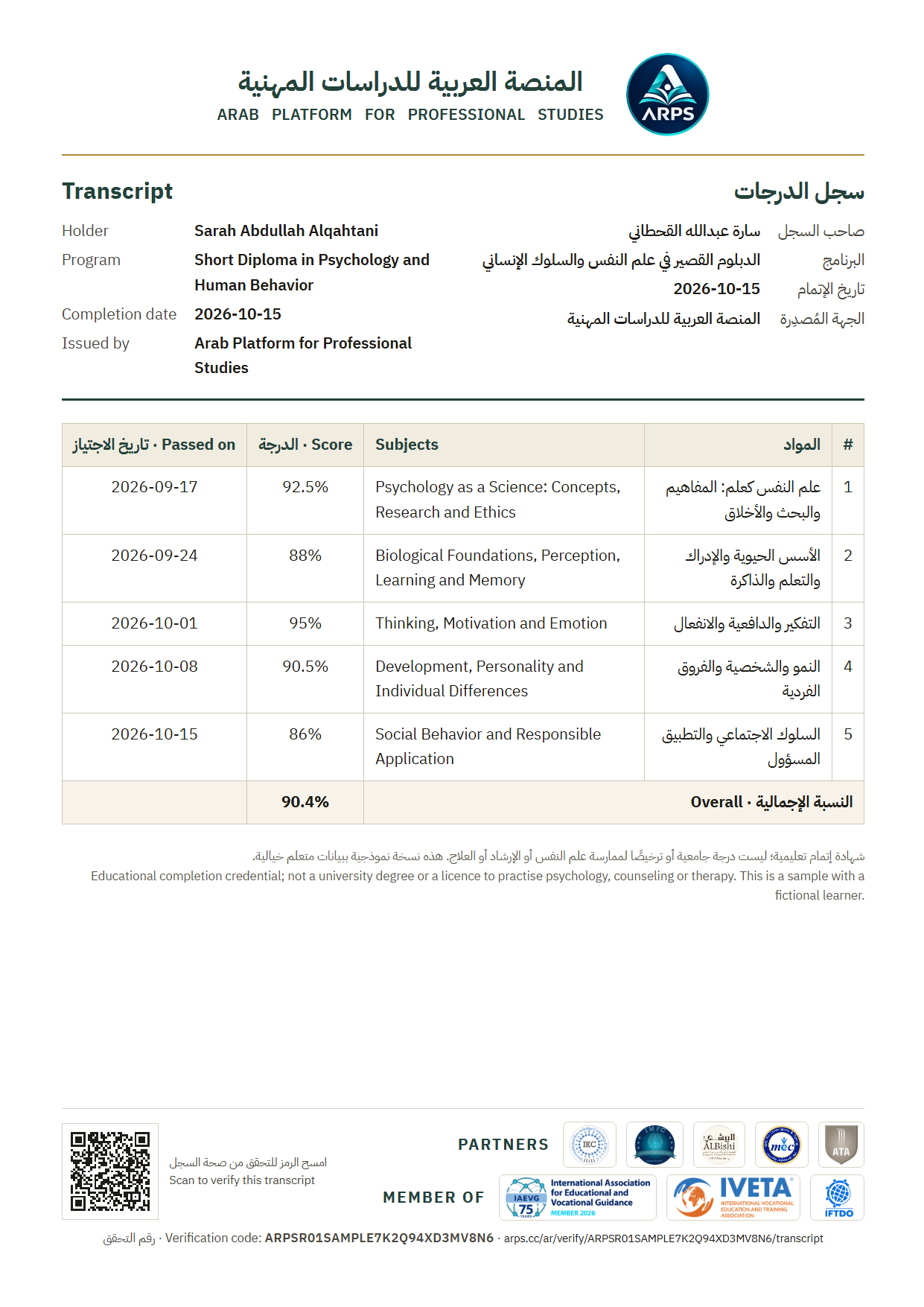
A sample from a real program in this track: Short Diploma in Psychology and Human Behavior. The learner, scores and dates are fictional; opens in a new window.
Disclaimer: Training completion, not a university degree or professional licence.
Program questions
Does this program diagnose developmental difficulties?
No. It teaches observation, everyday support and when to seek qualified evaluation.
Is prior experience required?
No advanced experience is required; concepts begin with explained cases.
How is learning assessed?
A short check in each lesson and a separate summative assessment for each subject.
Are official learning hours awarded?
Official route learning hours are not set; reading and practice times are editorial estimates only.
Must a child speak in every activity?
No. The program preserves participation goals while allowing gesture, pictures and safe action.
Show all (7)
Is Short Diploma in Child Development and Childhood free, and do I get a certificate?
Yes. Short Diploma in Child Development and Childhood is free on ARPS: every lesson, exercise and assessment is free, the first subject is open to read without an account, and the program is available in Arabic and English. Issuing a certificate is optional and has a published fee; it is a training completion certificate showing you passed the program's assessments, recognised by most private-sector organisations in the Gulf states and most Arab countries, and it strengthens your CV; confirming that a specific organisation accepts it remains your responsibility.
What other names is Short Diploma in Child Development and Childhood known by?
The subject of this program is also known as: child development, early childhood development, child growth and development. Learners usually find it by searching for: child development course, early childhood development course online, stages of child development, child observation skills, free child development course.
A foundational diploma for understanding family relationships in a structured way, improving communication, clarifying boundaries and roles, managing conflict and decisions, and recognizing when ordinary guidance should stop because safety and specialist referral take priority.
A six-subject foundation in general parenting and parental guidance: understanding development and behavior, communicating respectfully, building routines and boundaries, using nonviolent discipline, collaborating with schools, and supporting caregiver wellbeing, ending with an applied capstone.
A foundational, applied diploma connecting psychological wellbeing with self-awareness, stress management, sleep, movement, relationships, communication, problem-solving, decision-making and sustainable habits. It is non-therapeutic and does not use self-ratings to diagnose disorders.
A short diploma in analyzing bounded interpersonal disputes, screening mediation suitability, facilitating voluntary dialogue, and drafting agreements that can be carried out and reviewed.
6 subjects
25 lessons
61.5 hours
Free
Next step: a professional certification or a mini-master
Programs in the same domain that prepare you for an international certification exam or form a professional mini-master, also free.