Short Diploma in Adult and Workplace Learning is a free program on ARPS, the Arab Platform for Professional Studies. This short diploma examines how adults learn in organizations and at work: diagnosing a need, designing a suitable experience, supporting participation, and evaluating learning with appropriate limits.
Important notice: An educational completion diploma; it grants no professional licence or accredited learning hours.
Convert a documented participation barrier into a specific adjustment while keeping the learning criterion stable.
From lesson 1, readable now without an account: Where does adult learning happen?
Adult learning is broader than taking a course after initial schooling. UNESCO's Recommendation on Adult Learning and Education includes formal, non-formal and informal processes through which adults develop capabilities for living, working and participating. This is an international conceptual frame, not a claim that every country recognizes each route in the same way. We need two separate questions: how was the opportunity organized, and where did it occur? Organized learning can take place at work; incidental but useful learning can occur in a community center. Location alone does not determine the type, and a certificate of attendance does not establish that a skill was learned.
A free account saves your progress and takes you straight to lesson 1.
Program facts
Study fee
Free
subjects
6
lessons
24
Estimated time
80 hours
Content last reviewed
Access period
60 days
Study language
Arabic and English
About the program
The program begins with a practical question: when is a performance gap a learning need, and when is the remedy a change to workflow, resources, or support? Learners distinguish formal, non-formal, and informal adult learning and consider unequal access without projecting global data onto a particular person or place. They then define a need in terms of performance, audience, and constraints and write an observable learning outcome instead of accepting a generic request for a course.
The second subject designs an adult learning pathway that connects the outcome, activity, feedback, and evidence while considering access, time, and privacy. The third explores facilitation at work through dialogue and safe practice, separating what a facilitator can change from decisions that belong to the organization. The fourth plans evaluation: what participation, learning, and transfer indicators can each support, and what they cannot establish alone. The fifth closes with a limited improvement plan that respects evidence, implementation constraints, and stakeholder roles.
Place-based cases in the lessons are explicitly hypothetical. The program offers no local legal advice or employment guarantee. Minutes estimate an internal first learning path; official standard learning hours remain unset in the central route policy.
Practical relevance
Learners draft a performance-gap brief, an outcome–activity–evidence matrix, a facilitation and feedback plan, and an evaluation and improvement map. Each output uses a hypothetical case and must be adapted after checking the real work setting.
Why this program
The program links lifelong learning as an opportunity to the decisions organizations make every day. It leads from a needs question to evidence of improvement, testing each step through practice and applied questions so that a course is not assumed to solve every performance problem.
Career relevance
People in training, human resources, supervision, and organizational development can use the tools to frame a need, plan learning, and choose initial follow-up indicators. These are general educational skills; the program does not grant a professional authorization or meet a licensed occupation requirement.
Career paths this program serves
This program is a step on the paths of the following occupations. Open a path to see its other programs in study order.
Distinguish adult learning pathways and access barriers.
Diagnose a performance gap before prescribing training.
Write an observable learning outcome.
Choose adult-appropriate activities and feedback.
Facilitate safe workplace practice.
Show all (9)
Separate attendance, learning, and skill transfer.
Frame an evaluation question and feasible evidence method.
Propose a bounded improvement from evidence and constraints.
Plan, facilitate, audit and hand over a small learning pilot.
Learning outcomes (20)
Classify an adult learning opportunity by its organization and setting, justify the classification, and identify what the label cannot prove.
Convert a documented participation barrier into a specific adjustment while keeping the learning criterion stable.
Separate evidence of experience from assumptions about motivation or confidence and choose a low-risk entry activity.
Write an outcome with a performance, condition and criterion, then connect it to practice and evidence.
Describe a checkable performance gap and distinguish a knowledge cause from a resource or process cause.
Plan bounded evidence collection and compare people's reports with work samples and task conditions.
Compare evidenced needs using consequence, reach and intervention feasibility, then test decision sensitivity.
Write a design brief defining audience, performance outcome, baseline, success measure and claim limits.
Sequence an explained demonstration, guided rehearsal and independent attempt around one work decision.
Build an example that exposes reasoning and write different feedback for two plausible professional errors.
Facilitate a discussion that respects experience and tests a mistaken claim using a counter-case and performance evidence.
Redesign an activity for text, audio and limited connectivity without changing the assessed skill.
Design practice embedded in a workflow with explicit supervision limits and performance evidence.
Observe a specific behavior and give coaching that separates result from process and prompts a second attempt.
Map opportunity, cues, support and friction affecting use of a skill after instruction.
Organize peer exchange that retains verifiable solutions and escalates unsafe shortcuts.
Build an assessment blueprint and two-level rubric testing decisions and reasoning rather than satisfaction or attendance.
Distinguish participation, learning, behavior and organizational results and bound inferences among them.
Choose an evaluation question, baseline, credible comparison and minimally necessary data.
Recommend retaining, revising or stopping an activity using evidence, risks and a next-cycle test.
Who it is for
Supervisors who request learning for a team and want to distinguish a learning need from a workflow or resource barrier.
Training and development coordinators designing short adult activities with observable outcomes and evidence.
Human resources and community-service staff who monitor learning opportunities and access across different roles and backgrounds.
New facilitators and trainers who want to connect dialogue, practice, and feedback with responsible evaluation and improvement.
Prerequisites
A general understanding of a workplace or organization that serves adults is sufficient. No prior qualification in education or human resources is required. Training or supervisory experience may help you adapt the cases, but it is not an entry requirement.
Allow time to read hypothetical cases in Arabic or English, record short decisions, and compare your reasoning with feedback. You need not collect real employee data, upload files, or use an external system to complete the activities.
What it does not offer
Someone seeking a professional licence or officially accredited learning hours.
Someone seeking local legal advice, psychological diagnosis, or a guaranteed performance result without measurement.
Establish adult learning pathways and access barriers, distinguishing participation from demonstrated learning in a hypothetical case.
4 lessons · 9.5 hours
Where does adult learning happen?2 hours
Access and participation without assumptions2 hours
Experience, motivation and learning confidence2 hours
Observable learning outcomes2 hours
Subject 2
Needs diagnosis and prioritization
Diagnose a performance gap, its causes and audience before prescribing training; choose an observable outcome and justified priority.
4 lessons · 10 hours
Performance gap: is learning the remedy?2 hours
Collecting needs evidence from more than one angle2 hours
Prioritizing learning needs transparently2 hours
From gap to design brief2 hours
Subject 3
Learning design and facilitation
Design adult-appropriate activity, practice, feedback and facilitation while considering time, access and privacy.
4 lessons · 9.5 hours
From demonstration to independent practice2 hours
Worked examples and feedback that reveal the rule2 hours
Facilitating mixed experience and correcting a misconception2 hours
Adapting access while preserving the criterion2 hours
Subject 4
Workplace learning and transfer
Connect learning to workplace application opportunities and support, separating transfer from completion of an activity.
4 lessons · 9.5 hours
Learning in the task, not only about it2 hours
Observation and brief coaching2 hours
Why does a learned skill fail to transfer?2 hours
Peer exchange between learning and governance2 hours
Subject 5
Evaluation and responsible improvement
Choose feasible evaluation questions and evidence, limit conclusions and propose a responsible, actionable improvement.
4 lessons · 9.5 hours
Assessment tied to the learning outcome2 hours
From participation to work outcomes2 hours
A feasible evaluation plan that protects data2 hours
Improvement decisions and uncertainty2 hours
Subject 6
Learning pilot project from proposal to handover
The capstone builds a small learning pilot from a resource proposal to a package another facilitator can use. Learners calculate cash and work time, inspect provider conditions and rehearse a deliberate safe interruption. The rehearsal log records what participants received and what requires recovery. Results are audited with missing follow-up data, distinguishing use cost from cost per acceptable output. Handover traces a work-rule change into its example, questions and follow-up sheet. Outputs include a decision page, rehearsal record, audit table and handover file. These are educational activities using fictional data. Actual purchasing and operational authority remains with the responsible institution.
4 lessons · 28.5 hours
Building a learning pilot proposal within a resource limit6 hours
Rehearsing facilitation when a session is interrupted6 hours
Auditing a pilot with incomplete outcome data6 hours
Handing over the project and maintaining its learning version6 hours
Subjects unlock in sequence as you progress.
Strengths
Six sequenced subjects from need to improvement, ending in a learning pilot project.
Hypothetical cases and practices with outputs and separate feedback.
A summative assessment in each subject covering its four lessons.
Explicit limits on what participation and learning data can establish.
Evidence basis
General concepts draw on UNESCO, the ILO, and the OECD, while CDC guidance supports needs analysis and evaluation planning. Lessons paraphrase the sources and state their limits. Teaching cases are fictional and do not imply that the cited bodies tested this program.
Reference organizations
UNESCO
OECD
International Labour Organization
CDC
Methodology
Sequenced explanations, hypothetical cases, worked practices, applied questions, and a separate summative assessment for every subject.
How the route works
Short Diplomas are relatively comprehensive learning pathways that cover a major subject through five connected learning subjects and structured assessments, with a diploma transcript available with the credential.
Self-paced sequential study. Content unlocks progressively and each subject combines reading, examples, exercises, knowledge checks, and assessment.
Build integrated knowledge in a major subject.
Study through five clear, connected learning subjects.
Complete a defined assessment for each subject.
Receive a diploma transcript showing subjects and results when the credential is issued.
Assessment
Each Short Diploma contains five subjects, each with an approved assessment. A sixth final exam is not required when the five assessments adequately cover the learning outcomes.
Assessment attempts: 2 per assessment, 7 days apart
The pass mark is announced before the program is published.
Certificate
Successful completion makes the learner eligible for the Short Diploma certificate and Diploma Transcript under the credential policy.
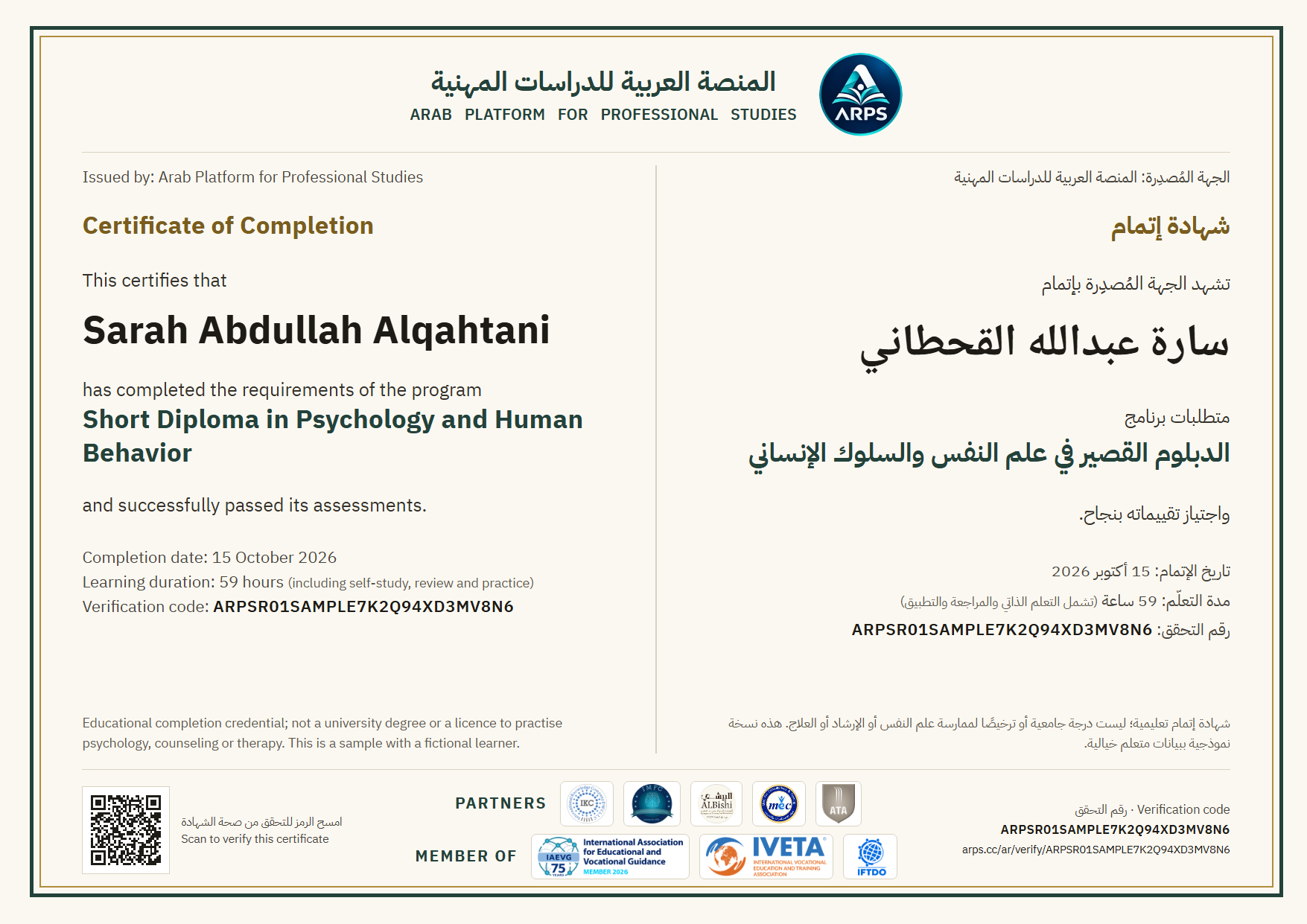
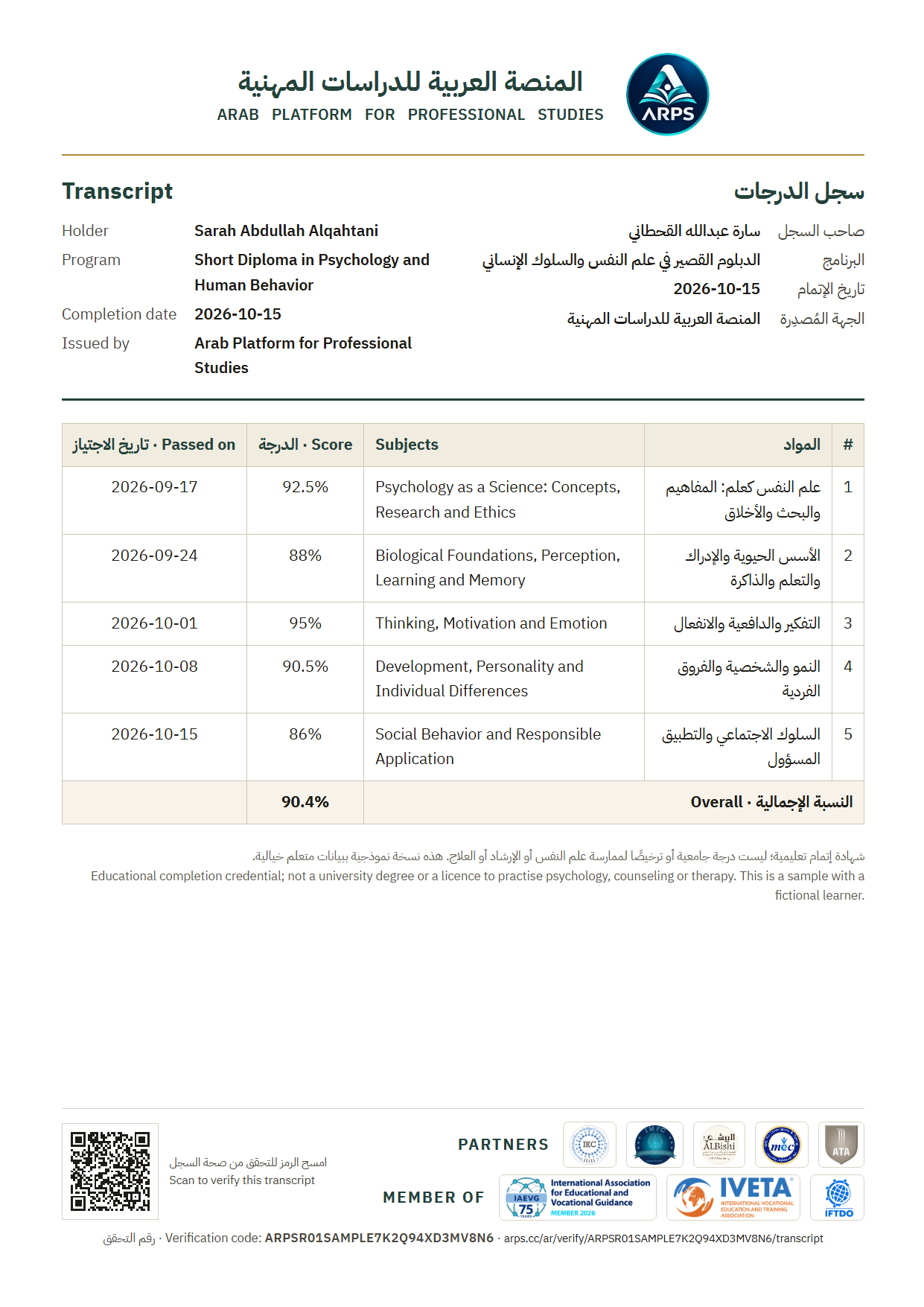
A sample from a real program in this track: Short Diploma in Psychology and Human Behavior. The learner, scores and dates are fictional; opens in a new window.
Disclaimer: Completion of a short educational program, not a university degree, professional licence or accredited hours.
Program questions
Does this program confer a professional licence?
No. It is a short educational completion diploma, not a licence, university degree, or source of officially accredited hours.
Do I need training experience?
No. The first subject introduces the concepts; later subjects build needs analysis, design, facilitation, and evaluation in sequence.
How many subjects and assessments are there?
There are six subjects with four lessons each, a separate summative assessment for each subject, and learning checks in lessons.
Are the cases based on real organizations?
No. Place-based cases are explicitly marked as hypothetical training scenarios, not data about an actual organization or city.
How is study time calculated?
The minutes are an internal estimate for a first pass through reading, practice, and assessment. Central calibration has not set official standard hours.
Show all (10)
Does attendance prove impact at work?
Attendance establishes participation only. Claims about transfer require appropriate performance indicators, a baseline, and attention to other influences.
Must I use colleagues’ data for exercises?
No. Every practice can be completed from its fictional case without collecting personal information or uploading files.
Does the program apply to every country and occupation?
It presents general educational principles and cannot replace an employer’s rules or local occupational requirements.
Is Short Diploma in Adult and Workplace Learning free, and do I get a certificate?
Yes. Short Diploma in Adult and Workplace Learning is free on ARPS: every lesson, exercise and assessment is free, the first subject is open to read without an account, and the program is available in Arabic and English. Issuing a certificate is optional and has a published fee; it is a training completion certificate showing you passed the program's assessments, recognised by most private-sector organisations in the Gulf states and most Arab countries, and it strengthens your CV; confirming that a specific organisation accepts it remains your responsibility.
What other names is Short Diploma in Adult and Workplace Learning known by?
The subject of this program is also known as: adult learning, adult education, workplace learning, andragogy. Learners usually find it by searching for: adult learning course online, adult learning principles, workplace learning course, adult education course free, andragogy training.
A practical foundation in moving from a learning problem to a coherent e-learning experience: analyze learners and context, write outcomes, align assessment and activities, structure content, select media, support accessibility, then evaluate and improve.
Learn to observe children's participation, plan responsive play, remove access barriers, and work with families through fictional early childhood cases, guided practice and a summative assessment for each subject.
Learn to diagnose a learnable performance gap, build an alignment map and storyboard for an online activity, then check access, rights, and measurement. Fictional cases produce specialist deliverables: a decision card, scenario, rubric, trial log, and handoff.
Practise bounded educational leadership tasks: diagnose a learning need, select a testable approach, facilitate team inquiry, allocate responsibility, and review outcomes within assigned authority.
6 subjects
32 lessons
55 hours
Free
Next step: a professional certification or a mini-master
Programs in the same domain that prepare you for an international certification exam or form a professional mini-master, also free.