Short Diploma in Early Childhood and Inclusive Education
Short Diploma in Early Childhood and Inclusive Education is a free program on ARPS, the Arab Platform for Professional Studies. Learn to observe children's participation, plan responsive play, remove access barriers, and work with families through fictional early childhood cases, guided practice and a summative assessment for each subject.
Important notice: Independent learning and an internal completion credential; no professional licence, university accreditation or diagnostic authority.
Record observable behaviour separately from developmental interpretation, adapt an invitation to an activity, and check its effect without diagnosing a child.
From lesson 1, readable now without an account: From observation to a response that enables participation
Participation is observable evidence, not a label for a child
A child may sit through story time without speaking; another may point to a picture or sequence puppets after the story. That snapshot cannot establish either child's understanding or motivation. Start with a narrow question: what opportunity to participate did the activity offer, and what did the child do within it? Keep three levels apart: an observable event, a possible interpretation that needs checking, and a teaching decision that can be revised. 'Laila turned toward the picture twice when the educator asked about the animal' describes an event and context. 'She did not understand the story' goes beyond the evidence. She may not have heard, may have needed more time, or may have preferred a different response mode. This distinction prevents an entire support plan from resting on one guess.
A free account saves your progress and takes you straight to lesson 1.
Program facts
Study fee
Free
subjects
6
lessons
24
Estimated time
62 hours
Content last reviewed
Access period
60 days
Study language
Arabic and English
About the program
This short diploma joins child development and responsive care with play, inclusive activity design and family partnership. Begin by recording what a child does in a specific setting; then inspect the environment and the way the activity is offered before making a fixed inference. Practise offering participation routes toward one learning goal, documenting bounded evidence and discussing next steps with families and colleagues. The five subjects include worked cases, exercises with feedback and a summative assessment each, followed by a four-lesson applied capstone. Cases are fictional. Real practice must follow local roles, policies and qualified referral services. Completion does not confer diagnostic or professional authority.
Practical relevance
Exercises yield observation records, activity plans, access options and family-conversation steps, with criteria for checking what occurred.
Why this program
It links observation, planning, delivery and review to concrete early childhood decisions, so inclusion becomes an examinable practice rather than a broad aspiration.
Career relevance
It helps early childhood staff and learners structure decisions about participation and documentation within their actual local role; it does not grant specialist status.
Career paths this program serves
This program is a step on the paths of the following occupations. Open a path to see its other programs in study order.
Separate observation from inference and choose a responsive step.
Plan accessible, developmentally appropriate play environments.
Find barriers and design participation options toward one goal.
Work with families and teams within privacy boundaries.
Review participation evidence and revise plans without diagnosing.
Learning outcomes (6)
This subject starts by separating what can be seen in a child's participation from an inference about the child
This subject turns developmental appropriateness into decisions about play settings
This subject begins by inventorying task demands before applying a label to a child
This subject treats family partnership as reciprocal knowledge, not a contest over whether home or classroom is more credible
The final subject integrates programme skills in a reviewable decision cycle
Build a traceable project from observer disagreement through material prototyping and handover rehearsal, defending an evidence-bound and authorized continuation decision.
Who it is for
Beginning early childhood teachers and aides who want a structured way to observe participation, adjust activities and examine environmental barriers, using cases they can discuss without sharing a real child's identifiable information.
Program coordinators, family members and learners interested in inclusion who want shared language for play, access, privacy and referral, while recognizing that real decisions depend on local roles, institutional guidance and qualified services.
Prerequisites
No advanced prior qualification or professional licence is required to study this material. Learners need to read short cases in Arabic or English, set aside time for observation and planning exercises, and understand that the fictional scenarios are not records about actual children.
When applying an idea at work, the learner must know the limits of their role and consult local institutional policy. Referral pathways, data handling and specialist responsibilities depend on local qualified services and cannot be established by this course alone.
What it does not offer
Diagnosing children, delivering treatment or prescribing specialist services.
Obtaining professional licensure or a university credential, or replacing local workplace training.
This subject separates observation from inference and links child action to a specific learning opportunity. Learners adjust pictures, timing or response modes while preserving the goal, and practise play that responds to child cues. Nurturing care connects comfort, safety, relationships and learning. Applications produce observation records, revised invitations and family messages, tracking evidence over time while distinguishing the educator’s role from professional screening.
4 lessons · 9.5 hours
From observation to a response that enables participation2 hours
Responsive play guided by a child's cues2 hours
Nurturing care as an interconnected support map2 hours
Developmental monitoring and dialogue before referral2 hours
Subject 2
Play and developmentally appropriate environments
This subject turns developmental appropriateness into play decisions. Learners design a shared goal with different expression routes, then examine goal evidence in a pretend market that respects home language. They map a play corner and inspect safety and access in the actual setting, then plan invitations, waiting, modelling and cues that fade with child independence. Applications produce an activity matrix, room plan, support table and follow-up plan checking who lacked an opportunity.
4 lessons · 9.5 hours
Common patterns, individuality and context in one activity2 hours
Play space: access, transitions and safety2 hours
Graduated support for language, movement and shared play2 hours
From play observation to tomorrow's plan2 hours
Subject 3
Participation barriers and universal design
This subject begins by inventorying task demands before applying a label to a child. Learners separate access to materials from instruction clarity and a speech-only response rule, then prioritize a change that retains the sorting or story goal. Next they design two ways to present cause and effect and two ways to show it, using a shared rule that distinguishes mode choice from understanding the relationship. The third lesson builds a goal-response-support grid: pictures or puppets can evidence sequence, naming one picture cannot do so alone, and a prompt belongs in the result record. Finally, learners compare a support offered to everyone with a targeted adjustment after local observation, set up a short trial log, and locate the point for family or qualified-service discussion when concern persists. Applications produce a barrier inventory, activity card, evidence grid and follow-up plan, insisting on actual participation without diagnosing from classroom records.
4 lessons · 9 hours
Find the barrier before describing the child2 hours
Different routes into an idea, one learning goal2 hours
Inclusive response and communication modes2 hours
From support for all to a targeted follow-up2 hours
Subject 4
Family partnership and ethical documentation
This subject treats family partnership as reciprocal knowledge, not a contest over whether home or classroom is more credible. Learners compare a home storytelling context with a group observation, then formulate a more comparable question and trial while respecting family language and preferred contact route. The second lesson produces a descriptive concern message that starts with a child's strength and the classroom's attempted changes; access to learning continues while professional screening remains a separate role. Next, learners minimize a child record: a clear purpose, necessary fields, transparent correction of an earlier inference, and controlled sharing under the actual setting's policy without inventing law. Finally, family, educator and a qualified professional when available coordinate around one participation goal, a limited trial, owner and review date. Real differences in opinion and the child's comfort remain visible. Applications yield messages, decision tables, limited records and checkable follow-up plans.
4 lessons · 9 hours
Family knowledge complements classroom evidence2 hours
Sharing a concern without diagnosis or alarm2 hours
A useful and limited observation record2 hours
Coordinating support roles around one participation goal2 hours
Subject 5
Inclusive planning and observation-led improvement
The final subject integrates programme skills in a reviewable decision cycle. Learners write a participation goal visible in child action and a baseline whose numerator and denominator count genuine opportunities; absence and inaccessible materials are excluded, and support is recorded beside results. They then plan a learning station with access and response choices and a cue ladder that never credits adult or peer work to the child, with a criterion for fading help. The third lesson interprets changes across small sessions, separating description from causation and noticing peer, time and material changes and social indicators that may deteriorate even as choice rises. Finally, learners compare two alternatives when access, choice, reciprocal turns and comfort point in different directions. They write a conditional recommendation to family and team with a review owner and date. Applications produce sound calculations, role logs, indicator displays and bounded decisions, not guarantees or universal developmental standards.
4 lessons · 9 hours
An observable participation goal and baseline2 hours
An inclusive activity plan and prompt fading2 hours
Read change without claiming a certain cause2 hours
Revise a plan when participation indicators conflict2 hours
Subject 6
Applied project: a transferable participation package
The capstone builds a participation package that another team can inspect and use. Learners reconcile observer event definitions and distinguish original observations from copied documents. They turn a documented need into a material specification, test a small prototype, and compare full cost and maintenance before expansion. An adult rehearsal then tests handover to a substitute educator, separating receipt, understanding and performance. Finally, learners present the evidence chain and defend a bounded decision, correcting claims that exceed actual testing. Outputs include an event dossier, trial specification, operating card and handover minutes. All project cases are fictional, respect safety, privacy and professional roles, and confer neither diagnostic authority nor institutional approval.
4 lessons · 13 hours
A project dossier that resolves observer disagreement3.5 hours
Prototyping inclusive materials within limited resources3.5 hours
Rehearsing an activity handover to a substitute educator3.5 hours
Presenting the project portfolio and defending its decision3.5 hours
Subjects unlock in sequence as you progress.
Strengths
Worked cases and two active exercises in every lesson.
Each decision is linked to a participation goal and reviewable evidence.
Five subjects, each with its own summative assessment and result record.
Evidence basis
Concepts draw on primary resources from WHO, UNICEF, UNESCO, NAEYC, CAST and CDC. Each is used within its stated scope; regional guidance is not presented as universal law.
Reference organizations
WHO
UNESCO GEM
NAEYC
CAST
CDC
Methodology
Lessons explain a concept, apply it in a worked case and require exercises with feedback. Review is an assisted author self-review in both languages.
How the route works
Short Diplomas are relatively comprehensive learning pathways that cover a major subject through five connected learning subjects and structured assessments, with a diploma transcript available with the credential.
Self-paced sequential study. Content unlocks progressively and each subject combines reading, examples, exercises, knowledge checks, and assessment.
Build integrated knowledge in a major subject.
Study through five clear, connected learning subjects.
Complete a defined assessment for each subject.
Receive a diploma transcript showing subjects and results when the credential is issued.
Assessment
Each Short Diploma contains five subjects, each with an approved assessment. A sixth final exam is not required when the five assessments adequately cover the learning outcomes.
Assessment attempts: 2 per assessment, 7 days apart
The pass mark is announced before the program is published.
Certificate
Successful completion makes the learner eligible for the Short Diploma certificate and Diploma Transcript under the credential policy.
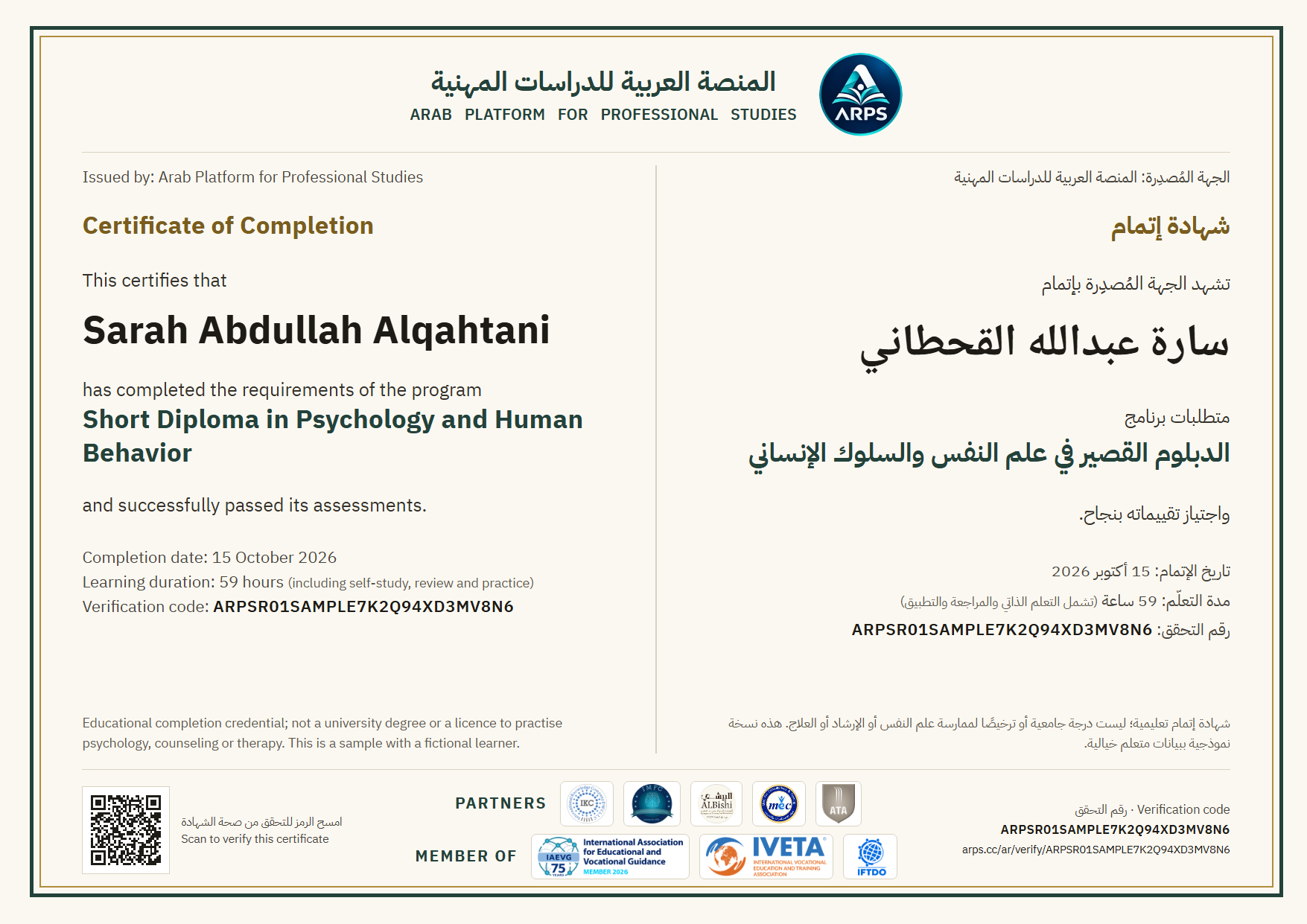
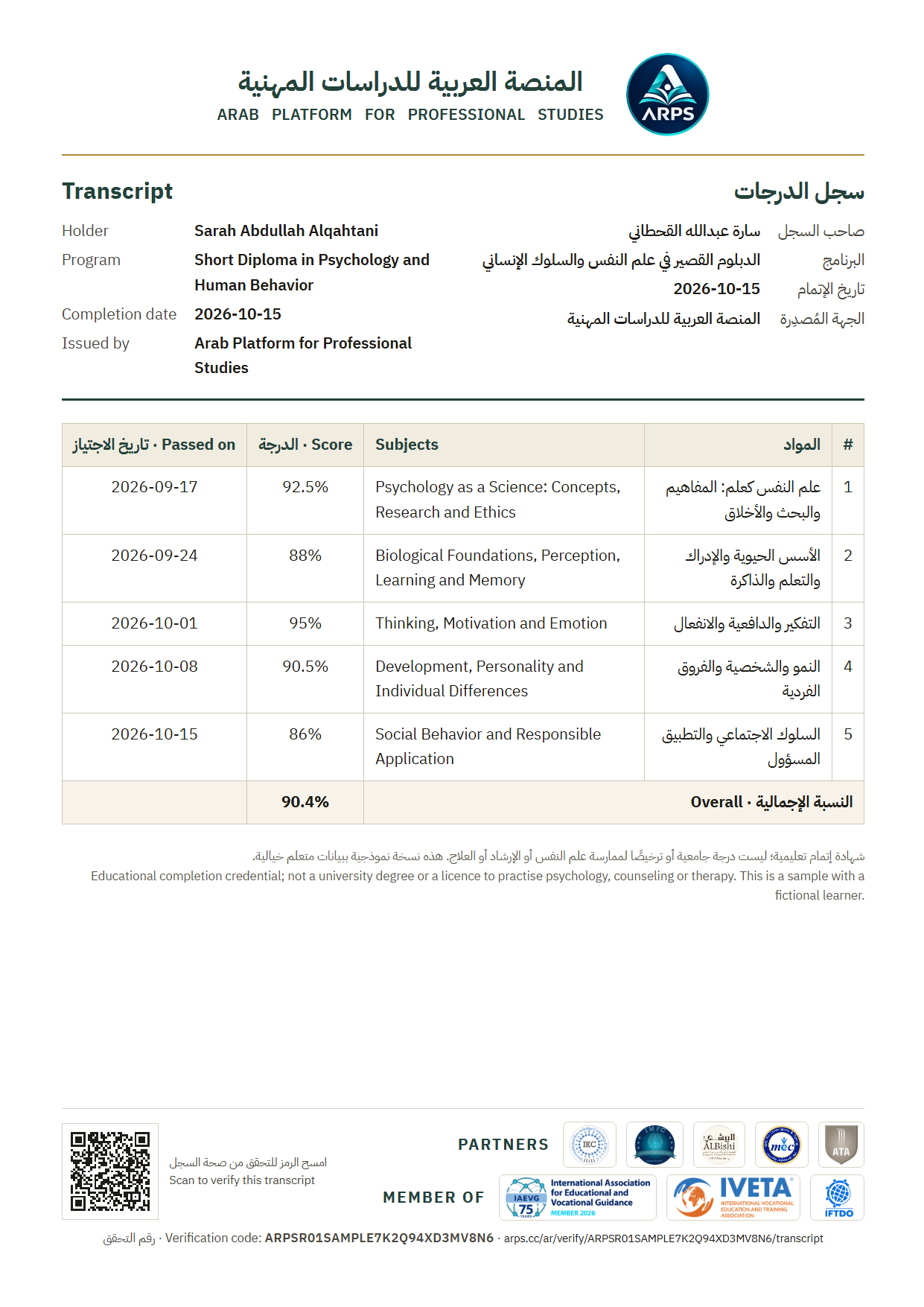
A sample from a real program in this track: Short Diploma in Psychology and Human Behavior. The learner, scores and dates are fictional; opens in a new window.
Disclaimer: Internal learning completion only; no professional licence, university degree or diagnostic authority.
Program questions
Does this credential grant a licence?
No. It records internal learning completion and grants no diagnostic or professional authority.
Are named places in cases local rules?
No. Case settings are fictional and local policy must be checked before real practice.
How is progress assessed?
Lessons include knowledge checks and every subject has a separate summative assessment under central assessment policy.
Do I need a prior specialist qualification?
No advanced qualification is required to study, but workplace use follows your role and local policy.
Can I study in Arabic?
Lessons, summaries and questions are available in both Arabic and English; switching language preserves progress.
Show all (7)
Is Short Diploma in Early Childhood and Inclusive Education free, and do I get a certificate?
Yes. Short Diploma in Early Childhood and Inclusive Education is free on ARPS: every lesson, exercise and assessment is free, the first subject is open to read without an account, and the program is available in Arabic and English. Issuing a certificate is optional and has a published fee; it is a training completion certificate showing you passed the program's assessments, recognised by most private-sector organisations in the Gulf states and most Arab countries, and it strengthens your CV; confirming that a specific organisation accepts it remains your responsibility.
What other names is Short Diploma in Early Childhood and Inclusive Education known by?
The subject of this program is also known as: early childhood education, inclusive education, early years education, inclusive early learning. Learners usually find it by searching for: early childhood education courses online free, inclusive education course, inclusive educational practices, inclusive education for students with disabilities, early childhood inclusion strategies.
A practical foundation in moving from a learning problem to a coherent e-learning experience: analyze learners and context, write outcomes, align assessment and activities, structure content, select media, support accessibility, then evaluate and improve.
This short diploma examines how adults learn in organizations and at work: diagnosing a need, designing a suitable experience, supporting participation, and evaluating learning with appropriate limits. Six subjects combine hypothetical cases, observable practice outputs, and a summative assessment for each subject.
Learn to diagnose a learnable performance gap, build an alignment map and storyboard for an online activity, then check access, rights, and measurement. Fictional cases produce specialist deliverables: a decision card, scenario, rubric, trial log, and handoff.
Practise bounded educational leadership tasks: diagnose a learning need, select a testable approach, facilitate team inquiry, allocate responsibility, and review outcomes within assigned authority.
6 subjects
32 lessons
55 hours
Free
Next step: a professional certification or a mini-master
Programs in the same domain that prepare you for an international certification exam or form a professional mini-master, also free.