Short Diploma in Biodiversity and Natural Resources
Short Diploma in Biodiversity and Natural Resources is a free program on ARPS, the Arab Platform for Professional Studies. Seven assessed subjects build an applied foundation in biodiversity and natural resources, from inventory design to a bounded decision memo, evidence preparation and a restoration pilot. Learners work through fictional datasets, calculations and evidence limits in both languages.
Classify inventory observations by diversity level and define a sampling unit and effort suitable for comparison.
From lesson 1, readable now without an account: Biodiversity Levels and the Sampling Unit
Outcome: The learner identifies the level of diversity supported by an observation, fixes the inventory unit and effort, and writes a comparison within the evidence limits.
Biodiversity is broader than the number of species names on a list. Article 2 of the Convention on Biological Diversity describes variability within species, between species and among ecosystems. Two plots can have the same observed species count while differing in variation within a species, habitat connections or ecosystem condition. The first question for an inventory is therefore not “Which number is larger?” It is “Which level of diversity is the decision about, and what observation can measure that level?” An unidentified photograph is not a new species merely because a spreadsheet has a blank row.
A free account saves your progress and takes you straight to lesson 1.
Program facts
Study fee
Free
subjects
7
lessons
26
Estimated time
85.5 hours
Content last reviewed
Access period
60 days
Study language
Arabic and English
About the program
The program moves from biodiversity levels and sampling units to ecosystem contributions and pressures, then water, soil and forests, conservation and restoration governance, and decision-led monitoring. Learners calculate richness and a simple evenness index, paired water differences, a forest stock balance and a treatment change against comparison. Exercises provide hypothetical inputs, observable outputs, worked solutions and review criteria. Judgments about real sites, legal designation and field intervention require competent local authorities, current sources and specialist expertise.
Practical relevance
Learners produce an inventory table, diversity calculation, pressure matrix, resource balance, participation and monitoring plan, and conditional decision memo. Worked answers show where a sample or model stops supporting the conclusion and when a specialist or authorized process must take over.
Why this program
The seven assessed subjects connect ideas often taught separately: species inventory, habitat condition, resource use and conservation choice. Each calculation is linked to a decision question, a confidence limit and a fact that could reverse the recommendation, rather than ending at a general definition or global target list.
Career relevance
The course helps readers of environmental and resource reports and members of research, planning or education teams interpret evidence and frame verification questions. It does not qualify a person for regulated practice, species assessment, reserve designation or an official report on behalf of an authority.
Career paths this program serves
This program is a step on the paths of the following occupations. Open a path to see its other programs in study order.
Define inventory units and effort, calculate richness, abundance and a simple diversity index, and explain their limits.
Read habitat extent, condition and connectivity while separating ecosystem processes from human benefits.
Compare water, soil and forest evidence and develop conservation or restoration options with participation and rights checks.
Design monitoring and a decision memo that names assumptions and facts that could change a recommendation.
Prepare environmental evidence before analysis by cleaning species records without losing their origin, setting disclosed location detail and assessing water-sample usability.
Run a bounded restoration pilot from supply specification and survival and cost audit to a reproducible evidence handover.
Learning outcomes (26)
Classify inventory observations by diversity level and define a sampling unit and effort suitable for comparison.
Calculate richness, relative abundance and a simple evenness index, and interpret the limits of each result.
Separate extent change from condition and connectivity, identifying an appropriate check for each claim.
Trace an ecosystem impact chain to a named beneficiary and prevent double counting of intermediate and final measures.
Compare explanations of environmental change using timing, pathway and observation quality before causal attribution.
Separate a non-native organism's identity, pathway, establishment and impact and select an authorized preventive step.
Calculate paired freshwater differences and assess quality flags before interpreting them.
Link a land-degradation mechanism to an objective, indicator and comparator and calculate a treatment change gap.
Reconcile a forest resource balance and inspect measurement discrepancy and patch risk hidden by the total.
Compare area-based conservation designs by habitat representation, condition, connectivity and governance.
Define a restoration trajectory and counterfactual and revise decisions when cover composition or function changes.
Map user groups, restrictions and participation gaps before recommending conservation that affects people.
Specify a monitoring protocol with baseline, sites, frequency, quality flag and decision trigger.
Test option dominance and ranking sensitivity to ranges, cost and non-tradable conditions.
Write a memo linking inventory, pressure, resource and conservation evidence with limits and a fact that could change the recommendation.
Distinguish confirmed detection, effort-bounded non-detection and uncertain identity in a visit ledger.
Separate ecosystem asset extent, intermediate function and final benefit to avoid double counting.
Check spatial, temporal, method and unit comparability before comparing water, soil and forest indicators.
Distinguish ecological boundary maps from access-right records and implementation responsibilities.
Record observations, inferences, priorities and evidence versions in an auditable decision register.
Clean occurrence records while preserving related representations, names and each correction source.
Assess locality uncertainty and disclosure detail against purpose and sensitivity.
Reconcile a water-sample batch and assess constituent usability from preservation and quality controls.
Prepare a supply specification, budget and planting pilot preserving propagation-material identity.
Audit planting cohorts, survival denominators and cost per documented survivor with unknown outcomes disclosed.
Hand over a reproducible evidence package with file provenance and access limits.
Who it is for
For learners seeking a foundation before deeper environmental study, and planning, data or sustainability staff who read inventories and reports without acting as the responsible specialist. Teachers and community coordinators explaining numerical limits, monitoring and participation also benefit.
Learners use fictional cases. The diploma provides no regulated professional licence or field-intervention permission; applying its methods at a real site requires suitable data, authority, expertise and local rules.
Prerequisites
Read a small table and use addition, subtraction, division and simple percentages. Lessons explain index formulas; university ecology study or advanced field experience is unnecessary.
Record tables, assumptions and evidence limits. Hand calculation or a familiar spreadsheet is enough. Cases are fictional, so specialized software, field equipment and real sample collection are unnecessary. Interest in maps and environmental observations helps.
What it does not offer
Professional licensing or legal designation of species and places.
Replacement of specialist field assessment or an official decision in a particular jurisdiction.
This subject establishes precise language for an ecological inventory before a site judgment is made. Learners distinguish variation within species, among species and among ecosystems, then define sampling unit, area, time and observer effort. They calculate observed richness, relative abundance and a simple index of count evenness, keeping the calculation separate from its causes. Map analysis then separates habitat extent from condition and a visible link from functional movement. Fictional datasets become a comparability table, calculation sheet and limits memo. Learners decide when evidence describes only the sampled plots and when matched surveys or field checks are needed before selecting a site. The subject assessment connects these calculations with a defensible next monitoring decision, without claiming unmeasured genetic diversity.
4 lessons · 10.5 hours
Biodiversity Levels and the Sampling Unit2.5 hours
Richness, Relative Abundance and Evenness2.5 hours
Habitat Extent, Condition and Connectivity2.5 hours
Detection Limits and Non-detection1.5 hours
Subject 2
Ecosystem functions and pressures
This subject traces an ecosystem contribution to a defined human benefit without counting one effect twice. Learners distinguish structure, process, service and beneficiary outcome, drawing a causal chain that separates retained water from avoided exposure. They then test competing habitat and species pressures, including land-use change, pollution, climate and observation effort itself. A timeline rejects a later pressure as the cause of an earlier event; an evidence matrix records supporting, conflicting and missing observations. For a potentially non-native organism, learners separate identity, arrival, establishment and impact before choosing a response. Fictional cases keep causal claims bounded and identify a lower-harm prevention or verification step. Field removal, legal classification and regulatory action remain with authorized specialists rather than being inferred from an introductory exercise.
4 lessons · 10.5 hours
From Ecosystem Function to Benefit2.5 hours
Pressures and Competing Explanations2.5 hours
Introduction Pathways and Spread Risk2.5 hours
Beneficiary, Time and Service Accounting Boundaries1.5 hours
Subject 3
Water, soil, forest and living resources
This subject keeps three resource accounts separate rather than collapsing them into one number. Learners compare synchronized upstream and downstream water samples, calculate paired differences and flag missing times or delayed transport. They formulate a measurable soil-degradation mechanism, distinguishing bare-ground condition from erosion pressure and restoration outcome. For forest resources they reconcile opening stock with growth, harvest and mortality, then investigate a survey gap and an old patch that an aggregate can hide. Each case ends with a bounded decision: a water reading does not prove organism death, seedling counts do not prove recovery, and greater wood stock neither grants harvesting authority nor guarantees sustainability. Worked tables, calculations and verification memos show what evidence would change a resource decision.
4 lessons · 10.5 hours
Designing Freshwater Quality Comparisons2.5 hours
Soil Degradation and Restoration Objective2.5 hours
Forest Area, Condition and Resource Stock2.5 hours
Reconciling Resource Evidence across Scales1.5 hours
Subject 4
Conservation, restoration and governance
This subject compares conservation and restoration through representation, condition, connectivity and governance rather than hectares alone. Learners ask whether a site design covers the intended habitat types and whether a mapped link actually works for a focal organism. They define a restoration objective, mechanism, baseline and comparator, interpreting seasonal cover change while separating confirmed native growth from unknown vegetation. A use map then records people, seasons, benefits and restriction costs, exposing why an absent seasonal group cannot be counted as general consent. Fictional cases change a concrete fact and show how that changes expansion or stopping decisions. The output is a reviewable verification and participation plan, while actual legal designation and rights decisions remain subject to the competent local process.
4 lessons · 10.5 hours
Area-Based Conservation and Representation2.5 hours
Restoration Trajectory and Counterfactual2.5 hours
Rights, Participation and Benefit Distribution2.5 hours
Conservation Agreement and Implementation Changes1.5 hours
Subject 5
Monitoring and integrated decisions
The final subject turns separate observations into a decision memo that can be revised. Learners begin with a question that new monitoring could change and choose baseline, fixed sites, timing, quality flag and an internal review trigger. They compare protection, restoration and monitoring options using benefit ranges, cost and rights conditions, then test whether a reasonable assumption changes the ranking. In the integrated case, they refuse to rank richness from unequal effort, treat a mixed-resolution map as uncertain rather than proven habitat loss, and do not call incomplete participation consent. They write alternatives, a conditional recommendation and one concrete fact that could reverse it. The result is a professional memo honest about the limits of classroom evidence and the need for authorized expertise in real implementation.
4 lessons · 10.5 hours
Monitoring Design from a Decision Question2.5 hours
Comparing Options under Uncertainty2.5 hours
Integrated Environmental Decision Memo2.5 hours
Decision Register and Reopening Triggers1.5 hours
Subject 6
Preparing environmental evidence for analysis
Prepares environmental evidence before comparison: cleaning species records while keeping their origin, handling location uncertainty and protecting sensitive data, and receiving water samples and assessing batch usability.
3 lessons · 13 hours
Cleaning species records without losing their origin4.5 hours
Location uncertainty and sensitive data protection4.5 hours
Receiving water samples and assessing batch usability4.5 hours
Subject 7
Capstone: a restoration pilot from supply to handover
A capstone on a bounded restoration pilot: preparing a supply specification that preserves propagation-material identity, auditing seedling survival and cost per outcome, then handing over an evidence package another team can review and recalculate.
3 lessons · 13 hours
Preparing a supply specification for a bounded restoration pilot4.5 hours
Auditing seedling survival and cost per outcome4.5 hours
Handing over an evidence package another team can review4.5 hours
Subjects unlock in sequence as you progress.
Strengths
Seven distinct subjects connect biodiversity, resources, conservation and decisions.
Fictional cases provide data, calculations, worked answers and correction criteria in Arabic and English.
Each subject has its own final assessment and contributes to the short-diploma transcript.
The material explicitly separates supported inference from claims needing another sample or authority.
Evidence basis
Concepts use the Convention on Biological Diversity, UN ecosystem accounting, and relevant IPBES, UNEP, FAO and UNCCD sources. Edition and verification details are recorded. Fictional regional scenarios are not presented as real observations or local law.
Reference organizations
Convention on Biological Diversity
United Nations Statistics Division
IPBES
UNEP
FAO
UNCCD
Methodology
Lessons link primary concepts to worked cases, practice and evidence-limit review.
How the route works
Short Diplomas are relatively comprehensive learning pathways that cover a major subject through five connected learning subjects and structured assessments, with a diploma transcript available with the credential.
Self-paced sequential study. Content unlocks progressively and each subject combines reading, examples, exercises, knowledge checks, and assessment.
Build integrated knowledge in a major subject.
Study through five clear, connected learning subjects.
Complete a defined assessment for each subject.
Receive a diploma transcript showing subjects and results when the credential is issued.
Assessment
Each Short Diploma contains five subjects, each with an approved assessment. A sixth final exam is not required when the five assessments adequately cover the learning outcomes.
Assessment attempts: 2 per assessment, 7 days apart
The pass mark is announced before the program is published.
Certificate
Successful completion makes the learner eligible for the Short Diploma certificate and Diploma Transcript under the credential policy.
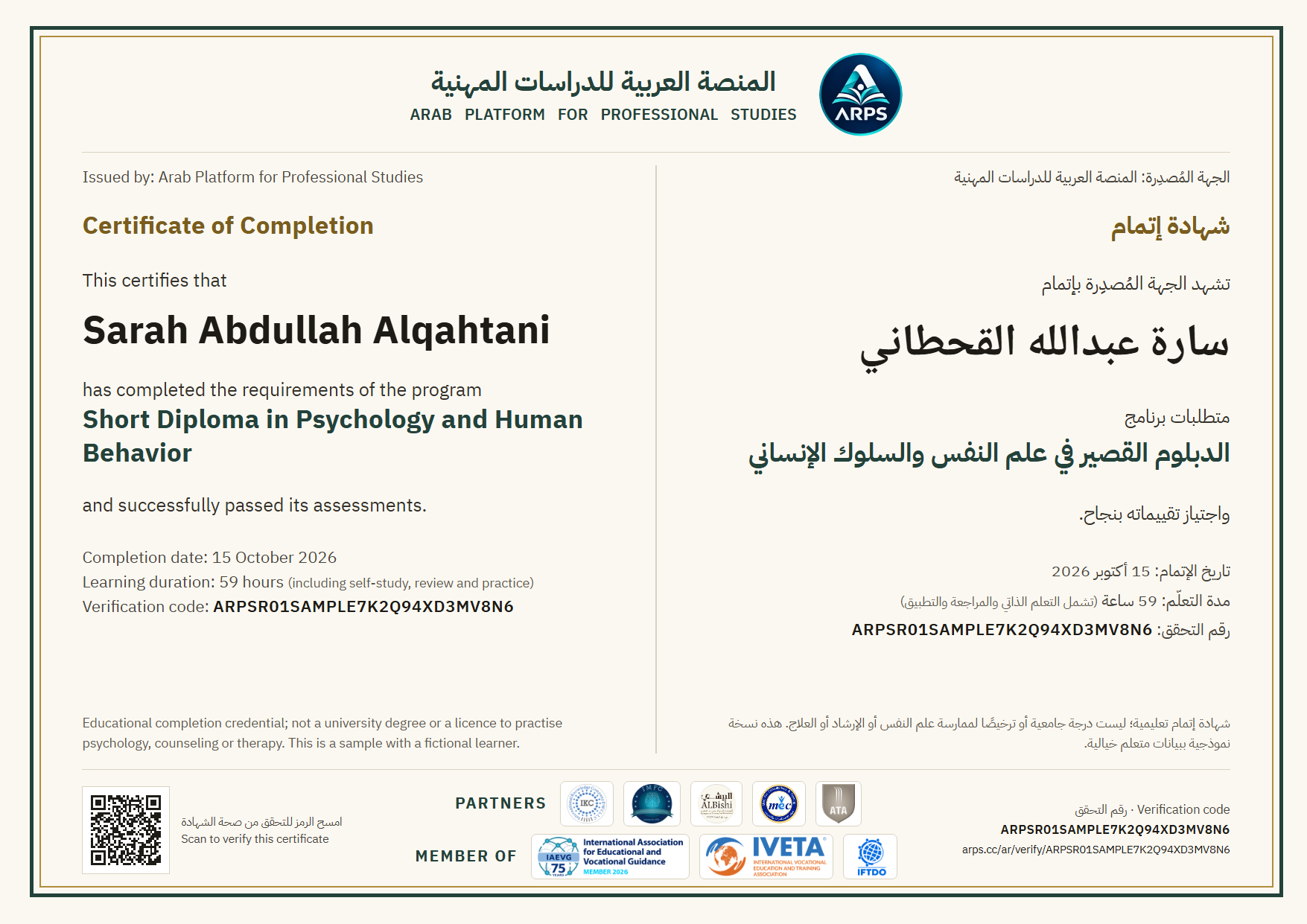
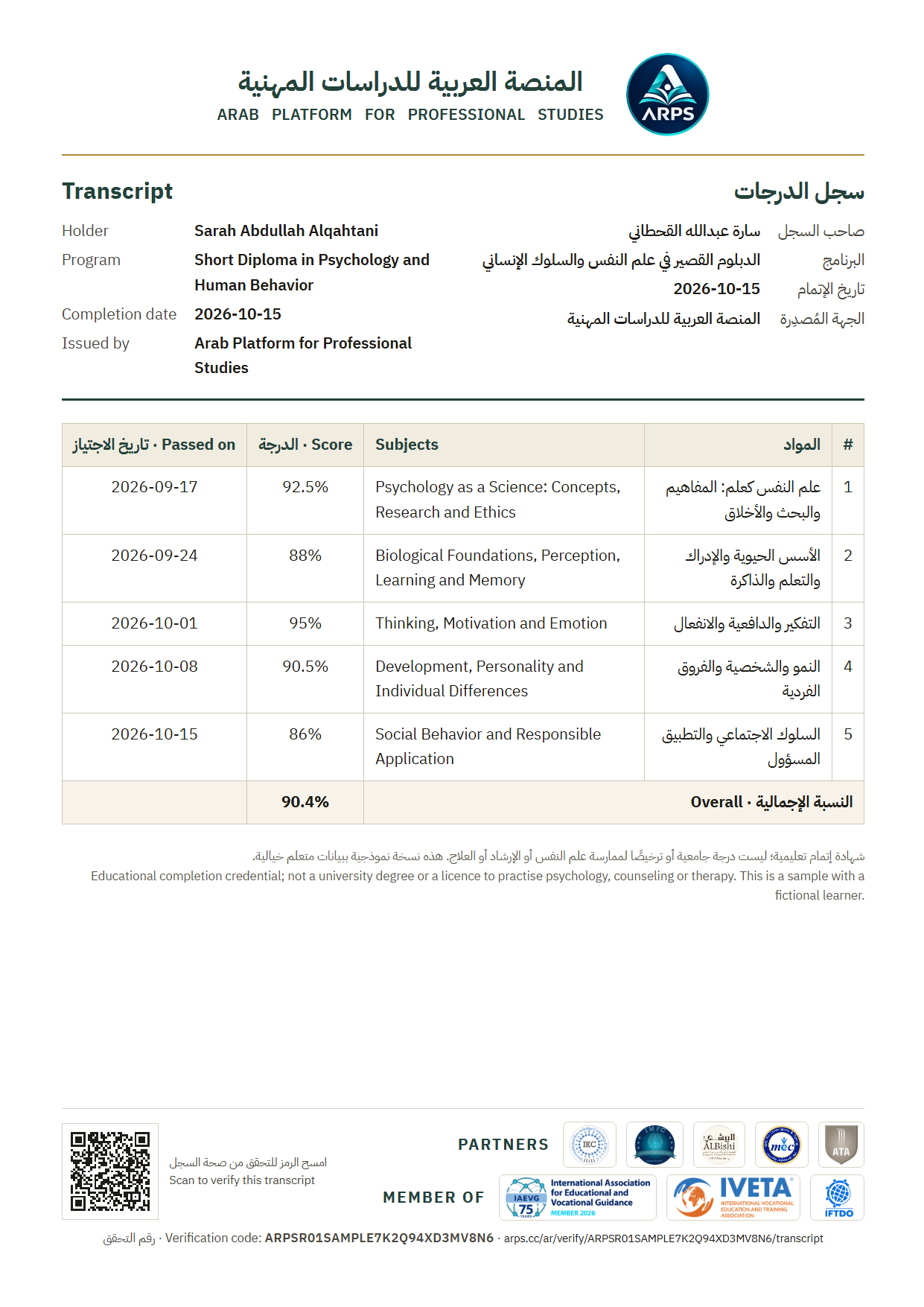
A sample from a real program in this track: Short Diploma in Psychology and Human Behavior. The learner, scores and dates are fictional; opens in a new window.
Disclaimer: Independent education leading to a training completion credential; it grants no university degree, professional licence or authority for field or legal decisions.
Program questions
Does this provide a professional licence or accreditation?
No. It is an assessed short diploma for learning completion, not authorization for regulated professional practice.
Do I need field experience?
No advanced experience is required. Lessons begin with sampling units and explain calculations before applied cases.
How is learning assessed?
Each lesson has a short check, and each subject has a separate final assessment under the route policy. Self-practice includes worked review criteria.
Are the city examples real field studies?
No. Named cities provide hypothetical training context; their numbers and habitats do not describe actual sites.
Can I implement field decisions after completion?
You can apply the reasoning framework, but real monitoring, intervention and formal classification require appropriate authority, current local sources and expertise.
Show all (7)
Is Short Diploma in Biodiversity and Natural Resources free, and do I get a certificate?
Yes. Short Diploma in Biodiversity and Natural Resources is free on ARPS: every lesson, exercise and assessment is free, the first subject is open to read without an account, and the program is available in Arabic and English. Issuing a certificate is optional and has a published fee; it is a training completion certificate showing you passed the program's assessments, recognised by most private-sector organisations in the Gulf states and most Arab countries, and it strengthens your CV; confirming that a specific organisation accepts it remains your responsibility.
What other names is Short Diploma in Biodiversity and Natural Resources known by?
The subject of this program is also known as: biodiversity, natural resources, conservation biology. Learners usually find it by searching for: biodiversity course, natural resource management course, biodiversity conservation online course, free biodiversity course.
A foundational short diploma that connects sustainability and ESG in practice: environmental, social and governance dimensions, materiality and stakeholders, emissions and climate risk, metrics and data, disclosure, transition planning and credible-claim review.
6 subjects
25 lessons
57 hours
Free
Short Diplomas
Environment, Sustainability, Energy, Agriculture & Food Systems
A short applied diploma on assessing resources, services, risk and equity before describing an area as water secure. Learners practice water balances, drinking-water safety, efficient use, drought and flood responses, and evidence-based decision briefs.
7 subjects
26 lessons
70 hours
Free
Specialist Preparation Programs
Environment, Sustainability, Energy, Agriculture & Food Systems