Short Diploma in Water and Water Security is a free program on ARPS, the Arab Platform for Professional Studies. A short applied diploma on assessing resources, services, risk and equity before describing an area as water secure. Learners practice water balances, drinking-water safety, efficient use, drought and flood responses, and evidence-based decision briefs.
Important notice: Independent completion education; no university degree, professional licence, or authority to issue health or engineering decisions.
Draw a catchment water balance and calculate change in storage with compatible units.
From lesson 1, readable now without an account: What Makes Water Secure for People and Communities?
A full reservoir may suggest that a place has no water problem. Yet water in storage is not necessarily water that people can use safely when they need it. Before judging, ask five questions. Is the quantity adequate over the period being considered? Is quality suitable for the intended use? Does service reach people reliably and fairly? What hazards could interrupt or contaminate it? Will ecosystems retain enough water and function to help sustain the resource? Water security connects these dimensions rather than reducing them to production or storage volume. UN-Water's 2013 working definition brings together sustainable access to acceptable quantity and quality, human well-being and livelihoods, protection from pollution and water-related disasters, and preservation of ecosystems. We use it as a foundational analytical frame, not a local law or a compliance threshold.
A free account saves your progress and takes you straight to lesson 1.
Program facts
Study fee
Free
subjects
7
lessons
26
Estimated time
70 hours
Content last reviewed
Access period
60 days
Study language
Arabic and English
About the program
How can we assess a resource and service without confusing stored volume, household access, water quality and ecosystem function? Five core subjects move from water accounting to drinking-water safety, demand and efficiency, climate risk, governance and equity. Lessons use explicitly fictional geographic cases with invented figures, reviewable exercises and an assessment for each subject. They claim no real city statistic or local compliance threshold. Completion can qualify learners to request an optional internal credential and subject transcript under platform policy; it grants no engineering, health or professional licence.
Practical relevance
Apply a bounded water balance, distinguish accounting gaps from proven leaks, interpret a sample within its limits and compare conditional options. Real action requires local evidence and authority.
Why this program
Water decisions vary with place, time and who receives service. Learn to separate observations from assumptions and revise a recommendation when measurements or their validity change.
Career relevance
Useful for early work in water planning, reporting or community initiatives. It makes no employment promise or claim of regulated professional competence.
Career paths this program serves
This program is a step on the paths of the following occupations. Open a path to see its other programs in study order.
Diagnose water security across quantity, quality, access, hazards and ecosystems.
Calculate a bounded water balance and interpret shortage and recharge evidence.
Trace a drinking-water hazardous event and choose suitable verification without claiming compliance.
Distinguish withdrawal, return flow and depletion, and real loss from an accounting difference.
Compare drought, flood and environmental-flow choices under uncertainty.
Write a decision brief and monitoring measures that expose equity and evidence gaps.
Learning outcomes (6)
Explain water security as quantity, quality, access, ecosystem and risk dimensions; identify the decision boundary.
Build and interpret a simple basin or service water balance with units, period and uncertainty.
Trace drinking-water hazards from source to user and select proportionate monitoring and escalation.
Compare sector demands and efficiency interventions without confusing withdrawal, consumption and savings.
Interpret drought and flood scenarios with exposure, vulnerability and environmental flow trade-offs.
Use evidence, participation and equity criteria to recommend and monitor a bounded water-security response.
Who it is for
For learners and early-career professionals encountering water issues: program coordinators, service teams, report writers, and participants in environmental or community initiatives. It suits anyone who must interpret resource, demand, quality and equity figures before making a bounded recommendation. Learners should distinguish a teaching exercise from an operational decision made by an authorized body using local evidence and applicable rules.
Prerequisites
No engineering qualification or advanced experience is required. Learners should be comfortable reading a short table and using addition, subtraction and percentages with units. Set aside time to complete exercises on paper or in a simple spreadsheet and explain assumptions and evidence limits. No confidential workplace data, measuring equipment or specialist software is required.
What it does not offer
Not training to design treatment works, certify actual drinking-water safety, or issue public-health instructions.
Not a legal accreditation or professional licence and not a substitute for local competent authorities and standards.
This subject starts by defining water security across quantity at the needed time, fitness for use, equitable and reliable access, resilience to hazards, and ecosystem function. Reservoir capacity or a single annual average cannot settle all these questions. For a water balance, define the place, time period and unit, then calculate storage change from inflows and outflows without counting a return flow twice. Compare resources and demand month by month: a positive annual total can coexist with a critical dry-month gap. For groundwater, distinguish stored water from renewable flow, and read well levels alongside pumping conditions and measurement locations. A useful decision states what the figures establish, what depends on measurement quality, and what needs checking before extra abstraction or a claim of security.
4 lessons · 9 hours
What Makes Water Secure for People and Communities?1.5 hours
Water Balance and Accounting Boundaries1.5 hours
Reading Demand and Resources Across Seasons1.5 hours
Groundwater Storage, Recharge and Monitoring3 hours
Subject 2
Drinking-Water Safety and Service Quality
This subject follows drinking water from source to user. A hazard is an agent capable of harm; a hazardous event opens a pathway, while a barrier prevents, detects or contains exposure. Neither alone proves a health outcome at a consumer tap. Distinguish operational measurements used for timely control from verification of the plan and independent surveillance where applicable. Interpret a laboratory result within its sample place, time, collection, transport and detection limit; “not detected” is not a guarantee for every point and hour. Finally, build an improvement card with the event, barrier, responsible follow-up and effectiveness indicator, and test whether messages reach affected groups. The training data cannot establish legal compliance or justify a general health instruction; actual decisions need local authority, applicable standards and representative evidence.
4 lessons · 9 hours
Source to Tap: Hazard Pathways1.5 hours
Operational Monitoring, Verification and Surveillance1.5 hours
Interpreting Water-Quality Results and Their Limits1.5 hours
Water-Safety Improvement and Communication3 hours
Subject 3
Demand, Efficiency and Options
This subject asks where withdrawn water goes, not only how much is pumped. Record withdrawals, return flows and depletion in place and time; a return to another basin or after the shortage season cannot automatically close a local gap. For a service network, calculate the difference between system input and billed volume, then separate authorized unbilled use, apparent losses and real losses before calling the entire difference pipe leakage. Work through an irrigation efficiency case in which pumping falls but recoverable return falls too; compute the net effect and recompute it if cropped area expands. Compare repair, demand measures, reuse and a new source under budget, timing, reliability and intended-use constraints. Check overlapping benefits and uncertainty. The resulting recommendation remains conditional on measurement, safe use and authority; a supplier estimate is not guaranteed water.
4 lessons · 9 hours
Withdrawals, Depletion and Return Flows1.5 hours
Calculating and Interpreting Service-Network Losses1.5 hours
When Does Efficiency Produce Real Water Savings?1.5 hours
Comparing Repair, Demand and Reuse Options3 hours
Subject 4
Climate Hazards and Ecosystems
This subject separates a climatic or water hazard from the people and assets exposed to it, and from vulnerability and preparedness factors that shape consequences. Heavy rain does not give two pumping stations identical risk: inspect location, tested backup power, service coverage and users dependent on continuity. Use declared drought entry and exit conditions, checking measurement validity before changing state. Then calculate hours of storage cover, the arrival and setup time for a mobile pump, and the remaining service gap. Equipment arrival is not proof that safe drinking water has been restored. Finally, reserve a conditional environmental flow in a fictional river balance; water left in the channel is not automatically waste. The thresholds and flows used in lessons are teaching values, not local law. State uncertainty, trade-offs among users and the sequence of safety and quality checks before declaring success.
4 lessons · 9 hours
Water Hazards, Exposure and Vulnerability1.5 hours
Drought Triggers and Response Ladders1.5 hours
Water-Service Continuity During Emergencies1.5 hours
Environmental Flow and Abstraction Trade-offs3 hours
Subject 5
Governance and Water-Security Decisions
This subject integrates governance, equity and implementation decisions. For integrated water resources management, examine the enabling environment, institutions and participation, management instruments and financing; a committee or a gauge alone cannot establish how the whole system performs. Compare average service hours with their distribution among households: identical means can hide concentrated interruption. Check the limits of a small survey and digital alerts before generalizing. End with a monitoring board that fixes the baseline, target and measurement method; compute the remaining gap each week without redefining success after seeing the result. Do not infer real committee authority from the teaching case, or treat higher total delivery as proof of fair access and safe drinking water without evidence at users' places and times.
4 lessons · 9 hours
Governance, Participation and Decision Evidence1.5 hours
Equitable Access Beyond Averages1.5 hours
A Water-Security Decision Brief1.5 hours
Monitoring Outcomes and Adjusting Course3 hours
Subject 6
From Field Evidence to Service Protection
This subject develops field questions that extend resource and network understanding. It starts with meter records, examining units, intervals, replacement and missing readings before interpreting network differences. It then explores household outage experience, separating payment from collection time and testing sensitivity to time values and denominators. Finally it maps source protection by linking activity, event, pathway and barrier and selecting observations that can change a decision. Cases use invented figures and explicit solutions while official health and operating decisions remain with competent authorities. Outputs include an audit ledger, burden comparison and source map, supported by exercises and questions that test decisions and identify evidence needed before real application.
3 lessons · 10.5 hours
Validate Meter Records Before Estimating Loss3 hours
Reveal Outage Burdens in Household Water Budgets3 hours
Prioritize Source Protection Using a Catchment Map3.5 hours
Subject 7
Willow District Water Security Project
The Willow District project integrates program skills in an invented service area with differing sectors. First build an evidence pack distinguishing user demand, plant production and delivered water, then calculate sector deficits and weighted service hours. Compare portfolios with costs, timing, overlap and shared dependencies, testing repair delay and constrained access to the most affected sector. Finally evaluate a before-and-after trial with a reference area and distinguish observed improvement from conditional causal interpretation. Deliverables include diagnosis, portfolio, trial report and a handover with roles and dates. Each stage has activities, rubrics, solutions and original questions. Water quality, equity and finance remain explicit decision pathways; the project provides analytical practice rather than operating authority or compliance judgment.
3 lessons · 14.5 hours
Build an Evidence Pack for a Water-Stressed District4.5 hours
Choose a Portfolio That Survives an Option Delay4.5 hours
Evaluate a Trial and Deliver the Revision Decision4.5 hours
Subjects unlock in sequence as you progress.
Strengths
Five core subjects, a field subject and a capstone connect resources, service, risk and equity within bounded decisions.
Worked numerical exercises distinguish stocks from flows and gross from net savings.
Explicitly fictional Arab-city scenarios avoid implying real local statistics or practices.
A summative assessment for every subject and a transcript show learning coverage without claiming licensed competence.
Evidence basis
General concepts use primary sources from UN-Water, UNESCO, FAO, WHO, USGS, IPCC and the World Bank. Case figures are invented, not attributed to those organizations.
Reference organizations
UN-Water
FAO
WHO
IPCC
Frameworks used
UN-Water water-security analytical definition — 2013 working definition
SDG 6.5.1 integrated water-resources-management components — Official methodology reviewed 2026-10-22
Methodology
Lessons teach with fictional cases, calculations, worked examples and guided exercises, followed by a separate summative assessment for each subject.
How the route works
Short Diplomas are relatively comprehensive learning pathways that cover a major subject through five connected learning subjects and structured assessments, with a diploma transcript available with the credential.
Self-paced sequential study. Content unlocks progressively and each subject combines reading, examples, exercises, knowledge checks, and assessment.
Build integrated knowledge in a major subject.
Study through five clear, connected learning subjects.
Complete a defined assessment for each subject.
Receive a diploma transcript showing subjects and results when the credential is issued.
Assessment
Each Short Diploma contains five subjects, each with an approved assessment. A sixth final exam is not required when the five assessments adequately cover the learning outcomes.
Assessment attempts: 2 per assessment, 7 days apart
The pass mark is announced before the program is published.
Certificate
Successful completion makes the learner eligible for the Short Diploma certificate and Diploma Transcript under the credential policy.
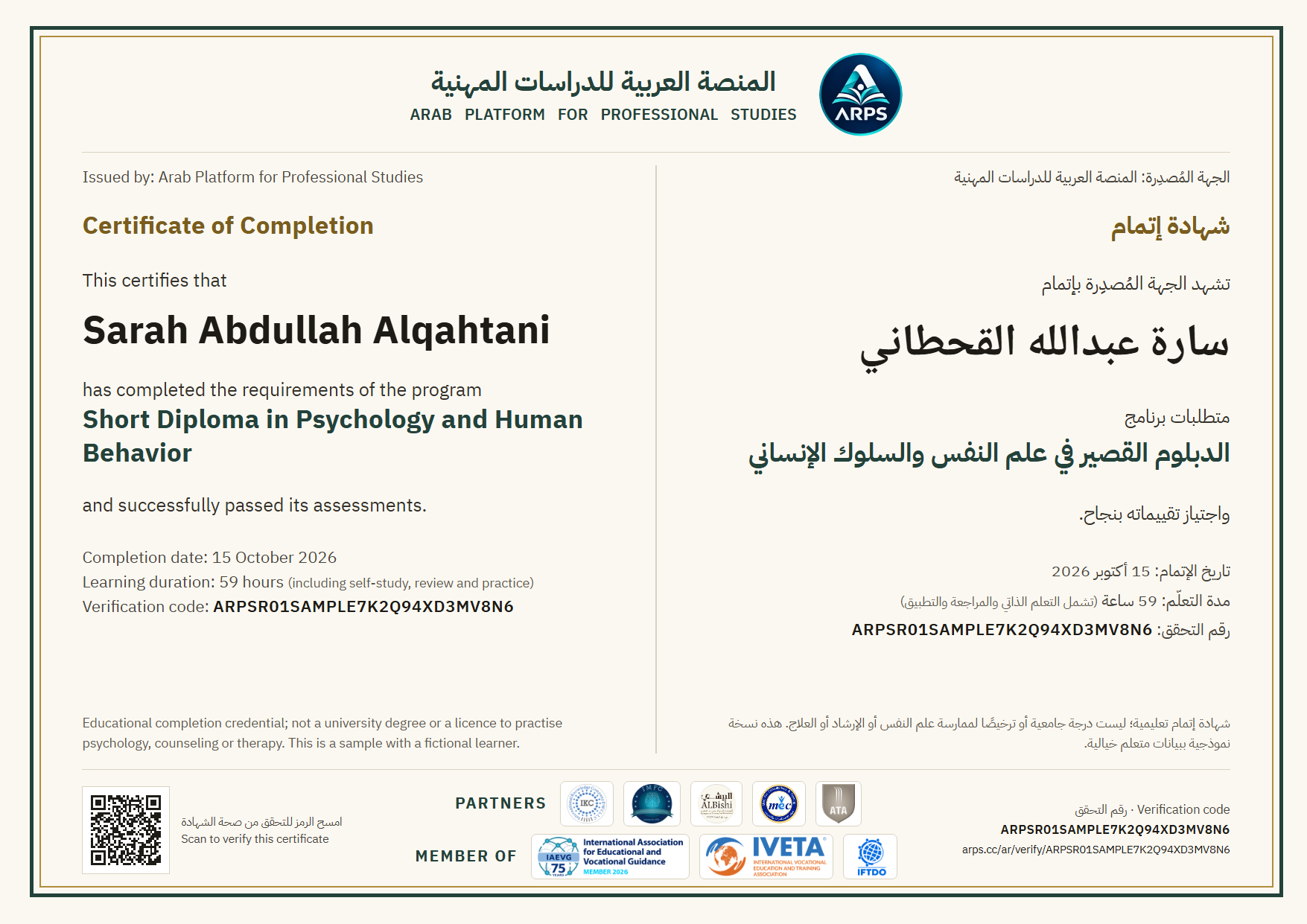
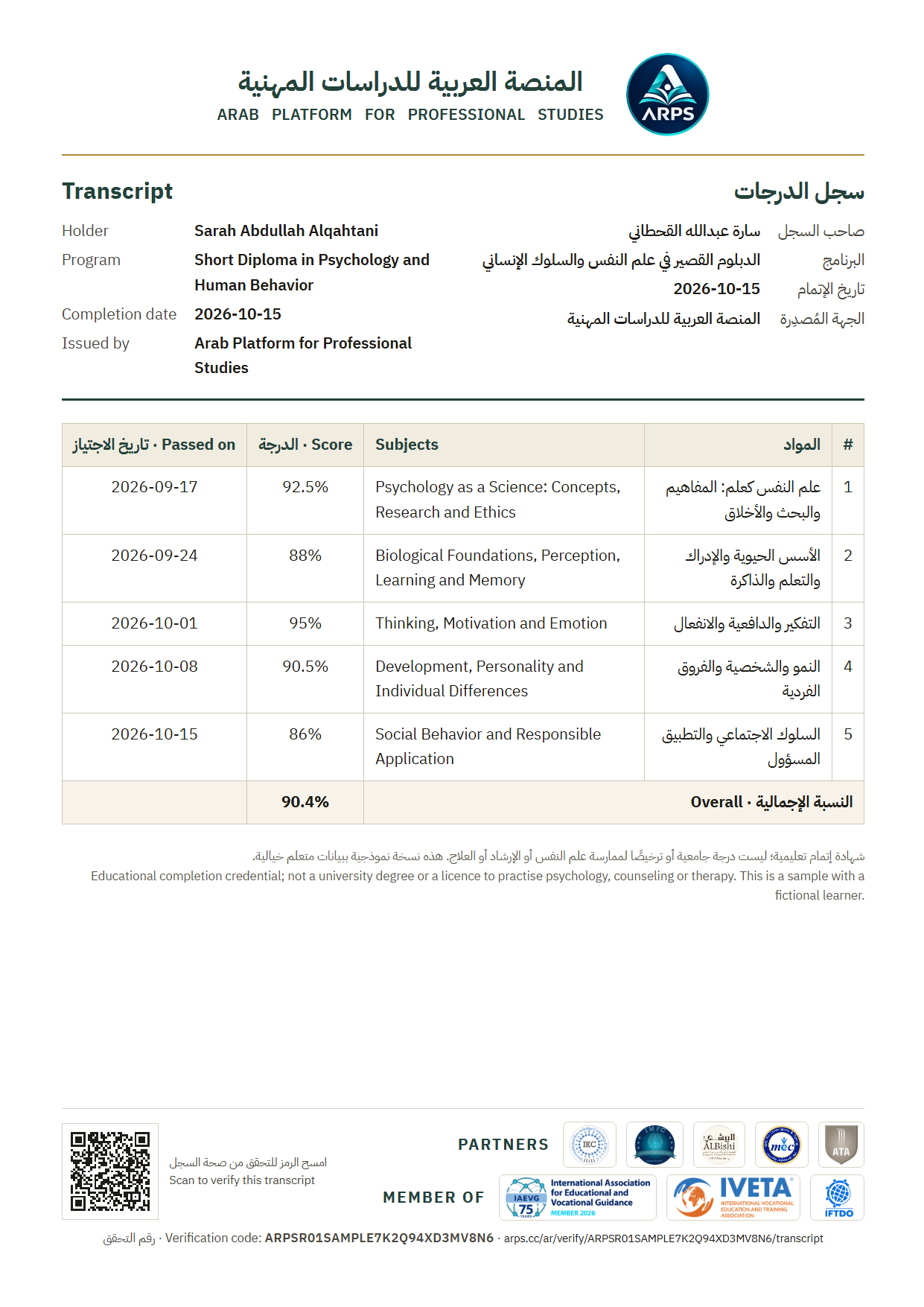
A sample from a real program in this track: Short Diploma in Psychology and Human Behavior. The learner, scores and dates are fictional; opens in a new window.
Disclaimer: Internal training completion credential with a subject transcript; not a degree or professional licence.
Program questions
Do I need an engineering background?
No. Basic tables and percentages are enough; real engineering requires qualified people and local standards.
Will I be qualified to declare drinking water safe?
You learn evidence limits and hazard pathways. Competent local bodies make actual compliance and health decisions.
Are the city figures in the cases real?
No. Named cities frame explicitly fictional scenarios; all figures are invented for learning.
How is the diploma assessed?
Lessons have practice and checks, followed by a recorded summative assessment for each subject.
Does the credential carry a licence or official hours?
Issuance is optional and paid: an internal credential with transcript, without a licence or official hours before calibration.
Show all (7)
Is Short Diploma in Water and Water Security free, and do I get a certificate?
Yes. Short Diploma in Water and Water Security is free on ARPS: every lesson, exercise and assessment is free, the first subject is open to read without an account, and the program is available in Arabic and English. Issuing a certificate is optional and has a published fee; it is a training completion certificate showing you passed the program's assessments, recognised by most private-sector organisations in the Gulf states and most Arab countries, and it strengthens your CV; confirming that a specific organisation accepts it remains your responsibility.
What other names is Short Diploma in Water and Water Security known by?
The subject of this program is also known as: water security, water resources management, water management. Learners usually find it by searching for: water security course, water resources management course, water management short course, free water security course.
A foundational short diploma that connects sustainability and ESG in practice: environmental, social and governance dimensions, materiality and stakeholders, emissions and climate risk, metrics and data, disclosure, transition planning and credible-claim review.
6 subjects
25 lessons
57 hours
Free
Short Diplomas
Environment, Sustainability, Energy, Agriculture & Food Systems
Seven assessed subjects build an applied foundation in biodiversity and natural resources, from inventory design to a bounded decision memo, evidence preparation and a restoration pilot. Learners work through fictional datasets, calculations and evidence limits in both languages.
7 subjects
26 lessons
85.5 hours
Free
Specialist Preparation Programs
Environment, Sustainability, Energy, Agriculture & Food Systems