Short Diploma in Facilities Management is a free program on ARPS, the Arab Platform for Professional Studies. A foundational short diploma connecting building services and users with assets, maintenance, space, suppliers, resources and risk. The lessons move from defining a service outcome to a bounded integrated improvement case.
Important notice: Independent education; no professional licence or endorsement by cited bodies. Technical safety decisions remain with competent specialists.
Calculate contact time within service hours and review denominator exceptions.
From lesson 1, readable now without an account: Facility Service Outcomes and Boundaries
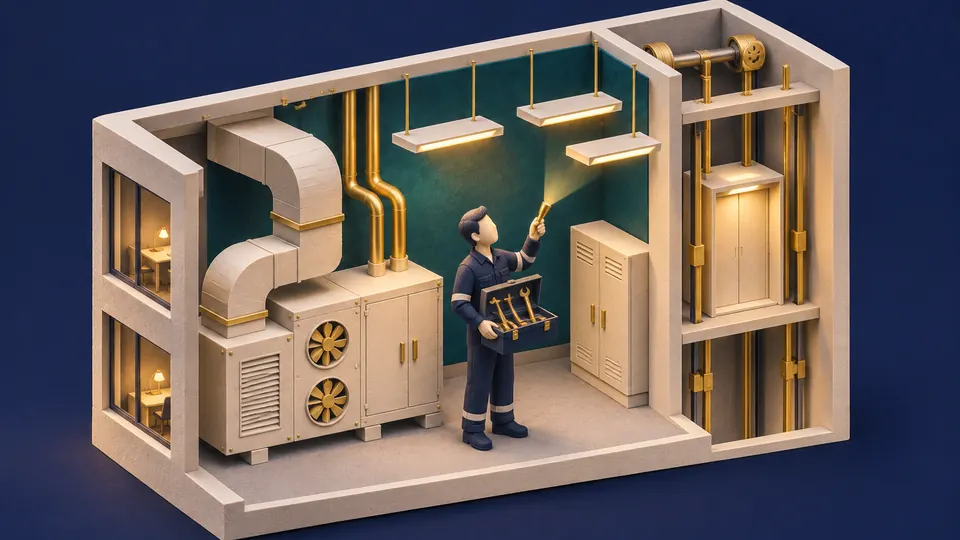
When a lift stops in an occupied building, the request sounds simple: repair the lift. A facilities coordinator must ask a broader question: who cannot reach their destination now, what service was expected, and what safe alternative exists while the equipment is unavailable? Facility management brings people, place and process together to support the organization's work. Its result is therefore more than a count of closed repair tickets. Continuity, user experience, risk and the resources used all matter. A technician may repair the machine and an external supplier may manage its contract, but someone must connect the repair to access, communication and verification of the outcome.
A free account saves your progress and takes you straight to lesson 1.
Program facts
Study fee
Free
subjects
7
lessons
26
Estimated time
74 hours
Content last reviewed
Access period
60 days
Study language
Arabic and English
About the program
A facilities coordinator must connect equipment repair with people's service, not only close tickets. The program begins with the demand organization, service outcomes and measurable levels. It then builds an asset register and maintenance choices that distinguish installed standby equipment from tested readiness. Space use, indoor-environment complaints and access are followed by normalized supplier bids, energy and water measures, and waste-stream evidence. The fifth subject combines risk, incident timelines and data quality in a reviewable improvement trial. Two further modules add operational readiness and resource control, then a capstone project for opening a fictional service center. Every operational case and price is fictional. Safety, design and regulatory decisions are explicitly directed to competent owners. Assessments test applied understanding within an educational completion diploma; they do not confer a license or external-body endorsement.
Practical relevance
Learners produce a service requirement sheet, service-level table, asset register, work-order board, space and energy measures, supplier review, risk entry and bounded improvement case.
Why this program
Facility service is shared among desk teams, technicians, suppliers and the demand organization. When metrics use different units or a case closes before the outcome is tested, a dashboard can appear strong while users still suffer. This program connects requirement definition, fault impact, maintenance, cost and alternatives to a measured result. It ends with a limited improvement proposal that can be tested and reversed if its assumptions fail.
Career relevance
Supports coordination of core facility services, reading asset and supplier records and discussing operating decisions with competent specialists. It does not replace engineering experience, licensing or specific hiring requirements.
Career paths this program serves
This program is a step on the paths of the following occupations. Open a path to see its other programs in study order.
Define verifiable facility-service outcomes, priorities, responsibilities and performance measures while stating decision limits.
Build a reliable asset register and prioritize maintenance and repair-versus-replacement decisions using service effects and available evidence.
Plan building-service continuity and incident response, escalating safety risks and verifying service recovery.
Measure energy, resource and indoor-environment performance with explicit data boundaries and propose verifiable improvement.
Review supplier, contract and governance performance and present a facility-improvement decision with effects, risks and evidence limits.
Show all (7)
Coordinate spare-parts stock, new-system acceptance and supplier scope changes with reviewable evidence.
Build a phased-opening evidence pack, resource plan, decision record and handover in a bounded simulation.
Learning outcomes (7)
Define verifiable facility-service outcomes, priorities, responsibilities and performance measures while stating decision limits.
Build a reliable asset register and prioritize maintenance and repair-versus-replacement decisions using service effects and available evidence.
Plan building-service continuity and incident response, escalating safety risks and verifying service recovery.
Measure energy, resource and indoor-environment performance with explicit data boundaries and propose verifiable improvement.
Review supplier, contract and governance performance and present a facility-improvement decision with effects, risks and evidence limits.
Coordinate material stock, system handover and supplier scope changes with reviewable evidence.
Build phased-opening evidence, resources, decision and handover records in a bounded simulation.
Who it is for
Designed for new building operations coordinators, administrative maintenance and reception supervisors, and staff overseeing cleaning, cooling, lift or space service contracts. It also suits learners moving from ticket tracking toward evidence-based decisions about outcomes, cost and risk. It does not presume that learners design electrical systems or interpret binding local requirements; such decisions remain with qualified specialists and the people authorized by the site.
Prerequisites
Suitable for someone who can read a simple incident table, add time intervals, calculate a percentage and distinguish an observation from an estimate. No advanced engineering background or particular maintenance software is assumed. Familiarity with an occupied building and its basic reporting process helps, but each professional term is explained when introduced and the lessons indicate when to consult an authorized technician or safety lead.
What it does not offer
Not preparation for engineering licensure, an IFMA credential or local compliance certification, and not a guide to electrical work or health diagnosis.
Facility management begins with the service people and the demand organization need, not with a disconnected list of faults. Learners distinguish repairing equipment from recovering a user outcome, then identify the affected group, decision owner, alternative and closure test. They translate demand into a service level with a defined clock and eligible denominator, calculating response compliance while documenting exceptions. A leak or interruption requires an explicit division of containment, specialist work, notice and verification without granting technical authority to an unqualified reporter. Finally, learners build a dashboard from comparable reports and separate overall workload from the high-impact category under decision. Lift, entry and climate cases show how a choice changes when an alternative lacks capacity or records use inconsistent counting units.
4 lessons · 8.5 hours
Facility Service Outcomes and Boundaries2 hours
Defining and Measuring Service Levels2 hours
Responsibilities and Handoffs2 hours
Performance Baseline and Decision Dashboard2 hours
Subject 2
Assets, Maintenance and Reliability
Learners build an asset register that distinguishes physical equipment from repeated labels and connects each item to location, system, work history and data ownership. An installed standby is not counted as ready until tested, so criticality follows failure impact, dependencies and recovery time. Reactive, preventive and condition-based maintenance are compared against failure mode and technical evidence rather than fashion. Work orders are sequenced by safety, continuity, alternatives and access windows, with outcome testing before closure. Repeated failures lead to testable competing explanations and a repair-versus-replace comparison over one cost horizon, excluding past sunk costs. The exercises demonstrate how a weak asset identity, an invented vibration limit or an untested backup can make a precise-looking decision unsound.
4 lessons · 8.5 hours
Asset Register and Criticality2 hours
Choosing a Maintenance Strategy2 hours
Work-Order Priority and Closure2 hours
Recurring Failure and Replacement Decision2 hours
Subject 3
Occupancy, Indoor Environment and User Experience
This subject treats a building as its users experience it. Learners compare bookings with actual room use and distinguish a weekly average from peak congestion before proposing a room reduction. For heat or odor complaints they record time and location and test competing explanations without diagnosing health or declaring engineering compliance from one sensor. They trace access from entry to the intended service, remove observed barriers and verify an alternative while respecting a reporter's privacy. An interruption notice then specifies affected users, timing, fallback and updates; incoming messages are triaged by impact rather than volume. Exercises connect room capacity, air schedules, cart storage and water restoration to testable choices, with safety and legal questions passed to competent owners.
Suppliers, Resources and Operational Sustainability
This subject compares service value on equivalent scope rather than ranking headline prices. Learners normalize cleaning bids for visit frequency and supplies and include uncertain rework in a conditional total. In supplier review they separate contact, arrival and restoration and require timestamped evidence before accepting an access-delay exception. For energy they define meter, area and period boundaries and compute intensity while accounting for changed workdays, weather and occupancy; a lower bill does not establish cause. Water and waste exercises investigate cumulative readings and possible overnight flow, calculate mixed paper per attendee and distinguish collection from confirmed processing. Every price and operational case is fictional, and an apparent saving remains a hypothesis until service and comparable data are tested.
4 lessons · 8.5 hours
Normalizing Service Bid Scope and Cost2 hours
Supplier and Contract Performance Review2 hours
Energy Intensity and Savings Tests2 hours
Water Investigation and Waste Sorting2 hours
Subject 5
Risk, Information and Integrated Improvement
The final subject brings earlier evidence into one decision. Learners state risk as an event and service consequence and distinguish possession of a battery or fallback from a successful test. They trace an incident from onset through user-service recovery and asset testing without extending one department's workaround to the whole building. They then audit asset and work-order records for physical identity, timestamps, closure tests and overlap among missing fields. The integrated case weighs cooling complaints, bookings, cost, energy and user comfort before proposing a reversible trial rather than unsupported purchasing. Its decision note states what is established, what remains uncertain, who owns the choice and when new facts should trigger review.
4 lessons · 8.5 hours
Facility Risk Register and Control Tests2 hours
Incident Coordination and Service Recovery2 hours
Asset and Work-Order Data Governance2 hours
A Reviewable Integrated Improvement Case2 hours
Subject 6
Operational Readiness and Resource Control
Adds operational control of spare-parts stock and reservations, acceptance of new systems with their operating knowledge, and supplier scope changes reconciled against invoices.
3 lessons · 9.5 hours
Spare Parts Stock and Reservation3 hours
Accepting a New System and Operational Knowledge3 hours
Controlling Scope Changes and Invoices3 hours
Subject 7
A Fictional Service Center Opening Project
A capstone in which learners plan a phased opening of a fictional service center, allocate resources and contingency, then rehearse the decision and hand over the file.
3 lessons · 13.5 hours
Capstone: A Phased Opening Evidence Pack4.5 hours
Capstone: Resources and Contingency Plan4.5 hours
Capstone: Decision Rehearsal and Handover4.5 hours
Subjects unlock in sequence as you progress.
Strengths
Varied numerical cases with observable outputs
Clear separation of response, recovery and verification
Integrated user, asset, supplier and risk decisions
Evidence basis
Scope follows IFMA's facility-management definition and primary standards and guidance overviews, with fictional numerical cases and explicit access limits.
Reference organizations
IFMA
ISO
U.S. Department of Energy
U.S. Environmental Protection Agency
Frameworks used
IFMA facility-management definition — Public guidance inspected 2026-10-23
DOE O&M best-practice guidance — Public guidance inspected 2026-10-23
EPA indoor-air guidance — Public guidance inspected 2026-10-23
ENERGY STAR metrics — Public guidance inspected 2026-10-23
Methodology
Original hypothetical cases and documented decisions identify service effects, data limits and specialist escalation.
How the route works
Short Diplomas are relatively comprehensive learning pathways that cover a major subject through five connected learning subjects and structured assessments, with a diploma transcript available with the credential.
Self-paced sequential study. Content unlocks progressively and each subject combines reading, examples, exercises, knowledge checks, and assessment.
Build integrated knowledge in a major subject.
Study through five clear, connected learning subjects.
Complete a defined assessment for each subject.
Receive a diploma transcript showing subjects and results when the credential is issued.
Assessment
Each Short Diploma contains five subjects, each with an approved assessment. A sixth final exam is not required when the five assessments adequately cover the learning outcomes.
Assessment attempts: 2 per assessment, 7 days apart
The pass mark is announced before the program is published.
Certificate
Successful completion makes the learner eligible for the Short Diploma certificate and Diploma Transcript under the credential policy.
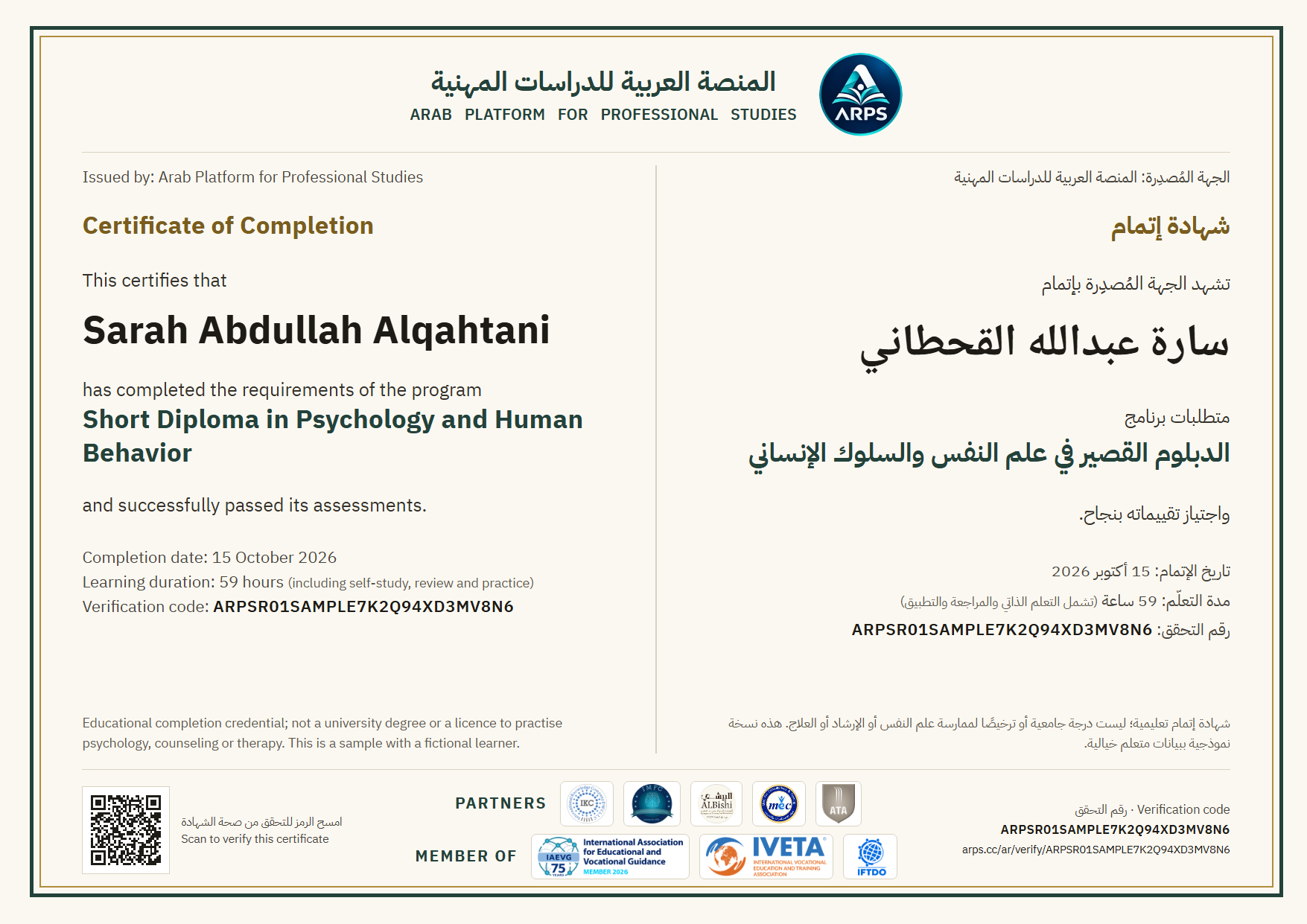
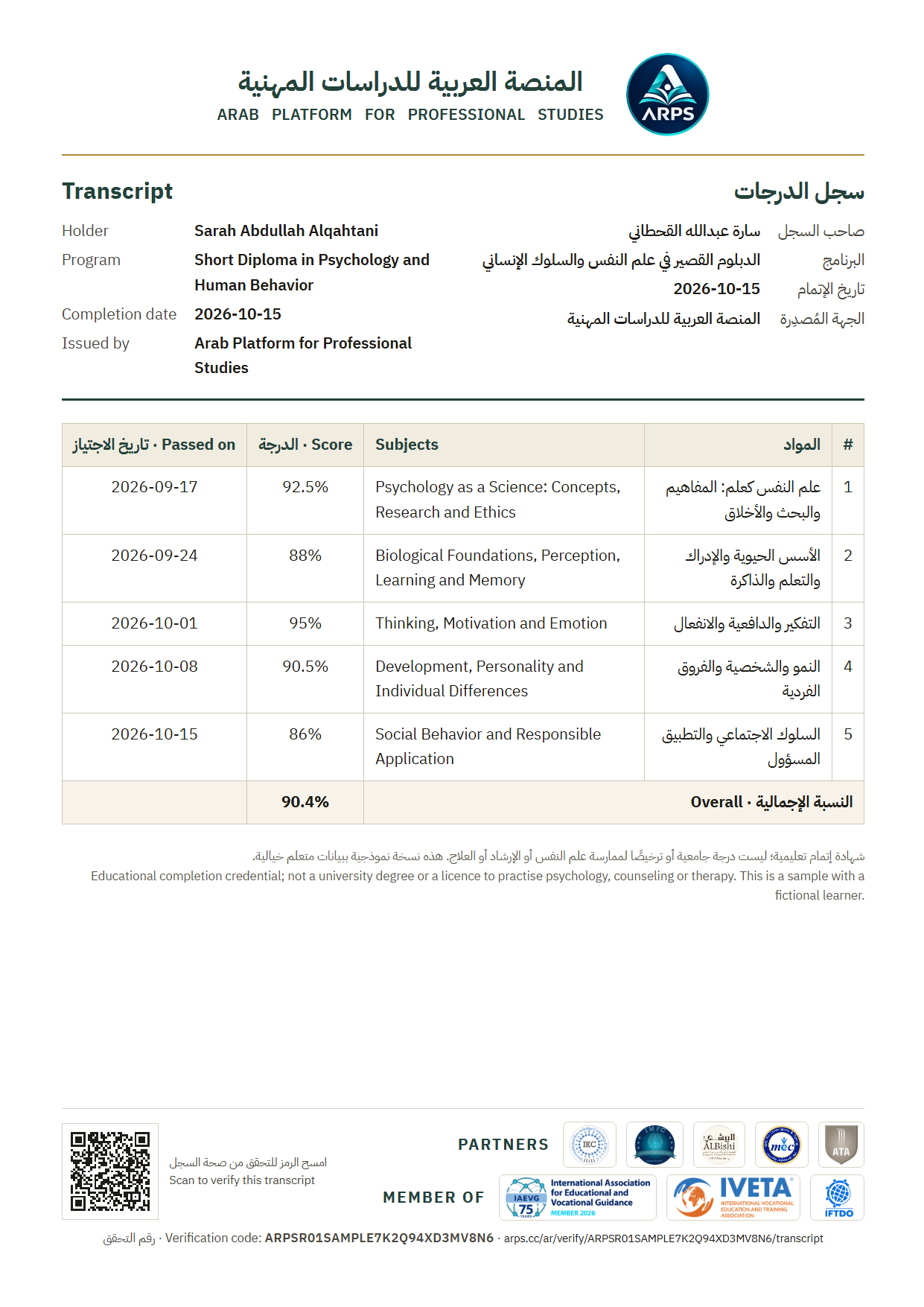
A sample from a real program in this track: Short Diploma in Psychology and Human Behavior. The learner, scores and dates are fictional; opens in a new window.
Disclaimer: Training completion, not a university degree or professional licence.
Program questions
Does this program grant a professional licence?
No. It is independent applied education and does not replace specialist qualification or site procedures.
Do I need engineering experience to start?
Engineering experience is not required; basic building-operations awareness and simple arithmetic help, while technical work remains with specialists.
Are the cases real building records?
No. Cases and figures are hypothetical decision practice, not local law or actual building performance.
Does the program authorize technical safety decisions?
It teaches escalation, verification and communication; qualified personnel and site procedures govern technical safety decisions.
How are learning outcomes checked?
Each lesson has two applied cases and a knowledge check, followed by a balanced subject assessment using independent items.
Show all (7)
Is Short Diploma in Facilities Management free, and do I get a certificate?
Yes. Short Diploma in Facilities Management is free on ARPS: every lesson, exercise and assessment is free, the first subject is open to read without an account, and the program is available in Arabic and English. Issuing a certificate is optional and has a published fee; it is a training completion certificate showing you passed the program's assessments, recognised by most private-sector organisations in the Gulf states and most Arab countries, and it strengthens your CV; confirming that a specific organisation accepts it remains your responsibility.
What other names is Short Diploma in Facilities Management known by?
The subject of this program is also known as: facilities management, facility management, property and facilities management. Learners usually find it by searching for: short course in facilities management, facilities management course, what is facilities management course, what qualifications do i need to be a facilities manager, facility maintenance management.
Practise facilities management specialist tasks from service report to asset decision: service card, asset register, work orders, maintenance, provider acceptance, occupant experience, resilience indicators and improvement. Fictional cases include worked feedback and clear authority boundaries.
9 subjects
32 lessons
60.5 hours
Free
Short Diplomas
Tourism, Hospitality, Events, Real Estate & Facilities
An applied foundation in managing tourism destinations as systems: demand and stakeholders, products and visitor experience, marketing, capacity, sustainability and risk. It uses country-neutral fictional cases and does not require advanced prior experience.
6 subjects
24 lessons
63.5 hours
Free
Short Diplomas
Tourism, Hospitality, Events, Real Estate & Facilities
An applied foundation linking property records, occupancy, maintenance and finance to a reviewable management plan through fictional cases and a summative assessment for each subject.
7 subjects
30 lessons
73.5 hours
Free
Professional Mini-Master
Tourism, Hospitality, Events, Real Estate & Facilities
Manage hotel service disruption from its effect on the guest journey through safe reopening and verified recovery, using evidenced decisions and one integrated assessment.