Short Diploma in Real Estate and Property Management
Short Diploma in Real Estate and Property Management is a free program on ARPS, the Arab Platform for Professional Studies. An applied foundation linking property records, occupancy, maintenance and finance to a reviewable management plan through fictional cases and a summative assessment for each subject.
Important notice: Independent education with optional completion credential; not a university degree, professional licence or endorsement by cited bodies.
Build a unit register with unique identifiers, defined area measures and dated sources, and expose conflicts instead of hiding them.
From lesson 1, readable now without an account: What are you managing, and for whom?
Imagine a building with four flats and two shops. One person owns it, occupiers use the units under different hypothetical agreements, and a management firm handles service requests for the owner. These are three different relationships: ownership of the asset, an occupier's agreed right to use a unit, and a manager's authority to perform specified work. Saying that the manager is 'responsible for the whole building' tells us too little about who may commit money or change occupancy terms. Start by reading the management instruction, describing the decision at hand, and identifying who owns that decision before making a promise or issuing a work order. This is a way to manage the case, not legal advice on a real agreement.
A free account saves your progress and takes you straight to lesson 1.
Program facts
Study fee
Free
subjects
7
lessons
30
Estimated time
73.5 hours
Content last reviewed
Access period
60 days
Study language
Arabic and English
About the program
How does a property manager decide what to investigate today, what needs owner approval and what counts as a verified result? The program begins with units, agreements and authority; moves through occupancy and occupier experience, maintenance work and risk, operating statements and budgets; then a dashboard and integrated property plan, and closes with record, collection and service-quality labs and a property committee capstone. Learners calculate simple rates, balances and costs while stating data sources and assumptions before recommending action. Cases and figures are fictional teaching devices, not market prices or universal legal requirements. Seven subject summatives sit alongside lesson knowledge checks. The optional platform training-completion credential is neither a university degree nor a professional licence or regulated status.
Practical relevance
Use a unit record, work order, bid comparison, operating statement and simple quarterly plan in a learning case or authorized work, adapting them to local agreements and policies.
Why this program
Property decisions are connected: vacancy changes income, a shop leak changes service and repair cost, and collection cash may reflect old debt. The program links records, investigation, calculation, authority and outcome in one method.
Career relevance
Suitable for people beginning to coordinate property records, occupier contact, vendors and budgets. It develops decision and evidence literacy in an educational scope, without promising employment or eligibility for licensed practice.
Career paths this program serves
This program is a step on the paths of the following occupations. Open a path to see its other programs in study order.
Document property units, parties and authority boundaries.
Calculate occupancy and arrears with stated period and denominator.
Sequence offer, agreement and handover and triage occupier reports.
Write work orders, compare contractor bids and assess operating risk.
Read operating results, budgets, variances and short asset lifecycle costs.
Show all (8)
Build a dashboard, quarterly action plan and traceable management handover.
Migrate a unit register, reconcile occupier receipts and audit a service-level agreement through documented work products.
Prepare a property committee dossier that freezes evidence, funds a work package under a cash constraint and transfers follow-up.
Learning outcomes (30)
Distinguish the property asset, occupancy rights, owner objective and manager mandate, then build a responsibility map for concurrent requests.
Build a unit register with unique identifiers, defined area measures and dated sources, and expose conflicts instead of hiding them.
Extract operating data from a fictional occupancy agreement while distinguishing explicit terms, ambiguity and questions needing specialist advice.
Record a defect with location, time and evidence, triage urgent exposure against nonurgent defects, and identify what requires specialist diagnosis.
Calculate snapshot vacancy, occupied unit-days and occupier turnover with stated denominator, period and exclusions.
Design a clear process separating enquiry, offer, acceptance, agreement and handover, with verification before each commitment.
Document unit condition at handover and exit, matching images and locations before attributing a change to the occupancy period.
Triage occupier reports by exposure, disruption and evidence, then give two honest updates without unverified promises.
Compare renewal and reletting cash over a defined horizon, calculate break-even downtime and interpret assumption limits.
Distinguish reactive from preventive work and prioritize two assets using failure impact, history and access window.
Draft a work order that states location, symptom, investigation scope, acceptance evidence, approval limit and escalation without assuming the fault's cause.
Normalize two bids that differ in scope, total cost, timing and risk, and identify the question needed before purchase.
Build a simple risk register distinguishing likelihood, impact, controls, residual risk, owner and review date without false numerical precision.
Distinguish attendance, work performance and acceptance, and document defects, deferred tests, payment decisions and follow-up under the applicable authority.
Prepare a simple operating statement separating period revenue, billing, collections, arrears and operating expense with an explicit result definition.
Prepare an annual forecast with timed contract changes and stated contingency, explaining a midyear rate change.
Calculate an operating variance, separate volume and rate effects, check invoice period and avoid unsupported blame.
Separate operating repair, capital replacement and owner approval, comparing a simple three-year cash view with disclosed sensitivity.
Allocate a shared cost under a hypothetical agreement and documented area, separate vacancy share, and reconcile budget to actual without universal recoverability claims.
Define four indicators for occupancy, arrears, response and maintenance with denominator, timing, source and data status across sites.
Prioritize quarterly actions with owner, date, budget, verification metric and approval boundary, explaining the effect of deferral.
Compare simplified hold and improve cash under sensitivity, and identify missing inputs before comparing disposal with ongoing ownership.
Assemble a handover package covering assets, agreements, balances, work orders, approvals, access and follow-up ownership while protecting information.
Write a one-page plan connecting baseline, sequenced actions, owners, authority, measures and assumption review.
Migrate a unit register without losing decision history through an evidenced, bounded work product.
Reconcile occupier receipts and a repayment proposal through an evidenced, bounded work product.
Audit a service-level agreement with a defensible sample through an evidenced, bounded work product.
Capstone dossier: freeze evidence and frame the decision through an evidenced, bounded work product.
Capstone panel: fund a work package under a cash constraint through an evidenced, bounded work product.
Capstone closeout: test results and transfer follow-up through an evidenced, bounded work product.
Who it is for
Designed for beginners and early-career property, asset, occupancy and facilities coordinators in residential or commercial settings who need to connect unit records, agreements, service and cost.
It also serves assistant property managers and staff reviewing occupier reports, work orders, supplier bids and budgets under a named decision maker.
It is not a route to licensed brokerage, professional valuation or country-specific legal advice; those require separate specialist preparation.
Prerequisites
No advanced property experience or professional licence is required. The program introduces basic records and explains authority limits before asking the learner to recommend a decision.
Learners should be able to read short agreements and tables, calculate percentages, multiply and subtract, and track dates, amounts and denominators in fictional cases. A calculator or simple spreadsheet can help check results; no specialist property system or real asset data is needed.
What it does not offer
This is not authorization to broker, value property or give regulated legal or financial advice.
It does not certify that one leasing, safety or cost-recovery rule applies in a particular country.
A property decision starts by identifying what is managed and on whose authority someone acts
4 lessons · 6 hours
What are you managing, and for whom?57 min
A property register fit for decisions57 min
Read the agreement without inventing missing terms54 min
From inspection to a verifiable repair decision57 min
Subject 2
Occupancy and occupier experience
Occupancy is a measure with a definition and time, not a general verdict on property success
5 lessons · 7 hours
Three occupancy indicators, three different questions54 min
From occupier enquiry to unit handover54 min
Condition record: compare the same thing at two times54 min
Receive the complaint, then triage it clearly57 min
Renew or relet? Price the time and cost54 min
Subject 3
Operations, maintenance and risk
Property operations link the asset register to failure history and the effect of interrupted service on occupiers
5 lessons · 7 hours
Plan maintenance before every task becomes urgent57 min
Write a work order with a clear scope and safety boundary57 min
Compare contractor bids on a common scope54 min
Turn risk observations into reviewable actions57 min
Verify completion before accepting the invoice57 min
Subject 4
Property finance and budgeting
Start a financial statement with period and basis
5 lessons · 7 hours
Read a property operating statement before judging cash54 min
Build an operating budget from units and assumptions54 min
Explain budget variance by price, volume and timing54 min
Compare repair and replacement over a short lifecycle54 min
Explain and reconcile a service-cost allocation54 min
Subject 5
Performance and property management plan
A property dashboard starts with period and denominator, not indicator color
5 lessons · 7 hours
Choose a dashboard with comparable definitions54 min
Turn owner goals and occupier concerns into a quarterly plan57 min
Compare hold, improve and dispose without claiming a valuation54 min
Hand over property management without losing open issues57 min
Integrate occupancy, operations and finance in one property plan54 min
Subject 6
Record, collection and service-quality labs
Three labs requiring documented work: migrating a unit register without losing decision history, reconciling occupier receipts with a repayment proposal, and auditing a service-level agreement with a defensible sample.
3 lessons · 19.5 hours
Migrate a unit register without losing decision history6 hours
Reconcile occupier receipts and a repayment proposal6 hours
Audit a service-level agreement with a defensible sample6 hours
Subject 7
Capstone: a property management committee dossier
A property committee capstone in three stages: freezing evidence and framing the decision, funding a work package under a cash constraint, then testing results and transferring follow-up.
3 lessons · 19.5 hours
Capstone dossier: freeze evidence and frame the decision5.5 hours
Capstone panel: fund a work package under a cash constraint6 hours
Capstone closeout: test results and transfer follow-up6 hours
Subjects unlock in sequence as you progress.
Strengths
Seven subjects connect property records with occupancy, operations, finance and final decisions.
Worked fictional cases and exercises have solutions and disclosed limits.
Varied lesson checks and subject banks include option-specific explanations.
Recurring distinctions separate observation from cause, cash from dues and performance from acceptance.
Evidence basis
Uses RICS property-management, maintenance and measurement guidance within its scope, IFMA operations competencies and BOMA educational topics. A UK service-charge example is illustrative, not general law. Explanations and questions are original.
Reference organizations
Royal Institution of Chartered Surveyors (RICS)
International Facility Management Association (IFMA)
Building Owners and Managers Association International (BOMA)
International Property Measurement Standards (IPMS)
Frameworks used
RICS Property agency and management principles — professional context only — first edition 2024, effective 2025
IPMS All Buildings — consistent area definition principle — 2023
Methodology
Subjects progress from records to a decision plan with fictional worked cases and original items. The author reviewed both locales and keys; no learner trial or external accreditation review occurred.
How the route works
Short Diplomas are relatively comprehensive learning pathways that cover a major subject through five connected learning subjects and structured assessments, with a diploma transcript available with the credential.
Self-paced sequential study. Content unlocks progressively and each subject combines reading, examples, exercises, knowledge checks, and assessment.
Build integrated knowledge in a major subject.
Study through five clear, connected learning subjects.
Complete a defined assessment for each subject.
Receive a diploma transcript showing subjects and results when the credential is issued.
Assessment
Each Short Diploma contains five subjects, each with an approved assessment. A sixth final exam is not required when the five assessments adequately cover the learning outcomes.
Assessment attempts: 2 per assessment, 7 days apart
The pass mark is announced before the program is published.
Certificate
Successful completion makes the learner eligible for the Short Diploma certificate and Diploma Transcript under the credential policy.
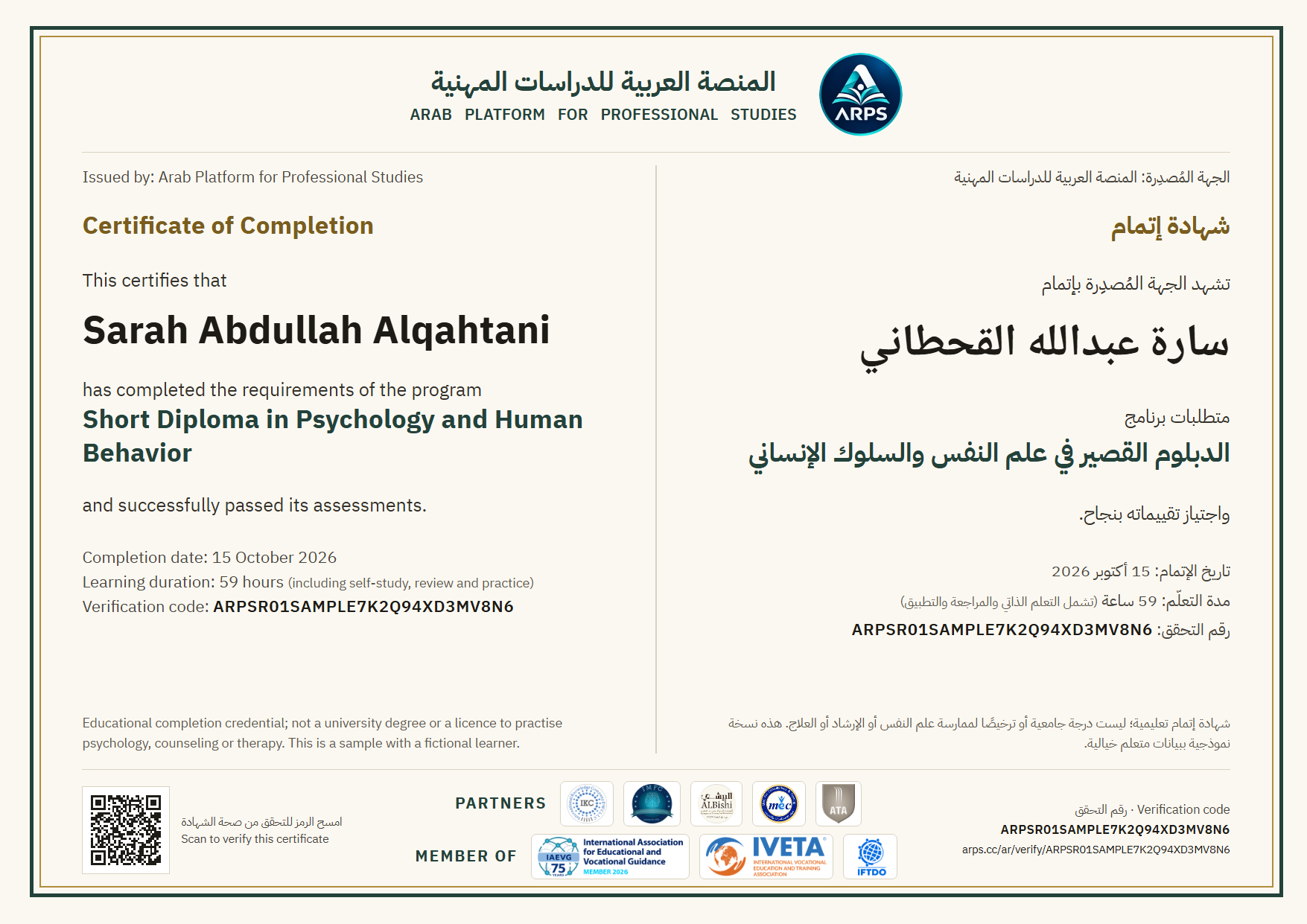
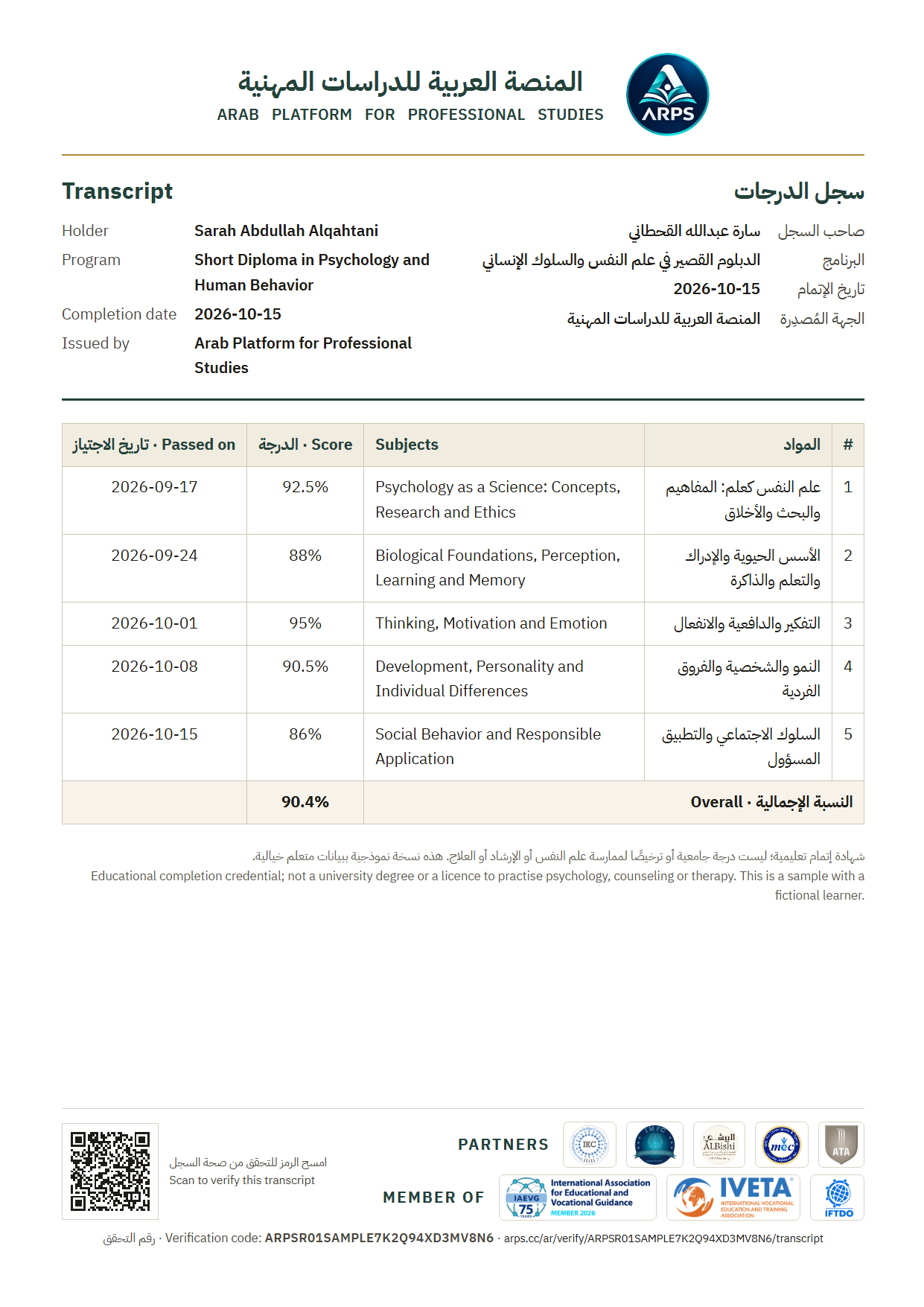
A sample from a real program in this track: Short Diploma in Psychology and Human Behavior. The learner, scores and dates are fictional; opens in a new window.
Disclaimer: Training completion, not a university degree or professional licence.
Program questions
Do I need prior experience?
No advanced experience is required; willingness to work through short cases and simple calculations is enough.
Which records will I learn to use?
You work with property and unit records, maintenance tickets, cost and due-date logs, and service handover records while separating observations from decisions.
How long is access?
The route sets a 30-day nominal duration and 60-day access window. Official learning hours are not set yet.
How am I assessed?
There are lesson knowledge checks and one summative per subject with a subject-results transcript; the platform policy sets the actual passing threshold.
Does this grant a property licence?
No. It is foundational training with an optional completion credential, not a professional licence or regulated title.
Show all (10)
Can I apply the agreement examples directly in my country?
Rules and contracts differ by location. Cases are fictional; check the applicable agreement, policy and local specialist before a real decision.
What does the service handover exercise cover?
Cases separate supplier completion, output inspection, acceptance and defect logging, then link acceptance to a payment decision under stated assumptions.
What kind of cases are used?
Fictional properties, units, suppliers and budgets with worked calculations, guided answers and assumption limits.
Is Short Diploma in Real Estate and Property Management free, and do I get a certificate?
Yes. Short Diploma in Real Estate and Property Management is free on ARPS: every lesson, exercise and assessment is free, the first subject is open to read without an account, and the program is available in Arabic and English. Issuing a certificate is optional and has a published fee; it is a training completion certificate showing you passed the program's assessments, recognised by most private-sector organisations in the Gulf states and most Arab countries, and it strengthens your CV; confirming that a specific organisation accepts it remains your responsibility.
What other names is Short Diploma in Real Estate and Property Management known by?
The subject of this program is also known as: property management, real estate management, property asset management, facility and property management. Learners usually find it by searching for: property management courses online, property management courses for beginners, property management courses free, how to become a property manager, real estate management course.
An applied foundation in managing tourism destinations as systems: demand and stakeholders, products and visitor experience, marketing, capacity, sustainability and risk. It uses country-neutral fictional cases and does not require advanced prior experience.
6 subjects
24 lessons
63.5 hours
Free
Short Diplomas
Tourism, Hospitality, Events, Real Estate & Facilities
A foundational short diploma connecting building services and users with assets, maintenance, space, suppliers, resources and risk. The lessons move from defining a service outcome to a bounded integrated improvement case. Each subject uses fictional worked cases, exercises with solutions, a knowledge check and a summative assessment. Learners calculate measures with explicit denominators, test alternatives before announcing recovery and identify where specialist judgment is required. Completion is educational and does not authorize licensed practice.
7 subjects
26 lessons
74 hours
Free
Specialist Preparation Programs
Tourism, Hospitality, Events, Real Estate & Facilities
Practise facilities management specialist tasks from service report to asset decision: service card, asset register, work orders, maintenance, provider acceptance, occupant experience, resilience indicators and improvement. Fictional cases include worked feedback and clear authority boundaries.
9 subjects
32 lessons
60.5 hours
Free
Professional Mini-Master
Tourism, Hospitality, Events, Real Estate & Facilities
Manage hotel service disruption from its effect on the guest journey through safe reopening and verified recovery, using evidenced decisions and one integrated assessment.