Specialist Preparation Program in Facilities Management
Specialist Preparation Program in Facilities Management is a free program on ARPS, the Arab Platform for Professional Studies. Practise facilities management specialist tasks from service report to asset decision: service card, asset register, work orders, maintenance, provider acceptance, occupant experience, resilience indicators and improvement. Fictional cases include worked feedback and clear authority boundaries.
Classify a fictional facility request into service and hazard paths, then write a card specifying scope, output, acceptance test, decision owner, and escalation.
From lesson 1, readable now without an account: From occupant need to a defined service card
Facility management connects place, people, and processes so that the built environment supports the purpose of the organization using it. A specialist does more than receive reports and dispatch them: the specialist turns a need into a service that can be delivered and verified within a stated authority. When an occupant says, ‘the corridor is unsuitable,’ filing the message under cleaning is premature. The problem might be a slippery floor, poor lighting, an obstruction, or uncomfortable temperature. Priority and accountable expertise change with the cause. Begin the service card with the symptom as reported, its location and time, and its immediate effect. Separate an observed fact from an intake worker's inference. Do not attribute a technical diagnosis to the occupant or convert a guess into a recorded fact.
A useful card has six working parts:
verifiable input
scope identifying the area and element
observable output
acceptance test
delivery owner
and decision owner when authority is exceeded
Input might be a report, a photograph stripped of personal information, and a room identifier. Output might be a dry floor and a resolved source of water, or a qualified inspection record, rather than ‘handled.’ The acceptance test differs from a response deadline. The former establishes the condition after work; the latter measures when action began. If electric shock, injury, or loss of a critical service is plausible, route the case through the site's safety and escalation procedure rather than the ordinary service queue. The facilities specialist coordinates warning, access control, and referral to competent staff. The specialist does not open an electrical panel or pronounce an area safe from a photograph.
Service boundaries specify what a team is engaged to do. Cleaning may include drying a surface after the water source is controlled. It does not include repairing a pipe or certifying electrical safety. If more than one team is needed, retain a parent case identifier and link the child work orders. Otherwise a complaint can appear closed after cleaning while the leak remains. Mark each child order with its parent case and expected update point. Tell the occupant what is complete and what is pending without promising a completion time outside the team's control. A good service card permits execution and review even when the helpdesk shift changes.
A free account saves your progress and takes you straight to lesson 1.
Program facts
Study fee
Free
subjects
9
lessons
32
Estimated time
60.5 hours
Content last reviewed
Access period
30 days
Study language
Arabic and English
About the program
A facilities management specialist works between users, assets, maintenance teams and providers. This program defines verifiable service output, builds an asset register with identity and provenance, triages orders, plans supported maintenance and tests closure rather than relying on attendance.
Learners map system dependencies, coordinate permits and isolation with qualified people, and review HVAC evidence within authority. They write provider scope, calculate an SLA with a defined denominator, protect complaint privacy and preserve open cases across handover. Space, resources and comfort are compared with operating context.
Finally they calculate availability, coordinate interruption, test a small improvement with a harm measure, and compare asset keep and renewal options with costs, risk and assumptions. Each lesson has fictional practice and a worked check. Time is an internal estimate; the program claims no licence, accredited hours or technical authorization.
Practical relevance
The methods can support a service card, asset record, triage list, maintenance plan, acceptance note, provider report and conditional renewal brief. Cases are fictional and must be adapted to local site rules, contracts and competent approvals before use.
Why this program
The program focuses on the practitioner who coordinates, measures and escalates facility services within a defined remit. Each lesson joins a decision to an inspectable work product so concepts lead to action and evidence.
Career paths this program serves
This program is a step on the paths of the following occupations. Open a path to see its other programs in study order.
Define verifiable service outputs and link them to asset identity and outage consequence.
Triage work orders, plan supported maintenance and close work through service testing.
Coordinate safety boundaries and review HVAC evidence with qualified people.
Measure provider performance, handle complaints and transfer open cases with minimal necessary data.
Interpret space, resource and comfort measures in their operating context.
Show all (9)
Calculate availability, test improvement and compare asset keep and renewal options with uncertainty.
Manage spares, the maintenance backlog, the operating budget and service change in an occupied site.
Use inspection samples, space acceptance, provider meetings and shift knowledge files as reviewable evidence.
Build and hand over a service-centre operating dossier, from a reconciled baseline to tested interventions.
Learning outcomes (32)
Classify a fictional facility request into service and hazard paths, then write a card specifying scope, output, acceptance test, decision owner, and escalation.
Create register rows for similar assets with unique IDs, location, boundary, evidence source, and verification status; detect duplicates and missing data.
Rank assets from consequence, likelihood, and fallback data; show how one changed fact alters priority; separate escalation from repair authority.
Classify reports from their evidence, identify the first action and authority boundary, and record priority rationale with a trigger for reassessment.
Turn documented requirements into maintenance tasks with owner, timing, approval, and planned downtime; resolve resource conflicts without inventing a universal frequency.
Distinguish task completion from service acceptance and decide closure or reopening after recurring failure using test evidence and chronology.
Map a service to assets, supplies, and affected areas; distinguish a shared symptom from a possible source while reserving technical diagnosis for qualified staff.
Check readiness for work near hazardous energy and stop or escalate when the authorized isolator, permit evidence, or site handover is missing.
Review an HVAC inspection request, technician result, and occupant reports; decide acceptance or follow-up using site criteria and measurement evidence.
Turn a cleaning or occupant-service need into areas, frequency, outcomes, evidence, and exclusions; distinguish a scope change from failed delivery.
Calculate compliance from a case log, distinguish response from resolution, and review access exceptions and invoice evidence without imposing unauthorized contract deductions.
Document a recurrent complaint without unnecessary personal data, linking it to work, verification, communication, and disclosure limits.
Produce a handover list covering open work, assets, access, risks, and acceptance, distinguishing service transfer from commercial closeout.
Calculate use from bounded observations and describe sampling bias without confusing approved capacity with observed attendance or relocating activities without checks.
Compare consumption periods with operating hours and meter boundaries, specifying field checks before attributing an increase to a fault or savings to an action.
Design a check for a comfort complaint conflicting with a sensor, then test an authorized change with a success measure and stop condition.
Sequence protection, impact assessment, fallback, communication, and recovery; identify an untested alternative and a decision reserved to the continuity owner.
Calculate bounded unplanned downtime and availability while exposing the effect of missing logs, planned outages, and small samples.
Form an improvement hypothesis for delayed service with baseline, sample, safety measure, and continue-or-stop decision without claiming causation from one week.
Compare keep and renew options using life-cycle cost, downtime, risk and data quality, then escalate a conditional recommendation within specialist authority.
Produce a defensible work artifact for spares between service readiness and excess stock with evidence and appropriate authority limits.
Produce a defensible work artifact for an executable maintenance backlog with evidence and appropriate authority limits.
Produce a defensible work artifact for an operating budget separating commitments and cash with evidence and appropriate authority limits.
Produce a defensible work artifact for changing service in an occupied site with evidence and appropriate authority limits.
Produce a defensible work artifact for an inspection sample exposing hidden service defects with evidence and appropriate authority limits.
Produce a defensible work artifact for accepting a new space before occupancy with evidence and appropriate authority limits.
Produce a defensible work artifact for a provider meeting ending in actionable decisions with evidence and appropriate authority limits.
Produce a defensible work artifact for a knowledge file usable by the next shift with evidence and appropriate authority limits.
Produce a defensible work artifact for project: establish a baseline from conflicting records with evidence and appropriate authority limits.
Produce a defensible work artifact for project: a work window with service continuity with evidence and appropriate authority limits.
Produce a defensible work artifact for project: test the benefit of two operational interventions with evidence and appropriate authority limits.
Produce a defensible work artifact for project: present and hand over a decision dossier with evidence and appropriate authority limits.
Who it is for
Facility coordinators, service supervisors and work-order staff with initial experience working alongside teams or providers who seek specialist responsibility. It suits learners who need to interpret asset records and service measures and prepare evidence-based owner recommendations. They should be willing to use simple tables and percentages and to recognize when escalation is required. Engineering or electrical authorization is neither assumed nor granted.
Prerequisites
You should recognize a work order, asset and provider and be able to read a simple table, calculate a percentage and record a site observation. Some work or training around building services helps, but technical qualification is not required. If you lack authority for a permit, isolation or system adjustment, your role in these exercises remains coordination, verification and escalation to a competent person.
Facilities management begins by defining the service a user expects and turning a report into a verifiable output. This module distinguishes cleaning the effect of a leak from checking its source and shows how to make a service card with an acceptance owner and authority boundary. It then builds an asset register with unique identity, location and provenance; similar units do not become one asset because names repeat. Finally, asset criticality is compared using outage consequence and backup capacity actually tested. Learners produce a service card, register rows and a reasoned ranking, and identify when qualified inspection is required.
3 lessons · 2 hours
From occupant need to a defined service card36 min
An asset register that supports location and maintenance36 min
Asset criticality: interruption, alternatives, and uncertainty34 min
Subject 2
Work orders and maintenance
The volume of work orders alone does not show that service is recovering. This module first triages reports by safety exposure, service consequence and time, separating response speed from intervention priority. It then builds a preventive calendar from task source, asset condition and available resources rather than assuming a universal interval. The third lesson separates task completion from acceptance: operational test, recurrent fault and a linked reopen record. Learners rank competing reports, review a schedule and write either an acceptance note or a follow-up decision. The specialist keeps the evidence chain intact without performing technical work outside authority.
3 lessons · 1.5 hours
Triage a work order without confusing hazard and queue time34 min
Preventive maintenance from evidence to calendar34 min
Close a work order after functional verification34 min
Subject 3
Systems, safety and intervention boundaries
Facility systems depend on one another; a symptom in one room may arise from shared supply or control. This module maps affected service from dependencies before asserting a diagnosis. It then organizes a stop point for work around hazardous energy: who permits, who isolates, who communicates with occupants and who tests return to service. OSHA guidance is discussed only in its U.S. scope, not as universal local law. Finally, HVAC acceptance uses a measurement representative of the complaint location and time, plus competent test evidence, without turning the specialist into a technician. Outputs are an impact map, readiness checklist and verification report.
3 lessons · 1.5 hours
Map service dependencies before diagnosing a fault34 min
Work readiness and energy isolation within authority34 min
Accept HVAC service from evidence, not impression34 min
Subject 4
Occupant services and providers
Provider management needs a service description and outcome, not a general promise or invoice. This module writes scope by place, frequency, exclusion and inspection test. It then calculates an SLA indicator from an eligible numerator and denominator, separating administrative closure from verified acceptance. An occupant complaint becomes a service record containing only data needed for response, without unnecessary identity or image sharing. During provider transition, open orders, warranties and follow-up ownership survive a joint handover. Learners produce a scope table, indicator calculation, redacted complaint record and handover note that protects service continuity.
4 lessons · 2 hours
A service scope that defines acceptance and exclusions32 min
A service-level measure with a defensible denominator32 min
Occupant complaint: service resolution with minimal data34 min
Transfer service between providers without losing obligations36 min
Subject 5
Space, resources and occupant experience
This module links occupant experience, space and resources without treating one number as a final verdict. Space analysis distinguishes approved capacity from observed attendance and states observation period and missing records. Energy and water comparisons account for operating hours, load and weather before labeling a rise an anomaly or a saving. Comfort review joins user complaint, local measurement, activity and solar exposure and calls for qualified inspection before system change. Learners produce conditional indicators and a repeatable verification plan. They can explain what was actually measured, what remains a hypothesis and how the decision reaches occupants and owner.
3 lessons · 1.5 hours
Space use between capacity and observation30 min
Understand energy and water anomalies before claiming savings34 min
Connect comfort reports, measurements, and activity34 min
Subject 6
Resilience, performance and improvement
This module brings the earlier work into a defensible resilience and improvement decision. During a critical interruption, learners map failure consequence, standby limits, status message and return step. They calculate availability from eligible hours and unplanned downtime without mixing planned maintenance into the denominator, while recognizing small-sample limits. A small improvement trial uses a baseline, harm measure and stop rule rather than declaring success after one week. Finally, keep and renew options are compared across one horizon with costs, risk and assumptions that might reverse the result. The decision file identifies evidence, approval authority and a review trigger.
4 lessons · 2.5 hours
Critical service loss: response, then continuity34 min
Reliability measures from records, not dashboard colour34 min
A small improvement test before wider rollout34 min
Asset renewal decision across cost and reliability36 min
Subject 7
Supply, cost and service change
This unit connects spares between service readiness and excess stock, an executable maintenance backlog, an operating budget separating commitments and cash, changing service in an occupied site through distinct applied outputs.
4 lessons · 15 hours
Spares between service readiness and excess stock3.5 hours
An executable maintenance backlog3.5 hours
An operating budget separating commitments and cash3.5 hours
Changing service in an occupied site3.5 hours
Subject 8
Provider evidence and space acceptance
This unit connects an inspection sample exposing hidden service defects, accepting a new space before occupancy, a provider meeting ending in actionable decisions, a knowledge file usable by the next shift through distinct applied outputs.
4 lessons · 15 hours
An inspection sample exposing hidden service defects3.5 hours
Accepting a new space before occupancy3.5 hours
A provider meeting ending in actionable decisions3.5 hours
A knowledge file usable by the next shift3.5 hours
Subject 9
Capstone: service-centre operating dossier
This unit connects project: establish a baseline from conflicting records, project: a work window with service continuity, project: test the benefit of two operational interventions, project: present and hand over a decision dossier through distinct applied outputs.
4 lessons · 15 hours
Project: establish a baseline from conflicting records3.5 hours
Project: a work window with service continuity3.5 hours
Project: test the benefit of two operational interventions3.5 hours
Project: present and hand over a decision dossier3.5 hours
Subjects unlock in sequence as you progress.
Strengths
Fictional cases with specific figures, decisions and worked answers distinct from practice inputs.
Work tools connect service, asset, provider, occupant and resilience choices.
Explicit authority boundaries and official source scope without treating one standard or law as universal.
Evidence basis
The material uses issuing-source pages and resources from ISO, IFMA, ASHRAE, the U.S. Department of Energy, EPA, NIST and OSHA within the latter's U.S. scope. Full paid standards were not accessed, so their public overviews only frame limited claims. Training figures and settings are fictional.
Methodology
Service card, asset register, work orders, measures, improvement trial and renewal choice with authority limits.
Assessment
Assessments follow the program blueprint and may use module assessments, a final assessment, or a combination, under the approved attempt policy.
Assessment attempts: 2 per assessment, 7 days apart
The pass mark is announced before the program is published.
Certificate
The credential confirms completion and successful assessment; it does not represent professional licensure unless explicitly and lawfully stated.
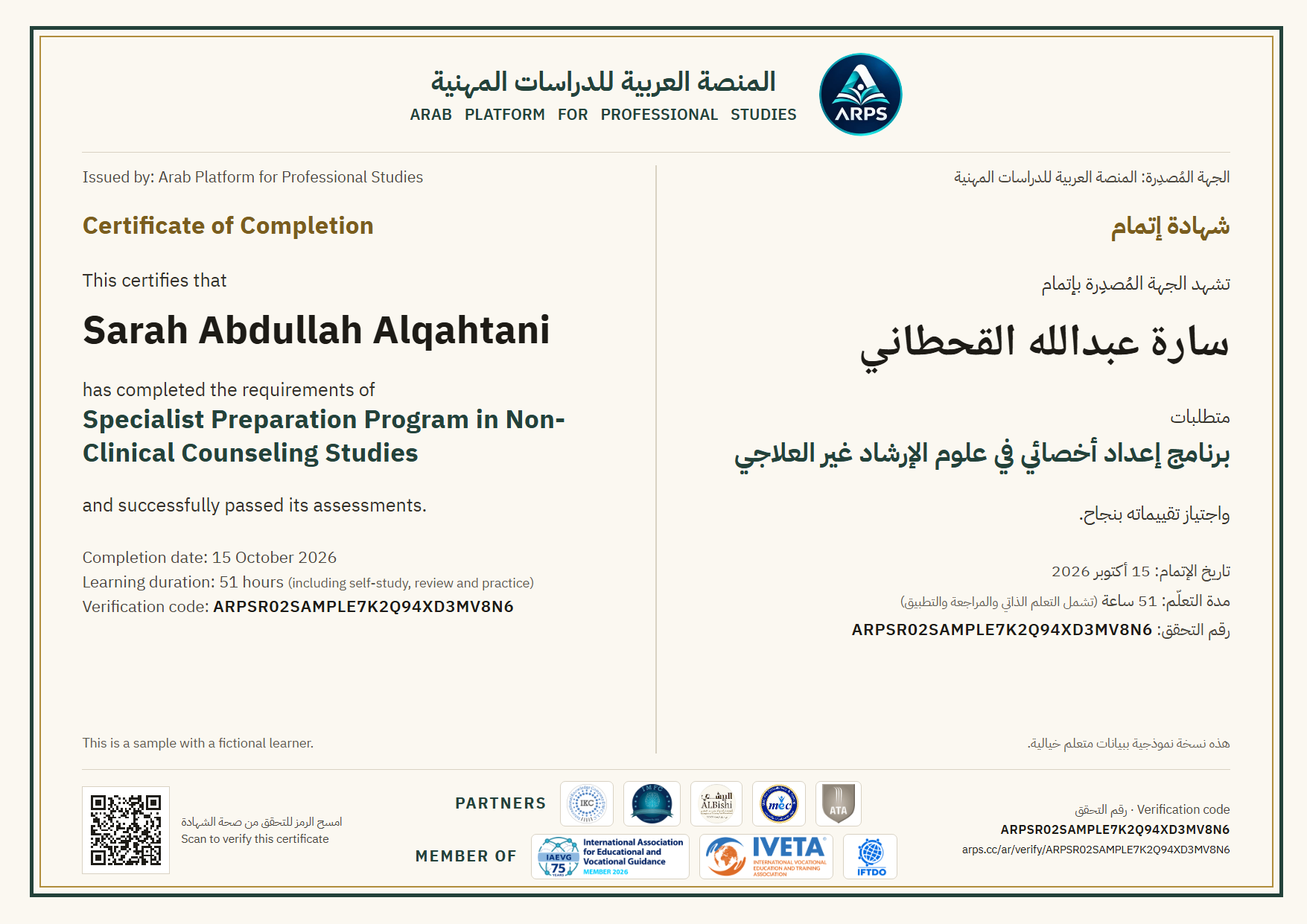
A sample from a real program in this track: Specialist Preparation Program in Non-Clinical Counseling Studies. The learner, scores and dates are fictional; opens in a new window.
No. It teaches tasks without a licence or technical authority.
Can I apply the case maintenance intervals at my site?
Case figures are fictional; site intervals depend on guidance, inspection, contract and applicable rules.
How is learning checked?
Each module has a knowledge check and assessment; central credential policy is separate.
Are the program hours accredited hours?
No. Time is an internal estimate; official hours are unspecified.
Are safety and privacy covered?
Yes: stop points, qualified escalation and minimum necessary complaint data.
Show all (8)
What is the final work product?
A decision file linking service, asset, performance, risk, alternatives and authority.
Is Specialist Preparation Program in Facilities Management free, and do I get a certificate?
Yes. Specialist Preparation Program in Facilities Management is free on ARPS: every lesson, exercise and assessment is free, the first subject is open to read without an account, and the program is available in Arabic and English. Issuing a certificate is optional and has a published fee; it is a training completion certificate showing you passed the program's assessments, recognised by most private-sector organisations in the Gulf states and most Arab countries, and it strengthens your CV; confirming that a specific organisation accepts it remains your responsibility.
What other names is Specialist Preparation Program in Facilities Management known by?
The subject of this program is also known as: facilities management, facility management, FM. Learners usually find it by searching for: facilities management course, facility manager training, facilities maintenance management, free facilities management course.
A foundational short diploma connecting building services and users with assets, maintenance, space, suppliers, resources and risk. The lessons move from defining a service outcome to a bounded integrated improvement case. Each subject uses fictional worked cases, exercises with solutions, a knowledge check and a summative assessment. Learners calculate measures with explicit denominators, test alternatives before announcing recovery and identify where specialist judgment is required. Completion is educational and does not authorize licensed practice.
7 subjects
26 lessons
74 hours
Free
Short Diplomas
Tourism, Hospitality, Events, Real Estate & Facilities
An applied foundation in managing tourism destinations as systems: demand and stakeholders, products and visitor experience, marketing, capacity, sustainability and risk. It uses country-neutral fictional cases and does not require advanced prior experience.
Learn the specialist tasks of innovation management, from an evidenced opportunity to a bounded experiment, decision and operating handover. Produce job aids, evidence logs, calculations and decision briefs using fictional bilingual cases.
Turn software requirements into checkable acceptance conditions and reproducible tests. Record execution and defects, then write an evidence bounded release recommendation. The program covers design, risk, accessibility, authorization, performance and automation.
10 subjects
40 lessons
53.5 hours
Free
Next step: a professional certification or a mini-master
Programs in the same domain that prepare you for an international certification exam or form a professional mini-master, also free.