Short Diploma in International Relations is a free program on ARPS, the Arab Platform for Professional Studies. A multi-subject foundation for evidence-based analysis of international relations. Six subjects connect actor mapping and interdependence, foreign policy and negotiation, the UN Charter and institutions, political economy, and security and transnational issues, then close with a regional cooperation committee project.
Important notice: Independent education; not a university degree, professional licence, diplomatic authority or endorsement by cited organizations.
Distinguish the elements of Sovereignty, interdependence and leverage in the case.
Produce a exposure map with asymmetry conclusion with reasons and limits.
From lesson 1, readable now without an account: Mapping actors in a cross-border event
A report may say that two countries are negotiating after a relief vessel is delayed at a port. That shorthand hides the decision we need to explain. A state is a political entity with territory, population and authority; a government is the set of institutions exercising that authority at a given time. A transport ministry may take a decision within its remit, but a carrier or aid group does not acquire state authority by joining the conversation. Start an international relations analysis by separating each actor, its interest and the means of influence it actually controls.
A free account saves your progress and takes you straight to lesson 1.
Program facts
Study fee
Free
subjects
6
lessons
25
Estimated time
58.5 hours
Content last reviewed
Access period
60 days
Study language
Arabic and English
About the program
Six subjects connect actor mapping and interdependence, foreign policy and negotiation, the UN Charter and institutions, political economy, and security and transnational issues, then close with a regional cooperation committee project. Fictional cases progress from exposure and bargaining calculations to an integrated options brief, with worked answers and review criteria. Each subject has its own summative assessment and a result in the completion transcript. The program does not claim accredited hours, a professional licence or a legal judgment about a real dispute.
Practical relevance
Learners practice reviewable decision matrices, bounded calculations, timelines and evidence questions.
Why this program
One international event can involve actors, rules, interests and numbers; reading each in isolation can mislead.
Career relevance
Useful for initial briefs and claim checking in media and institutional work, without replacing legal specialists or competent authorities.
Career paths this program serves
This program is a step on the paths of the following occupations. Open a path to see its other programs in study order.
Calculate negotiation alternatives and economic exposure
Select a peaceful process and locate a rule's source
Write an integrated options brief with measurable follow-up
Run a fictional regional cooperation committee project: frame the commission, test ranking sensitivity, schedule delivery, estimate impact and weigh information value before expanding
Learning outcomes (25)
Analyze Mapping actors in a cross-border event and apply the result in a fictional case while stating evidence limits.
Analyze Sovereignty, interdependence and leverage and apply the result in a fictional case while stating evidence limits.
Analyze Levels of explanation and proximate causes and apply the result in a fictional case while stating evidence limits.
Analyze Explanatory lenses and discriminating evidence and apply the result in a fictional case while stating evidence limits.
Analyze From objectives to foreign-policy instruments and apply the result in a fictional case while stating evidence limits.
Analyze Alternatives, reservation limits and agreement range and apply the result in a fictional case while stating evidence limits.
Analyze Signals, reassurance and credibility and apply the result in a fictional case while stating evidence limits.
Analyze A negotiation brief from positions to verification and apply the result in a fictional case while stating evidence limits.
Analyze Reading the Charter without confusing law and position and apply the result in a fictional case while stating evidence limits.
Analyze Choosing the relevant UN organ and apply the result in a fictional case while stating evidence limits.
Analyze Selecting a peaceful settlement method and apply the result in a fictional case while stating evidence limits.
Analyze Sources of a rule and limits of jurisdiction and apply the result in a fictional case while stating evidence limits.
Analyze Trade volume and concentration of exposure and apply the result in a fictional case while stating evidence limits.
Analyze Trade non-discrimination with scope checks and apply the result in a fictional case while stating evidence limits.
Analyze Reading finance and debt service without invented causality and apply the result in a fictional case while stating evidence limits.
Analyze Comparing restrictions, incentives and cooperation and apply the result in a fictional case while stating evidence limits.
Analyze Threat, vulnerability, risk and response and apply the result in a fictional case while stating evidence limits.
Analyze Coordinating transnational issues without merging legal frameworks and apply the result in a fictional case while stating evidence limits.
Analyze Conflicting evidence and calibrated confidence and apply the result in a fictional case while stating evidence limits.
Analyze An integrated options brief with follow-up and apply the result in a fictional case while stating evidence limits.
Frame a commission question connecting the committee decision with its authority and evidence needs.
Explain how scales, weights and missing data affect option rankings.
Calculate delivery dates and inspect dependencies and resources controlling operation.
Distinguish observed improvement from estimated impact and examine comparison validity.
Compare information benefits with testing and waiting costs before choosing an expansion stage.
Who it is for
This program is for new international relations learners and people in journalism, public affairs, civil society or international business who need disciplined analytical language. It suits anyone who wants to separate evidence from positions in an international event and write a short, bounded brief. Advanced diplomatic or legal experience is not assumed. Completion does not authorize representation of a state or regulated professional practice.
Prerequisites
Learners should be able to read professional English and simple tables, and distinguish a number from its source and publication date. Familiarity with international news helps but is not required: terms are introduced when first used, and fictional cases include the needed data. Be ready to compare alternatives, calculate basic percentages and inspect an original document when a rule may have changed. Study time counts one language, not both together.
What it does not offer
This is not training for licensed diplomatic practice, international litigation or live governmental action.
This subject begins with an actor map: who controls a decision, who supplies information or implementation capacity, and how a firm's or aid group's influence differs from public authority. It separates sovereign equality from unequal resources and calculates exposure to a supply interruption using substitutes, stocks and a stated time horizon. Individual, state and system levels help distinguish a proximate cause from a wider condition in a fictional incident. Three lenses then test security concerns, cooperation rules and shared norms against different observations. Each lesson asks for a falsifiable hypothesis and a contrary observation rather than a theory label alone. Learners produce an actor matrix, dependence map, causal grid and lens comparison, and see why a statement or single percentage cannot establish authority, motive or leverage.
4 lessons · 7 hours
Mapping actors in a cross-border event1.5 hours
Sovereignty, interdependence and leverage1.5 hours
Levels of explanation and proximate causes1.5 hours
Explanatory lenses and discriminating evidence3 hours
Subject 2
Foreign policy and negotiation
The subject moves from explaining relations to preparing foreign-policy options that can be evaluated. A means-ends chain for an educational exchange separates goal, nearer result, instrument and constraint, so the indicator measures the intended effect rather than mere activity. A fictional negotiation then calculates an executable fallback, reservation limits and a possible agreement range while stating units and non-price conditions. The signals lesson distinguishes observation from interpretation and checks capability, cost, audience and reassurance before assigning motive. Finally, a river-data brief separates positions from interests and compares phased, verifiable exchange options. Signing an arrangement does not prove it worked, and a mediator gains no decision authority simply by attending. The output is a practical options memo with owners, evidence needs and a defined review point.
4 lessons · 7 hours
From objectives to foreign-policy instruments1.5 hours
Alternatives, reservation limits and agreement range1.5 hours
Signals, reassurance and credibility1.5 hours
A negotiation brief from positions to verification3 hours
Subject 3
Rules, organizations and dispute settlement
This subject teaches disciplined use of institutional and legal texts. Learners separate a Charter principle from a state statement or news characterization, placing fact, provision and missing evidence in an issue map before judging a possible threat of force. They distinguish the General Assembly's and Security Council's mandates and outputs, keeping a draft apart from an adopted text and field implementation. Negotiation, enquiry, mediation, arbitration and adjudication are compared against the type of disagreement and parties' acceptance; a court's jurisdiction is never presumed from an issue's importance. A final source log distinguishes treaty, custom, general principles and subsidiary means while testing applicability to the parties. The resulting forum and settlement memo states when a legal question remains open and what original text or observation could resolve it.
4 lessons · 7 hours
Reading the Charter without confusing law and position1.5 hours
Choosing the relevant UN organ1.5 hours
Selecting a peaceful settlement method1.5 hours
Sources of a rule and limits of jurisdiction3 hours
Subject 4
Political economy and global interdependence
The subject asks how global economic ties create exposure or opportunity without inviting a causal leap. Learners calculate a food supplier's share of imports and of consumption using different denominators, then build a stock-and-substitution timeline that does not count inventory twice. In trade, they separate the treatment of two foreign partners from treatment of an import relative to a domestic product, checking agreement scope and conditions before any legal conclusion. In finance, they read the statistical definition of ODA and the debt-service-to-exports indicator, separating a pledge from disbursement and percentage points from debt-stock growth. A final comparison tests restriction, incentive and cooperation through causal mechanism, spillover and record quality rather than political labels. Outputs include an exposure table, bounded indicator memo and reviewable policy-options matrix.
4 lessons · 7 hours
Trade volume and concentration of exposure1.5 hours
Trade non-discrimination with scope checks1.5 hours
Reading finance and debt service without invented causality1.5 hours
Comparing restrictions, incentives and cooperation3 hours
Subject 5
Security, transnational issues and integration
The final subject combines the program's tools in limited decisions that state uncertainty honestly. It separates a possible threat from a vulnerable communication channel and estimates the effect of a specified outage while testing backup capacity and message quality. A case involving heat, people's movement and health visits keeps each dataset's definition, time and privacy boundary; a media label cannot confer legal status. A conflicting-evidence log separates a notice's issuance, effective period and implementation while checking source independence and version history. Learners then write an integrated brief about fictional relief transit, with actors and authority limits, facts and figures, options working through different mechanisms, and indicators for review after a week. The output distinguishes a truck that crossed from aid that reached recipients, and a completed file from a permit, while keeping unresolved legal questions visible.
4 lessons · 7 hours
Threat, vulnerability, risk and response1.5 hours
Coordinating transnational issues without merging legal frameworks1.5 hours
Conflicting evidence and calibrated confidence1.5 hours
An integrated options brief with follow-up3 hours
Subject 6
Regional cooperation committee project: commissioning to impact testing
The learner completes a fictional regional committee project through five connected decisions. The work begins by defining the commission, delegated authority and appropriate evidence. A ranking audit then exposes weights capable of reversing choices. An implementation network calculates dependencies, resource conflicts and time reserves. An impact design separates observed improvement from the change represented by a comparison group. Finally, information-value calculations consider test accuracy, price and waiting before a revisable next-stage commitment. Products include a commission brief, sensitivity table, schedule, evaluation sheet and decision tree. Learners check calculations and limitations and respond to financial, operational and distributional objections before submitting an integrated briefing. All project data are invented; primary sources support methods and their application limits.
5 lessons · 16.5 hours
Define the commission and decision boundaries3.5 hours
Audit rankings and their sensitivity3.5 hours
Schedule cooperation under resource conflicts3.5 hours
Estimate impact using two time paths3.5 hours
Information value and staged expansion3.5 hours
Subjects unlock in sequence as you progress.
Strengths
Six distinct subjects and a summative for each
Fictional regional cases with worked solutions and checks
Clear separation of legal text and analytical hypothesis
Evidence basis
Institutional rules are linked to UN and ICJ texts, trade to WTO material, and indicators to OECD and World Bank definitions. Every named-city exercise is explicitly fictional.
Reference organizations
United Nations
International Court of Justice
World Trade Organization
World Bank
World Health Organization
Methodology
Original bilingual lessons with marked fictional cases; institutional claims link to primary sources and source limits are stated. Assisted self-review is not external endorsement.
How the route works
Short Diplomas are relatively comprehensive learning pathways that cover a major subject through five connected learning subjects and structured assessments, with a diploma transcript available with the credential.
Self-paced sequential study. Content unlocks progressively and each subject combines reading, examples, exercises, knowledge checks, and assessment.
Build integrated knowledge in a major subject.
Study through five clear, connected learning subjects.
Complete a defined assessment for each subject.
Receive a diploma transcript showing subjects and results when the credential is issued.
Assessment
Each Short Diploma contains five subjects, each with an approved assessment. A sixth final exam is not required when the five assessments adequately cover the learning outcomes.
Assessment attempts: 2 per assessment, 7 days apart
The pass mark is announced before the program is published.
Certificate
Successful completion makes the learner eligible for the Short Diploma certificate and Diploma Transcript under the credential policy.
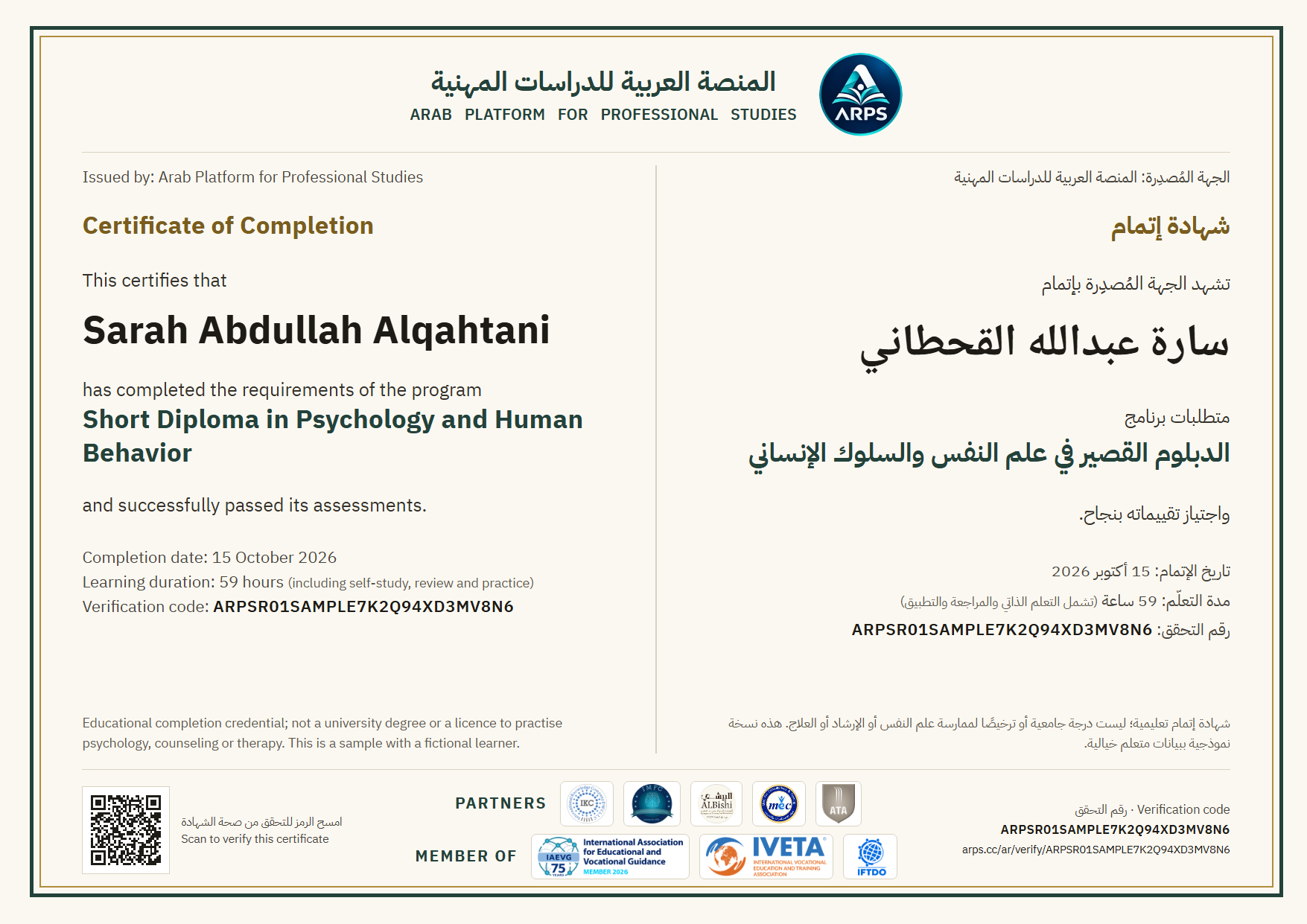
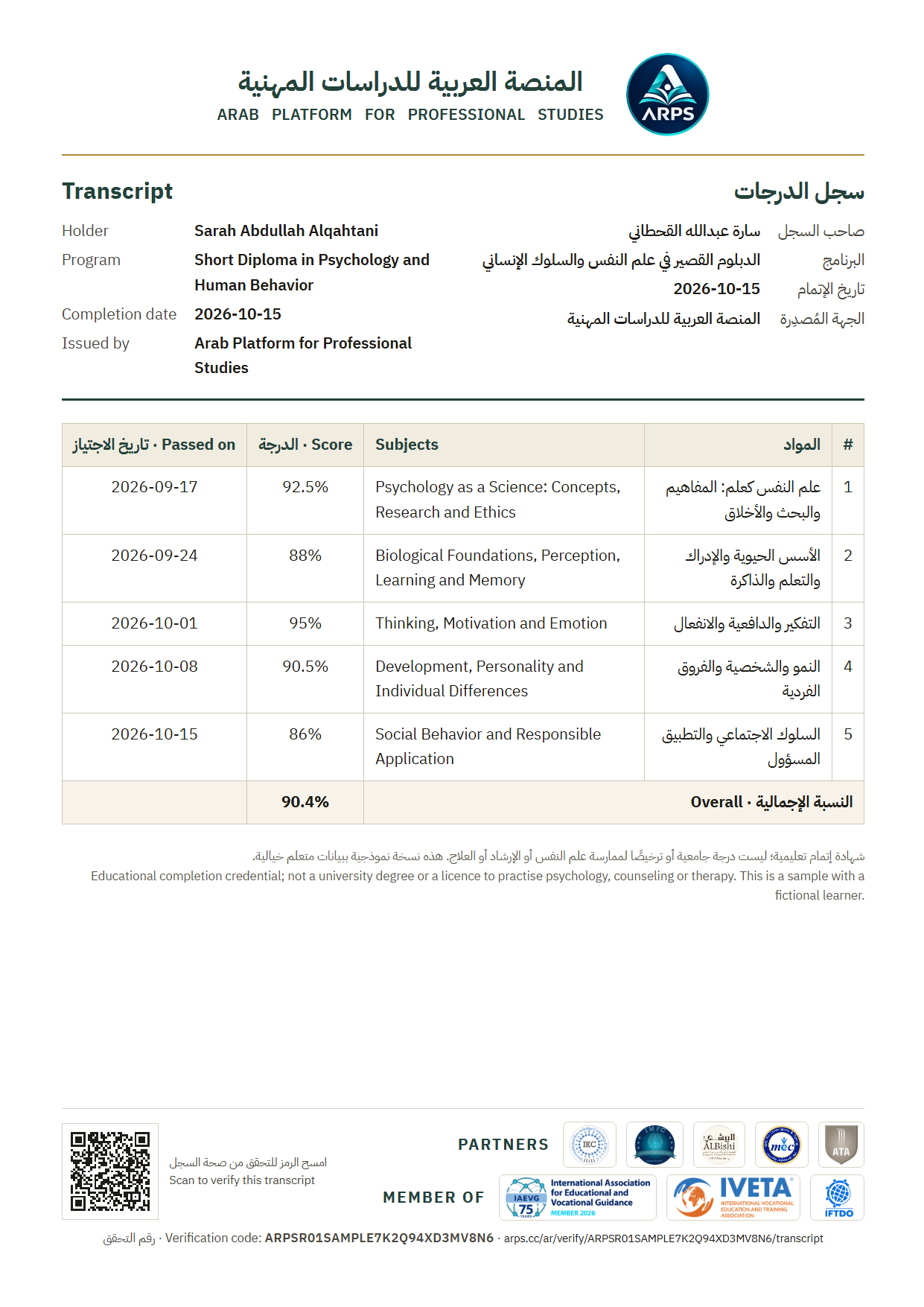
A sample from a real program in this track: Short Diploma in Psychology and Human Behavior. The learner, scores and dates are fictional; opens in a new window.
Disclaimer: Training completion, not a university degree or professional licence.
Program questions
Is this diploma a university degree?
No. It is an independent educational program with a subject assessment and completion transcript, not a university degree or licence.
How is progress assessed?
Each lesson has a learning check and each subject a summative assessment under the two-attempt policy.
What does the final subject integrate?
The sixth subject is a fictional regional committee project that moves from the commission and ranking audit to implementation scheduling, impact estimation and a staged expansion decision based on information value.
Does the program award accredited hours?
No official learning hours are claimed before central route calibration, and the credential grants no licence.
How long is study access?
The route sets a 30-day nominal duration and a 60-day access window; the six subjects unlock in sequence.
Show all (10)
What if I do not pass a subject assessment?
The route permits at most two attempts with a seven-day wait before retry, without automatic access extension.
Is audio included?
The current pathway is text-first, with an integrated text summary for each subject; unavailable audio is not counted in study time.
Are the cases real events?
Named cities are clearly marked fictional learning settings; general concepts link to original sources without invented local events or laws.
Is Short Diploma in International Relations free, and do I get a certificate?
Yes. Short Diploma in International Relations is free on ARPS: every lesson, exercise and assessment is free, the first subject is open to read without an account, and the program is available in Arabic and English. Issuing a certificate is optional and has a published fee; it is a training completion certificate showing you passed the program's assessments, recognised by most private-sector organisations in the Gulf states and most Arab countries, and it strengthens your CV; confirming that a specific organisation accepts it remains your responsibility.
What other names is Short Diploma in International Relations known by?
The subject of this program is also known as: international relations, diplomacy, global politics. Learners usually find it by searching for: short courses in international relations, short courses in international relations and diplomacy, online international relations course, international relations theories, free international relations course.
A foundational diploma on moving from a public problem to comparable alternatives, then to neutral, evidence-informed policy design, implementation, monitoring and evaluation.
A structured foundational diploma on how political systems are built and how their institutions interact: the state, constitutions, systems of government, elections, representation, parties, civil society, public institutions and public policy. It uses neutral descriptive comparison and trains learners to separate factual claims from value judgments and to read evidence within its limits.
A foundation short diploma in Peace and Conflict Studies. Eight connected subjects teach learners to classify a dispute, map actors, test intervention risks, design a bounded dialogue and monitor a conditional recommendation. Fictional Arab-city cases, worked exercises and a subject assessment provide practice. Completion does not grant mediation authority or professional accreditation.
Prepare a specialist decision file for international organizations and global affairs: map mandates, verify documents and positions, coordinate actors, assess response needs, and monitor results. Every applied task ends with an output and a clear authority boundary.
7 subjects
32 lessons
52 hours
Free
Next step: a professional certification or a mini-master
Programs in the same domain that prepare you for an international certification exam or form a professional mini-master, also free.