Short Diploma in Peace and Conflict Studies is a free program on ARPS, the Arab Platform for Professional Studies. A foundation short diploma in Peace and Conflict Studies. Eight connected subjects teach learners to classify a dispute, map actors, test intervention risks, design a bounded dialogue and monitor a conditional recommendation.
Important notice: Independent education and completion diploma; not a university degree, mediation licence or endorsement by cited bodies.
Classify a disagreement by its observable evidence, distinguish research coding from legal classification, and record what remains unknown.
From lesson 1, readable now without an account: Classifying a dispute and its limits
What is being classified, and for what purpose?
In everyday speech, conflict may mean disagreement over a decision, a strained relationship between groups, or organized armed fighting. A shared label does not transfer the rules of one category to another. Start with an observable account: who did what, when, who stated a claim, and which independent record supports it? Then name the purpose of classification. A local dialogue design needs information about parties, issues and safety. A research dataset requires its own definition and time unit. A legal assessment of armed conflict calls for different facts and legal criteria and should be undertaken by suitably qualified people. A casualty threshold borrowed from a research database cannot make that legal determination. This lesson teaches a bounded educational decision; it does not classify a real incident in law.
A free account saves your progress and takes you straight to lesson 1.
Program facts
Study fee
Free
subjects
8
lessons
24
Estimated time
83 hours
Content last reviewed
Access period
60 days
Study language
Arabic and English
About the program
How do you distinguish a disagreement over a shared service from a research or legal classification of armed conflict? The course begins with terms and evidence limits, then maps actors, relationships and escalation drivers without turning an assumption into a fact. It compares responses through conflict sensitivity: might allocating a resource or choosing invitees harm unheard people? It examines consent, mandate and inclusion before designing a reviewable dialogue or facility arrangement. Learners then build a bounded theory of change, separate implementation, outcome and harm indicators, and write a recommendation that names what remains unknown. Later subjects add safe listening and information verification, fair comparison of service options with a challenge route, and a capstone decision file for a fictional community center. The cases in five Arab cities are fictional teaching settings, not reports of local events. Every lesson asks for a reasoned output and provides a worked answer; learners need not contact real disputants or use real personal information. This is foundational analytic education and a completion diploma, not a university degree, licence or endorsement by the organizations cited as sources.
Practical relevance
Learners produce an actor map, issue tree, risk register, listening charter, conditional arrangement, indicator card and decision memo. All are practiced with complete fictional data in the lessons. No access to real personal records, paid software or live parties is required.
Why this program
The word conflict can be applied to every disagreement, and a single meeting can be called peacebuilding without an outcome measure. This program gives learners a chain of questions: which classification is supported, who is absent, what harm might an intervention create, and what evidence should change the decision?
Career relevance
People in education, development, public services and community programs can use these skills to read a dispute file, ask better questions about evidence and participation, and draft bounded decision memos. The relevance is to reasoning at work; it does not promise employment or authorize professional mediation or legal decisions.
Career paths this program serves
This program is a step on the paths of the following occupations. Open a path to see its other programs in study order.
Distinguish a local dispute from research and legal armed-conflict definitions and their limits.
Map actors, interests and relationships while separating observation from inference.
Compare prevention and intervention choices by testing benefit and unintended harm.
Design bounded dialogue with consent, mandate, inclusion and a stop rule.
Build a theory of change and indicators with baseline, denominator and privacy limits.
Show all (9)
Write a conditional recommendation with alternatives, review time and explicit evidence gaps.
Conduct short, protective interviews, correct rumors without amplifying them and build chronologies that handle gaps.
Compare service options under different fairness weights and design a challenge route with clear authority limits.
Complete a community-center decision file, from evidence and authority boundaries to a recommendation with exit conditions.
Learning outcomes (15)
Classify a disagreement by its observable evidence, distinguish research coding from legal classification, and record what remains unknown.
Distinguish an observed reduction in incidents from a defensible claim about sustaining peace, with an explicit denominator and alternative explanation.
Construct a revisable actor-and-relationship map that separates expressed positions, possible interests, influence, representation and evidentiary confidence.
Build an issue tree that distinguishes an observed trigger from proximate causes, structural drivers and consequences, with evidence and competing pathways.
Triangulate contradictory testimony and operational records without counting dependent reports as independent confirmation.
Use a bounded scenario matrix and observable indicators to select a reversible prevention measure without claiming to predict violence.
Map how a proposed youth grant interacts with existing dividers and connectors before assuming that a beneficial intent produces a beneficial effect.
Redesign grant selection and communication when equal formal rules produce unequal practical access, while retaining an auditable, privacy-aware appeal route.
Define a proportionate monitoring and pause rule for a small peace-sensitive programme, distinguishing implementation, outcome and unintended harm.
Test readiness, consent and perceived impartiality before inviting parties into a bounded dialogue, with a safety-based alternative when conditions are absent.
Design an inclusive, safe consultation sequence that distinguishes speaking, representation, influence and permission to share statements.
Compare draft community-process clauses for clarity, consent, implementability, monitoring and a safe route for disagreement without claiming to create a legal peace agreement.
Write a bounded theory of change with assumptions, decision points and a plausible unintended-effect pathway.
Select process, outcome and harm indicators with baseline, denominator, timing and privacy limits.
Integrate classification, actor analysis, conflict sensitivity, consent and monitoring into a qualified decision memo.
Who it is for
Students and beginners seeking a connected foundation in peace and conflict concepts, able to inspect a short case and its evidence limits.
Early-career staff in education, development and public services who must describe access or resource disputes and map people without claiming to represent absentees.
Community-program coordinators who want to test how activities affect relationships and adapt invitations, privacy and monitoring when exclusion or harm appears.
Prerequisites
You should be able to read a short case, separate observation from interpretation and compare two choices in a table. Basic percentages with a calculator help, and lessons show the calculation. Prior peace studies, law or statistics are not required.
You should explain a choice briefly and revise it when new evidence appears. Field experience and contact with real disputants are unnecessary; the practice files and their numbers are fictional.
What it does not offer
It is not a licensed mediator course and confers no legal or field authority to intervene in a live dispute.
It cannot replace specialist safety or legal assessment and is not accredited by the UN, ICRC or data providers cited.
This subject begins with observed facts before naming a conflict: what decision is disputed, who stated a claim, and what can the record not reveal? Learners distinguish a social disagreement from a recurring conflict an
3 lessons · 10 hours
Classifying a dispute and its limits2.5 hours
Peace and sustaining peace without causal leaps2.5 hours
Actors, relationships and claims2.5 hours
Subject 2
Conflict dynamics and evidence
This subject moves from naming an issue to testing explanations. Learners build an issue tree that treats a fictional pump stoppage as a time-specific trigger, distinguishes a possible allocation rule, and places queue l
3 lessons · 10 hours
Issue trees, causes and triggers2.5 hours
Triangulating accounts and records2.5 hours
Escalation and prevention scenarios2.5 hours
Subject 3
Conflict sensitivity and prevention
This subject follows a fictional training-grant programme in Rabat through its operations rather than assuming that good intent guarantees benefit. Learners map how one announcement channel might advantage an existing ne
3 lessons · 10 hours
How an intervention interacts with conflict2.5 hours
Selecting beneficiaries without deepening division2.5 hours
Monitoring harm and stop rules2.5 hours
Subject 4
Dialogue, mediation and inclusion
This subject tests dialogue conditions before issuing a joint invitation. In a fictional an Arab city facility dispute, learners distinguish consent to written exchange from consent to a meeting and identify the proposed
3 lessons · 10 hours
Dialogue readiness, consent and impartiality2.5 hours
Inclusion and meaningful participation2.5 hours
A reviewable trial arrangement2.5 hours
Subject 5
Peacebuilding, monitoring and integration
This subject brings conflict analysis and intervention design into one revisable decision. In a fictional an Arab city education hall, learners build a chain from resources and activities to outputs and bounded outcomes,
3 lessons · 10 hours
A conditional theory of change2.5 hours
Process, outcome and harm indicators2.5 hours
An integrated evidence-limited recommendation2.5 hours
Subject 6
Safe listening and information verification
Learners practice short interviews that protect contributors, correct a circulating rumor without amplifying it and build a chronology that handles gaps and clock differences.
3 lessons · 10.5 hours
A short interview that protects the contributor3 hours
Correcting a rumor without amplifying it3 hours
Building a chronology that handles gaps3 hours
Subject 7
Tradeoffs and fairness in service procedures
Learners compare service options when fairness weights differ and design a challenge route that separates intake, review and decision with clear deadlines and authority limits.
2 lessons · 7 hours
Testing alternatives when fairness weights differ3 hours
A challenge route separating intake from judgment3 hours
Subject 8
Capstone: a community-center decision file
A capstone in which learners assemble a decision file for a fictional community center, design a negotiable allocation trial, stress-test its monitoring and hand over a recommendation with exit conditions.
4 lessons · 14.5 hours
Building the case file and authority boundary3 hours
Designing a negotiable allocation trial3 hours
Stress-testing monitoring with counterexamples3 hours
Handing over a recommendation with exit conditions3 hours
Subjects unlock in sequence as you progress.
Strengths
Eight linked subjects move visibly from classification and evidence to a revisable recommendation.
Clearly marked fictional Arab-city cases and two fully worked exercises in each lesson.
Bilingual applied questions with reasons for every option and a reserve bank for each subject assessment.
Explicit boundaries on inference, privacy, consent and monitoring harm.
Evidence basis
UN guidance informs conflict analysis, intervention sensitivity, mediation and sustaining peace; UCDP/PRIO supplies a research coding definition, and ICRC guidance distinguishes legal classification. Each concept is limited to its source's scope. Case numbers and places are fictional; cited bodies did not review or endorse this course.
Reference organizations
United Nations Sustainable Development Group
United Nations Peacemaker
UCDP/PRIO
International Committee of the Red Cross
Methodology
Fictional cases, worked exercises and author self-review; no independent learner trial or external accreditation.
How the route works
Short Diplomas are relatively comprehensive learning pathways that cover a major subject through five connected learning subjects and structured assessments, with a diploma transcript available with the credential.
Self-paced sequential study. Content unlocks progressively and each subject combines reading, examples, exercises, knowledge checks, and assessment.
Build integrated knowledge in a major subject.
Study through five clear, connected learning subjects.
Complete a defined assessment for each subject.
Receive a diploma transcript showing subjects and results when the credential is issued.
Assessment
Each Short Diploma contains five subjects, each with an approved assessment. A sixth final exam is not required when the five assessments adequately cover the learning outcomes.
Assessment attempts: 2 per assessment, 7 days apart
The pass mark is announced before the program is published.
Certificate
Successful completion makes the learner eligible for the Short Diploma certificate and Diploma Transcript under the credential policy.
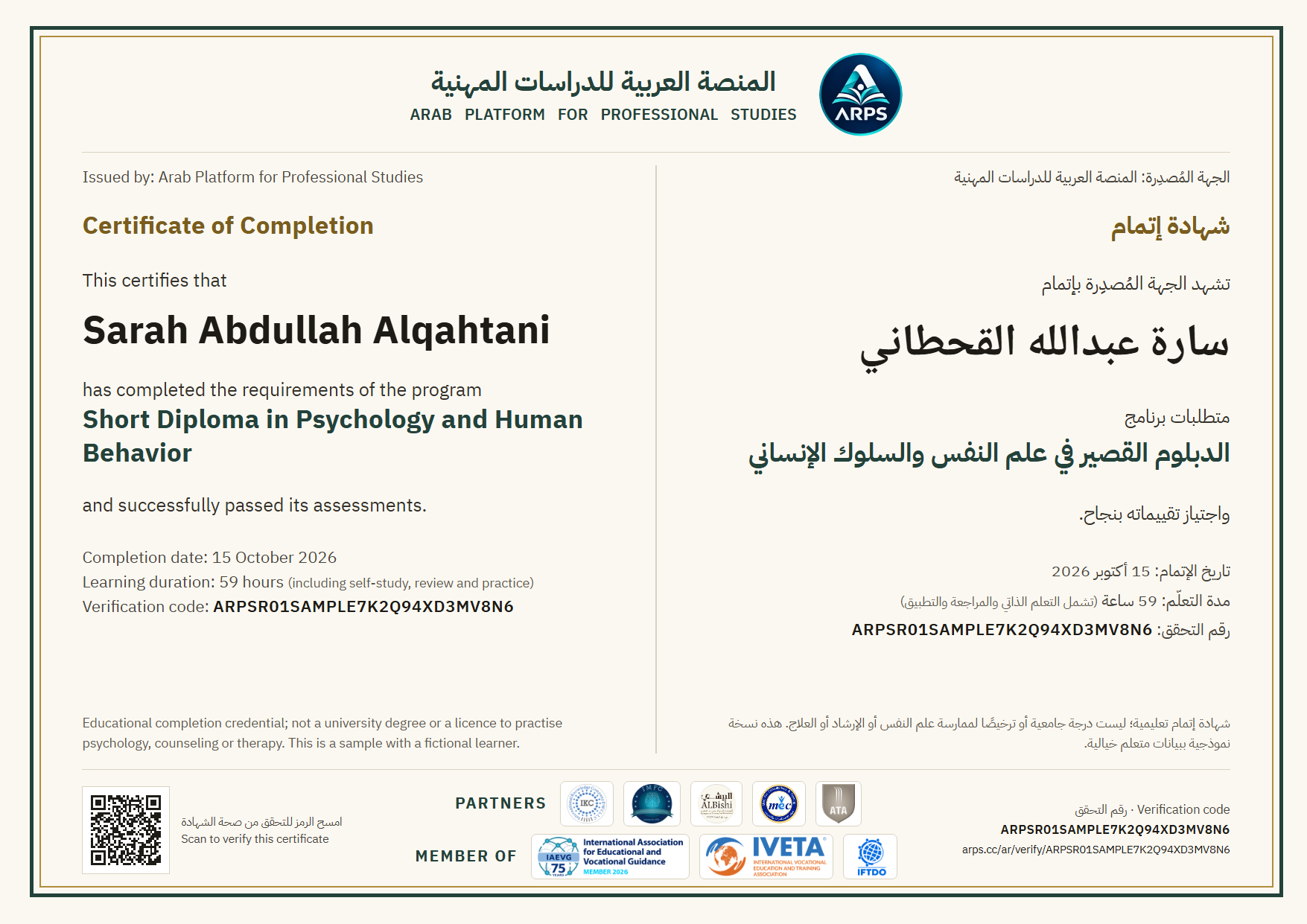
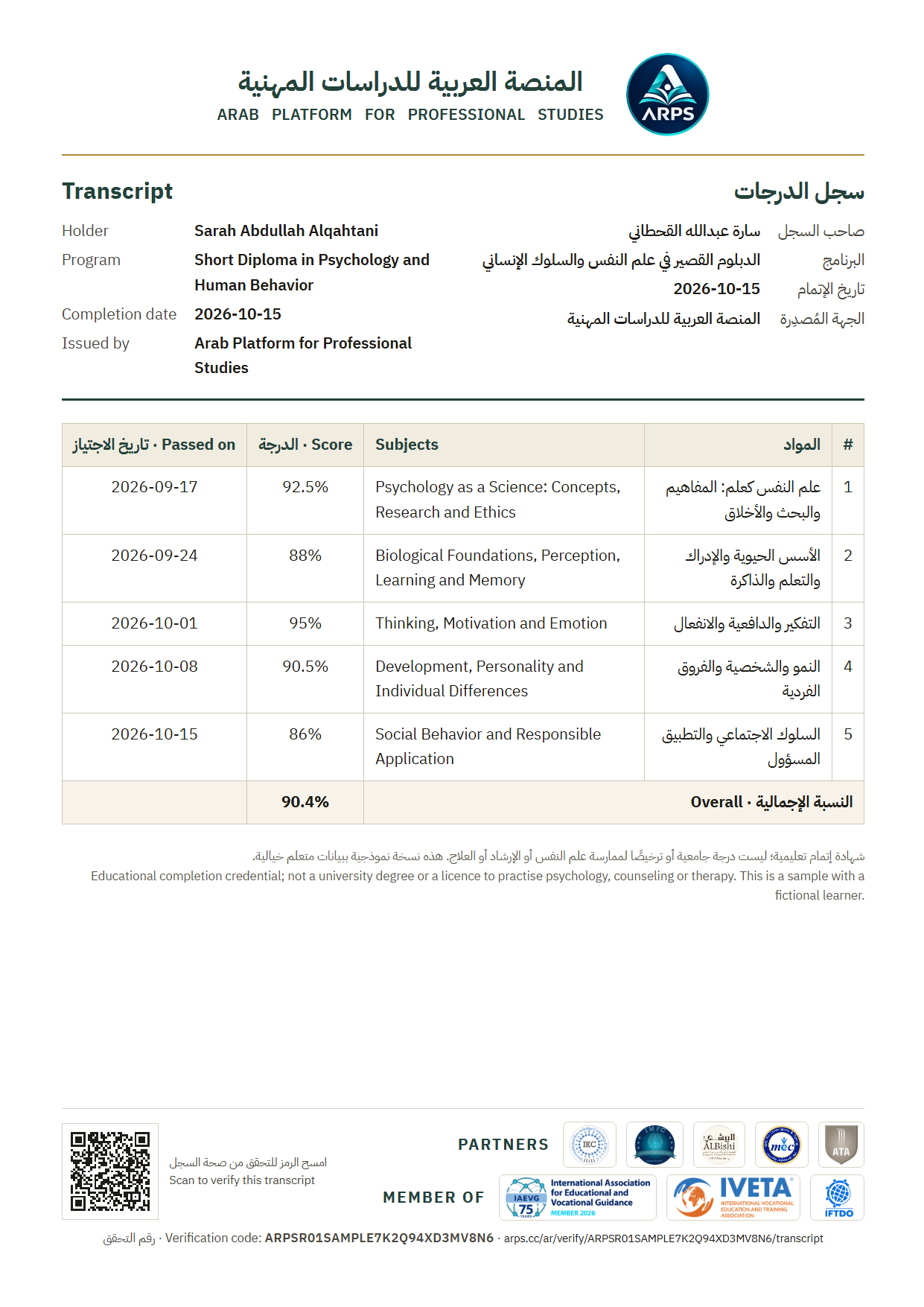
A sample from a real program in this track: Short Diploma in Psychology and Human Behavior. The learner, scores and dates are fictional; opens in a new window.
Disclaimer: Educational completion diploma; not a university degree, mediation authority or professional licence.
Program questions
Does the diploma authorize mediation?
No. It is educational completion; live interventions require suitable authority, preparation and safety review.
Are the cases factual?
No. Cities are fictional teaching settings, and people and figures do not report local practice.
How am I assessed?
Each lesson has a short check and every subject has a separate assessment drawn from a question bank under platform policy.
Do I need legal training?
No. You learn to separate research and legal labels without classifying a real case under law.
How does this differ from specialist conflict-analysis training?
It links classification, analysis, response, dialogue and monitoring at foundation level; it does not prepare an accredited specialist or consultant.
Show all (10)
Do exercises require real personal data?
No. All facts and numbers are invented within lessons, which also examine identity protection when considering real-world use.
What does a rise in challenges after opening a new route mean?
Volume alone proves neither improved nor reduced trust; lessons check substance, access and safety before interpreting a trend.
Does studying mediation create a binding agreement?
No. Draft arrangements are educational proposals conditional on mandate and consent; they impose no rights or duties on real parties.
Is Short Diploma in Peace and Conflict Studies free, and do I get a certificate?
Yes. Short Diploma in Peace and Conflict Studies is free on ARPS: every lesson, exercise and assessment is free, the first subject is open to read without an account, and the program is available in Arabic and English. Issuing a certificate is optional and has a published fee; it is a training completion certificate showing you passed the program's assessments, recognised by most private-sector organisations in the Gulf states and most Arab countries, and it strengthens your CV; confirming that a specific organisation accepts it remains your responsibility.
What other names is Short Diploma in Peace and Conflict Studies known by?
The subject of this program is also known as: peace and conflict studies, peacebuilding, conflict analysis, peace studies. Learners usually find it by searching for: short courses in peace and conflict studies, what is peace and conflict studies, peacebuilding course free, conflict analysis course, peace and conflict studies jobs.
A foundational diploma on moving from a public problem to comparable alternatives, then to neutral, evidence-informed policy design, implementation, monitoring and evaluation.
A structured foundational diploma on how political systems are built and how their institutions interact: the state, constitutions, systems of government, elections, representation, parties, civil society, public institutions and public policy. It uses neutral descriptive comparison and trains learners to separate factual claims from value judgments and to read evidence within its limits.
Prepare a specialist decision file for international organizations and global affairs: map mandates, verify documents and positions, coordinate actors, assess response needs, and monitor results. Every applied task ends with an output and a clear authority boundary.
7 subjects
32 lessons
52 hours
Free
Next step: a professional certification or a mini-master
Programs in the same domain that prepare you for an international certification exam or form a professional mini-master, also free.