Short Diploma in Patient Experience is a free program on ARPS, the Arab Platform for Professional Studies. A foundation diploma connecting patient accounts with service journeys, communication, measurement and improvement. Learners classify reports, map handoffs, interpret bounded experience indicators and test safe changes within a service role.
Important notice: Independent completion education; no clinical licence, university degree or endorsement by cited organizations.
Classify reports of care interactions as experience, satisfaction, clinical outcome or possible safety signal and route the latter without making a clinical judgment.
From lesson 1, readable now without an account: What does a patient's account establish?
What does a patient's account establish?
Patient experience describes what a person encountered while seeking and receiving care: access to an appointment, clear explanations, information moving between teams, and respectful treatment. An experience question asks about an observable event or its frequency, such as whether the team explained the next step in understandable language. Satisfaction compares what happened with a person's expectations. Two people may wait the same time and report different satisfaction. A clinical outcome describes an effect on health; courtesy or waiting time alone does not establish it. Experience is one component of quality, so a better experience measure alone cannot prove better safety or clinical effectiveness.
A free account saves your progress and takes you straight to lesson 1.
Program facts
Study fee
Free
subjects
6
lessons
24
Estimated time
74 hours
Content last reviewed
Access period
60 days
Study language
Arabic and English
About the program
What does patient experience mean when someone praises a kind receptionist yet cannot identify who will explain a test result? The diploma begins by separating reported events from satisfaction and clinical outcomes. Five subjects then address understandable communication, participation and role limits; referral, access and follow-up journeys; carefully defined patient-reported measures; and small improvement tests with balancing measures. Every subject uses invented case data and worked decisions, from a survey denominator to a closed-loop handoff. Learners then specify an improvement aim and interpret a short result sequence with uncertainty. A sixth, capstone subject builds an evidence dossier for a broken follow-up in a fictional clinic, tests a communication pack, prepares a field pilot across a shift change and defends a conditional recommendation. The course does not grant a clinical licence, professional credential authorization or a universal legal procedure.
Practical relevance
The learning tables can support a review of appointments, referrals or follow-up messages using authorized data: what was sent, what was received and what the person understood. Real use requires organizational procedures, protected data and decision authority.
Why this program
A system can show that information was sent while a patient still lacks a usable next step. This program connects operational records with patient accounts, then turns a vague service problem into a checkable decision without inventing a clinical outcome.
Career relevance
Relevant to people in reception, appointments, patient experience, coordination and service improvement who need a common language for reports and local indicators. It does not establish eligibility for a regulated role or prove clinical practice experience.
Career paths this program serves
This program is a step on the paths of the following occupations. Open a path to see its other programs in study order.
Separate experience events from satisfaction, clinical outcomes and safety signals.
Map touchpoints and handoffs in booking, referral and follow-up.
Write clear communication and check understanding without exceeding the service role.
Calculate response proportions with correct denominators and inference limits.
Test a small service change and inspect effects and balancing measures over time.
Build an evidence dossier, a tested communication pack, a shift pilot and a conditional recommendation in an integrated follow-up project.
Learning outcomes (24)
Classify reports of care interactions as experience, satisfaction, clinical outcome or possible safety signal and route the latter without making a clinical judgment.
Map a patient's stated priorities to observable touchpoints, separate patient needs from staff assumptions, and identify an access barrier without making a clinical decision.
Triage a mixed experience complaint and possible safety signal while preserving role boundaries, patient dignity and closed-loop ownership.
Build a bounded baseline of patient-experience signals from heterogeneous reports without manufacturing a rate, clinical outcome or causal conclusion.
Rewrite follow-up information in plain language and use teach-back to check the clarity of the explanation without testing or blaming the patient.
Plan an accessible contact path based on the person's stated language and format preferences while protecting clinical meaning, privacy and survey comparability.
Capture patient goals and feasible service choices, refer clinical trade-offs to a clinician, and check whether the patient had a genuine opportunity to participate.
Respond to a service complaint with acknowledgement, fact-finding, authorized action and a closed follow-up loop without pre-judging clinical or staff fault.
Map an end-to-end referral journey with frontstage patient actions, backstage dependencies, ownership and an evidence check at each handoff.
Calculate and interpret access friction by channel and denominator, notice missing attempts, and propose a bounded service check rather than infer demand or clinical priority.
Design a reliable test-result notification handoff with sender, recipient, receipt, exception route and patient update while leaving clinical interpretation to authorized roles.
Prioritize a journey bottleneck with explicit experience evidence, safety triage, reach, feasibility and equity constraints rather than raw complaint volume alone.
Select or draft a narrowly defined patient-reported experience question, with recall window and response options aligned to the event, without claiming an untested local item is a validated CAHPS measure.
Compute a patient-reported experience proportion from eligible respondents, disclose response and missingness, and reject unsupported site or subgroup comparisons.
Code de-identified patient narratives using a small explicit codebook, preserve contradictory evidence, and separate theme counts from prevalence or causal claims.
Triangulate survey, observation and operational records that disagree, diagnose a definition mismatch, and state a bounded verification plan before proposing a cause.
Convert an evidenced follow-up problem into a time-bound, population-specific improvement aim with outcome, process and balancing measures.
Co-design a small service change with patient input, record competing preferences and selection criteria, and avoid claiming one participant represents all patients.
Design a small Plan-Do-Study-Act test of a callback change with prediction, data plan, balancing measure, stop rule and a bounded next-cycle decision.
Read a short sequence of experience and balancing results, distinguish sustained learning from one favorable week, and recommend adopt, adapt or stop with a verification boundary.
Build an evidence dossier linking facts to sources, denominators and consequential verification requests.
Design and test a communication pack with consistent channels, usability evidence and privacy protection.
Prepare a shift pilot with workload, roles, confirmed handover, balancing evidence and explicit suspension rules.
Write a conditional recommendation from sequential results, missingness and an operating maintenance plan.
Who it is for
The diploma serves reception, appointments, patient-experience and improvement staff who need a structured foundation for interpreting patient accounts and service records without giving treatment advice. It also helps small-team leads examine communication and follow-up journeys and explain the limits of a local measure.
New learners interested in care-service quality can use the cases, provided they understand that real institutional work requires permission, protected information and locally authorized decisions.
Prerequisites
No clinical licence or advanced healthcare training is required. Learners should be willing to read service cases and respect the boundaries of their role. Basic comfort with fractions and percentages helps with the measurement exercises, along with the ability to separate a recorded event, a person's account and a team assumption.
Anyone applying an exercise in a real healthcare organization must first check local referral, privacy and communication procedures with the authorized owner and use only permitted data.
What it does not offer
This is not instruction in diagnosis, test-result interpretation, medicine changes or licensed clinical practice.
Local survey exercises do not replace official CAHPS instruments or their translation and analysis requirements for standardized comparisons.
Patient experience foundations and role boundaries
This subject separates what happened to a patient from their satisfaction and from a clinical outcome that may be unknown. It maps touchpoints from booking through follow-up and records patient statements separately from team assumptions. You practice splitting a report that combines a service delay with a possible safety question, routing the clinical strand to a qualified role while keeping an owner for the service response. You then build a baseline from accounts, logs and survey answers with explicit denominators, without turning one comment or send log into a rate for all patients. Cases are fictional, decisions follow organizational authority, and completion is educational rather than a professional licence.
4 lessons · 9.5 hours
What does a patient's account establish?2.5 hours
The patient's stated priority, not the team's assumption2 hours
When a service complaint includes possible harm2 hours
A baseline starts by defining what was measured2 hours
Subject 2
Communication and participation
This subject moves from plain instructions to teach-back, checking what a person would do in their own words instead of asking whether they understood. It plans a usable contact route from language and format preference, with a fallback when a message does not arrive and with privacy safeguards. It separates appointment-service preferences from treatment trade-offs that a patient discusses with a clinician. A complaint response then combines specific acknowledgement, fact checking, authorized correction and follow-up that confirms the response arrived. Repeated reports are used for learning without inventing a prevalence rate. Cases contrast messages, logs and patient accounts, asking learners to draft practical responses within a clear role boundary.
4 lessons · 9.5 hours
Check your explanation, not the patient's memory2.5 hours
A usable channel in a language the person can use2 hours
Participation requires choices, meaning and role boundaries2 hours
A complaint response: listen, act within authority, then follow through2 hours
Subject 3
Journey, access and coordination
This subject maps a referral from the patient's explanation through receipt and action by another service, showing visible and backstage work. It calculates access friction with separate denominators for phone and web attempts and answered calls, without converting attempts into unique people. It designs result follow-up so result arrival, clinical review, contact attempt and actual patient notification remain separate states; service staff do not interpret clinical meaning. Finally, it weighs two bottlenecks by experience evidence, reversibility of a test and risk of excluding a channel rather than automatically selecting the largest complaint count. Each exercise produces a map, table or decision with an owner and a verification boundary.
4 lessons · 9 hours
From referral to response: a journey does not end when a request is sent2.5 hours
Appointment access begins with attempts, not only completed bookings2 hours
Result follow-up is more than sending an alert2 hours
Which bottleneck should be tested first?2 hours
Subject 4
Listening to patients and measuring experience
This subject creates a question about a defined event in a visit or call, with a recall window and a not-applicable option, instead of a broad satisfaction rating or praise-seeking wording. It calculates proportions among eligible respondents while displaying invitations, nonresponse and blank items, and limits site comparisons when channels or populations differ. Patient comments are coded with a small codebook that retains positive, negative and unclear accounts without turning comment counts into all-patient prevalence. Finally, logs, accounts and observations of waiting are aligned to the same start and end points before subtracting numbers or proposing a cause. Each lesson ends in an inspectable measurement output and a stated inference boundary.
4 lessons · 9 hours
Ask what happened, not for a vague rating2.5 hours
A proportion speaks only after its denominator2 hours
One comment describes an experience; repetition does not create a population denominator2 hours
When numbers and accounts disagree, inspect the event definition2 hours
Subject 5
Improving experience and checking effects
This subject converts a specific problem into a time-bound aim for a defined group, separating the experience outcome from staff activity and a balancing measure for unintended effects. People with different needs help design a message or card; conflicting preferences, privacy and fallback options are recorded without claiming that a small group represents everyone. A small test is planned with a falsifiable prediction, before-and-after observations and a stop rule for a lost urgent question or disclosure. Finally, learners read a sequence of weeks rather than selecting one high point, then recommend adopting, adapting or stopping an unsafe version with follow-up. Recommendations stay within service authority and do not promise a clinical effect.
4 lessons · 9 hours
From a defined problem to an aim that can be judged2.5 hours
Design with people and test, rather than asking them to bless a finished answer2 hours
A small test learns before scaling2 hours
Scaling needs a sequence and safeguards, not one attractive week2 hours
Subject 6
Capstone: restore clear and safe follow-up
A capstone in a fictional clinic that builds an evidence dossier for a broken follow-up, tests a communication pack, prepares a field pilot across a shift change and defends a conditional recommendation.
4 lessons · 28 hours
Build an evidence dossier for a broken follow-up6 hours
Test a communication pack before approval6 hours
Prepare a field pilot across a shift change6 hours
Defend a recommendation and its reversal conditions6 hours
Subjects unlock in sequence as you progress.
Strengths
Five connected subjects move from describing experience through communication, journeys and measurement to tested improvement, and a sixth capstone subject integrates them in one follow-up project.
Exercises contain case data, worked decisions and inference boundaries, including sending versus receipt and comprehension.
Fictional Arab-region settings are explained in parallel Arabic and English without asserting actual local practice.
Evidence basis
The course uses AHRQ guidance on experience, CAHPS and communication, WHO material on patient engagement for safety, and IHI's improvement framework. Citations support specific principles only; invented numbers and cases are not data from those organizations and imply no endorsement.
Reference organizations
Agency for Healthcare Research and Quality
World Health Organization
Institute for Healthcare Improvement
Frameworks used
Patient-reported experience measurement approach — AHRQ current public guidance
Model for Improvement and PDSA — IHI current public guidance
Methodology
Original teaching with fictional cases and primary sources linked to bounded claims.
How the route works
Short Diplomas are relatively comprehensive learning pathways that cover a major subject through five connected learning subjects and structured assessments, with a diploma transcript available with the credential.
Self-paced sequential study. Content unlocks progressively and each subject combines reading, examples, exercises, knowledge checks, and assessment.
Build integrated knowledge in a major subject.
Study through five clear, connected learning subjects.
Complete a defined assessment for each subject.
Receive a diploma transcript showing subjects and results when the credential is issued.
Assessment
Each Short Diploma contains five subjects, each with an approved assessment. A sixth final exam is not required when the five assessments adequately cover the learning outcomes.
Assessment attempts: 2 per assessment, 7 days apart
The pass mark is announced before the program is published.
Certificate
Successful completion makes the learner eligible for the Short Diploma certificate and Diploma Transcript under the credential policy.
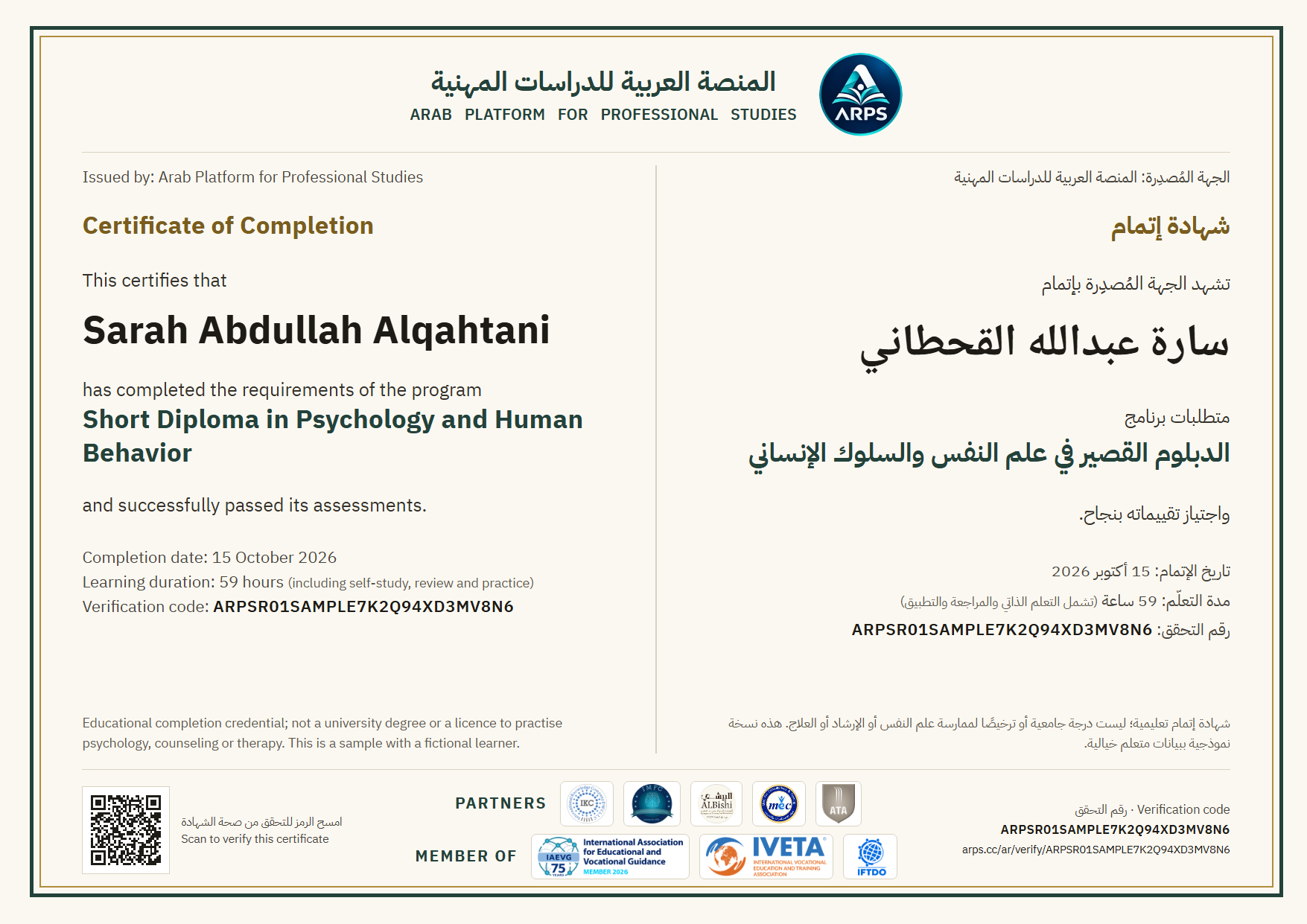
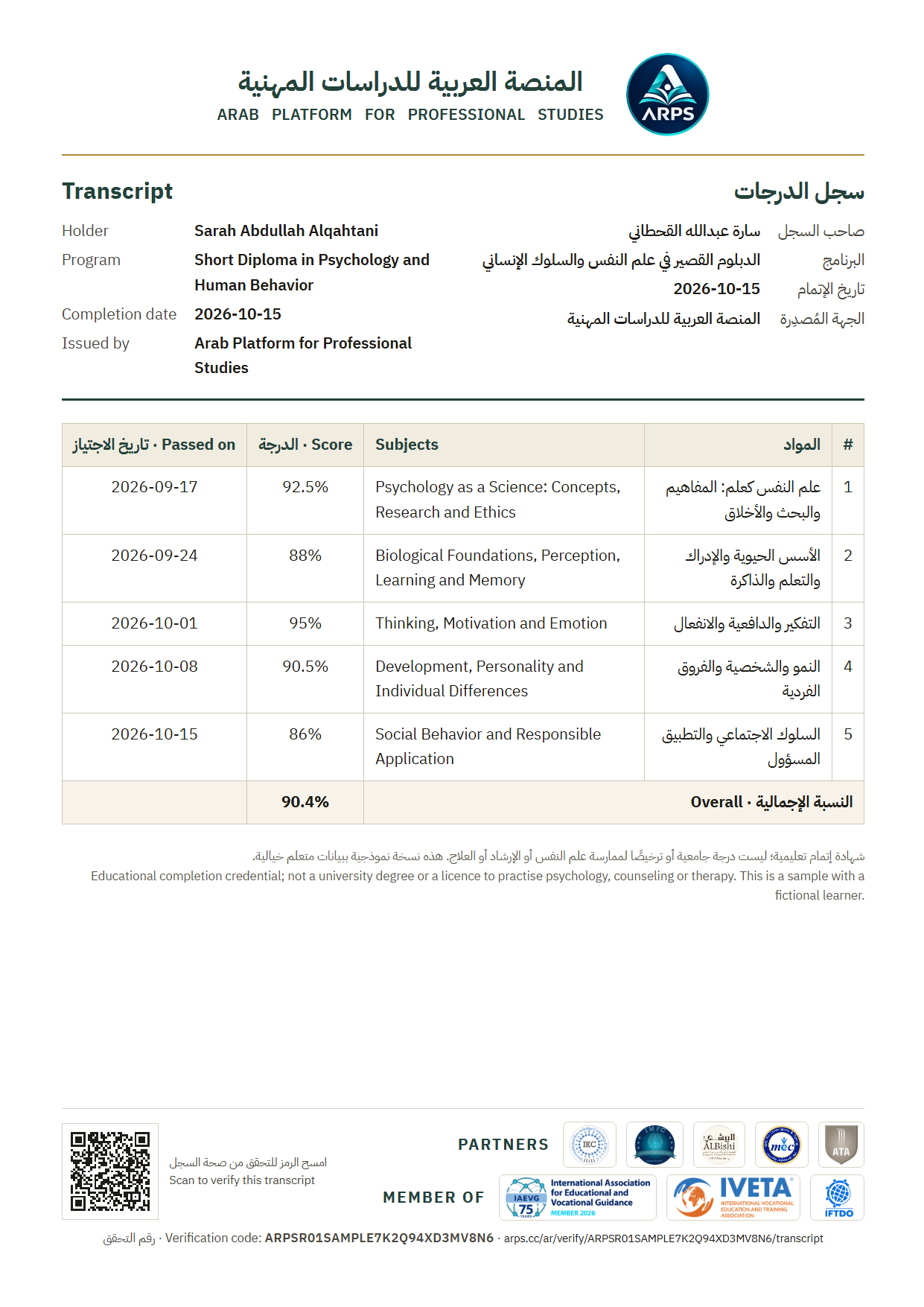
A sample from a real program in this track: Short Diploma in Psychology and Human Behavior. The learner, scores and dates are fictional; opens in a new window.
Disclaimer: Educational completion with subject results, not a healthcare licence or university degree.
Program questions
Will I learn to interpret test results or advise on treatment?
No. You learn to record and route a patient's question to an authorized clinician and follow whether the service response reached the person.
Are the exercises based on real patients?
No. Case facts and locations are invented for analysis and decision practice without personal data.
Can a local survey item be compared directly with CAHPS?
No. Standardized comparison requires the appropriate instrument, version, administration and analysis guidance; a local question has a narrower use.
Do I need previous healthcare experience?
Clinical experience is not required. The lessons ask you to read service cases, calculate simple proportions and respect organizational role limits in real work.
How are the six subjects assessed?
Each subject has learning checks and its own summative assessment in the completion pathway, with subject results recorded. Passing does not grant an external professional authorization.
Show all (7)
Is Short Diploma in Patient Experience free, and do I get a certificate?
Yes. Short Diploma in Patient Experience is free on ARPS: every lesson, exercise and assessment is free, the first subject is open to read without an account, and the program is available in Arabic and English. Issuing a certificate is optional and has a published fee; it is a training completion certificate showing you passed the program's assessments, recognised by most private-sector organisations in the Gulf states and most Arab countries, and it strengthens your CV; confirming that a specific organisation accepts it remains your responsibility.
What other names is Short Diploma in Patient Experience known by?
The subject of this program is also known as: patient experience, patient satisfaction, patient-centered care. Learners usually find it by searching for: patient experience courses online, patient experience training, patient satisfaction course, improving patient experience, patient-centered care training.
A foundational, applied diploma in managing health services through governance, operations, capacity, quality, safety, data, budgeting, patient experience, and resilience. It makes clear what management can change and what must remain a clinical decision for qualified professionals.
6 subjects
24 lessons
65.5 hours
Free
Short Diplomas
Public Health, Nutrition, Wellbeing & Healthcare Management
A foundational diploma on foods, nutrients, dietary patterns, labels, food safety and everyday behaviour, taught as general education that can transfer across cultures without prescribing individualized therapeutic diets.
6 subjects
25 lessons
56 hours
Free
Short Diplomas
Public Health, Nutrition, Wellbeing & Healthcare Management
An educational diploma in health policy and economics with six subjects and a capstone, connecting access, equity, financing and economic evaluation to operational tools and a reviewable recommendation.
7 subjects
24 lessons
77 hours
Free
Short Diplomas
Public Health, Nutrition, Wellbeing & Healthcare Management
A foundational, applied diploma on how public health examines population health, how data, risks and health claims should be read, and how preventive or educational messages and programmes can be designed without turning population averages into individual diagnosis or advice.
6 subjects
24 lessons
57 hours
Free
Next step: a professional certification or a mini-master
Programs in the same domain that prepare you for an international certification exam or form a professional mini-master, also free.