Specialist Preparation Program in Placemaking and Place Development
Specialist Preparation Program in Placemaking and Place Development is a free program on ARPS, the Arab Platform for Professional Studies. A practical specialist program for reading place evidence, comparing interventions, and organizing delivery and follow up within authority limits. The module begins by defining the site, task boundary and decision owner, then turns conflicting impressions into an evidence ledger and.
Produce a annotated access map and barrier register from the case facts and state decision limits.
From lesson 1, readable now without an account: Site brief and evidence
Place development begins with a decision an authorized owner can make, not with an attractive image of a site. A request to ‘make the square lively’ leaves the site boundary, users, time of concern, and authority over movement, furniture, and programming undefined. A useful site brief separates five matters: the intervention boundary, the use to improve, affected groups, available and missing evidence, and the people who can approve technical and operational decisions. The specialist can then diagnose and compare options while identifying decisions that require a designer, traffic or accessibility specialist, or municipal approval. Asking whether people feel safe does not establish engineering safety.
Mark the site boundary on a working map, then mark a wider influence area that includes entrances and nearby crossings. Keep an evidence ledger with columns for observation, collection method, time and location, denominator, user group, supported inference, and unsupported inference. A 30-minute pedestrian count measures passages in that window. It does not measure unique people, quality of staying, or an entire day. A snapshot of people seated is not the number of daily visits. These distinctions matter because comparing raw counts from unequal windows can reverse the apparent trend.
State the problem as a testable proposition: ‘In the selected observation windows many people pass through but few stop; we should test whether limited shade and seating contribute, while checking pedestrian access first.’ This is a hypothesis rather than a finding. Keep an alternative explanation: perhaps the chosen window is a commuting period when stopping is naturally uncommon. To separate the explanations, repeat counts in comparable periods, ask specific questions of varied user groups, and record weather and nearby activity. Do not treat the views of the most available participants as a representative neighbourhood vote.
The brief should declare a success measure and a stop condition before installation. A reversible seating trial might aim to increase observed seating in comparable windows, provided an accessible route remains open. The specialist may propose the trial and its observation schedule. The specialist cannot assume that placing furniture in a public right of way is legally permitted, or that changing a crossing needs only user support. If an immediate hazard or access obstruction appears, stop the trial and refer it to the authorized owner. Use the same unit of measure before and after; changing the denominator after seeing results weakens the decision.
Before visiting the site, connect each decision question to a collection method. An absent user group may signal an access barrier; current user counts alone cannot establish that access is adequate. Mark unresolved questions and their collection owner instead of treating missing evidence as a negative finding.
A free account saves your progress and takes you straight to lesson 1.
Program facts
Study fee
Free
subjects
8
lessons
32
Estimated time
54 hours
Content last reviewed
Access period
30 days
Study language
Arabic and English
About the program
The module begins by defining the site, task boundary and decision owner, then turns conflicting impressions into an evidence ledger and testable questions. Learners map entrances, edges, desire lines and barriers while separating distance from safe and accessible passage. They design comparable observation windows with explicit time denominators and distinguish passages, staying activity and unique people. A stakeholder matrix then separates reported claims, direct observations and untested hypotheses. The working output is an initial site file that states what a specialist can describe and what needs referral to a designer, traffic authority or local decision maker. The named Arab city settings are fictional; their numbers are not facts about those cities.
Practical relevance
Learners produce a site file, evidence matrix, decision pack, operating log and handover, with clear specialist escalation.
Why this program
Place decisions need a reviewable chain from problem and observation to option, pilot and operation.
Career paths this program serves
This program is a step on the paths of the following occupations. Open a path to see its other programs in study order.
Produce and review the define the place and mandate work products for a bounded fictional public space, documenting evidence, alternatives, authority limits and escalation.
Produce and review the diagnose place quality and participation work products for a bounded fictional public space, documenting evidence, alternatives, authority limits and escalation.
Produce and review the design intervention options work products for a bounded fictional public space, documenting evidence, alternatives, authority limits and escalation.
Produce and review the deliver and steward the place work products for a bounded fictional public space, documenting evidence, alternatives, authority limits and escalation.
Produce and review the measure outcomes and improve work products for a bounded fictional public space, documenting evidence, alternatives, authority limits and escalation.
Show all (8)
Produce and review the integrated place-development dossier work products for a bounded fictional public space, documenting evidence, alternatives, authority limits and escalation.
Complete specialist place-performance tasks on night journeys, seasonal water use, lifecycle cost and fair local use.
Deliver a multi-site neighbourhood corridor capstone, from dossier and conditional funding to handover and independent review.
Learning outcomes (8)
Produce and review the define the place and mandate work products for a bounded fictional public space, documenting evidence, alternatives, authority limits and escalation.
Produce and review the diagnose place quality and participation work products for a bounded fictional public space, documenting evidence, alternatives, authority limits and escalation.
Produce and review the design intervention options work products for a bounded fictional public space, documenting evidence, alternatives, authority limits and escalation.
Produce and review the deliver and steward the place work products for a bounded fictional public space, documenting evidence, alternatives, authority limits and escalation.
Produce and review the measure outcomes and improve work products for a bounded fictional public space, documenting evidence, alternatives, authority limits and escalation.
Produce and review the integrated place-development dossier work products for a bounded fictional public space, documenting evidence, alternatives, authority limits and escalation.
Deliver specialist place performance tasks with reviewable evidence and explicit authority limits.
Deliver neighbourhood corridor development capstone with reviewable evidence and explicit authority limits.
Who it is for
This program serves practitioners in public space improvement, community engagement, municipal facility operations and place stewardship who need a repeatable site workflow. It suits staff preparing a decision brief, temporary pilot or monitoring record under the authority of a place owner. It does not grant engineering design authority or professional licensure, and it does not assume the learner can issue statutory approvals.
Prerequisites
Learners should be able to read a simple site plan, record field observations in a table, and interpret rates and time comparisons. Experience with public service or place operations helps but no licensed professional role is assumed. They should distinguish a direct observation from a participant opinion and seek specialist review for engineering design, traffic or legal accessibility decisions.
The module begins by defining the site, task boundary and decision owner, then turns conflicting impressions into an evidence ledger and testable questions. Learners map entrances, edges, desire lines and barriers while separating distance from safe and accessible passage. They design comparable observation windows with explicit time denominators and distinguish passages, staying activity and unique people. A stakeholder matrix then separates reported claims, direct observations and untested hypotheses. The working output is an initial site file that states what a specialist can describe and what needs referral to a designer, traffic authority or local decision maker. The named Arab city settings are fictional; their numbers are not facts about those cities.
4 lessons · 3 hours
Site brief and evidence44 min
Access and barriers map44 min
Use observation protocol44 min
Stakeholder evidence matrix44 min
Subject 2
Diagnose place quality and participation
This module establishes evidence before selecting a design response. Learners build a bounded baseline, define counting units and decide when two periods or groups can fairly be compared. They inspect comfort, shade, seating and observed activity without treating the mere presence of an object as proof that people use it. They invite less represented groups through privacy aware methods and record uncertainty, rather than treating the loudest meeting voice as the whole community. Finally, they connect a problem, a proposed cause, an indicator and a contrary test while separating association from causation. The output is a small evidence dashboard and repeatable follow up protocol with limits and specialist approval needs. All example data are fictional.
4 lessons · 3 hours
Baseline and rate denominators44 min
Comfort and activity audit44 min
Representative participation44 min
Testing place hypotheses44 min
Subject 3
Design intervention options
The module turns evidence into comparable intervention options. Learners publish criteria for access, comfort, safety, operating cost and reversibility, then test how weighting changes a ranking instead of hiding preferences in one score. They contrast temporary and permanent responses, separating what observation can test from what needs technical review or permission. A small pilot receives a hypothesis, indicator and stop date, with clear limits on inference from a short sample. The final product is a decision pack explaining tradeoffs, risks and unknowns to the authorized owner. This is an early specialist decision aid for a fictional place, not an engineering design or traffic approval.
4 lessons · 3 hours
Option comparison criteria44 min
Temporary or permanent intervention44 min
Designing a site pilot44 min
Intervention decision pack44 min
Subject 4
Deliver and steward the place
This module turns a proposal into work that can be monitored. Learners sequence tasks and dependencies, identify permission owners and day to day operators, and keep a risk register that separates likelihood from impact. They write checkable procurement or commissioning requirements rather than selecting an attractive object on appearance alone, and compare offers under consistent criteria. A temporary launch plan covers access, safety, cleaning, emergencies and stop conditions before inviting the public. The output is a responsibility and deliverable schedule with acceptance criteria and explicit escalation for engineering or statutory work. Its cases and figures are fictional and do not describe a particular city permitting process.
4 lessons · 3 hours
Delivery sequence and owners44 min
Delivery risk register44 min
Checkable procurement brief44 min
Launch and stop plan44 min
Subject 5
Measure outcomes and improve
This module follows the place after opening. Learners create an inspection and maintenance cycle connecting an observation to a responder and response date, while separating routine fixes from faults needing closure or referral. They observe use across times and activities instead of inferring success from launch day, and compare follow up data with the baseline while logging weather, events and counting method changes. They also create an understandable feedback channel and fair response to competing complaints, then decide when to retain, modify or stop an intervention. The output is an operating and periodic review log that another steward can inherit, without assuming every increase in counts improves the place.
4 lessons · 3 hours
Inspection and maintenance44 min
Post-opening use measurement44 min
Responding to user feedback44 min
Retain, modify or stop44 min
Subject 6
Integrated place-development dossier
The final module assembles the site work into a defensible decision. Learners retrace the evidence chain from initial complaint through baseline, alternatives, pilot and operation, and identify links that remain hypotheses. They prepare a brief with a recommended and rejected option, reasons for each, cost, ownership, risks and authority limits. They test it against objections from different users and revise it without erasing disagreement. Last, they specify handover, later measurement, stop points and escalation so that the decision can be revisited after implementation. Assessment examines professional judgment and checkable work in a fictional case; it grants neither professional licensure nor an external credential.
4 lessons · 3 hours
Integrated evidence chain44 min
Recommendation and alternatives44 min
Testing objections and revision44 min
Handover and follow-up44 min
Subject 7
Specialist place performance tasks
Extended tasks with distinct outputs linking evidence and decisions.
4 lessons · 15 hours
Night journeys and glare3.5 hours
Seasonal use and water stewardship3.5 hours
Lifecycle cost and supplier acceptance3.5 hours
Fair use and local place economy3.5 hours
Subject 8
Neighbourhood corridor development capstone
Extended tasks with distinct outputs linking evidence and decisions.
4 lessons · 15 hours
Corridor dossier and influence areas4 hours
Intervention portfolio and conditional funding4 hours
Pilot disruption and recovery rehearsal4 hours
Handover and independent review dossier4 hours
Subjects unlock in sequence as you progress.
Strengths
Worked fictional place cases
Exercises with outputs and review criteria
Clear decision and escalation boundaries
Evidence basis
Specific concepts draw on primary professional sources for place diagnosis, measurement and interim interventions; cases and numbers are instructional.
Methodology
From site brief and observation to option comparison, temporary pilot and operation, with explicit hypotheses and escalation.
Assessment
Assessments follow the program blueprint and may use module assessments, a final assessment, or a combination, under the approved attempt policy.
Assessment attempts: 2 per assessment, 7 days apart
The pass mark is announced before the program is published.
Certificate
The credential confirms completion and successful assessment; it does not represent professional licensure unless explicitly and lawfully stated.
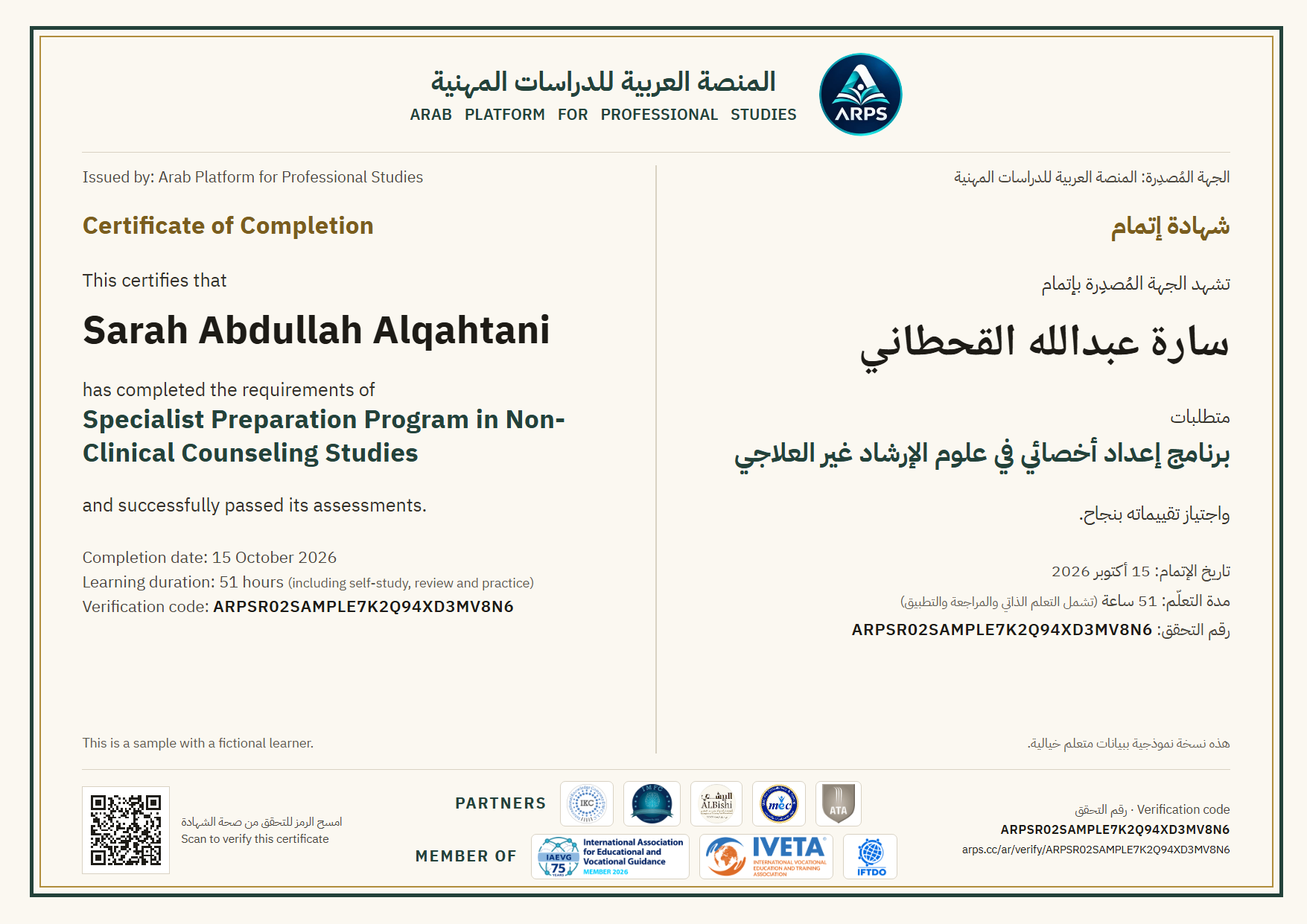
A sample from a real program in this track: Specialist Preparation Program in Non-Clinical Counseling Studies. The learner, scores and dates are fictional; opens in a new window.
No. It teaches specialist tasks and referral boundaries, not design licensure or statutory approval.
How are skills assessed?
Lessons include exercises with solutions and review criteria, followed by a module assessment.
Are the examples real city data?
No. Named cities are fictional training settings and the figures are invented.
Must I have approval authority?
No. Learners practice role limits and referral to the decision owner.
What does the observation lesson produce?
An observation record with explicit time denominators and sample limits.
Show all (8)
When should a specialist refer a decision?
When it needs design, safety review or a permit beyond the specialist role.
Is Specialist Preparation Program in Placemaking and Place Development free, and do I get a certificate?
Yes. Specialist Preparation Program in Placemaking and Place Development is free on ARPS: every lesson, exercise and assessment is free, the first subject is open to read without an account, and the program is available in Arabic and English. Issuing a certificate is optional and has a published fee; it is a training completion certificate showing you passed the program's assessments, recognised by most private-sector organisations in the Gulf states and most Arab countries, and it strengthens your CV; confirming that a specific organisation accepts it remains your responsibility.
What other names is Specialist Preparation Program in Placemaking and Place Development known by?
The subject of this program is also known as: placemaking, place development, urban design. Learners usually find it by searching for: placemaking course, placemaking courses online, creative placemaking course, public space design course.
Advanced preparation for testable housing and urban policy advice. Diagnose the problem, compare feasible options, and make a conditional recommendation grounded in evidence, equity and delivery capacity.
An applied short diploma in housing need, location, land, affordability, tenure, delivery and evaluation through fictional cases with worked solutions.
Learn the specialist tasks of innovation management, from an evidenced opportunity to a bounded experiment, decision and operating handover. Produce job aids, evidence logs, calculations and decision briefs using fictional bilingual cases.
Turn software requirements into checkable acceptance conditions and reproducible tests. Record execution and defects, then write an evidence bounded release recommendation. The program covers design, risk, accessibility, authorization, performance and automation.
10 subjects
40 lessons
53.5 hours
Free
Next step: a professional certification or a mini-master
Programs in the same domain that prepare you for an international certification exam or form a professional mini-master, also free.