Short Diploma in Housing and Urban Policy is a free program on ARPS, the Arab Platform for Professional Studies. An applied short diploma in housing need, location, land, affordability, tenure, delivery and evaluation through fictional cases with worked solutions. How can we tell whether a district faces a shortage of units, weak services or the cost of a poor location?
Important notice: Independent educational programme; completion credential only, without a professional licence or external endorsement.
Calculate and qualify housing cost burden using consistent numerator, denominator and period.
From lesson 1, readable now without an account: From Unit Counts to Housing Adequacy
If a city reports that it built a thousand homes, has it solved its housing need? The count describes an addition to the stock, but says little about whether households can afford the homes, whether they are safe, or whether they are well located. Begin a diagnosis with a clear observation unit: one household occupying one dwelling during a stated period. Then separate the condition observed from the policy judgment that might follow. An occupied dwelling can still be inadequate for several reasons. If every problem is called a shortage of units, a city might commission new construction when repair or improved services would serve some households better.
A free account saves your progress and takes you straight to lesson 1.
Program facts
Study fee
Free
subjects
6
lessons
25
Estimated time
72.5 hours
Content last reviewed
Access period
60 days
Study language
Arabic and English
About the program
How can we tell whether a district faces a shortage of units, weak services or the cost of a poor location? The programme begins with housing adequacy and household burden, then connects land, planning and networks to delivery. It compares demand and supply instruments and tenure, moves through regeneration, resilience, participation and implementation, and leads to a bounded policy brief, indicators and a test of assumptions. It closes with an applied project on bringing fictional vacant homes into use: a household-protecting field register, occupancy-ready offers, operating finance, complaint follow-up and a phased expansion decision. Named-city cases are fictional; the programme provides no legal or engineering decision for a real city.
Practical relevance
Apply household cost, supply pipeline, site, allocation and monitoring methods to fictional cases, then carry the reasoning method to verified real-world data.
Why this program
Costly housing choices are sometimes made from unit counts alone. Learn to separate need and connect household evidence with stock, location and an appropriate instrument before commitment.
Career relevance
Municipal, housing programme and community research staff can use the material to ask sharper questions, read tables and explain tradeoffs. It promises neither employment, promotion nor authority for regulated practice.
Career paths this program serves
This program is a step on the paths of the following occupations. Open a path to see its other programs in study order.
Diagnose adequacy, cost burden and need without conflating households and units.
Compare land, location, services and preliminary unit capacity.
Choose a conditional support or tenure instrument matched to household barriers.
Plan regeneration and delivery around safety, participation and dependencies.
Measure outcomes, examine causality and write an integrated policy brief.
Show all (7)
Build a field register that protects household data and turn vacant homes into occupancy-ready offers.
Calculate operating and cash gaps, track barriers and complaints, and defend a phased expansion decision ready for handover.
Learning outcomes (25)
Distinguish housing adequacy from unit count; classify the seven adequacy dimensions in a household case.
Calculate and qualify housing cost burden using consistent numerator, denominator and period.
Segment housing need without conflating households, people, units and waiting lists.
Turn a diagnosis into a bounded problem statement and equity test.
Read a land-to-home pipeline and locate where permitted capacity differs from delivered homes.
Compare location by access to jobs, services and transport rather than plot price alone.
Explain how land-use rules, infrastructure and delivery capacity interact.
Estimate an elementary housing supply scenario with density, site and infrastructure constraints.
Separate price, rent, deposit, operating costs and access to finance.
Compare demand support, supply support and regulation under different market responses.
Distinguish tenure security, ownership and rental choice.
Build a transparent eligibility and allocation rule for a hypothetical programme.
Compare upgrading, rehabilitation, relocation and replacement with resident impacts.
Evaluate basic heat, flood and energy risks in housing interventions.
Map institutions, residents and decision rights for an urban housing project.
Assess implementation feasibility, budget and unintended consequences.
Choose output and outcome indicators with baselines and disaggregation.
Distinguish monitoring change from attributing impact.
Compare policy options with costs, equity, location and feasibility.
Write an integrated housing and urban policy brief.
Reconcile visits to the survey boundary and design correction and privacy controls supporting occupancy decisions.
Prepare offers linking unit readiness, service capacity and terms to household matching and dwelling handover.
Calculate operating and timing gaps and compare funded responses that preserve service continuity and clear responsibilities.
Analyze application and complaint journeys and select a follow-up action addressing a documented barrier while preserving correction rights.
Defend phased expansion using resource calculations and verification conditions, handing over a project another team can operate.
Who it is for
This short diploma serves learners, municipal and housing programme staff, and community researchers seeking a foundation across related subjects. It suits people who want to diagnose need, compare policy instruments and write a reviewable preliminary brief. It confers no professional licence or authority to issue engineering or legal decisions. Cases progress from household costs through site choice, delivery and evaluation.
Prerequisites
No advanced background in planning or real estate is required. Learners should be able to read a simple table, calculate percentages with a calculator, and write a short decision paragraph. The lessons introduce necessary terms when used and rely on fictional cases. Learners are expected to separate verified evidence from assumptions and avoid treating classroom exercises as local legal rules.
What it does not offer
Issuing permits, legal judgments, engineering designs or operative allocation decisions.
This subject asks what makes a dwelling adequate for its occupants rather than counting units alone. The seven adequacy elements help record observations and unknowns without turning them into local legal verdicts. Learners calculate rent and wider housing-travel burdens with declared income definitions and periods, then test variable earnings. They distinguish households, dwellings and people, and separate quantitative need from repairable quality deficits while checking vacant stock. Finally, they frame a bounded problem from potentially conflicting registers and samples without projecting a convenience sample to the entire city. The outputs are a diagnostic matrix, a reconciled stock table, a data-gap register and an equity question that precede selection of a policy instrument.
4 lessons · 8.5 hours
From Unit Counts to Housing Adequacy1.5 hours
Comparing Housing Cost Burdens1.5 hours
Separating Households, Units and Need1.5 hours
Framing the Problem and Testing Equity2.5 hours
Subject 2
Land, Location and Housing Supply
This subject follows land from theoretical capacity to a completed, occupied home and shows why permission is not construction. Learners calculate losses across stages of one cohort and inspect the location and timing of a gap before calling it a bottleneck. They compare sites by practical access to work and services, travel cost, and household preferences. Next they separate land-use permission from network and financing capacity, using the binding constraint to explain conditional deliverability. Finally, they estimate site yield from gross area, net developable share and density, then distinguish preliminary capacity from homes actually suitable and affordable to target households. Every calculation carries its unit, assumption and decision limit rather than presenting a sketch as a delivery promise.
4 lessons · 8.5 hours
The Land-to-Delivery Pipeline1.5 hours
Location as Practical Access1.5 hours
Connecting Land Rules, Services and Delivery1.5 hours
Estimating a Site's Housing Yield2.5 hours
Subject 3
Affordability, Tenure and Policy Instruments
This subject separates entry deposits, recurring cost and access to a suitable offer. Learners compare moving-day cash with income left after rent, utilities and travel, avoiding the claim that a home is accessible merely because rent is lower. They then examine mechanisms of demand support, supply support, regulation and transport, who benefits first, and how prices might respond under specific market conditions. On tenure, they distinguish stability of occupation from ownership and assemble facts before proposing repair or a move without inventing local law. The subject ends with a teaching rule for eligibility, priority, dwelling-household fit, ties, appeals and privacy. Its output is a policy design open to review, not an operative allocation decision.
4 lessons · 8.5 hours
What Prevents a Household from Accessing Housing?1.5 hours
How Housing Policy Instruments Work1.5 hours
Tenure Security Is Not the Same as Ownership1.5 hours
Transparent Eligibility and Reviewable Allocation3 hours
Subject 4
Urban Upgrading, Sustainability and Governance
This subject weighs in-place upgrading, rehabilitation, temporary moves and replacement against safety, disruption and a credible route back. It separates heat or water hazards from exposure and resident vulnerability, counting overlaps before reporting beneficiaries. Learners choose proportionate, low-regret measures and check comfort or service reliability after delivery instead of merely counting installed assets. They map who holds a decision, who is affected and where participation can still change the choice, recording the response to residents' input. Finally, they turn a policy into phases with dependencies, costs, accountable actors and pause triggers. Real engineering and legal judgments remain with competent bodies, while all numerical cases in the subject are fictional teaching material.
4 lessons · 7.5 hours
Upgrade in Place or Relocate?1.5 hours
Housing, Heat, Floods and Energy1.5 hours
Who Decides and Who Is Heard?1.5 hours
An Implementation Plan That Exposes Dependencies1.5 hours
Subject 5
Evaluation and Integrated Policy Brief
The final subject connects each instrument to an outcome that can be measured. Learners define an indicator with numerator, denominator, date and baseline, separating repaired homes as an output from reliable service as a result. They then distinguish before-and-after monitoring from causal attribution, calculating a simple difference-in-differences with its assumptions and a concrete event that could change interpretation. In an options appraisal, they disclose exclusion conditions and weights and test how one changed fact reverses the rank. The path ends with a one- to two-page brief combining household, stock and location diagnosis, intervention alternatives, staged delivery, an equity test, an outcome measure and a review point. Success is a recalculable, revisable argument, not unsupported proof of impact.
4 lessons · 7.5 hours
From Output to Outcome Indicator1.5 hours
Did the Intervention Cause the Improvement?1.5 hours
Comparing Options Under Uncertainty12 min
An Integrated Housing Policy Brief3 hours
Subject 6
Applied Project: Safe and Sustained Use of Vacant Homes
Learners carry out a vacant-home operations project in a fictional neighbourhood, beginning with a field register that protects household data and exposes coverage gaps. They turn the list into reviewable offers, distinguishing consent from service readiness and actual occupation. Next they prepare an operating budget, cash schedule and tests for lower collection and expiring funding. For follow-up, they design application and complaint routes with accountable actions and closure evidence, connecting corrections to the offer file. They combine these outputs in a scale decision bounded by capacity and funding, testing delayed service without making unsupported delivery promises. The handover consists of a register, offer file, budget, follow-up map and decision that another team can trace.
5 lessons · 32.5 hours
Building an Auditable Household Field Register6 hours
Turning Vacancies into Occupancy Ready Offers6 hours
Funding Operations after the Grant Ends6 hours
Tracking Barriers and Complaints during the Pilot6 hours
The Scale Decision and Project Handover6 hours
Subjects unlock in sequence as you progress.
Strengths
Worked cases and exercises with reviewable outputs in every lesson.
Connects household diagnosis to site, instrument, delivery and outcome measurement.
A distinct end assessment for each of the six subjects, including the applied project.
Evidence basis
Primary sources from UN-Habitat, OHCHR, OECD and the World Bank support claims within the inspected scope of each source.
Reference organizations
OHCHR
UN-Habitat
OECD
World Bank
Methodology
Cases and questions were authored for this programme and consequential claims tied to source scope. Review is assisted self-review, not endorsement or learner testing.
How the route works
Short Diplomas are relatively comprehensive learning pathways that cover a major subject through five connected learning subjects and structured assessments, with a diploma transcript available with the credential.
Self-paced sequential study. Content unlocks progressively and each subject combines reading, examples, exercises, knowledge checks, and assessment.
Build integrated knowledge in a major subject.
Study through five clear, connected learning subjects.
Complete a defined assessment for each subject.
Receive a diploma transcript showing subjects and results when the credential is issued.
Assessment
Each Short Diploma contains five subjects, each with an approved assessment. A sixth final exam is not required when the five assessments adequately cover the learning outcomes.
Assessment attempts: 2 per assessment, 7 days apart
The pass mark is announced before the program is published.
Certificate
Successful completion makes the learner eligible for the Short Diploma certificate and Diploma Transcript under the credential policy.
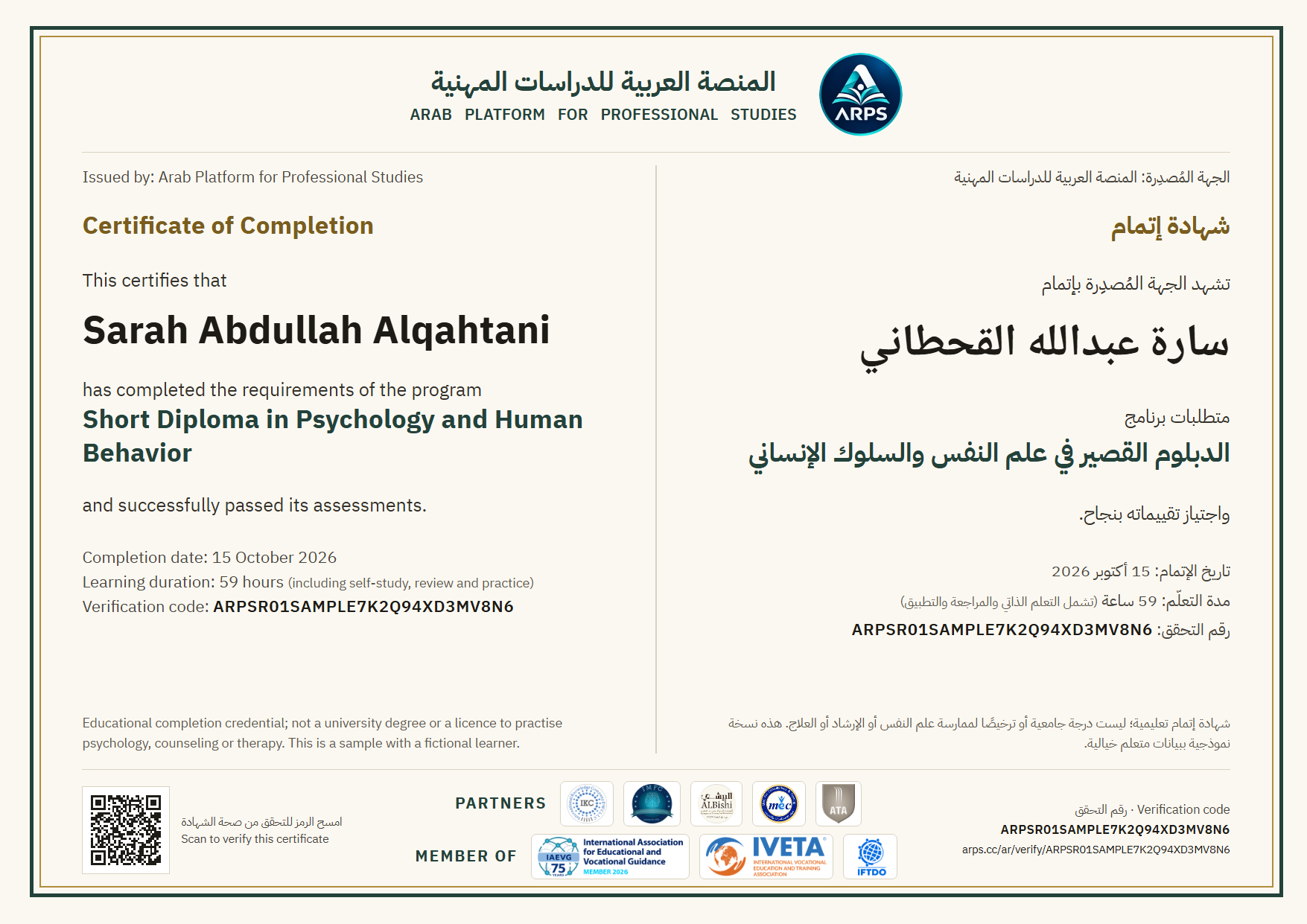
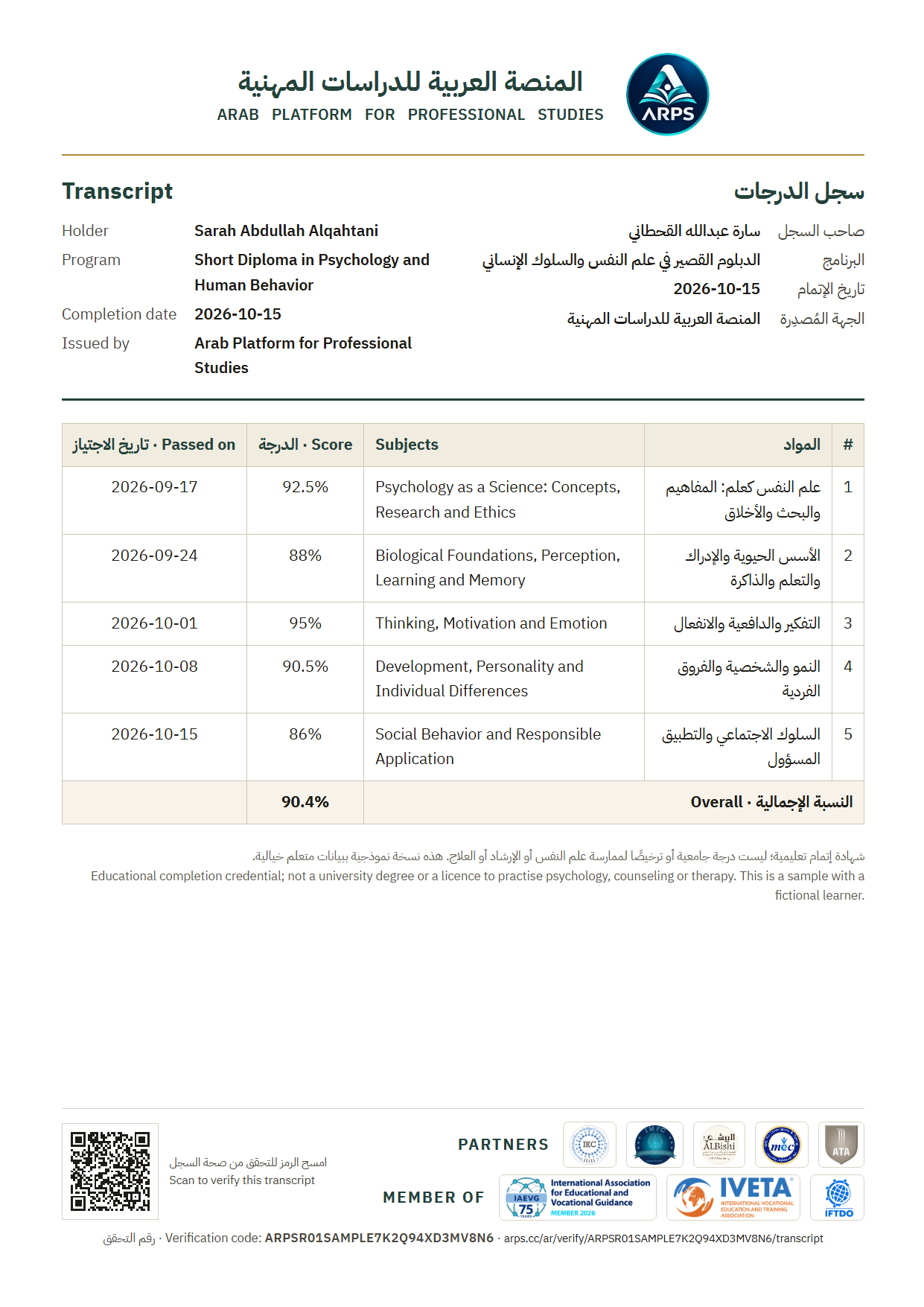
A sample from a real program in this track: Short Diploma in Psychology and Human Behavior. The learner, scores and dates are fictional; opens in a new window.
Disclaimer: Training completion, not a university degree or professional licence.
Program questions
Does the course grant a professional licence?
No. It leads only to an educational completion credential and grants no legal or engineering authority.
Are the named-city case numbers real?
No. Cases are explicitly labelled hypothetical training scenarios with invented data.
What is the final learner output?
A short policy brief joining diagnosis, alternatives, implementation, outcome measures and evidence limits, followed by an applied-project file with a phased expansion decision that another team can operate.
Do I need engineering experience?
No. Reading a simple table and calculating a percentage are enough; the lessons show the steps.
Are local charts and data current?
No real local dataset is supplied; verify data for your own city before applying any inference.
Show all (7)
Is Short Diploma in Housing and Urban Policy free, and do I get a certificate?
Yes. Short Diploma in Housing and Urban Policy is free on ARPS: every lesson, exercise and assessment is free, the first subject is open to read without an account, and the program is available in Arabic and English. Issuing a certificate is optional and has a published fee; it is a training completion certificate showing you passed the program's assessments, recognised by most private-sector organisations in the Gulf states and most Arab countries, and it strengthens your CV; confirming that a specific organisation accepts it remains your responsibility.
What other names is Short Diploma in Housing and Urban Policy known by?
The subject of this program is also known as: housing policy, urban policy, affordable housing policy. Learners usually find it by searching for: housing policy course, urban policy course, affordable housing training, free urban policy course.
Advanced preparation for testable housing and urban policy advice. Diagnose the problem, compare feasible options, and make a conditional recommendation grounded in evidence, equity and delivery capacity.
A practical short diploma connecting urban service needs with data, technology, equity and measurement through fictional cases and solved practice. Seven subjects, including service-asset management and an integrated capstone, each have a summative assessment.
This short diploma connects market-research design with consumer-behavior interpretation and evidence-bounded decisions. Six subjects progress from the research question through sampling, measurement, analysis, choice journeys, testing, and recommendation, ending with an applied market-research capstone.
6 subjects
24 lessons
62.5 hours
Free
Next step: a professional certification or a mini-master
Programs in the same domain that prepare you for an international certification exam or form a professional mini-master, also free.