Short Diploma in Smart Cities is a free program on ARPS, the Arab Platform for Professional Studies. A practical short diploma connecting urban service needs with data, technology, equity and measurement through fictional cases and solved practice. Seven subjects, including service-asset management and an integrated capstone, each have a summative assessment.
Important notice: Foundational training completion; no professional licence or engineering authorization.
Map a service journey and responsible actors across digital and counter channels, identifying where a user without digital access is excluded.
From lesson 1, readable now without an account: From an urban problem to a smart intervention
Start with the service, not the device
Imagine a bus stop where passengers arrive at different times. A new display says “soon,” yet buses do not arrive when expected. A passenger cannot tell whether to wait or take another route. Installing a display is a technical output: we can count the units and test whether they turn on. Helping a passenger make a dependable travel decision is a service outcome. A hundred working displays can leave the outcome unchanged if vehicle-location data arrive late or the wording gives no useful wait estimate. A practical smart-city inquiry starts with an observable urban problem. It asks whether data, technology and operating changes can improve the service, who benefits and who might be left out. Connected devices alone do not establish that a city is smart.
The U4SSC initiative examines city performance across economy, environment, society and culture, with indicators intended to assess how digital technologies contribute to sustainable development. UN-Habitat's playbooks place people, inclusion and rights at the centre of digital transition. Neither framework says that every screen or sensor is beneficial. Together they prompt two questions: What public benefit is sought, and what evidence, including residents' experience, would show that it occurred? Throughout this diploma, technology is one part of a service with staff, procedures and alternative access channels.
A free account saves your progress and takes you straight to lesson 1.
Program facts
Study fee
Free
subjects
7
lessons
26
Estimated time
60 hours
Content last reviewed
Access period
60 days
Study language
Arabic and English
About the program
A smart city starts with a resident need: a bus connection, a lit route, waste collection or a flood warning. You learn to define the service outcome before choosing a device, then trace data from observation to decision and test freshness, meaning and privacy. Compare mobility, lighting, water and waste effects on neighbouring services. Plan participation that reaches people without an app, compare supplier offers over lifecycle cost and portability, and name decision and complaint owners. In the fifth subject, write a pilot hypothesis and indicator with denominator and period, interpret missing data and alternative explanations, and decide whether to scale, modify or stop. You then link equipment identity to location, function and condition, allocate maintenance work and spare parts, and finish with an integrated capstone on access from a bus stop to a neighbourhood library. Named Arab cities and figures appear only in hypothetical teaching cases; they do not report real performance or local law. This is not an operational plan for a real road or an engineering authorization.
Practical relevance
Apply an indicator card, cross-service effects matrix, acceptance test and small pilot plan, including when to revise or pause a system after access or safety failure.
Why this program
The five subjects let you test claims of urban ‘smartness’ against actual service results, using worked calculations and clear inference limits rather than device counts.
Career relevance
Useful to people supporting city services, data analysis, supplier review or bounded pilots. Completion does not confer a professional title or authority to operate critical infrastructure.
Career paths this program serves
This program is a step on the paths of the following occupations. Open a path to see its other programs in study order.
Define an urban problem and measurable service outcome.
Map service journeys and channels for different users.
Check device-data meaning, freshness and minimum needed fields.
Compare mobility, lighting, water and waste impacts on neighbouring services.
Plan traceable participation, decision rights and complaints.
Show all (10)
Compare lifecycle offers, data portability and safety conditions.
Compute an indicator with denominator, period and missing data.
Design a pilot and justify scale, modification or stop.
Reconcile an asset register, prioritise preventive inspection and allocate work orders and spare parts.
Run an integrated library-access project from route observation and trial plan to implementation audit, decision report and handover.
Learning outcomes (26)
Frame a testable urban-service problem and distinguish service outcome from technology output using bus-arrival information.
Map a service journey and responsible actors across digital and counter channels, identifying where a user without digital access is excluded.
Compute an urban-service indicator from a baseline, denominator and defined segment, explaining when two districts cannot be compared.
Compare two urban interventions by problem fit, feasibility and exclusion risk, then justify a bounded trial.
Trace a device or administrative observation to a decision and check freshness, unit and location before use.
Specify a foundational data-exchange contract across vendors, including identifiers, timestamps, units and failure states.
Choose data-minimization, access and retention controls for an urban service and explain the privacy effect.
Trace a connected-service failure, define a fallback and recovery test, and prevent stale data from appearing live.
Relate transport reliability and accessibility to a defined mobility intervention and before-and-after measures.
Distinguish power, energy and avoided energy, calculating a bounded lighting comparison with operating hours and meter boundary.
Trace a water or waste alert to field verification and operational response without treating the signal as a service outcome.
Analyze cross-domain effects of an urban intervention and set a limit that prevents shifting burden to other users or districts.
Diagnose access, affordability, ability and trust barriers using mixed-channel evidence instead of inferring one cause from a single uptake rate.
Design participation that reaches people absent from an app and trace input, response and decision effect.
Compare urban-service procurement offers by data portability, accountability and lifecycle and exit costs.
Assign decision, review and complaint rights in an urban digital service and identify when independent human review is needed.
Define an urban-pilot hypothesis, comparison group and stop conditions before implementation.
Compute a before-and-after indicator with denominator and segment and test its sensitivity to missing data.
Balance benefit, cost, operational burden and equity when deciding whether to scale, modify or stop a pilot.
Build a bounded city proposal linking service, data, rights, measures and limits of generalization in one decision.
Produce an evidence-linked operational output for asset registers and preventive inspection.
Produce an evidence-linked operational output for allocating work orders and spare parts.
Produce an evidence-linked operational output for case dossier and library-route observation.
Produce an evidence-linked operational output for trial plan and partner deliverables.
Produce an evidence-linked operational output for implementation audit and deviation analysis.
Produce an evidence-linked operational output for decision report and operational handover.
Who it is for
This foundation suits beginners in city services, transport, utilities and digital-transformation teams seeking practical decision skills without engineering training.
Early-career analysts, participation coordinators and supplier reviewers can connect indicators to resident journeys, privacy and lifecycle cost.
Public-service and community initiatives can use it for exploratory pilots.
It does not suit anyone seeking a licence to operate traffic signals or warnings, or proof of a real city or vendor's performance.
Prerequisites
No advanced technical, engineering or planning background is required; the course begins with a service problem before discussing devices.
Basic table reading and percentages are useful because exercises compare denominators and baselines; needed expressions are explained in the lessons.
Learners work through fictional cases and explain decision limits. No real city dataset, specialist software or authority to operate public infrastructure is needed.
What it does not offer
Not an engineering licence or approved training to operate traffic signals or public safety warnings.
Does not establish a real vendor's or city's performance and does not award a university degree.
The subject starts with a resident's service problem and separates a device output from an outcome that matters to a rider or applicant. Learners map the journey across an app, counter and phone, naming responsible actors and people a single-channel dataset misses. They calculate a rate with a defined denominator, period and baseline, then compare districts without confusing counts, percentages and causal claims. Finally, they weigh an arrival-feed repair, additional displays and a bounded signal-priority trial against problem fit, feasibility, safety and exclusion risk. Clinic, waste and transport exercises require a testable written decision rather than a technology slogan. Worked examples show how missing observations and alternative explanations limit inference. All numbers are fictional training data, not reported results from a real city.
4 lessons · 7.5 hours
From an urban problem to a smart intervention1 hours
Service journeys and stakeholders1 hours
Baselines, denominators and comparisons1 hours
Choosing a testable smart intervention1 hours
Subject 2
Urban Data and Digital Architecture
This subject traces an observation from a sensor or administrative record to an operating decision. Learners inspect observation and receipt times, units and location before treating a reading as usable: a delayed message is not a live state, and a millimetre-to-centimetre mismatch can reverse an alert. They then specify a small vendor-to-vendor data contract covering identifiers, field meaning, empty success responses, errors and stale records. The privacy lesson asks which parking data are necessary, who may access them and how long they should remain, without collecting identity unrelated to availability. Finally, learners trace a sensor or network failure, choose a human fallback and test recovery so an old batch cannot overwrite current state. The fictional cases separate data evidence from authority to take safety-sensitive field action.
4 lessons · 7.5 hours
From observation to operating decision1 hours
Interoperability between systems1 hours
Collect only what the service needs1 hours
Safe failure and recovery1 hours
Subject 3
Services, Mobility and Environment
This subject connects transport reliability with access to the transfer point instead of reducing the rider journey to vehicle speed or display count. Learners compute a defined late-arrival rate before and after a bounded intervention, then examine kerbs, walking routes and users who may not benefit. In lighting, they distinguish watts of power from kilowatt-hours of energy and calculate a conditional saving using operating time and meter boundary while treating visibility and safety as separate requirements. Water and waste lessons trace an alert through field verification, work assignment and evidence of service outcome; a full bin or sensor value is not a completed repair. A cross-service matrix then asks whether a loading change improves one service while burdening pedestrians or buses. Fictional exercises require reproducible indicators and explicit decision limits.
4 lessons · 7.5 hours
Reliable and accessible mobility1 hours
Streetlighting and measured energy1 hours
From alert to water and waste response1 hours
Cross-service effects of an intervention1 hours
Subject 4
Equity, Participation and Governance
The subject begins with a service-portal completion gap and resists explaining it by age or phone ownership alone. Learners distinguish eligible people, starters and completers, then test whether burden moved to counter or phone. Participation work recruits people outside the app and logs a comment, supporting evidence, response and effect on alternatives. Procurement work combines setup, recurring support and possible exit cost, and tests whether exported records retain interpretable field meanings before scoring a bid. A mandatory safety or portability condition must pass before a weighted comparison; low price cannot offset failure. Finally, learners assign the service decision owner, reviewer and field lead, and design a complaint and correction trail that retains the case history while protecting the reporter. Fictional cases exercise accountable decisions that another reviewer can reconstruct.
4 lessons · 7 hours
Diagnosing access gaps1 hours
Co-designing a city service1 hours
Procurement with exit options1 hours
Decision rights and review1 hours
Subject 5
Pilots, Evaluation and Scaling
The final subject integrates the programme through a bounded pilot that can be modified or stopped. Learners write a hypothesis linking intervention mechanism to service outcome, select a comparison site, period, baseline and stop condition before deploying a device. They calculate percentage-point and relative changes, then test denominators, small groups, missing data and changing channel mix; a before-and-after gap alone is not attributed to the intervention. A scale decision balances financial saving with operating cost, service continuity, visibility and access, and seeks evidence from the new site instead of copying the first district's settings. The closing proposal links fresh data, an alternative warning channel, decision ownership and effects on neighbouring services. Its answer separates what the fictional evidence establishes from what field specialists still need to verify.
4 lessons · 7 hours
A testable city pilot1 hours
Reading an indicator with uncertainty1 hours
Deciding whether to scale1 hours
An integrated city proposal1 hours
Subject 6
Service assets and maintenance resources
This subject connects equipment identity to location, service function, observed condition and ownership. Learners reconcile purchase and visit records with physical assets while retaining movements and history rather than deleting discrepancies to force matching totals. They prioritise preventive inspection by the consequence of losing a function and the availability of an appropriate alternative. Work then moves to allocating maintenance orders across time, skills and parts, distinguishing technician person-hours from elapsed waiting. Worked cases address weekly scheduling constraints, reserved stock and changing replenishment time. Exercises produce a usable register, inspection programme, work schedule and stock card. Figures are fictional and technical intervention remains with qualified roles; the learner practises organising decisions, documenting evidence and recognising the limits of operational knowledge.
2 lessons · 8 hours
Asset registers and preventive inspection3 hours
Allocating work orders and spare parts3 hours
Subject 7
Capstone: access to the neighbourhood library
The capstone joins programme skills around the journey from a bus stop to a neighbourhood library. Learners begin with a route map and evidence log separating observation, complaint and causal explanation, then define measurement units, observation periods and participant protections. They design a bounded trial package with assigned outputs, start conditions and restoration arrangements. Next they audit actual implementation, incomplete records and changing sample composition, preserving corrections alongside their sources and reasons. The subject ends with an evidence-proportionate decision report and a handover package a substitute can use. Eight exercises build an integrated dossier, plan, audit and recommendation with separate solutions and criteria. Cases and figures are fictional; actual spatial or operational changes require review and authorisation by the competent authority.
4 lessons · 15.5 hours
Case dossier and library-route observation3 hours
Trial plan and partner deliverables3 hours
Implementation audit and deviation analysis3 hours
Decision report and operational handover3 hours
Subjects unlock in sequence as you progress.
Strengths
Seven subjects connect problem, architecture, services, governance, piloting, asset maintenance and an integrated capstone.
Worked cases and practice expose denominator, causal and missing-data limits.
Lesson checks are separate from each subject's summative assessment and transcript.
Hypothetical cases in named Arab cities keep training distinct from licence and live operations.
Evidence basis
Concepts draw on primary public pages from ITU, UN-Habitat, NIST, the US Department of Energy and the World Bank. Claims remain within the reviewed page scope, and fictional case outcomes are not attributed to those sources.
Reference organizations
ITU
UN-Habitat
NIST
US Department of Energy
World Bank
Frameworks used
U4SSC smart-city indicator methodology public overview — Public page checked 2026-10-22
NIST smart-connected-city framework public overview — Public page checked 2026-10-22
Methodology
Five subjects connect urban-service cases to solved practice and assessments while stating source and fictional-case limits.
How the route works
Short Diplomas are relatively comprehensive learning pathways that cover a major subject through five connected learning subjects and structured assessments, with a diploma transcript available with the credential.
Self-paced sequential study. Content unlocks progressively and each subject combines reading, examples, exercises, knowledge checks, and assessment.
Build integrated knowledge in a major subject.
Study through five clear, connected learning subjects.
Complete a defined assessment for each subject.
Receive a diploma transcript showing subjects and results when the credential is issued.
Assessment
Each Short Diploma contains five subjects, each with an approved assessment. A sixth final exam is not required when the five assessments adequately cover the learning outcomes.
Assessment attempts: 2 per assessment, 7 days apart
The pass mark is announced before the program is published.
Certificate
Successful completion makes the learner eligible for the Short Diploma certificate and Diploma Transcript under the credential policy.
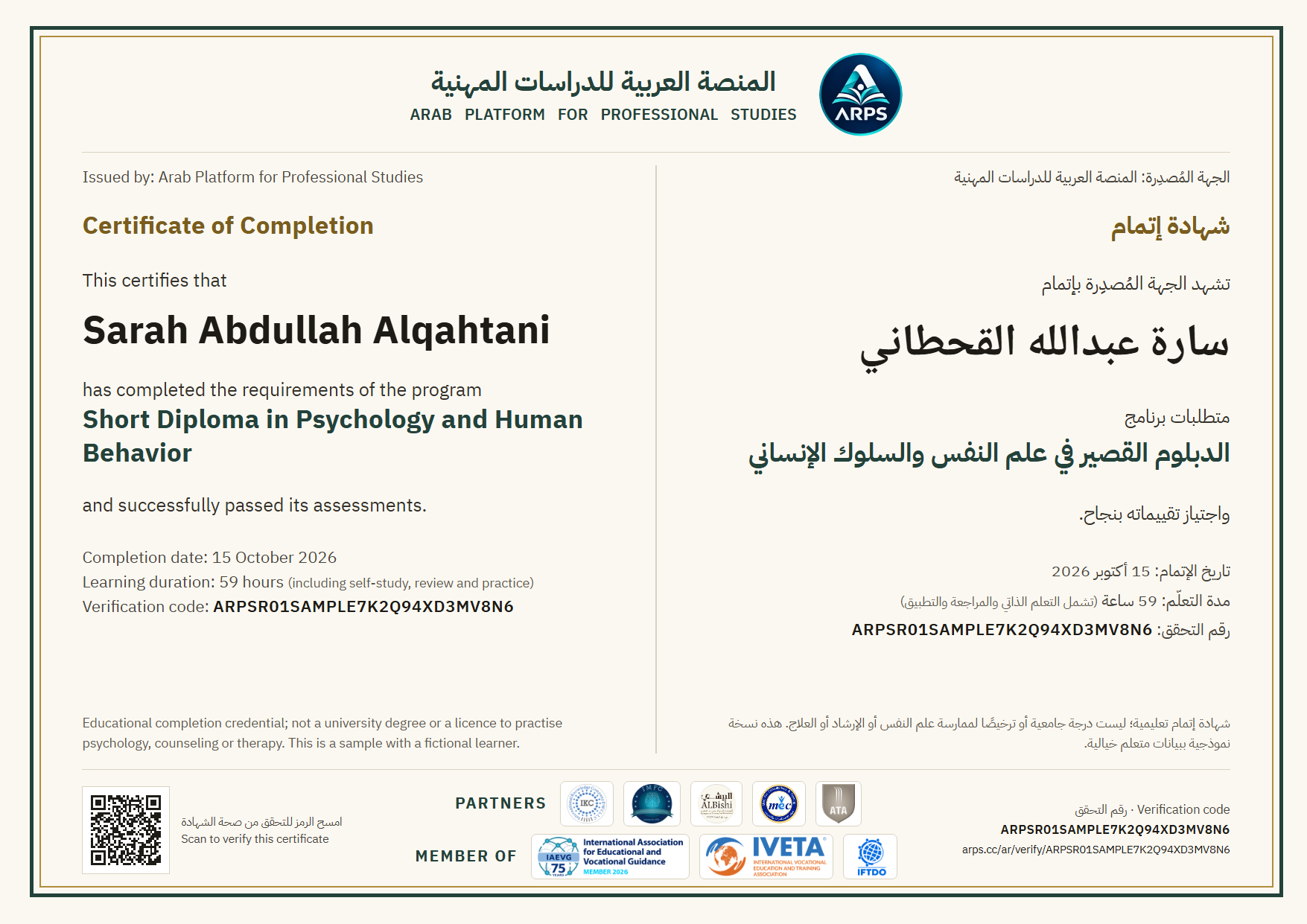
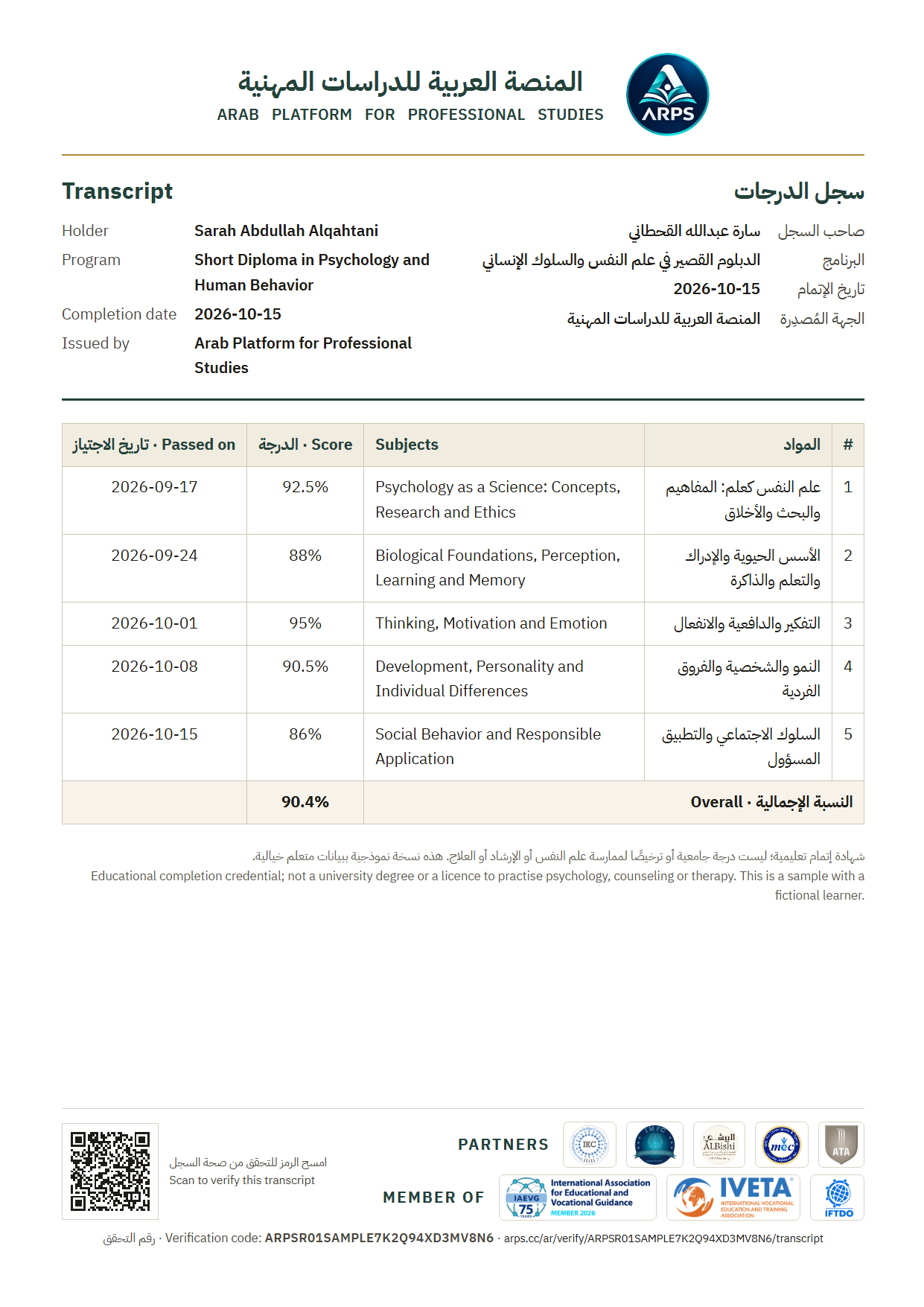
A sample from a real program in this track: Short Diploma in Psychology and Human Behavior. The learner, scores and dates are fictional; opens in a new window.
Disclaimer: Training completion in smart-city concepts; not a university degree, professional licence or authorization to operate critical infrastructure.
Program questions
Do I need a technical background?
No. Basic tables and percentages suffice; terms are explained before application in the cases.
Does the diploma authorize city-infrastructure work?
No. It records learning completion and does not replace local permissions, qualified specialists or safety procedures.
Is a particular platform or supplier taught?
No. You learn to test meaning, interoperability and exit options across products.
How is progress assessed?
Each lesson has a short check and each subject has its own summative assessment under the route's central attempt policy.
Are the figures results from real cities?
No. Case numbers are fictional for learning; the conceptual sources are named with the limits of what they support.
Show all (7)
Is Short Diploma in Smart Cities free, and do I get a certificate?
Yes. Short Diploma in Smart Cities is free on ARPS: every lesson, exercise and assessment is free, the first subject is open to read without an account, and the program is available in Arabic and English. Issuing a certificate is optional and has a published fee; it is a training completion certificate showing you passed the program's assessments, recognised by most private-sector organisations in the Gulf states and most Arab countries, and it strengthens your CV; confirming that a specific organisation accepts it remains your responsibility.
What other names is Short Diploma in Smart Cities known by?
The subject of this program is also known as: smart cities, smart city, smart urban development, urban technology. Learners usually find it by searching for: smart cities course free, smart city planning, smart cities and iot, smart cities in the world, smart city technologies.
An applied short diploma in housing need, location, land, affordability, tenure, delivery and evaluation through fictional cases with worked solutions.
Advanced preparation for testable housing and urban policy advice. Diagnose the problem, compare feasible options, and make a conditional recommendation grounded in evidence, equity and delivery capacity.
This short diploma connects market-research design with consumer-behavior interpretation and evidence-bounded decisions. Six subjects progress from the research question through sampling, measurement, analysis, choice journeys, testing, and recommendation, ending with an applied market-research capstone.
6 subjects
24 lessons
62.5 hours
Free
Next step: a professional certification or a mini-master
Programs in the same domain that prepare you for an international certification exam or form a professional mini-master, also free.