Professional Mini-Master in Supply Chain Analytics and Operational Resilience
Professional Mini-Master in Supply Chain Analytics and Operational Resilience is a free program on ARPS, the Arab Platform for Professional Studies. Turn demand, inventory and service data into defensible network and recovery decisions. Nine advanced modules progress from measurement and forecasting to disruption testing, allocation, special inventory flows and discrete optimization, ending in a multi-product network capstone connecting service, cash.
Build a due-date cohort and calculate order and unit service without double-counting split shipments.
From lesson 1, readable now without an account: Demand, service and the analytical grain
A warehouse dashboard may report that every shipment left on schedule while customers say that half their orders arrived late. Both reports can describe the same operation. The warehouse may count dispatch events; the customer may count complete deliveries. Before calculating a percentage, decide what one row represents. This is the analytical grain: a whole order, an order line, or an event affecting a shipment. Counting event rows does not give an order count. The distinction determines what question a result can answer. A dispatch improvement, for example, does not necessarily resolve a delay between the loading bay and the receiving customer.
A free account saves your progress and takes you straight to lesson 1.
Program facts
Study fee
Free
subjects
9
lessons
50
Estimated time
157.5 hours
Content last reviewed
Access period
60 days
Study language
Arabic and English
About the program
A lower purchase price can produce a higher accepted-unit cost, and sufficient end-of-week supply can coexist with missed customer deadlines. The program teaches these distinctions through fictional cases with complete inputs and reproducible calculations. You begin with demand cohorts, measurement units and operating-event quality, then compare forecasts, inventory policies and capacity-constrained supply plans. Transport, facility, pooling and supplier decisions lead into dependency maps, stress states, time-based flows and mitigation portfolios. Recovery objectives, shortage allocation, continuity exercises and intervention measurement culminate in a network memo linking the constraints. You choose an alternative, explain its valid conditions, identify what the analysis has not established and specify which change in demand, lead time or evidence requires a new decision.
Practical relevance
Exercises can be completed on paper or with an optional spreadsheet. All required data are included; no software purchase or company-file upload is required. You construct inventory and backlog balances, check lane and facility constraints, calculate allocation, regret and break-even thresholds, and write a conditional decision memo. The method can later be transferred to a familiar operation after validating its inputs, commitments and authority. The teaching cases do not demonstrate real supplier readiness or an untested emergency plan.
Why this program
Supply-chain decisions interact: more stock may protect a period without removing a shared dependency, and restoring production to the demand rate can leave backlog unchanged. The material therefore connects cost, service, timing and input quality. Cases compare objectives rather than claim a universally best answer: minimum expected cost may violate a binding service floor, and maximum service within cash does not establish universal profitability. The focus is a method of calculation, checking and explanation, including sensitivity to the assumption that changes the recommendation.
Career relevance
The material relates to demand and inventory planning, network design, supplier management, operational continuity and supply-chain analysis. It supports practitioners who review plans or communicate recommendations across procurement, operations, finance and customer service. The emphasis is explaining constraints and numbers across functions. The program develops professional judgement within that scope without claiming measured job-market ranking or endorsement by a professional body.
Career paths this program serves
This program is a step on the paths of the following occupations. Open a path to see its other programs in study order.
Construct consistent service measures and operating data, analysing variability and contribution without denominator confusion or unsupported causality.
Evaluate demand forecasts, inventory policies and supply plans under lead-time, capacity and shortage-cost constraints.
Design transport, facility and supplier comparisons linking feasibility, capacity, pooling, service and total cost.
Stress-test network resilience using dependency models, scenarios, time-based flows, mitigation portfolios and digital-order reconciliation.
Formulate an integrated recovery decision with executable objectives, declared allocation policy, service and cost measurement, and evidence limits.
Apply forecast-to-commitment decisions, special inventory flows and discrete optimization in a multi-product lot-network capstone.
Learning outcomes (5)
Construct consistent service measures and operating data, analysing variability and contribution without denominator confusion or unsupported causality.
Evaluate demand forecasts, inventory policies and supply plans under lead-time, capacity and shortage-cost constraints.
Design transport, facility and supplier comparisons linking feasibility, capacity, pooling, service and total cost.
Stress-test network resilience using dependency models, scenarios, time-based flows, mitigation portfolios and digital-order reconciliation.
Formulate an integrated recovery decision with executable objectives, declared allocation policy, service and cost measurement, and evidence limits.
Who it is for
Supply-chain professionals, managers and practitioners with foundational knowledge seeking advanced judgment and integrated decisions.
Planning, procurement, warehousing and transport staff who link analysis to inventory, network and supplier decisions.
Continuity and operations leaders who design network resilience and disruption-recovery plans and measure their effect.
Prerequisites
Working knowledge of purchase orders, inventory and customer service levels.
Percentages, means and variance, and using spreadsheets to build simple models.
Foundational supply-chain experience, or readiness to work through the detailed fictional cases in the programme.
Introductory familiarity with total cost and working-capital concepts.
Baselines and time-respecting forecast evaluation1 hours
Seasonality, promotions and censored demand1 hours
From demand distributions to safety stock1 hours
Review policies and working capital1 hours
S&OP alignment and intermittent demand1 hours
Subject 3
Network, capacity and sourcing design
Transportation, facility choices, capacity, pooling/postponement and supplier allocation.
5 lessons · 6 hours
An auditable constrained transportation model1 hours
Facility location with fixed costs and service limits1 hours
Bottlenecks and reserve capacity1 hours
Inventory pooling and postponement1 hours
Supplier allocation, contracts and total cost1 hours
Subject 4
Risk modelling and network stress testing
Translate dependencies, disruptions and digital ambiguity into service constraints, decision tests and feasible mitigation portfolios.
5 lessons · 6 hours
Multi-tier dependencies and exposure mapping1.5 hours
Disruption scenarios and probabilities1 hours
Time-based inventory and recovery simulation1 hours
Selecting mitigations under a budget1 hours
Digital risks and supplier-data reliability1 hours
Subject 5
Operational recovery, governance and integration
Translate disruption impact into objectives,allocation,exercise decisions and recovery measurement,then integrate them in a network memo constrained by service and cash.
5 lessons · 6 hours
Impact analysis and recovery objectives1.5 hours
Activating alternatives and allocating shortages1 hours
Incident coordination and continuity exercises1.5 hours
Measuring recovery and learning from interventions1 hours
Integrated case: a resilient-network decision1 hours
Subject 6
Extending analytics from forecasts to commitments
Extend forecasts into supply commitments through coherence, judgment, information value, and shortage and excess costs.
6 lessons · 27.5 hours
Reconciling regional and product forecasts4.5 hours
Testing the value of judgmental adjustments4.5 hours
Structured analogies for a new product launch4.5 hours
Information value before a supply commitment4.5 hours
Single-season buying with salvage4.5 hours
Backtesting decisions rather than forecast rankings4.5 hours
Subject 7
Special inventory flows and reverse operations
Allocate lots and operate returns, repair, and substitution while preserving physical identity and acceptance status.
6 lessons · 27.5 hours
Allocating dated inventory across lots4.5 hours
Grading returns and recovering value4.5 hours
Managing repairable units4.5 hours
Constrained substitution across items and recipes4.5 hours
Lateral transshipment with cutoffs4.5 hours
Scoping a lot withdrawal through traceability4.5 hours
Subject 8
Discrete optimization decisions and constraint diagnosis
Construct feasible discrete routing, packing, and supply plans and diagnose constraints that prevent execution or change tradeoffs.
6 lessons · 27.5 hours
Routing a vehicle with time windows4.5 hours
Packing containers with incompatible loads4.5 hours
Multi-period production lots and setups4.5 hours
Freight tariffs and contractual breakpoints4.5 hours
Cost-service tradeoffs without arbitrary weights4.5 hours
Diagnosing an infeasible optimization plan4.5 hours
Subject 9
Capstone: a multi-product distributor lot network
Defend an integrated network decision linking demand, shelf life, substitution, recovery, and dispatch to a contingent investment policy.
7 lessons · 32 hours
Project dossier: a multi-product lot network4.5 hours
Project plan: coherent demand and feasible promises4.5 hours
Project allocation: shelf life and substitution4.5 hours
Project recovery: operating the reverse loop4.5 hours
Project dispatch: integrating packing and routing4.5 hours
Project adaptation: a contingent policy4.5 hours
Project defence: investment and transfer testing4.5 hours
Subjects unlock in sequence as you progress.
Strengths
Worked calculations distinguish aggregate sufficiency from location and timing feasibility.
Alternative comparisons use explicit objectives and service,cash and probability assumptions.
A capstone project connects the preceding modules with self-practice and specific feedback.
Evidence basis
Instruction uses primary sources for operating events, forecasting, inventory, network optimisation and continuity. Scoped passages include GS 1, the authors forecasting textbook, academic inventory and network materials, and NIST. Source-supported principles are separated from original case inputs; fictional numbers are not attributed to the publishers. Only the public ISO description was used within its scope, not paid clauses. Historical references retain their edition boundaries and are not presented as current universal requirements.
Reference organizations
GS1
NIST
Methodology
Instruction uses primary sources for operating events,forecasting,inventory,network optimisation and continuity.Scoped passages include GS1,the authors forecasting textbook,academic inventory and network materials,and NIST.Source-supported principles are separated from original case inputs;fictional numbers are not attributed to the publishers.Only the public ISO description was used within its scope,not paid clauses.Historical references retain their edition boundaries and are not presented as current universal requirements.
Program questions
What knowledge should I bring?
Bring basic purchasing, inventory and service knowledge, plus percentages, means, variance and table reading. Lessons build from these foundations and explain advanced decision formulas. Operating experience helps interpretation, but workplace data are unnecessary.
Does the program train me on a specific planning application?
It focuses on reasoning, data, constraints and verification rather than a vendor interface. Tables and formulas can be solved manually or transferred to a spreadsheet. It does not train production-system configuration or package installation.
How do I analyse disruption when its probability is unknown?
You define coherent states, test severity and derive probability thresholds where the model permits. Unknown probability does not prevent service-feasibility or recovery-flow analysis, but it prevents unsupported expected-value claims.
Do the examples establish readiness of my own plan?
Examples teach analysis rather than demonstrate your operations. Lessons distinguish an assumed-state decision, tabletop discussion, contact test and actual accepted delivery. Transfer requires valid inputs, qualification, authority and a test of your route.
What will I produce in the integrated case?
A memo selects between stock and additional-source options within cash and service constraints, showing daily balances and residual risk. You test arrival delay and higher demand, and specify activation conditions and evidence that would change the choice. All inputs are included.
Show all (8)
How does assessment connect with learning?
Each lesson has practice separate from the final bank. The final contains 50 logical questions, one from every lesson, covering all nine modules. Items assess taught calculation and reasoning. A module breakdown within that final is not a separate comprehensive module examination.
Is Professional Mini-Master in Supply Chain Analytics and Operational Resilience free, and do I get a certificate?
Yes. Professional Mini-Master in Supply Chain Analytics and Operational Resilience is free on ARPS: every lesson, exercise and assessment is free, the first subject is open to read without an account, and the program is available in Arabic and English. Issuing a certificate is optional and has a published fee; it is a training completion certificate showing you passed the program's assessments, recognised by most private-sector organisations in the Gulf states and most Arab countries, and it strengthens your CV; confirming that a specific organisation accepts it remains your responsibility.
What other names is Professional Mini-Master in Supply Chain Analytics and Operational Resilience known by?
The subject of this program is also known as: supply chain analytics, supply chain resilience, operational resilience. Learners usually find it by searching for: supply chain analytics course, learn demand and inventory planning, free supply chain resilience program, distribution network optimization, online program with completion certificate.
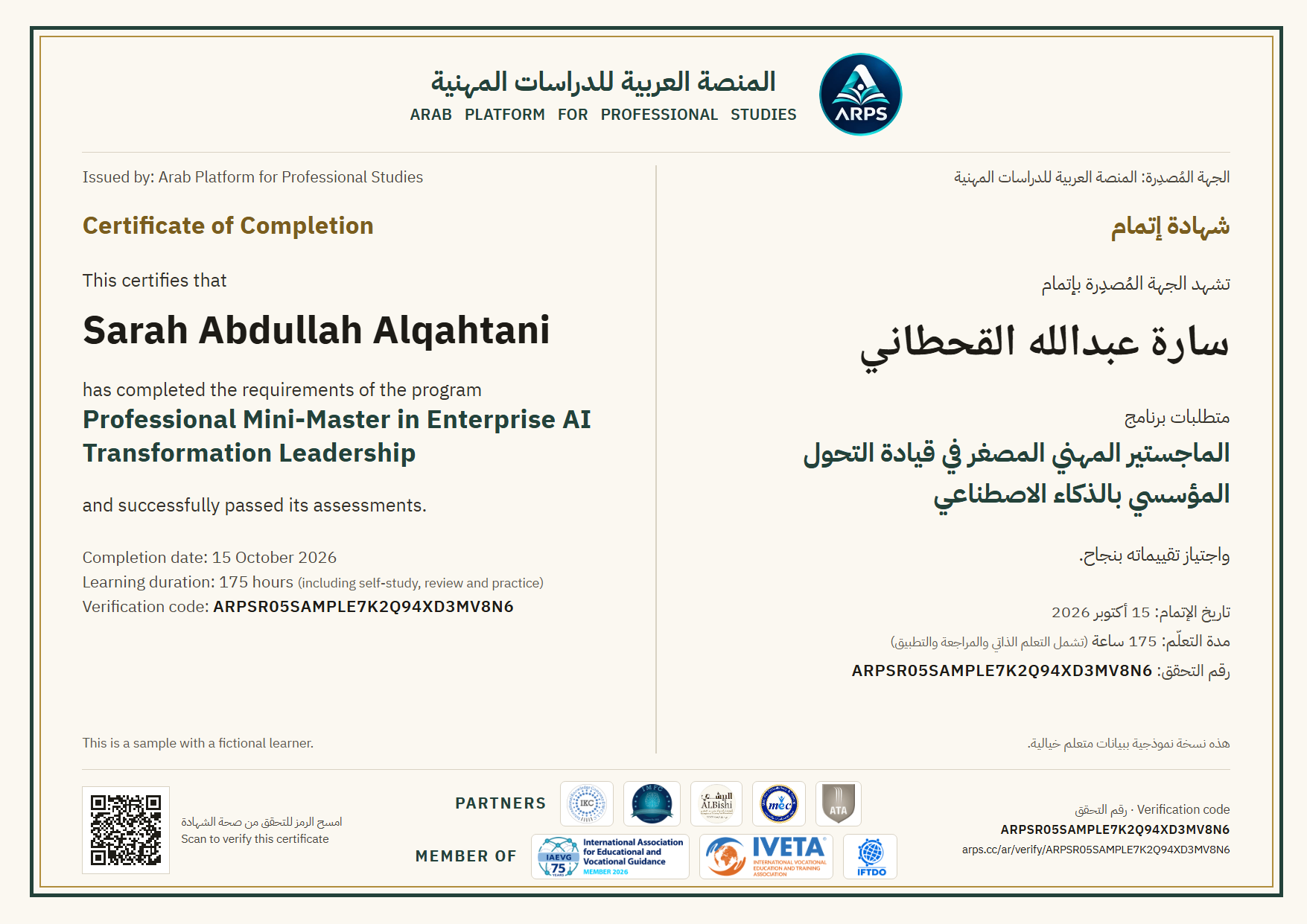
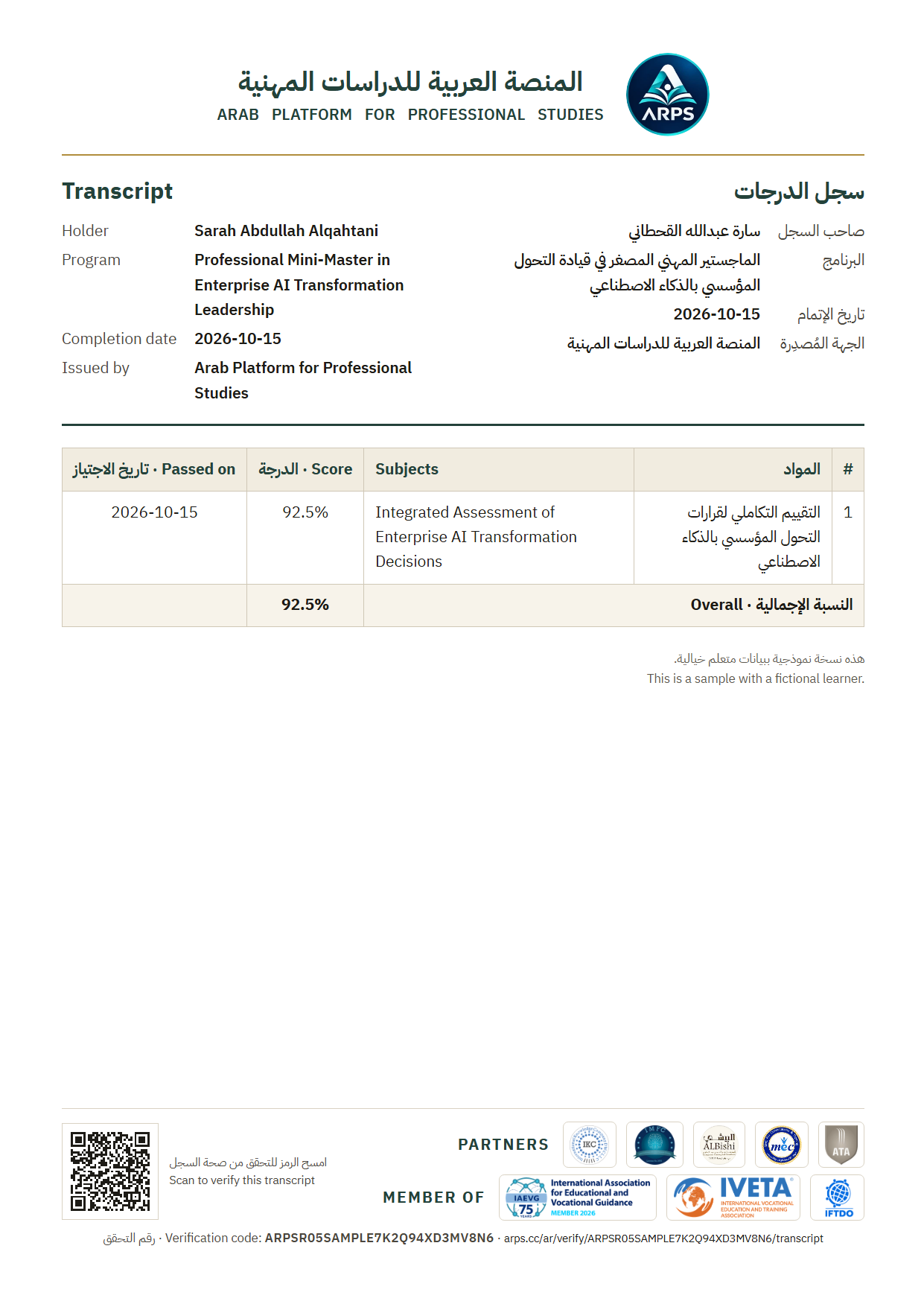
A sample from a real program in this track: Professional Mini-Master in Enterprise AI Transformation Leadership. The learner, scores and dates are fictional; opens in a new window.
Learn a practical order-to-delivery decision chain: clean demand signals, calculate inventory and material needs, control receipt and commitments, trace products, plan transport and escalate with evidence.
Analyse strategic portfolio and project decisions where benefits, resources and obligations compete, and build a defensible recommendation that can be executed and reviewed.
An honest note: the professional mini-master is an intensive professional program; it is not an academic degree or a licence and is not equivalent to a university master's or MBA. The optional ARPS certificate is a training completion certificate showing you passed the program's assessments.