Professional Mini-Master in Strategic Portfolio and Project Governance
Professional Mini-Master in Strategic Portfolio and Project Governance is a free program on ARPS, the Arab Platform for Professional Studies. Analyse strategic portfolio and project decisions where benefits, resources and obligations compete, and build a defensible recommendation that can be executed and reviewed.
Build an outcome chain, outcome measure and guardrail to test an investment thesis.
From lesson 1, readable now without an account: Translate strategy into a portfolio thesis
An investment board receives six requests that all appear useful, but strategy does not instruct it to fund everything attractive. Suppose the organisation seeks to shorten delays in a core service while preserving financial trust over two years. The first portfolio governance task is to turn that statement into a decision thesis. What observable change in customer experience or operations matters? Which work could plausibly cause it? What evidence would change the board's view? A portfolio is a collection of initiatives managed together in service of strategic objectives, rather than a list of projects or a traffic light dashboard. PMI's public overview of its fourth portfolio standard connects portfolio management to strategic planning. It does not prescribe this organisation's weights or legal authority. The thesis must be agreed locally with sponsors, operations and finance, distinguishing assumptions from approved choices.
A free account saves your progress and takes you straight to lesson 1.
Program facts
Study fee
Free
subjects
6
lessons
50
Estimated time
158.5 hours
Content last reviewed
Access period
60 days
Study language
Arabic and English
About the program
Five advanced modules take you from portfolio mandate to an integrated professional decision, followed by a capstone. Start with admission boundaries, delegation and risk appetite, then compare alternatives under funding, skill, dependency and uncertainty constraints. Design forums, gates, assurance and reports that preserve numerical meaning and knowledge limits. Connect benefits to adoption, operating ownership and evaluation before rebalancing and handing over continuing responsibilities. The fifth module combines these skills in a decision dossier, negotiation, shock response, execution control and experience review. The capstone then applies them to a multi-service, multi-site portfolio. Complete fictional data and guided feedback support the work without confidential information or commercial tools.
Practical relevance
Exercises produce elements of a decision: a portfolio thesis, package comparison, switching value, gate condition, indicator interpretation, benefit and handover plan, and commitment reconciliation. Feedback explains calculations, assumptions, competing options and facts that would change the answer. Transfer the reasoning to work after checking local authority, data and constraints. Included fictional cases are sufficient; uploading employer files is unnecessary.
Why this program
Every project can appear attractive separately while the portfolio exceeds capacity or shares one concentrated exposure. Financial arithmetic can be correct while an option remains ineligible or benefits unrealised. This programme examines the connections between strategy, selection, governance and operation, showing how evidence and constraints change recommendations. It suits practitioners who already know project fundamentals and want to exercise judgement in tradeoffs that a ranking alone cannot settle. Neither continuation nor expansion is assumed to be correct in every case.
Career relevance
The material relates to portfolio, programme, PMO, governance and operational responsibilities, particularly preparing or reviewing investment decisions. It develops analysis, accountability and communication across disciplines. It promises neither employment, promotion nor investment returns and grants no professional licence or university degree.
Career paths this program serves
This program is a step on the paths of the following occupations. Open a path to see its other programs in study order.
Evaluate portfolio mandate, admission, delegation, risk appetite and investment justification before commitment.
Select executable packages under value, uncertainty, skill, dependency and stopping-cost constraints.
Design decision forums, gates, assurance and traceable reports preserving independence, permission and knowledge limits.
Evaluate benefit realisation, effects and common risks, rebalance the portfolio and transfer continuing responsibility.
Formulate an integrated portfolio decision and defend it through negotiation, adaptation, control and experience review.
Apply portfolio decisions in a multi-service, multi-site capstone: a unified dossier, a decision hearing, a transition of services competing for one team, a scale decision and a portfolio review.
Learning outcomes (5)
Evaluate portfolio mandate, admission, delegation, risk appetite and investment justification before commitment.
Select executable packages under value, uncertainty, skill, dependency and stopping-cost constraints.
Design decision forums, gates, assurance and traceable reports preserving independence, permission and knowledge limits.
Evaluate benefit realisation, effects and common risks, rebalance the portfolio and transfer continuing responsibility.
Formulate an integrated portfolio decision and defend it through negotiation, adaptation, control and experience review.
Who it is for
Portfolio, programme, PMO and governance managers and experienced operational practitioners participating in decisions across projects
Members of investment and steering committees and strategy and finance staff who review funding requests for initiatives
Experienced project managers moving into portfolio or independent assurance roles in public or private organizations
Prerequisites
Foundational experience managing a project, programme or process and monitoring cost, time and risk
Ability to interpret ratios, indicators and a simple budget; advanced analytical methods are explained in the lessons
General awareness of how budgets are approved and decisions are made in organizations, and readiness to analyse fictional portfolio cases and write reasoned decision memos.
Turn organisational objectives into investment boundaries, authority, appetite and a testable decision memorandum.
10 lessons · 26.5 hours
Translate strategy into a portfolio thesis54 min
Set portfolio boundaries and admission criteria51 min
Design delegated authority and conflicts controls1 hours
Balance horizons and risk appetite1 hours
Challenge an investment request1 hours
Design strategy measures resistant to gaming4.5 hours
Allocate portfolio outcomes across unequal service units4.5 hours
Map sequential investment commitments in a decision tree4.5 hours
Compare alternatives with different cash and benefit timing4.5 hours
Challenge assumptions using a relevant reference class4.5 hours
Subject 2
Portfolio selection under resource constraints
Select and sequence initiative bundles while making preferences, uncertainty, capacity, dependencies and future decision costs explicit.
10 lessons · 27 hours
Build a multicriteria value model1 hours
Compare portfolio scenarios1 hours
Model capacity and bottlenecks1 hours
Map dependencies and sequence initiatives1 hours
Decide stop, defer or start1 hours
Fund stages with different marginal returns4.5 hours
Choose a package robust to bounded effort estimates4.5 hours
Value the removal of a particular specialist constraint4.5 hours
Allocate ringfenced funding within a portfolio4.5 hours
Replan a rolling window around locked commitments4.5 hours
Subject 3
Governance architecture and assurance
Build decision governance, assurance and reporting that expose conditions, exceptions and knowledge limits before commitment.
10 lessons · 27.5 hours
Design decision forums1 hours
Set stage gates and conditional authority1 hours
Plan proportionate independent assurance1 hours
Escalate conflicting indicators1 hours
Build decision useful portfolio reports1 hours
Build a review sample tied to decision exposure4.5 hours
Resolve evidence version conflicts before commitment4.5 hours
Manage a temporary exception to an explicit end decision4.5 hours
Analyse the service impact of a decision backlog4.5 hours
Assign accountability across a shared supplier deliverable4.5 hours
Subject 4
Benefits, risk and rebalancing
Turn value promises into ownership, evaluation, aggregate risk, rebalancing and sustainable handover.
10 lessons · 29 hours
Build outcome chains and assign benefit owners1.5 hours
Establish baselines and value measures1.5 hours
Aggregate interacting portfolio risk1.5 hours
Rebalance against new evidence1.5 hours
Transfer benefits into operations1.5 hours
Separate shared benefits without double attribution4.5 hours
Track outcome decay after a successful launch4.5 hours
Stress cash availability under simultaneous risks4.5 hours
Measure lost demand hidden behind an improving indicator4.5 hours
Budget sustained outcomes before financing new work4.5 hours
Subject 5
Integrated executable portfolio decision
Integrate argument, negotiation, adaptation, control and learning in an executable professional portfolio decision.
5 lessons · 9 hours
Assemble a defensible decision dossier2 hours
Negotiate contested portfolio choices1.5 hours
Respond to a strategic shock2 hours
Turn selection into execution controls1.5 hours
Review the decision and institutional learning2 hours
Subject 6
Capstone: a multi-service, multi-site portfolio
A capstone that applies portfolio decisions across multiple services and sites, from a unified portfolio dossier and a decision hearing with shifting evidence to a scale decision and a review of stopped work and missing outcomes.
5 lessons · 29 hours
Build one portfolio dossier for units with different seasons6 hours
Run a decision hearing as evidence strength changes6 hours
Transition two services competing for one team6 hours
Build a scale decision accounting for site mix6 hours
Review a portfolio with stopped work and missing outcomes6 hours
Subjects unlock in sequence as you progress.
Strengths
Integrated tradeoffs linking value, capacity, authority and outcomes
Numerical cases, worked reasoning and guided practice in both languages
An integrated final aligned to all fifty lessons and a separate synthesis for each module
Evidence basis
Concepts use inspected passages from GovS 002, the Green and Orange Books, evaluation and multicriteria guidance, with academic probability and measurement sources. Cases and figures are original and hypothetical. Public professional-source overviews are explicitly bounded. Naming a publisher implies neither its endorsement nor accreditation of the programme.
Reference organizations
Government Project Delivery
HM Treasury
Methodology
Concepts use inspected passages from GovS 002, the Green and Orange Books, evaluation and multicriteria guidance, with academic probability and measurement sources. Cases and figures are original and hypothetical. Public professional-source overviews are explicitly bounded. Naming a publisher implies neither its endorsement nor accreditation of the programme.
Program questions
How does this differ from introductory project management?
The programme assumes foundational experience and goes beyond defining a project lifecycle. Analyse competing investments, scarce skills and funding, eligibility, authority and dependencies, then justify a package and monitor effects. Cases examine when an earlier recommendation should change rather than teaching one decision template to memorise.
Do I need specialist analysis software?
Written calculations or a simple calculator are sufficient. Weights, scenarios, sensitivity and aggregation are explained step by step. You do not need to build a simulation, buy software or implement a commercial portfolio-management system.
Must I submit a workplace project for the credential?
Exercises are ungraded self-check applications with guided solutions. The qualifying assessment uses automatically graded case questions after the five core modules, rather than a written project marked by a person. Separate practice questions let you try the skills before the final assessment.
What do module transcript results mean?
They show performance on each module’s questions within the same accepted final attempt. They are not independent examinations or comprehensive mastery diagnoses. No grades exist before learner performance, and results from different attempts are not combined.
Can source guidance be applied in any organisation?
Sources teach analytical methods with their contexts and limits identified. A government rule in one country does not automatically confer authority in your organisation. Check delegation, contracts, rights and local constraints with specialists before a real commitment. Fictional cases are not personalised legal or financial advice.
Show all (8)
How can workplace information be used safely?
Included case data are sufficient. If transferring an exercise to work, use authorised information and minimise personal or sensitive data. The programme requests no passwords, private contracts or submission of secrets to an external service. Fictional values can be substituted.
Is Professional Mini-Master in Strategic Portfolio and Project Governance free, and do I get a certificate?
Yes. Professional Mini-Master in Strategic Portfolio and Project Governance is free on ARPS: every lesson, exercise and assessment is free, the first subject is open to read without an account, and the program is available in Arabic and English. Issuing a certificate is optional and has a published fee; it is a training completion certificate showing you passed the program's assessments, recognised by most private-sector organisations in the Gulf states and most Arab countries, and it strengthens your CV; confirming that a specific organisation accepts it remains your responsibility.
What other names is Professional Mini-Master in Strategic Portfolio and Project Governance known by?
The subject of this program is also known as: project governance, portfolio management, strategic portfolio management. Learners usually find it by searching for: project governance course, learn portfolio management, free portfolio governance program, benefits management for strategic projects, online program with completion certificate.
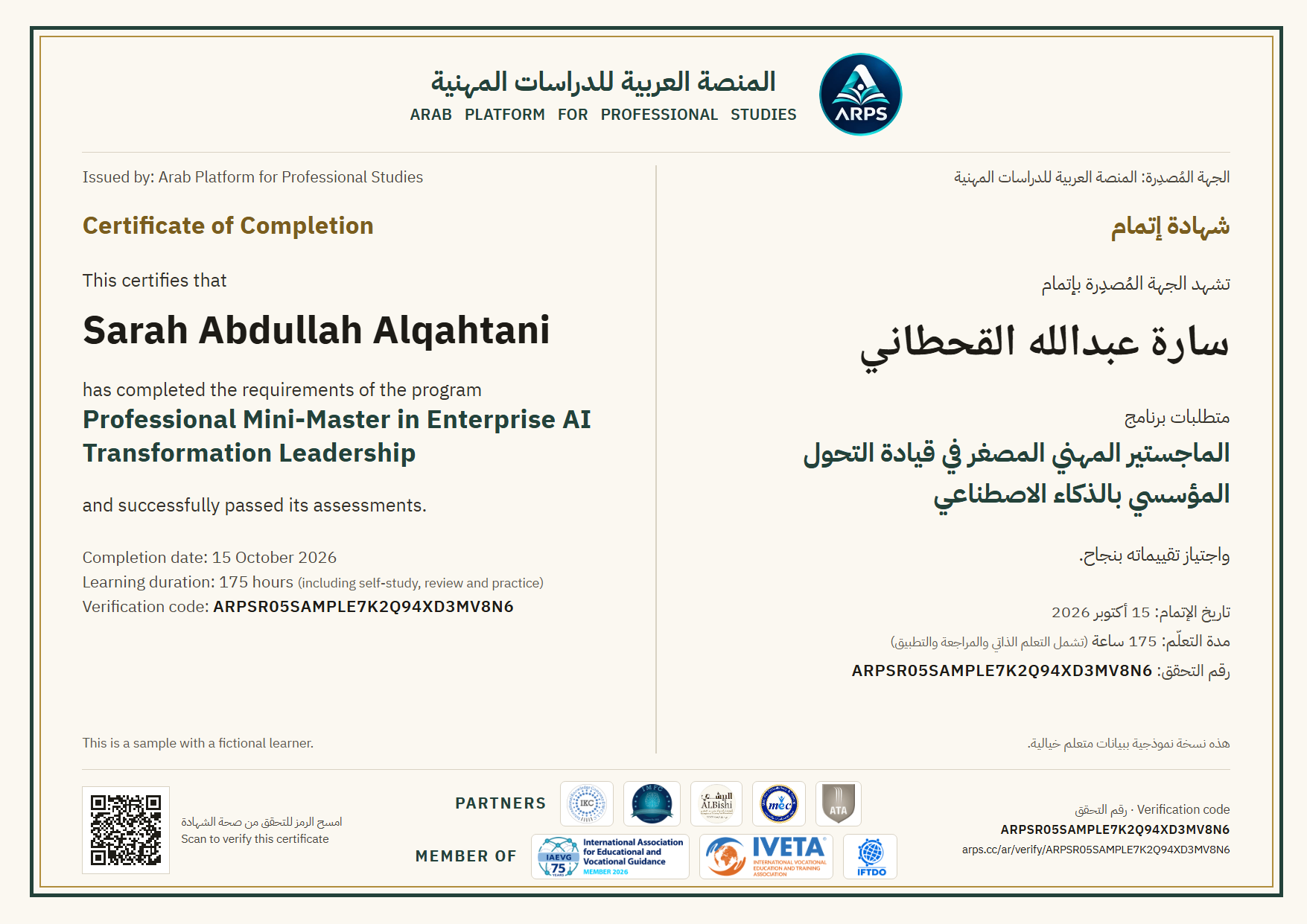
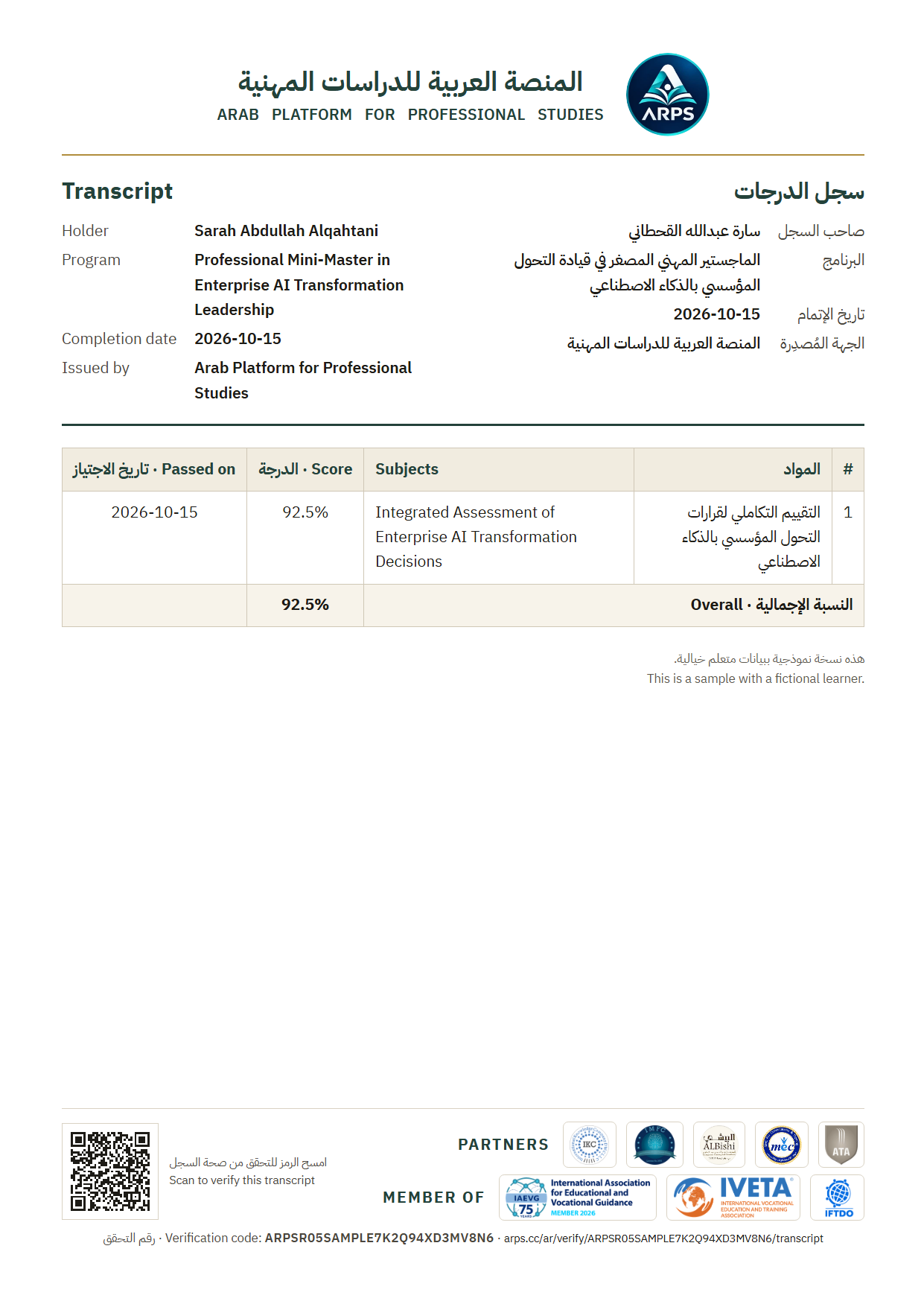
A sample from a real program in this track: Professional Mini-Master in Enterprise AI Transformation Leadership. The learner, scores and dates are fictional; opens in a new window.
Turn demand, inventory and service data into defensible network and recovery decisions. Nine advanced modules progress from measurement and forecasting to disruption testing, allocation, special inventory flows and discrete optimization, ending in a multi-product network capstone connecting service, cash and timing.
An applied program for specialists who create and inspect project-management artifacts from authorization through closure, using execution, calculation and escalation cases within clear authority boundaries.
An honest note: the professional mini-master is an intensive professional program; it is not an academic degree or a licence and is not equivalent to a university master's or MBA. The optional ARPS certificate is a training completion certificate showing you passed the program's assessments.