Professional Mini-Master in Knowledge Stewardship and Responsible Heritage Interpretation
Professional Mini-Master in Knowledge Stewardship and Responsible Heritage Interpretation is a free program on ARPS, the Arab Platform for Professional Studies. Turn a conflicted heritage dossier into a sourced, revisable interpretation and access plan. The programme begins with a professional distinction: a document establishes what it says, not every inference later placed in a catalogue or label.
Trace acquisition and custody events without filling provenance gaps; produce a dated chain with unknown intervals.
From lesson 1, readable now without an account: An evidence ledger before the story
When a museum receives a box of photographs, recordings and objects, a phrase on an old card can quietly become a database fact and then an unqualified gallery label. Responsible knowledge stewardship slows that chain. An *object* is the material held or documented. A *claim* is a revisable statement about it. A *source* is an identifiable record or testimony that bears on the claim. An *inference* is a further step made by a staff member rather than something the source states directly. Put all four in one field and the next curator cannot tell what a narrator witnessed from what a cataloguer inferred.
A free account saves your progress and takes you straight to lesson 1.
Program facts
Study fee
Free
subjects
8
lessons
51
Estimated time
178.5 hours
Content last reviewed
Access period
60 days
Study language
Arabic and English
About the program
The programme begins with a professional distinction: a document establishes what it says, not every inference later placed in a catalogue or label. Across eight advanced modules, learners build a claim ledger and custody timeline, map participation and the limits of permission and access, then organise entities, events, translations and digital derivatives without losing source context. They write Arabic and English labels and media alternatives that preserve the same qualifications, and test visitor understanding without treating preference as historical proof. The journey ends with a decision dossier weighing staged release, open risks and review dates. All training cases are fictional. Exercises produce inspectable tables, decisions and text; local legal or authenticity rulings remain outside scope and need specialist review. The extension adds identity and source-version investigation, operational access and sampling review, and a family-archive exhibition capstone from question to defence and handover.
Practical relevance
Learners produce an evidence ledger, access matrix, event map, equivalent labels, and staged release and monitoring plan for a fictional mixed collection. Further practice produces investigation, loan, correction and recovery-test packets, followed by a capstone dossier covering evidence, participation, description, visitor routes and open-work handover.
Why this program
An unsupported phrase on an old card can be copied into a catalogue and exhibition until repetition makes it look true. This programme teaches teams to interrupt that chain: link each assertion to its source, preserve disagreement and versions, assign access review, and offer visitors useful wording without manufactured certainty. It connects knowledge stewardship to release decisions instead of stopping at label editing.
Career relevance
Relevant to collections management, cataloguing, interpretive editing, digital archiving and contributor participation where teams need a decision record they can hand over and revise.
Career paths this program serves
This program is a step on the paths of the following occupations. Open a path to see its other programs in study order.
Build an evidence and custody map that preserves conflicts and gaps and supports reversible claim correction.
Design community participation and access decisions that separate professional consent practice and rights review from legal authority claims.
Build layered description, source links and digital derivatives that preserve language, context and change history.
Write interpretation across media that communicates evidence, uncertainty and contributor voices with equivalent meaning.
Defend a staged release plan with responsibilities, indicators and documented repairs to evidence and access.
Learning outcomes (5)
Build an evidence and custody map that preserves conflicts and gaps and supports reversible claim correction.
Design community participation and access decisions that separate professional consent practice and rights review from legal authority claims.
Build layered description, source links and digital derivatives that preserve language, context and change history.
Write interpretation across media that communicates evidence, uncertainty and contributor voices with equivalent meaning.
Defend a staged release plan with responsibilities, indicators and documented repairs to evidence and access.
Who it is for
This programme serves leads of museums, archives and heritage initiatives who manage collection records or oral accounts and must make reviewable description, access and interpretation decisions. It assumes foundational experience reading an intake file and coordinating a small team. Exhibition editors and data stewards facing conflicting sources, community participation requests and unresolved rights boundaries will also find its cases useful.
Prerequisites
Learners should be able to read an object record, compare two documents describing it, distinguish an accession date from a creation date, and draft a basic description in Arabic or English. Advanced legal or programming experience is not required. The exercises assume an ability to build a simple table, document the source of each decision, and discuss a bounded professional question with colleagues or specialists.
Build a ledger separating object, claim, source and inference. Trace custody and its gaps, comparing conflicting accounts without turning a receipt into ownership or memory into certainty. An event map links entities and documents; correction preserves identifiers and dependent copies. Rank documentation gaps by their display consequences. Outputs are an inspectable evidence ledger, timeline and follow-up plan another recipient can resume.
6 lessons · 8.5 hours
An evidence ledger before the story1.5 hours
Custody chain and dated gaps1.5 hours
Reconciling claim-level conflicts1.5 hours
Event-centred relationship modelling1.5 hours
Stable identifiers and reversible correction1.5 hours
Prioritising documentation gaps1.5 hours
Subject 2
Community participation and access boundaries
Map participation while separating knowledge from decision authority and preserving disagreement. Define distinct recording, translation and display choices, then build field-level access. Separate rights, privacy and donor conditions from descriptive errors. Respond to restriction or correction through scoped action, derivative tracing and truthful communication. Produce an executable participation and use protocol, referring specialist questions to their qualified owners.
6 lessons · 8.5 hours
Participation and authority map1.5 hours
Consent at distinct stages1.5 hours
Field-level access decisions1.5 hours
Rights-issue triage1.5 hours
A documented interpretive disagreement1.5 hours
Access review and withdrawal requests1.5 hours
Subject 3
Context preservation and knowledge operations
Organise description so objects remain distinct from images and accounts. Preserve date roles, languages and events, reviewing contested terms without erasing sources. Distinguish preservation, working and access copies and explain checksum limits. Test search and export through tasks revealing changed meaning or restricted disclosure. Produce a maintainable description map, relationships and testing register that can move without losing context.
6 lessons · 8.5 hours
Crosswalking descriptive levels1.5 hours
Original language, translation and uncertainty1.5 hours
Design an interpretive question and display layers preserving equivalent certainty. Connect text, image and testimony while retaining attribution and qualifications across translation. Provide image, audio and video alternatives and an activity explaining how evidence changes judgment. Test a versioned prototype and turn a specific misunderstanding into a checkable amendment. The output is a responsible learning path across media.
6 lessons · 8.5 hours
Interpretive question and claim boundary1.5 hours
Layered labels with visible uncertainty1.5 hours
Voice attribution and testimony translation1.5 hours
Accessible alternatives with equal evidence boundaries1.5 hours
Interactive choice that exposes trade-offs1.5 hours
Interpretive review and revision1.5 hours
Subject 5
Implementation governance and integrated evaluation
Combine decisions into a release plan with explicit dependencies and ownership. Build indicators connecting calculation to semantic quality and sample limits, and identify questions for specialists. Trace new evidence or objections through dependent outputs. Compare full release, delay and staged scope against work time and risk. Finish with a decision dossier handing over established and open matters with owners, review points and closure criteria.
6 lessons · 8.5 hours
Release dependencies and gates1.5 hours
Decision authority and referral1.5 hours
Indicators for documentation, access and understanding1.5 hours
New evidence and objection impact1.5 hours
Staged release under resource constraints1.5 hours
Integrated decision dossier and handover1.5 hours
Subject 6
Identity investigations and evidence quality
Apply object-identity and source-independence investigation to editions, loans, maps and changing accounts. Produce comparison and correction packets preserving source-to-claim relationships, and choose follow-up capable of changing a decision.
7 lessons · 41.5 hours
Distinguish a surrogate from an object before merging records6 hours
Detect dependence among apparently agreeing sources6 hours
Date intervals across calendar systems6 hours
Reconcile loan identifiers across institutions6 hours
Test handwritten transcription errors6 hours
Separate historical place from sensitive location6 hours
Choose the next evidence search under a time limit6 hours
Subject 7
Knowledge operations across parties and versions
Operate correction and access decisions, select an appropriate review sample and prioritise a backlog. Examine listening, alternative costs and recovery, distinguishing observed results from plans or unverified external effects.
7 lessons · 42 hours
Trace a correction through published derivatives6 hours
Review search paths that reveal withheld fields6 hours
Design an audit sample for rare consequential errors6 hours
Negotiate an actionable interpretation agreement6 hours
Facilitate a listening session under unequal authority6 hours
Cost description work without selling certainty6 hours
Restore verified description after a backup failure6 hours
Subject 8
Family archive exhibition capstone
Build a fictional family-archive exhibition through seven stages: question, evidence and explanations, then participation, transferable description and visitor routes. Simulate a decision under new information, defend the dossier and hand over owned open work with closure criteria.
7 lessons · 41.5 hours
Define the capstone question and evidence packet6 hours
Compare competing explanations of the same mark6 hours
Design a participation packet that protects withdrawal6 hours
Prepare a description package for system transfer6 hours
Produce a visitor path for different reading needs6 hours
Simulate a release meeting after unexpected evidence6 hours
Defend the capstone dossier and hand over open work6 hours
Subjects unlock in sequence as you progress.
Strengths
Revisable claim ledger
Field- and use-specific access decisions
Bilingual interpretation preserving uncertainty
Evidence basis
Professional concepts draw on scoped primary resources from ICOM, UNESCO, Collections Trust, CIDOC CRM, WIPO, DCMI, PREMIS, W3C and the Smithsonian, with each source's limits stated.
Reference organizations
ICOM
UNESCO
Collections Trust
CIDOC CRM
WIPO
Frameworks used
ICOM Code of Ethics — current public code
Spectrum — 5.1
CIDOC CRM — 7.1.3
Methodology
Compare scoped primary sources and draft revisable decisions in fictional cases.
Program questions
Does this award an academic degree?
No. The title is an internal professional category; an optional certificate is neither an academic master's degree nor a professional licence.
Do the exercises determine a country's law?
No. Cases are fictional and country neutral; rights and authenticity issues require specialist review in the relevant context.
How is learning assessed?
Lessons include exercises and knowledge checks. One integrated final covers the learning modules and capstone application. Baseline questions are retained; extension items occupy separate practice and final pools. The capstone produces evidence, decisions, visitor routes and open-work handover.
Is there a fee to study?
Learning is free. Certificate issuance is optional and priced by the platform before payment.
Is an audio edition included?
This bundle has no audio edition. Lessons and summaries are available as text in both languages.
Show all (8)
Are the cases based on real institutions?
No. The labelled regional scenarios are fictional teaching cases, not evidence of local facts or statistics.
Is Professional Mini-Master in Knowledge Stewardship and Responsible Heritage Interpretation free, and do I get a certificate?
Yes. Professional Mini-Master in Knowledge Stewardship and Responsible Heritage Interpretation is free on ARPS: every lesson, exercise and assessment is free, the first subject is open to read without an account, and the program is available in Arabic and English. Issuing a certificate is optional and has a published fee; it is a training completion certificate showing you passed the program's assessments, recognised by most private-sector organisations in the Gulf states and most Arab countries, and it strengthens your CV; confirming that a specific organisation accepts it remains your responsibility.
What other names is Professional Mini-Master in Knowledge Stewardship and Responsible Heritage Interpretation known by?
The subject of this program is also known as: knowledge management, heritage interpretation, cultural heritage management, heritage stewardship. Learners usually find it by searching for: knowledge management courses online, heritage interpretation plan, heritage interpretation theory, cultural heritage management course, knowledge management course free.
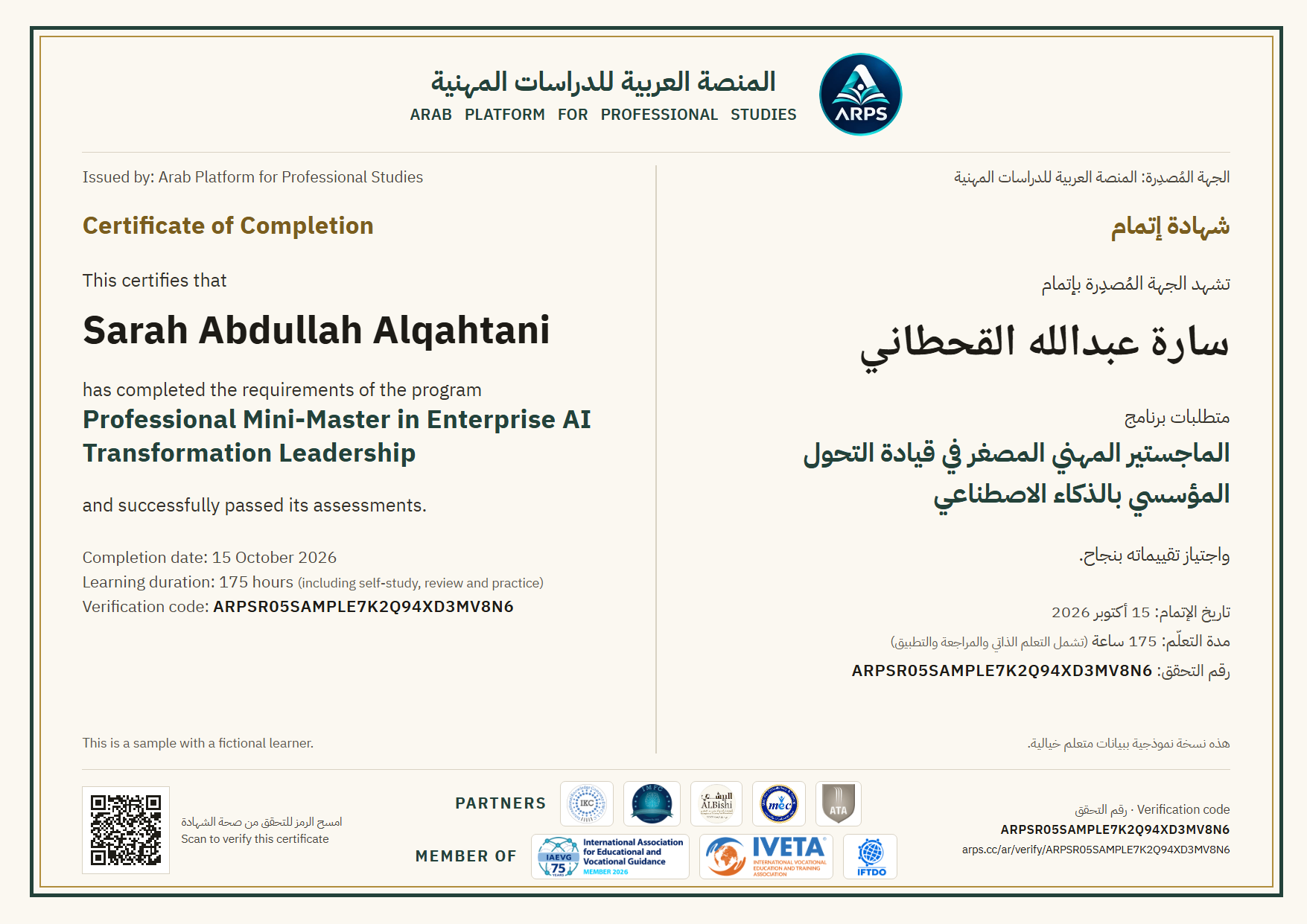
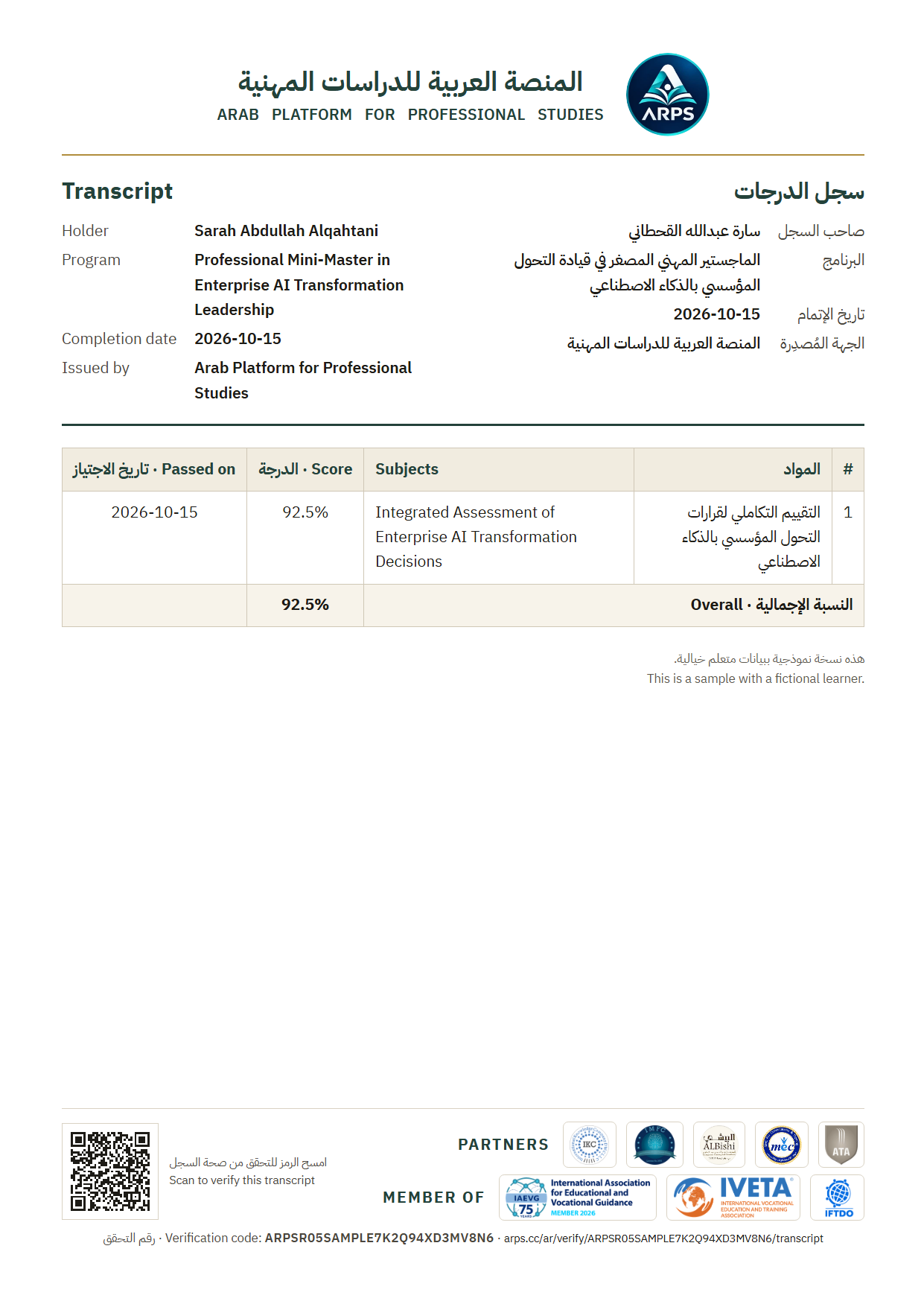
A sample from a real program in this track: Professional Mini-Master in Enterprise AI Transformation Leadership. The learner, scores and dates are fictional; opens in a new window.
Turn a practical ethics question into evidence, options, reasons and a conditional recommendation. Apply outcome, duty, care, privacy and fairness tools to fictional cases, then write a brief for the authorized owner and a follow-up plan that can reveal failure.
10 subjects
30 lessons
51.5 hours
Free
Short Diplomas
History, Philosophy, Civilization & Religious Studies
A foundational short diploma in philosophy and thought. Learn to frame a question, examine a concept and an argument, assess knowledge and choice, weigh justice, and build a reasoned position open to revision. Seven subjects use invented worked cases, guided practice and an assessment for each subject.
7 subjects
30 lessons
70.5 hours
Free
Professional Mini-Master
Career Development, Personal Skills & Productivity
An honest note: the professional mini-master is an intensive professional program; it is not an academic degree or a licence and is not equivalent to a university master's or MBA. The optional ARPS certificate is a training completion certificate showing you passed the program's assessments.