Short Diploma in Philosophy and Thought is a free program on ARPS, the Arab Platform for Professional Studies. A foundational short diploma in philosophy and thought. Learn to frame a question, examine a concept and an argument, assess knowledge and choice, weigh justice, and build a reasoned position open to revision.
Important notice: Independent education; not a university degree, professional licence or endorsement by cited organizations.
Distinguish necessary from sufficient conditions in a purpose-bound definition.
Test a definition using counterexamples and a borderline case.
From lesson 1, readable now without an account: What makes a question philosophical?
When does a question become philosophical?
Imagine a public library with a system that recommends books. The team asks, “How many books were borrowed last month?” A count of circulation records can answer that once the period is defined. It then asks, “Does a reader choose freely when an algorithm decides what appears first?” Counting records cannot settle this question. We must say what free choice means, what sort of influence would undermine it, and what reasons support that judgment. The question is philosophical because the contested concepts and criteria matter, even though empirical facts also help us apply them.
A free account saves your progress and takes you straight to lesson 1.
Program facts
Study fee
Free
subjects
7
lessons
30
Estimated time
70.5 hours
Content last reviewed
Access period
60 days
Study language
Arabic and English
About the program
How do we move from a quick opinion to a judgment with a criterion, evidence and limits? The program starts with familiar questions about choice and fairness, then teaches how to examine terms, definitions, counterexamples and the structure of arguments. It proceeds to knowledge, testimony, skepticism and induction, then to personal identity, mind, consciousness, free will and responsibility. The fourth subject tests action, duty, virtue, justice and authority in cases with specified promises and scarce resources. The last connects scientific explanation, models, language and art interpretation in a position that states its objection and what might change it.
Every teaching case is fictional and states its relevant assumptions. Read a worked example, then complete practice with guided feedback before learning checks. The diploma does not claim to settle open philosophical disputes. It teaches fair comparison of positions, simple calculations where cases require them, and conclusions proportional to evidence. Each subject summative covers its lessons and appears in the subject transcript. The route sets a nominal thirty-day duration and a sixty-day access window; official learning hours await central calibration.
The extension adds institutional decision, consultation and personal-memory applications, plus a capstone allocating a room and revising the decision after objections and new evidence. The five core subjects remain in place.
Practical relevance
Apply the method to an ambiguous notice, a scarce-resource decision or a change in a measured number. Keep the invented case separate from your own context. A real organizational decision requires its actual data, governing rules and authorized decision maker.
Why this program
We often gather facts and still jump from a count to a verdict on freedom, or from two events in sequence to a certain cause. This program addresses those jumps with clear criteria, competing explanations, countercases and conclusions within the evidence. It moves from individual tools to a position that acknowledges objections, costs and limits.
Career relevance
These skills help people explain decisions and examine reasons in education, work and public discussion. That is a connection to thinking, writing and dialogue, not a promise of employment, promotion, licensure or an academic degree. The program grants no professional authority.
What you will learn
Turn a broad question into a clear criterion and test a definition with a counterexample.
Build an argument from premises and conclusion, state a strong objection and a limited reply.
Examine belief, testimony and doubt, and compare competing explanations of a case.
Distinguish a person’s persistence from changing traits and identification evidence.
Compare first-person experience with external measures and their limits.
Show all (11)
Analyze choice, coercion and responsibility without equating cause with blame.
Weigh consequences, duties, virtue and justice when allocating scarce resources.
State a model’s limits, resolve equivocation and compare readings of an invented artwork.
Write a reasoned position with evidence, an objection and a revision condition.
Separate evidential support from proportionate action, and evaluate consultation, testimony and authorized use in institutional decisions.
Build a feasible cultural decision dossier and revise it proportionately after objections and new evidence.
Learning outcomes (30)
Distinguish empirical, conceptual and normative questions in a concrete case.
Distinguish necessary from sufficient conditions in a purpose-bound definition.
Reconstruct an argument including an implicit premise.
Present two opposing positions with their criteria and strongest objections.
Identify the question, answer and objection in a dialogue passage.
Separate belief, truth and justification in a knowledge claim.
Separate superficially conflicting testimony into precise claims.
Distinguish checkable local doubt from broad philosophical skepticism.
Distinguish inductive prediction from causal explanation.
Distinguish correcting a record from suspending a causal explanation.
Distinguish persistence from character change and identification evidence.
Compare physicalist and dualist accounts of experience and body.
Distinguish different uses of consciousness in a case.
Distinguish causes, coercion and causal determinism.
Distinguish causal responsibility from moral blameworthiness.
Compare consequentialist and duty-based reasons for a promise-conflict decision.
Distinguish appraisal of an act from appraisal of a character trait.
Compare general lottery with need priority for a scarce resource.
Distinguish authority to impose a rule from its moral justification.
Present the strongest reasons on both sides of a need-versus-promise dispute.
Distinguish description and association from causal explanation.
Distinguish correct calculation within a model from valid use of that model.
Detect a word’s shift in meaning between premise and conclusion.
Compare readings of an invented work using visible features.
Build a position with reasons, a fair objection, a response and epistemic limits.
Separate evidential support from proportionate action and specify review conditions.
Evaluate consultation access, denominators and the decision role of different voices.
Distinguish testimony, interpretation and the scope of authorized use.
Build and justify feasible allocations using distinct people and visit measures.
Revise a dossier proportionately after objections and new evidence.
Who it is for
This diploma suits philosophy beginners, teachers, writers and people in education, culture or public services who explain arguments or discuss decisions. It also suits readers who want to distinguish a description from a value judgment.
Learners should be willing to read short cases, compare reasons and revise conclusions. It does not provide a comprehensive history of philosophy, a licensed qualification or a ready ruling for an actual organizational dispute.
Prerequisites
No prior philosophy course is required. Be ready to read a short passage, identify its claim and reason, and test your view against a counterexample.
The lessons explain simple percentages in fictional cases. Basic addition and division, and willingness to write a brief answer with evidence and limits, are enough. No specialized software or personal data is needed.
What it does not offer
Not a university degree, professional licence, legal advice or therapeutic training.
Not a comprehensive history of philosophers or a replacement for extended reading of primary works.
Turn a broad question into a testable criterion, probe definitions and counterexamples, reconstruct arguments and objections, compare positions, and read a short dialogue before attributing a final view.
5 lessons · 7.5 hours
What makes a question philosophical?48 min
Definitions and conceptual analysis57 min
Arguments, objections and replies57 min
Philosophical positions and disagreement57 min
Reading a short philosophical text57 min
Subject 2
Knowledge, justification and doubt
Distinguish lucky true belief from knowledge, assess testimony within scope, suspend judgment with a stated reason, compare competing explanations, and revise dependent claims while retaining what still holds.
5 lessons · 7 hours
Belief, truth and knowledge57 min
Testimony and expertise57 min
Skepticism and its limits54 min
Induction and inference to the best explanation57 min
Epistemic error and correction54 min
Subject 3
Self, mind and freedom
Test personal identity criteria, the mind–body relation and first-person experience. Compare control and alternatives in choice, then separate causal contribution from moral blame.
5 lessons · 7 hours
Personal identity over time57 min
Mind and body54 min
Consciousness and first-person perspective57 min
Choice and determinism57 min
Responsibility and intention57 min
Subject 4
Ethics and social thought
Compare consequences, duty and virtue in bounded cases. Calculate allocations of a scarce resource, ask when authority justifies a freedom-limiting rule, and reason fairly when need and promise carry different weights.
5 lessons · 7 hours
Action, consequence and duty57 min
Virtue and character54 min
Justice and distribution54 min
Liberty and authority54 min
Moral disagreement and dialogue57 min
Subject 5
Science, meaning and synthesis
Separate scientific description from causal explanation and test a model’s useful limits. Resolve ambiguity, compare art readings using features, and integrate the tools into a reasoned, revisable position.
5 lessons · 7.5 hours
Scientific explanation and limits57 min
Models and reality57 min
Language and meaning54 min
Aesthetics and interpretation57 min
Building a responsible philosophical position1 hours
Subject 6
Philosophical reasoning in institutional decisions
An applied subject bringing philosophical tools into small institutional decisions: acting on incomplete evidence, whose voice counts in consultation, and displaying personal memory in a public exhibition.
3 lessons · 20.5 hours
Acting when evidence remains incomplete6 hours
Whose voice is heard in consultation?6 hours
Displaying personal memory in a public exhibition6 hours
Subject 7
A revisable cultural decision project
A capstone building a decision dossier for allocating a cultural room with limited resources, then revising it proportionately after objections and new evidence.
2 lessons · 13.5 hours
Build a room allocation decision dossier6 hours
Challenge and revise the dossier6 hours
Subjects unlock in sequence as you progress.
Strengths
Seven subjects connect methods of inquiry with knowledge, self, ethics, science, meaning and institutional decisions.
Invented worked cases expose limits in counts, generalization and interpretation.
Each lesson has guided practice; learning checks are separate from subject assessments.
An integrated text summary connects the lessons before each of the five core subject assessments.
Evidence basis
Conceptual claims link to specified sections of the Stanford Encyclopedia of Philosophy and a primary text of Plato’s Euthyphro. Teaching cases and questions use original wording. Links do not imply endorsement or partnership with the sources.
Reference organizations
Stanford Encyclopedia of Philosophy
MIT Internet Classics Archive
Methodology
Lessons explain a concept, work a fictional case and provide guided practice. Text and questions underwent assisted bilingual self-review, and outcomes are linked to separate learning and summative items; no learner psychometric study was performed.
How the route works
Short Diplomas are relatively comprehensive learning pathways that cover a major subject through five connected learning subjects and structured assessments, with a diploma transcript available with the credential.
Self-paced sequential study. Content unlocks progressively and each subject combines reading, examples, exercises, knowledge checks, and assessment.
Build integrated knowledge in a major subject.
Study through five clear, connected learning subjects.
Complete a defined assessment for each subject.
Receive a diploma transcript showing subjects and results when the credential is issued.
Assessment
Each Short Diploma contains five subjects, each with an approved assessment. A sixth final exam is not required when the five assessments adequately cover the learning outcomes.
Assessment attempts: 2 per assessment, 7 days apart
The pass mark is announced before the program is published.
Certificate
Successful completion makes the learner eligible for the Short Diploma certificate and Diploma Transcript under the credential policy.
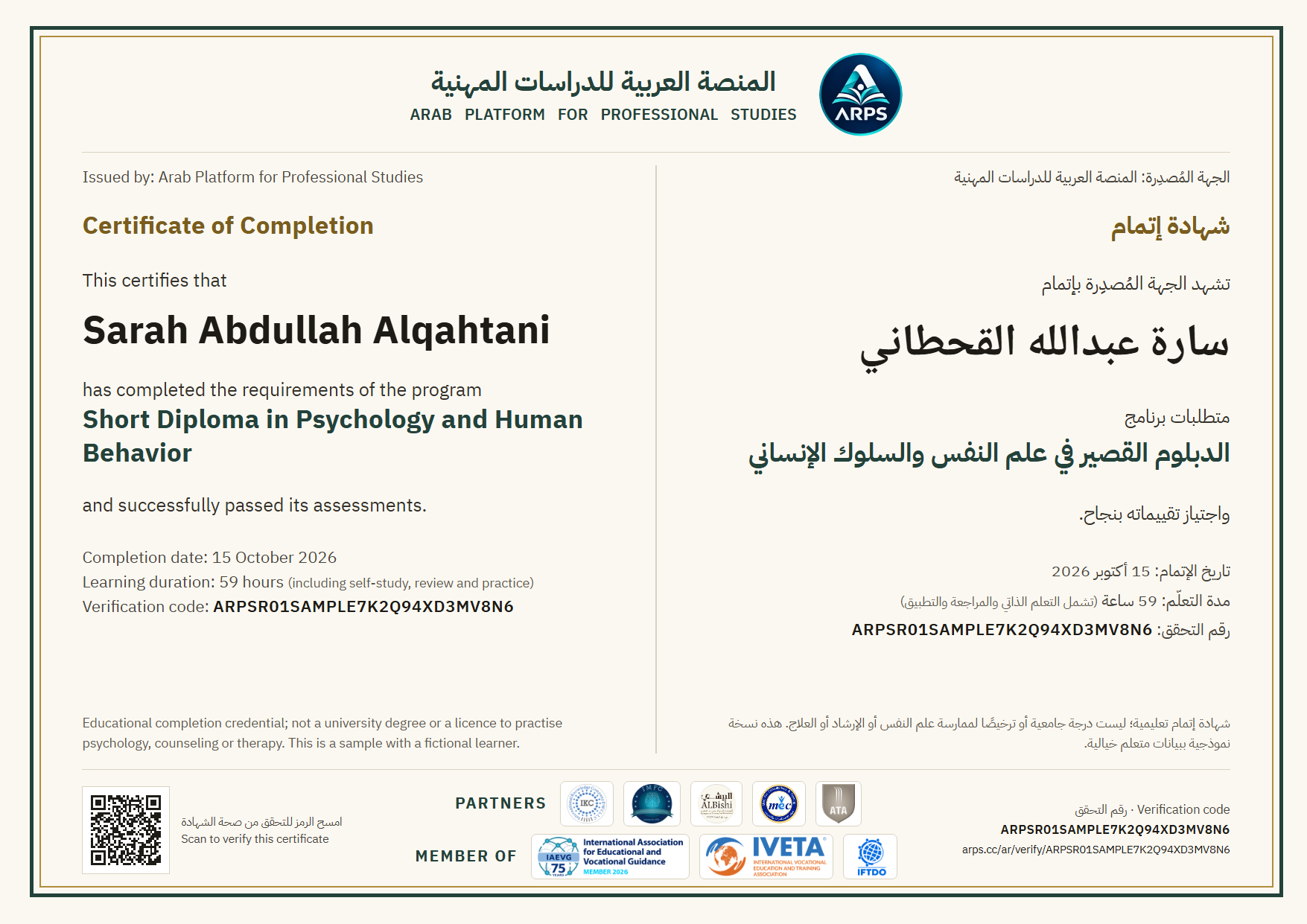
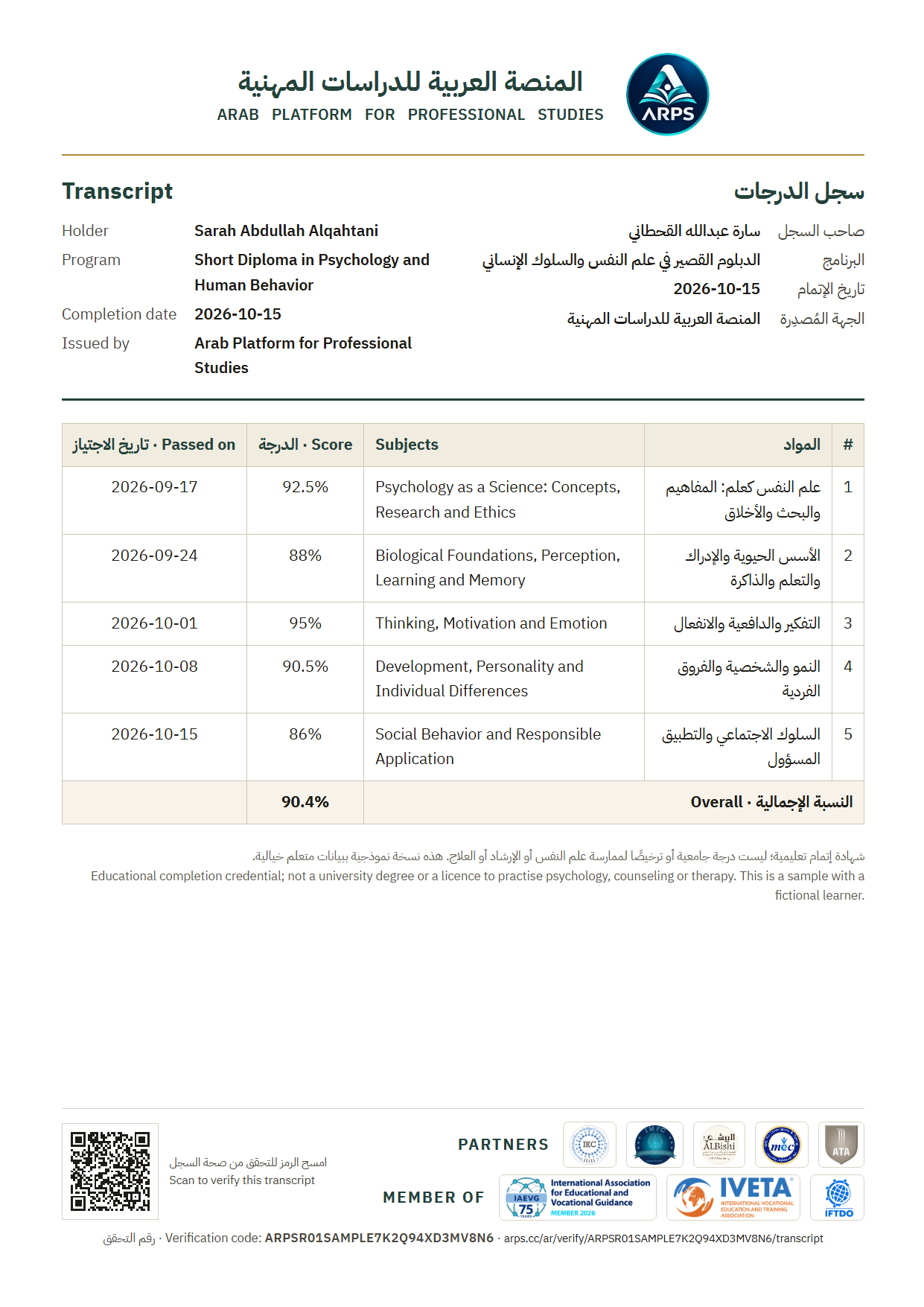
A sample from a real program in this track: Short Diploma in Psychology and Human Behavior. The learner, scores and dates are fictional; opens in a new window.
Disclaimer: Training completion, not a university degree or professional licence.
Program questions
Do I need prior philosophy study?
No. The diploma starts with questions, definitions and arguments before moving to knowledge, self and ethics. Careful reading and trying counterexamples matter more than memorizing school names.
Does it teach the history of every philosopher?
No. It focuses on selected concepts, reasoning tools and applied issues. A short dialogue trains close reading; broad intellectual history and complete original works require separate study.
How are the subjects assessed?
Every lesson has a learning check, and each subject has a separate summative covering its lessons. Subject results appear in the transcript. The platform sets the operational passing policy centrally; the content quality score is not a learner threshold.
Is the diploma an academic degree?
No. It is a training completion credential under platform policy. It does not grant a university degree, licence or authorization for a regulated profession.
Are the case numbers real field research?
No. Cases and numbers are invented for learning and marked as such. Transfer the reasoning method to your context, checking real data and authority rather than copying an example’s outcome.
Show all (9)
Can the ethics material be applied at work?
Its questions about outcomes, duties and fairness can help structure discussion. An actual decision needs its facts, rules and an authorized decision maker; this diploma provides no legal ruling.
How should I use a thought experiment?
State the proposed case precisely, identify the principle it tests, and compare the case with a relevant variation. A surprising intuition is a starting point for an argument, not proof by itself.
Is Short Diploma in Philosophy and Thought free, and do I get a certificate?
Yes. Short Diploma in Philosophy and Thought is free on ARPS: every lesson, exercise and assessment is free, the first subject is open to read without an account, and the program is available in Arabic and English. Issuing a certificate is optional and has a published fee; it is a training completion certificate showing you passed the program's assessments, recognised by most private-sector organisations in the Gulf states and most Arab countries, and it strengthens your CV; confirming that a specific organisation accepts it remains your responsibility.
What other names is Short Diploma in Philosophy and Thought known by?
The subject of this program is also known as: philosophy, introduction to philosophy, philosophical thinking, logic and critical thinking. Learners usually find it by searching for: philosophy courses online, philosophy courses online free, introduction to philosophy course, how to start learning philosophy, philosophy of mind basics.
Learn to read archaeological evidence in context, then move from a research question to recording, dating, interpretation and preservation through fictional cases.
6 subjects
26 lessons
67 hours
Free
Specialist Preparation Programs
History, Philosophy, Civilization & Religious Studies
Turn a practical ethics question into evidence, options, reasons and a conditional recommendation. Apply outcome, duty, care, privacy and fairness tools to fictional cases, then write a brief for the authorized owner and a follow-up plan that can reveal failure.
10 subjects
30 lessons
51.5 hours
Free
Professional Mini-Master
History, Philosophy, Civilization & Religious Studies
This short diploma connects market-research design with consumer-behavior interpretation and evidence-bounded decisions. Six subjects progress from the research question through sampling, measurement, analysis, choice journeys, testing, and recommendation, ending with an applied market-research capstone.