Short Diploma in Archaeology and Archaeological Studies
Short Diploma in Archaeology and Archaeological Studies is a free program on ARPS, the Arab Platform for Professional Studies. Learn to read archaeological evidence in context, then move from a research question to recording, dating, interpretation and preservation through fictional cases.
Important notice: Foundational learning, not authorization for independent excavation or practice, a university degree, or endorsement by cited bodies.
Explain What counts as archaeological evidence and context? with the evidence limits stated.
Produce a reviewable decision from fictional inputs.
From lesson 1, readable now without an account: What counts as archaeological evidence and context?
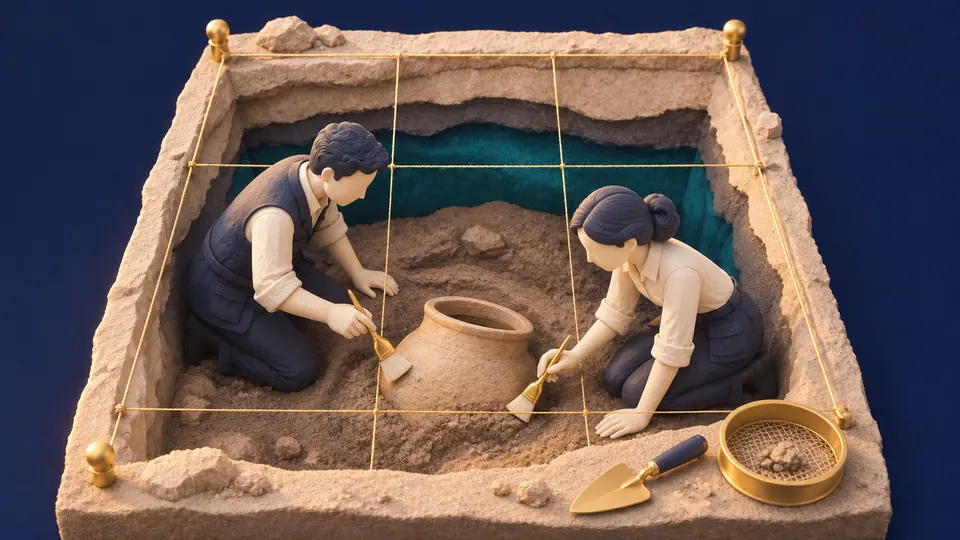
A pottery sherd near a wall does not by itself show that the wall builders used the vessel. The sherd may have arrived in fill dumped after the wall fell out of use. Begin by identifying the kind of evidence, then ask where it was recorded, what it touches or cuts, and how it could have reached that position. A portable human-made object, such as a pottery sherd, is an artifact. A wall foundation or hearth pit is a feature that is recorded in place. Unworked seeds and animal remains may be ecofacts when they inform a question about human activity and the associated deposit. A shaped bone tool, however, needs its human modification recorded and may be classified as an artifact for the analysis at hand. These working classes do not prove age, authenticity, or function. [NPS, What Is Archeological Context, 2023; NPS, Archeology glossary, checked 2026-10-23]
A free account saves your progress and takes you straight to lesson 1.
Program facts
Study fee
Free
subjects
6
lessons
26
Estimated time
67 hours
Content last reviewed
Access period
60 days
Study language
Arabic and English
About the program
This short diploma builds a foundation in archaeology and archaeological studies across six connected subjects. It starts with record formation and research questions, then covers survey and documentation, stratigraphy, dating and finds analysis, the limits and ethics of interpretation, an evidence-linked preservation and communication decision, and finally a capstone in which the evidence changes before a decision. Each lesson has a worked case and two exercises with checkable outputs and solutions; each subject has a separate summative bank. Named regional scenarios are fictional teaching cases. The program requires no site visit or collection. It is foundational learning, not an excavation permit, independent practice qualification or university degree.
Practical relevance
Learners build a source matrix, repair a location register, test a date interpretation and draft a decision memo from fictional data while stating what the evidence cannot support.
Why this program
An archaeological object is more informative when its relation to location, layers and associated material is preserved. Learners distinguish observation from hypothesis and test rival explanations before writing a public claim.
Career relevance
Reading records, criticizing sources and documenting limits can help people understand heritage, museum and research work. Completion does not establish independent professional competence or replace field training and competent-authority permission.
Career paths this program serves
This program is a step on the paths of the following occupations. Open a path to see its other programs in study order.
Classify evidence and context and frame a testable archaeology question.
Plan survey and document provenience, standing remains and reusable files.
Build a relative sequence and interpret dating, finds and samples within their limits.
Compare explanations while considering provenance, communities and sensitive information.
Propose preservation, communication and an integrated evidence-linked decision.
Review an evidence package when a key record changes and propose a reasoned interim decision.
Learning outcomes (5)
The learner analyses decisions in The Archaeological Record and Research Questions from a fictional evidence record and justifies the finding and its limits.
The learner analyses decisions in Survey and Documentation from a fictional evidence record and justifies the finding and its limits.
The learner analyses decisions in Stratigraphy, Dating and Analysis from a fictional evidence record and justifies the finding and its limits.
The learner analyses decisions in Archaeological Interpretation and Ethics from a fictional evidence record and justifies the finding and its limits.
The learner analyses decisions in Preservation, Communication and Synthesis from a fictional evidence record and justifies the finding and its limits.
Who it is for
The program serves learners seeking an organized introduction before specialization, and heritage, museum or education professionals seeking common language for evidence, preservation and interpretation. It fits people who prefer desk-based work on fictional data and detailed correction of decisions; it does not assume membership of a field team.
It also helps readers of archaeological reports ask how sampling, visibility and dating constrain claims. The program states its skill boundaries openly, leaving real site decisions to qualified specialists and responsible authorities.
Prerequisites
You need basic ability to read medium-length learning texts and compare simple numerical inputs such as survey area or an approximate date. Archaeological terms are introduced before they are applied, so prior excavation experience or special equipment is not required.
Paper notes or a text editor are enough to make the matrices and decisions. All training cases, dates and quantities are supplied within the lessons; you need not visit a site or access a real heritage register, and no personal or sensitive data are requested.
What it does not offer
Independent field excavation or issuing site permits.
Establishing artifact title or applying a particular country's law without local verification.
This subject begins with findspot and association rather than an object's appearance alone. Learners distinguish a portable artifact, fixed feature and environmental remain, then ask how the archaeological record formed and changed. Broad interest becomes a testable question with observable variables and competing explanations. A relative sequence is built from layer, cut and fill relations, while unrecorded links remain open instead of being invented. Fictional cases compare find density only after visible area, fill origin and collection effort are considered. Finally, learners build an evidence register separating observation from interpretation, justify confidence, and repair claims about function or priority that the record cannot yet support.
5 lessons · 10 hours
What counts as archaeological evidence and context?2 hours
From broad interest to a testable question2 hours
How do deposits form and change?2 hours
Visibility, sampling and apparent absence2 hours
Evidence register and bounded claims2 hours
Subject 2
Survey and Documentation
The subject starts with a desk assessment that defines the decision and spatial and temporal boundaries, then tests the origin and independence of each map, image and report. Learners design regular or targeted survey routes for a stated question and calculate visible area so raw find counts do not mislead. A provenience register keeps coordinates as measured, with datum, precision and source rather than fabricated decimals. Standing remains are recorded through measurements, images, material condition and the contact between a blocked opening and wall before a building phase is proposed. The subject ends with unique file IDs, versions, metadata and links among image, context and sample, allowing another researcher to reconstruct the record and its revisions.
5 lessons · 10 hours
Desk assessment before field decisions2 hours
Design transects before comparing results2 hours
Provenience and coordinate precision2 hours
Read a standing structure without inventing its date2 hours
A record another researcher can reuse2 hours
Subject 3
Stratigraphy, Dating and Analysis
This subject orders events across multiple layers, cuts and fills, exposing contradictory cycles and leaving unlinked units outside an invented chain. Learners see how an object's manufacture date may place a lower bound on secure deposition without giving an exact fill or neighbouring building date. Calibrated radiocarbon results are read as ranges and probabilities tied to the sample material, possible old wood and later movement, rather than a convenient single year. Finds analysis separates sherd count, weight and minimum vessel count and checks recovery differences. Environmental samples and controls are then chosen for a stated question; arithmetic cannot restore context labels lost when two samples were mixed before flotation.
5 lessons · 10 hours
A relative sequence without contradictory edges2 hours
An object's date and a deposit's limit2 hours
Read a calibrated radiocarbon range2 hours
Count sherds without inventing vessel counts2 hours
Environmental samples matched to a question2 hours
Subject 4
Archaeological Interpretation and Ethics
Learners compare production and domestic interpretations through competing predictions, independent observations and stratigraphic links that determine evidential weight. Blank space on a settlement map where no survey occurred is not proof of absent occupation; site density needs surveyed area, visibility and effort. An object outside its context calls for a documented ownership chain; published images or seller stories are not transfer records, while a gap alone is not a final legal verdict. Possible remains or sensitive places require preserved records, controlled disclosure, competent authority and relevant consultation. Exhibit language is revised so ancient finds do not speak for the identity or beliefs of living communities without evidence and participation.
5 lessons · 10 hours
Interpret function from competing evidence2 hours
Settlement pattern with blank map areas2 hours
Provenance is a documented chain2 hours
Communicate sensitive evidence responsibly2 hours
Interpretation without speaking for living communities2 hours
Subject 5
Preservation, Communication and Synthesis
Preservation in place is treated as a decision about condition, threat and monitoring, including changed water or vehicle movement without direct excavation. Learners treat the archive as a linked chain of identifiers, versions and metadata connecting image, context and sample while preserving correction history. A public label translates observation into clear explanation with stated confidence and may withhold precise location for a fragile feature. In evidence synthesis, copied descriptions do not become independent sources, and a documented cut does not become an absolute date. The final memo compares rival interpretations, proposes a discriminating check and interim protection, identifies decision authority, and names what new evidence would trigger revision.
5 lessons · 10 hours
Preservation in place is a conditional decision3 hours
An archive transfer that preserves relationships3 hours
A public label that is clear and warranted3 hours
Synthesize evidence without adding false certainty3 hours
An integrated archaeological decision memo3 hours
Subject 6
Capstone: reconcile evidence and decision
A capstone in which learners review an archaeological package for a fictional site after a new document arrives before the decision meeting, revealing that the photograph used to establish the fill-paving relationship belongs to a neighbouring sector. Learners set the boundary of the error's impact, separate correcting the image link from revising the functional interpretation, and keep the previous report and the new version in distinct folders. They then sort the outputs that cite the photograph into those to suspend and those supported independently, and propose an interim decision that names the decision authority and the evidence that would trigger revision.
1 lesson · 9 hours
Review an archaeological package after evidence changes9 hours
Subjects unlock in sequence as you progress.
Strengths
Context and source traced before interpretation.
Quantitative and written practice with independent solutions.
Learning checks separated from summative assessment.
Ethical preservation and communication of uncertainty.
A final decision integrating survey, layers and dating.
Evidence basis
Public guidance from archaeology, heritage and archive organizations is used within recorded inspection limits, with original teaching cases and questions. Citation does not imply those organizations endorse this program.
Reference organizations
National Park Service
Historic England
Chartered Institute for Archaeologists
Archaeology Data Service
UNESCO
ICOMOS
Methodology
Concepts are taught through worked cases, two exercises and correction criteria, then tested in separate subject assessments. Review is assisted self-review, with no claim of independent human validation.
How the route works
Short Diplomas are relatively comprehensive learning pathways that cover a major subject through five connected learning subjects and structured assessments, with a diploma transcript available with the credential.
Self-paced sequential study. Content unlocks progressively and each subject combines reading, examples, exercises, knowledge checks, and assessment.
Build integrated knowledge in a major subject.
Study through five clear, connected learning subjects.
Complete a defined assessment for each subject.
Receive a diploma transcript showing subjects and results when the credential is issued.
Assessment
Each Short Diploma contains five subjects, each with an approved assessment. A sixth final exam is not required when the five assessments adequately cover the learning outcomes.
Assessment attempts: 2 per assessment, 7 days apart
The pass mark is announced before the program is published.
Certificate
Successful completion makes the learner eligible for the Short Diploma certificate and Diploma Transcript under the credential policy.
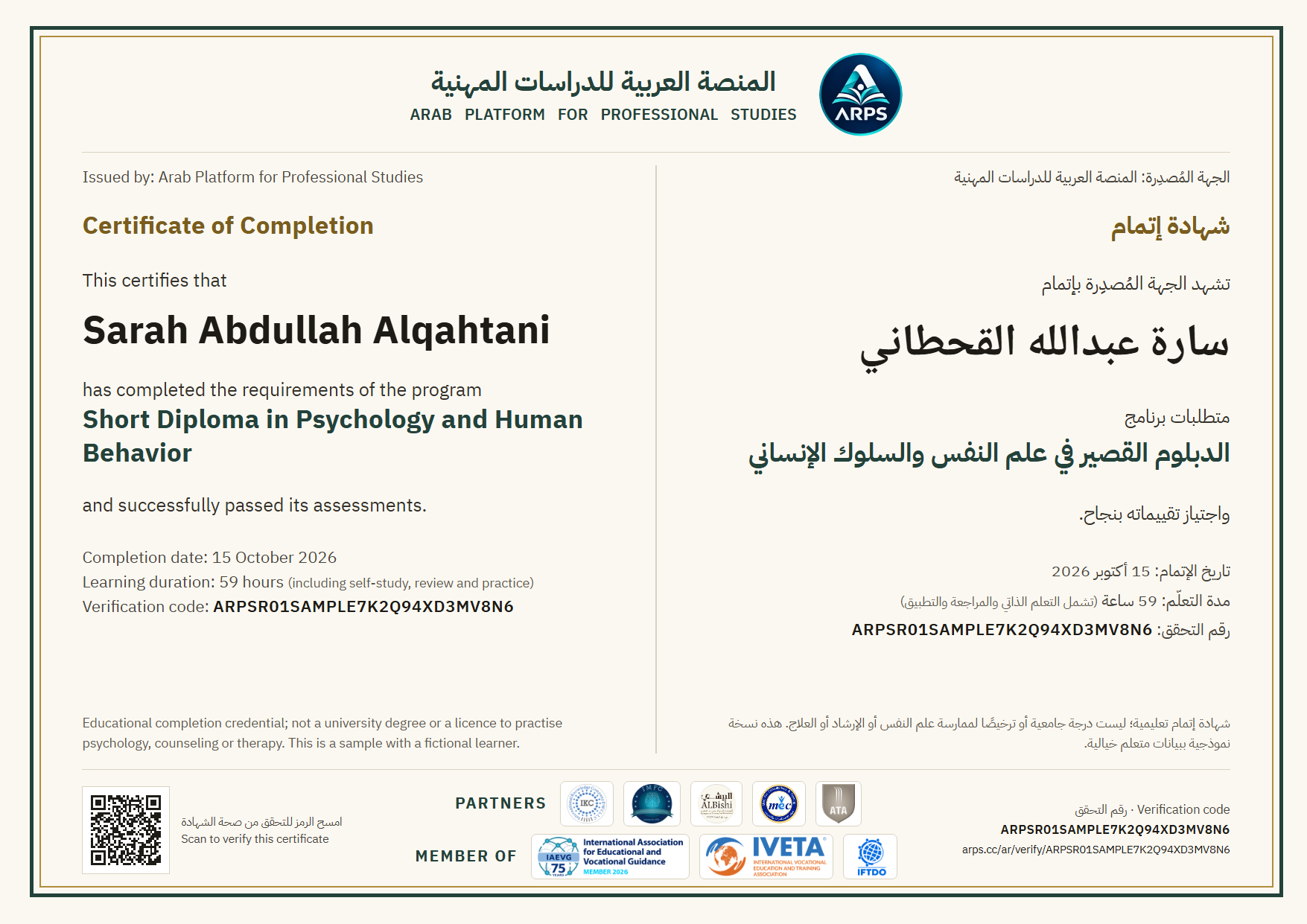
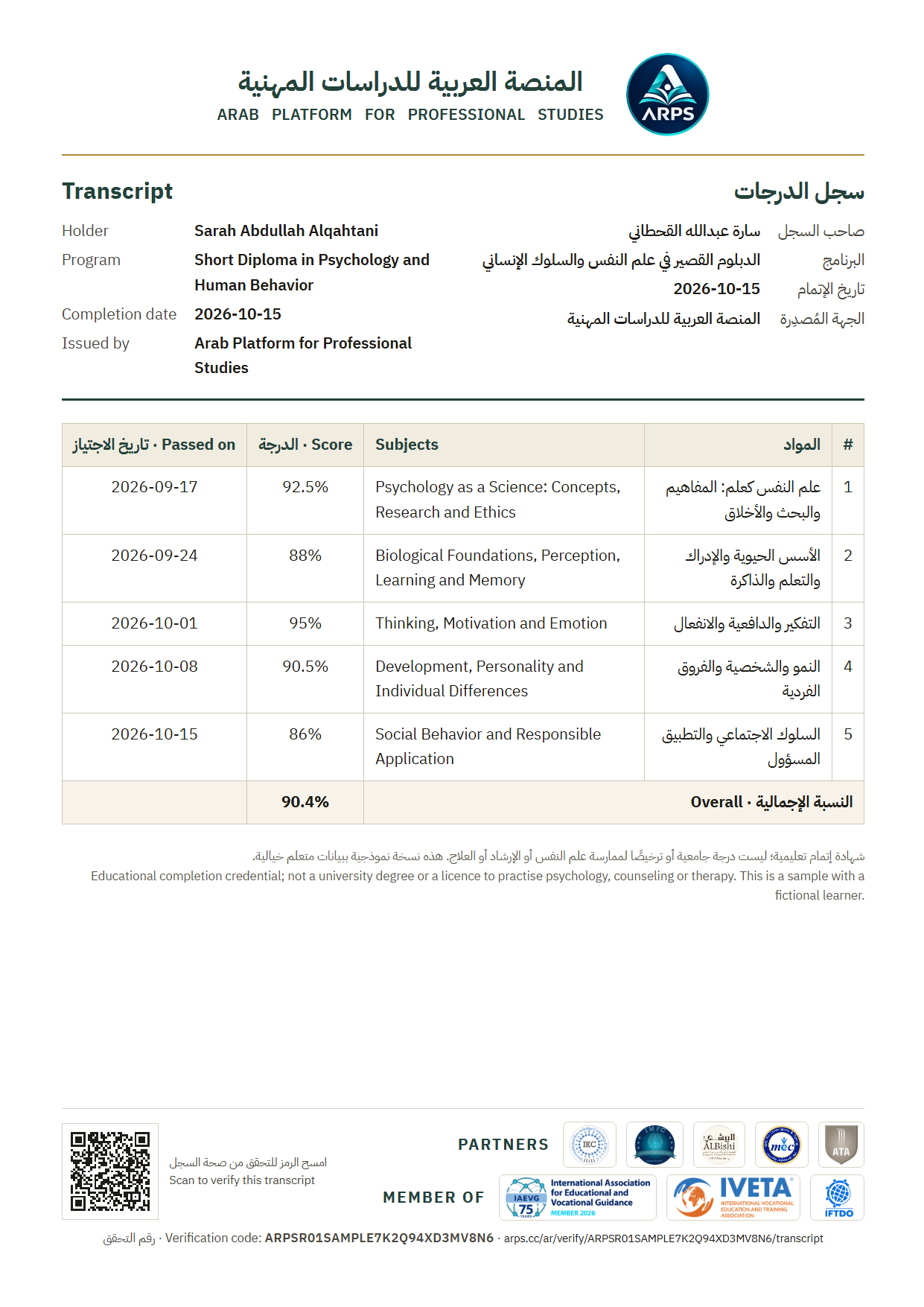
A sample from a real program in this track: Short Diploma in Psychology and Human Behavior. The learner, scores and dates are fictional; opens in a new window.
Disclaimer: Learning completion only; no excavation licence, independent practice authorization or university degree.
Program questions
Will I visit an archaeological site?
No. All exercises are desk-based fictional cases; real fieldwork requires appropriate authority and specialist supervision.
Does this authorize independent excavation?
No. It develops understanding of evidence and records, not a permit or independent field competence.
How are subjects assessed?
Lessons include learning checks and each subject has a separate summative assessment with results recorded under route policy.
Do named cities describe actual sites?
No. City names frame explicitly fictional training data, not factual claims about a site or local law.
What can dating establish?
Lessons separate material age from deposition and assess calibration ranges and sample association before dating events.
Show all (7)
Is Short Diploma in Archaeology and Archaeological Studies free, and do I get a certificate?
Yes. Short Diploma in Archaeology and Archaeological Studies is free on ARPS: every lesson, exercise and assessment is free, the first subject is open to read without an account, and the program is available in Arabic and English. Issuing a certificate is optional and has a published fee; it is a training completion certificate showing you passed the program's assessments, recognised by most private-sector organisations in the Gulf states and most Arab countries, and it strengthens your CV; confirming that a specific organisation accepts it remains your responsibility.
What other names is Short Diploma in Archaeology and Archaeological Studies known by?
The subject of this program is also known as: archaeology, archaeological studies, archaeological science. Learners usually find it by searching for: archaeology courses online, archaeology course free, introduction to archaeology, archaeological excavation methods, what is archaeology.
A foundational short diploma in philosophy and thought. Learn to frame a question, examine a concept and an argument, assess knowledge and choice, weigh justice, and build a reasoned position open to revision. Seven subjects use invented worked cases, guided practice and an assessment for each subject.
7 subjects
30 lessons
70.5 hours
Free
Specialist Preparation Programs
History, Philosophy, Civilization & Religious Studies
Turn a practical ethics question into evidence, options, reasons and a conditional recommendation. Apply outcome, duty, care, privacy and fairness tools to fictional cases, then write a brief for the authorized owner and a follow-up plan that can reveal failure.
10 subjects
30 lessons
51.5 hours
Free
Professional Mini-Master
History, Philosophy, Civilization & Religious Studies
This short diploma connects market-research design with consumer-behavior interpretation and evidence-bounded decisions. Six subjects progress from the research question through sampling, measurement, analysis, choice journeys, testing, and recommendation, ending with an applied market-research capstone.