
Specialist Preparation Program in Ethics and Applied Philosophy

Specialist Preparation Program in Ethics and Applied Philosophy is a free program on ARPS, the Arab Platform for Professional Studies. Turn a practical ethics question into evidence, options, reasons and a conditional recommendation. Apply outcome, duty, care, privacy and fairness tools to fictional cases, then write a brief for the authorized owner and a follow-up plan that can reveal failure.

A paper trolley at a railway switch with figurines on both tracks, an ethicist figurine at the lever deep in thought: cover of the ARPS program Specialist Preparation Program in Ethics and Applied Philosophy Studying is completely free
Estimated time
51.5 hours
subjects
10
lessons
30
Study language
Arabic and English

Certificate issuance fee

$90

331 AED or 338 SAR

After you pay the certificate fee, you can print the certificate and transcript in both Arabic and English, or in English only.

Start the first subject now Fees by route

What you will learn in the first 10 minutes

The opening lessons of the first subject, with the reading time set for each. Approximate total time in minutes: 7

  1. Framing the ethical question and separating facts from values 7 min read
    • Create an issue card that distinguishes verified facts, untested assertions and value judgments, and identifies a decision within its owner's authority.

From lesson 1, readable now without an account: Framing the ethical question and separating facts from values

When a team calls a practice ‘unethical’, the decision is still undefined. The team may disagree about what happened, the weight of a harm, or who has authority to act. A specialist turns the concern into a bounded practical question: who may do what, when, to whom, and with which alternatives? Begin with the decision, not with a list of theories or a search for someone to blame. Precise framing keeps a discussion about a changeable procedure from becoming a judgment about a person's character.

An issue card has seven fields:

  • the specific decision and its deadline
  • the decision owner
  • feasible options
  • affected people
  • established facts and how they were established
  • untested assertions or forecasts
  • and the values or obligations that make the choice matter

A sentence can mix fact and value. Separate them before analysis. ‘Registration closed at six’ is a fact if the system log confirms it. ‘That was unfair to evening workers’ is a judgment requiring further information about eligibility, why the time was chosen, and feasible alternatives. The distinction does not diminish the value judgment. It prevents an inference from being presented as if a system measured it.

Next, grade the evidence for the precise claim it supports. A published notice shows what was posted, not that everyone read it. A participant's account shows a direct experience, not necessarily every group's experience. A manager's objection identifies a perspective without ending inquiry. For each claim, state what supports it, what could disconfirm it, and how uncertainty changes the decision. If waiting one day could supply decisive information, delay may be justified. If delay itself risks harm, propose a limited precaution and a review date instead of indefinitely saying that more data are needed.

Separating description from evaluation begins applied philosophical analysis, but the description itself is never entirely neutral. Choosing whose impact counts and what harm to measure reflects values. Test the card with two questions. Did it omit a less powerful group because that group is difficult to reach? Did it describe the favored option positively and its rival in loaded language? Restate options as actions with observable consequences. Replace ‘act responsibly or ignore complaints’ with ‘extend registration for two days and notify applicants’ and ‘retain the closure but open a defined exception route’. Those actions can be compared; the loaded labels decide the matter before inquiry begins.

The card gives its writer neither legal authority nor the power to decide for the organization. An ethics specialist assembles reasons, risks and alternatives, and states limits of knowledge. If the case reveals an urgent safety complaint or exposed personal data, use the organization's established containment route immediately and continue ethical analysis afterward. Where the dispute concerns two reasonable preferences, identify the disagreement for the decision owner. This lesson's output is not the final verdict. It is a question that evidence and fair comparison can answer.

Give the issue card an evidence table rather than a spurious numerical confidence score. Mark each proposition as a direct record, a participant account, or an inference, and state whether a different finding would change the option. In the library case, the system can reproduce the time at which places filled. A claim that every evening worker was denied a chance lacks support. If the decision is whether to fund another session, the decisive information may be eligible unmet demand and instructor cost, not merely the complaint count. Ethical framing directs data collection instead of demanding every imaginable datum.

Distinguish ‘could not book’ from ‘did not obtain a place’. Someone may read the notice in time but find capacity exhausted; someone else may never receive the notice. The first problem may call for more capacity, the second for a different communication channel, and a third for a different window. If all are called ‘unfair access’, the remedy can miss the actual cause. The card need not settle every causal question, but it must say what remains unknown before recommending that others lose confirmed places.

Naming affected people is more than an expression of sympathy. Ask who bears the cost of each option, how they will learn the decision, and how they can contest an error. Confirmed participants may have rearranged their schedules. Late readers need an intelligible waiting-list route. A second session requires instructor time and funding. Do not assume equal stakes or treat the loudest voices as representative of the silent. If a child or a person requiring access accommodations is involved, gather the necessary requirements without publishing personal details in a general issue card.

End with a review trigger rather than a slogan: ‘If the send log shows that a list promised advance notice never received it, the manager will reassess a remedy for that group before authorizing another session.’ This names a testable fact, a decision owner and what could change. ‘We will reconsider if new facts emerge’ does not guide an inquiry. Where two values remain in tension, write the reason for the provisional choice and its strongest objection. That makes the card open to criticism and correction rather than a justification written after the fact.

Read the full lesson free
Start free

A free account saves your progress and takes you straight to lesson 1.

Program facts

Study fee
Free
subjects
10
lessons
30
Estimated time
51.5 hours
Content last reviewed
Access period
30 days
Study language
Arabic and English

About the program

Move from framing a case and its affected people to comparing outcomes, duties and relationships. Apply the tools to service data, research participation, scarce opportunities and system-assisted decisions. Each lesson includes a fictional worked case and an exercise with correction criteria. Then write a decision brief and failure-capable review measures. Later modules extend to integrity in working relationships, evidence and public dialogue, and access and lasting effects, and you close with the shared learning centre capstone. Authorized owners retain implementation and legal or clinical decisions.

Practical relevance

Use issue cards, impact maps, constraint ledgers and decision briefs when reviewing complaints, allocating opportunities or trialing a decision-support system within your role.

Why this program

Workplace ethical decisions need honest facts, risks and authority boundaries rather than broad slogans. These lessons build usable tools and make their reasons reviewable.

What you will learn

  • Frame a bounded ethical issue and stakeholder impact map with evidence and authority limits.
  • Compare possible outcomes and constraints using sensitivity tests and a less harmful option.
  • Revise a general rule for care relationships and defend a decision against a serious objection.
  • Review data purpose and research voluntariness and design bounded collection and notice.
  • Review oversight of automated decisions and design a correctable allocation rule for scarce opportunities.
Show all (10)
  • Deliver an integrated ethics brief and testable monitoring and escalation plan.
  • Apply integrity tools to gifts and conflicts of interest, report protection, fair hiring and supplier due diligence.
  • Examine causal claims, communicate risk with clear counts, facilitate disagreement and correct a public error.
  • Test access, weigh present against future effects and set boundaries for a behavioural trial.
  • Complete the shared learning centre capstone, from evidence triage to a revised recommendation and tested implementation plan.
Learning outcomes (10)
  1. Frame a bounded ethical issue and stakeholder impact map with evidence and authority limits.
  2. Compare possible outcomes and constraints using sensitivity tests and a less harmful option.
  3. Revise a general rule for care relationships and defend a decision against a serious objection.
  4. Review data purpose and research voluntariness and design bounded collection and notice.
  5. Review oversight of automated decisions and design a correctable allocation rule for scarce opportunities.
  6. Deliver an integrated ethics brief and testable monitoring and escalation plan.
  7. Apply Integrity in working relationships through evidence-based decisions within authority limits.
  8. Apply Evidence and public dialogue through evidence-based decisions within authority limits.
  9. Apply Access and lasting effects through evidence-based decisions within authority limits.
  10. Apply Capstone: the shared learning centre through evidence-based decisions within authority limits.

Who it is for

  • This program serves practitioners assembling evidence, reasons and options for ethical decisions in education, community services or data teams. It suits staff preparing an issue card, impact map or brief for an authorized owner, particularly around complaints, scarce opportunities or decision-support trials. The focus is a revisable recommendation within the specialist's role. It grants no legal, clinical or research-approval authority.

Prerequisites

  • You need to read short workplace instructions and a simple numerical table, and distinguish an observed event from an inference needing evidence. No philosophy degree, programming experience or legal role is required. Each case supplies its inputs, though service or teaching experience may help. Be ready to state a decision reason, check a ratio's denominator and mark uncertainty before recommending action.

Curriculum

  1. Subject 1 Open for free

    Framing the issue and affected people

    Frame the question and evidence limits, then map effects on present and absent voices. Produce an issue card and impact map.

    2 lessons · 2 hours
    1. Framing the ethical question and separating facts from values 1 hours
    2. Mapping affected people, power and consent 1 hours
  2. Subject 2

    Outcomes and constraints

    Compare outcomes with matching units and sensitivity tests, then examine duties, promises and less revealing alternatives. Produce an outcome table and constraint ledger.

    2 lessons · 2 hours
    1. Comparing consequences and harms under uncertainty 1 hours
    2. Duties, rights and the limits of exceptions 1 hours
  3. Subject 3

    Care and justified judgment

    Examine care relationships and implementation burdens, then compare reasons and a serious objection without numerical moral scoring. Produce an option revision and argument.

    2 lessons · 2 hours
    1. Practical wisdom and care in relationships 1 hours
    2. Balancing reasons and the strongest objection 1 hours
  4. Subject 4

    Data and human participation

    Review data purpose, linkage risk and research voluntariness. Design bounded flows and understandable invitations, referring formal questions to competent owners.

    2 lessons · 2 hours
    1. Data purpose, collection limits and reuse 1 hours
    2. Research participation, consent and vulnerability 1 hours
  5. Subject 5

    Automated decisions and allocation fairness

    Test system purpose and meaningful human correction, then apply allocation distinguishing eligibility, priority and ties. Produce oversight and fair-allocation procedures.

    2 lessons · 2 hours
    1. Human oversight of system-assisted decisions 1 hours
    2. Allocating scarce opportunities and procedural fairness 1 hours
  6. Subject 6

    Decision brief and follow-up

    Combine facts and alternatives in a decision brief, then design follow-up detecting implementation failure, with containment, correction and review dates.

    2 lessons · 2.5 hours
    1. The integrated ethics decision brief 1 hours
    2. Monitoring, correction and escalation 1.5 hours
  7. Subject 7

    Integrity in working relationships

    Address gifts, recusal, reporting protection, hiring fairness and supplier impacts. Separate relationships from accusations and verify that remedy reaches affected people.

    4 lessons · 8 hours
    1. Gifts and conflicts of interest 2 hours
    2. Protecting a report from retaliation 2 hours
    3. Recusal and fair hiring 2 hours
    4. Supplier due diligence and remedy 2 hours
  8. Subject 8

    Evidence and public dialogue

    Audit causal claims, denominators and risk communication; facilitate reasoned disagreement. Correct a false claim for its relevant audience and repair individual effects.

    4 lessons · 8 hours
    1. Causal claims in service reports 2 hours
    2. Communicating risk with clear counts 2 hours
    3. Facilitating ethical disagreement 2 hours
    4. Correcting a public error and repairing harm 2 hours
  9. Subject 9

    Access and lasting effects

    Test a complete access journey, compare current benefits with later burdens and design a truthful message trial with relevant measures, stopping rules and review.

    3 lessons · 6 hours
    1. Testing access to an event 2 hours
    2. Justice across present and future 2 hours
    3. Boundaries of a behavioural trial 2 hours
  10. Subject 10

    Capstone: the shared learning centre

    Develop a learning-centre dossier through evidence triage, allocation, grievance, scheduling and results audit. Deliver a revised recommendation and implementation plan tested by bounded simulation.

    7 lessons · 13.5 hours
    1. Project intake and evidence triage 2 hours
    2. Designing seats and access support 2 hours
    3. Handling a project grievance 2 hours
    4. Bounding an automated scheduling pilot 2 hours
    5. Auditing the centre results dashboard 2 hours
    6. Objection hearing and revised recommendation 2 hours
    7. Handover and challenge the implementation plan 2 hours

Subjects unlock in sequence as you progress.

Strengths

  • Framing the issue and affected people
  • Outcomes and constraints
  • Care and justified judgment
  • Data and human participation
  • Automated decisions and allocation fairness
Show all (8)
  • Decision brief and follow-up
  • Integrity, evidence and access in practice
  • Integrated capstone project

Evidence basis

Named academic references support philosophical concepts; OECD, UNESCO and Belmont are used within their stated scopes. All teaching cases and numbers are fictional.

Methodology

The method frames a question, tests facts, effects, constraints and objections, then recommends and monitors.

Assessment

Assessments follow the program blueprint and may use module assessments, a final assessment, or a combination, under the approved attempt policy.

Assessment attempts: 2 per assessment, 7 days apart

The pass mark is announced before the program is published.

Certificate

The credential confirms completion and successful assessment; it does not represent professional licensure unless explicitly and lawfully stated.

Every certificate has a public verification code. Verify a certificate

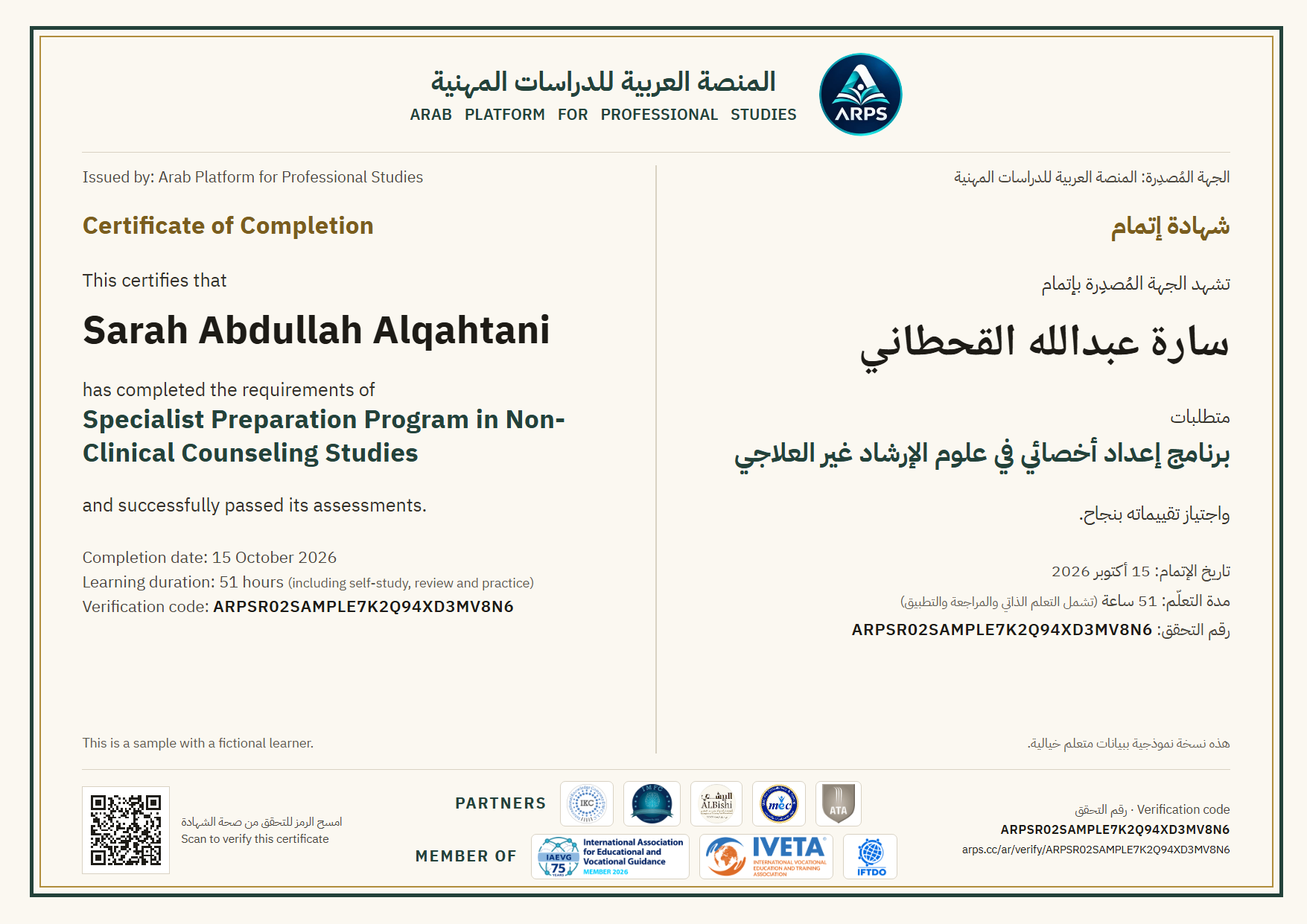
A sample from a real program in this track: Specialist Preparation Program in Non-Clinical Counseling Studies. The learner, scores and dates are fictional; opens in a new window.

Verification example: a real issued certificate

Program questions

Does the program grant a licence?

No. It develops bounded analysis and recommendations; legal, clinical and institutional decisions remain with authorized owners.

Do I need workplace data?

No. Fictional cases provide inputs and worked solutions; workplace transfer requires permission and data controls.

Do the city examples state local law?

No. Named cities are fictional training settings without asserted local law or real statistics.

How does practice differ from assessment?

Practice produces a card or brief checked against a solution; assessment scores a specific decision question automatically.

Who decides whether to act?

The specialist supplies evidence and options; the authorized owner decides under organizational policy.

Show all (7)
Is Specialist Preparation Program in Ethics and Applied Philosophy free, and do I get a certificate?

Yes. Specialist Preparation Program in Ethics and Applied Philosophy is free on ARPS: every lesson, exercise and assessment is free, the first subject is open to read without an account, and the program is available in Arabic and English. Issuing a certificate is optional and has a published fee; it is a training completion certificate showing you passed the program's assessments, recognised by most private-sector organisations in the Gulf states and most Arab countries, and it strengthens your CV; confirming that a specific organisation accepts it remains your responsibility.

What other names is Specialist Preparation Program in Ethics and Applied Philosophy known by?

The subject of this program is also known as: applied ethics, practical ethics, applied philosophy, professional ethics. Learners usually find it by searching for: applied ethics course, applied ethics course online, practical ethics course, ethical decision making course, applied ethics course free.

Professionals in this domain

Connect with certified consultants, trainers, coaches and specialists in the same domain across the ARPS communities.