Professional Mini-Master in Sustainable Transport Planning and Mobility Transition Measurement
Professional Mini-Master in Sustainable Transport Planning and Mobility Transition Measurement is a free program on ARPS, the Arab Platform for Professional Studies. Plan a deliverable sustainable transport package, then test its effects on access, emissions and different groups with explicit data boundaries.
Construct a reproducible functional-area baseline and calculate a person-trip modal split without mixing people, trips, vehicles and trip legs.
From lesson 1, readable now without an account: Define the mobility system boundary and baseline
Before choosing a bus route or cycle corridor, define the system that the intervention will change. A useful planning unit is a person's complete journey from origin to destination for a stated purpose during a stated period. A journey is not a person: one person may make several journeys in a day. Two bus boardings are not necessarily two journeys if they are legs of one journey to work. Put four boundaries at the top of the baseline: the functional area, including origins and destinations that cross an administrative line; the measured days and hours; the people and trip purposes included; and the counting unit. Without these boundaries, a later change may reflect a changed definition rather than changed behaviour. The European SUMP Guidelines use a functional urban area, participation and evaluation as planning concepts. They are used here as a method, not as a claim that one city's legal rules apply everywhere.
A free account saves your progress and takes you straight to lesson 1.
Program facts
Study fee
Free
subjects
9
lessons
50
Estimated time
169 hours
Content last reviewed
Access period
60 days
Study language
Arabic and English
About the program
A main corridor can become faster while a peripheral worker finds the return trip harder. This programme begins with person journeys, demand evidence and a reproducible baseline. It then compares service, street, demand and land-use packages, estimates bounded operating emissions, and connects funding and governance to delivery. In the fifth module you build an indicator dictionary, a temporal and spatial comparison, and an adaptation rule for results that miss expectations. Numeric cases set in Arab cities are fictional training scenarios, supported by worked exercises and an integrated final assessment. The outcome is a justified options plan, not a promise that one project suits every city. Later modules add representative evidence, everyday journey barriers and operating decisions, and an integrated fictional-city capstone covers safeguards, finance, evaluation and handover.
Practical relevance
You can apply the reasoning to a corridor or district you know, using suitable public data or the training figures without entering personal records. You will construct a simple journey matrix and access view, compare packages under cost and equity constraints, calculate activity and emissions in declared units, and write a delivery decision with monitoring and correction rules. No specialist modelling purchase or organisational dataset is required to complete the teaching cases.
Why this program
Good transport decisions do not follow from one vehicle-speed number. Planners need to see complete journeys, who gains and loses, vehicle activity behind emissions, and cash available when works must be paid for. This programme teaches you to keep those measures clear and then combine them in an accountable decision. When a source is absent or a definition changes, you learn to suspend the claim and seek the specific missing evidence instead of filling the gap with a comfortable forecast.
Career relevance
The material is relevant to urban transport planning, service management, municipal consulting and programme evaluation. It develops professional judgement and communication across operations, environment, finance and community teams. Professional Mini-Master is an internal programme title; it is not a university degree, professional licence or external accreditation, and carries no employment or promotion promise.
Career paths this program serves
This program is a step on the paths of the following occupations. Open a path to see its other programs in study order.
Diagnose person journeys, spatial gaps and complete travel time with an auditable baseline and denominators.
Design service, street, demand and land-use packages and compare them under financial and equity conditions.
Estimate vehicle activity, operating emissions and uncertainty without mixing units or boundaries.
Sequence delivery, financing and governance across stakeholder conflicts and service risks.
Measure package effects with suitable indicators and comparisons, then apply a declared continue-or-adjust rule.
Show all (9)
Evaluate whether mobility evidence represents residents and links validly to journeys and services, and choose extra measurement that could change the decision.
Design alternatives for disrupted everyday journeys that connect operating calculations with access, timing and safeguards.
Compare charging, on-demand service, bikeshare, fare and investment decisions by resources, distributional effects and funding.
Produce an integrated mobility plan that can be recalculated, challenged and handed over, with explicit constraints, finance, evaluation and evidence limits.
Learning outcomes (9)
Diagnose person journeys, accessibility and spatial gaps using a documented baseline with consistent units and denominators.
Design service, street, demand and land-use packages and appraise them under cost, equity and access constraints.
Estimate vehicle activity, operating emissions, net change and uncertainty without mixing boundaries.
Sequence financing, delivery, accountability and procurement against dependencies, risks and verifiable outputs.
Build a measurement, comparison and dashboard protocol, then justify continuation or adaptation with bounded evidence.
Evaluate representation and linkage validity in mobility evidence and select additional measurement capable of changing a decision.
Design alternatives for disrupted everyday journeys, connecting operating calculations with access, timing, resources and safeguards.
Compare charging, on-demand service, bikeshare, fare and investment decisions through resources, distributional effects and funding branches.
Produce an integrated mobility-plan argument that can be reproduced, challenged and handed over with explicit constraints, finance, evaluation and evidence limits.
Who it is for
Transport planners and urban mobility managers who read origin-destination tables and participate in package selection, and who want to connect service changes with access, emissions and equity. Municipal consultants and transport-authority teams can also use the shared language across operations, environment, finance and communities. Relevant foundational experience with transport data and basic spreadsheet work is expected.
Prerequisites
Foundational experience with a transport service or urban project and the ability to read journey and origin-destination tables, rates, denominators, distances and times. Basic spreadsheet knowledge helps with the calculations, but coding and an engineering licence are not required. Learners should be able to distinguish a person journey from a boarding leg and an observation from an assumption; both distinctions are refreshed at the start.
The module begins by fixing the functional area, measurement period and counting unit, then separates person journeys from boarding legs and vehicle trips. Learners construct a mode-share baseline with explicit denominators and
5 lessons · 9.5 hours
Define the mobility system boundary and baseline2 hours
Build an origin-destination matrix and identify unobserved demand2 hours
Measure door-to-opportunity accessibility2 hours
Frame the problem and decision criteria from conflicting evidence2 hours
Audit service regularity and missing service periods2 hours
Subject 2
Designing and Appraising Option Packages
The module moves from diagnosis to comparable option packages. Learners calculate buses from cycle time and headway, keeping the operating fleet separate from reserves and minimum peripheral service. They prepare a street-width
5 lessons · 8 hours
Trade off network coverage and service frequency1.5 hours
Allocate street space and secure access to stops1.5 hours
Appraise a station area and land use without displacement1.5 hours
Combine demand and parking management with service improvement1.5 hours
Rank packages and test decision sensitivity1.5 hours
Subject 3
Estimating Emissions and Co-effects
The module begins with an inventory boundary separating person journeys and passenger kilometres from the vehicle kilometres used for emissions estimation. Learners reconcile journey surveys with bus operations, apply illustrative factors labelled
5 lessons · 8 hours
Set a transport inventory boundary and convert trips to vehicle activity1.5 hours
Apply emissions factors with unit and boundary checks1.5 hours
Estimate package effects against a no-action pathway1.5 hours
Report co-effects and uncertainty without invented monetisation1.5 hours
Test fleet electrification against energy and service constraints1.5 hours
Subject 4
Governing, Financing and Delivering the Package
The module makes an option plan deliverable without hiding who owns a decision, funding or risk. Learners map street authority, operator, technical reviewer and users in a bus-loading dispute and count deliveries
5 lessons · 8 hours
Map stakeholders and decision rights1.5 hours
Build the funding envelope and test travel affordability1.5 hours
Sequence delivery, pilot gates and service continuity1.5 hours
Maintain a risk register and control pilot changes1.5 hours
Specify procurement and a verifiable performance contract1.5 hours
Subject 5
Measuring and Adapting the Mobility Transition
This module connects package resources and outputs to actual use and resident outcomes, preventing a rise in boardings from becoming an unsupported claim of car diversion. Learners define each indicator's numerator, denominator,
5 lessons · 8 hours
Build a causal chain for mobility transition1.5 hours
Define mobility indicators, denominators and spatial breakdowns1.5 hours
Design a temporal and spatial comparison with causal limits1.5 hours
Integrate a package and decide whether to continue or adapt1.5 hours
Govern dashboard quality, privacy and public reporting1.5 hours
Subject 6
Decision evidence that represents residents
Examines who decision evidence reaches and what it records: a stratified sample for journeys missing from phone data, tracking households when panel participants leave, matching trip records with clock differences, counting opportunities open at arrival time, and a choice robust to estimation bounds.
5 lessons · 23 hours
Design a stratified sample for journeys missing from phone data4.5 hours
Track households when panel participants leave4.5 hours
Match trip records with clock differences4.5 hours
Count opportunities open at arrival time4.5 hours
Choose an option robust to estimation bounds4.5 hours
Subject 7
Everyday journeys resilient to barriers
Tests complete everyday journeys: a walking route with shade and rest, managing school streets during arrival windows, allocating loading space by occupancy time, securing a worker journey before a shift, and maintaining access when a corridor is interrupted.
5 lessons · 23 hours
Choose a walking path with shade and rest4.5 hours
Manage school streets during arrival windows4.5 hours
Allocate loading space by occupancy time4.5 hours
Secure a worker journey before a shift begins4.5 hours
Maintain access when a corridor is interrupted4.5 hours
Subject 8
Operating and funding decisions with lasting effects
Connects operating decisions with long-lasting commitments: scheduling fleet charging within depot capacity, a demand-responsive feeder with fair booking, rebalancing shared cycles, evaluating a fare cap and recurring revenue, and buying flexibility through staged expansion.
5 lessons · 23 hours
Schedule fleet charging within depot capacity4.5 hours
Design a demand-responsive feeder with fair booking4.5 hours
Rebalance shared cycles before stations empty4.5 hours
Evaluate a fare cap and recurring revenue4.5 hours
Purchase flexibility through staged expansion4.5 hours
Subject 9
Capstone: a defensible mobility plan
A capstone mobility plan for a fictional city: writing the commission and data room, building three packages and closing the emissions ledger, safeguards for affected groups, the delivery programme and finance, a preregistered evaluation protocol, then defending the recommendation and handing over an updatable plan.
10 lessons · 45.5 hours
Write the Port Al-Nour project commission4.5 hours
Prepare the project data room and assumptions4.5 hours
Build three Port Al-Nour packages4.5 hours
Close the project activity and emissions ledger4.5 hours
Write safeguards for affected groups4.5 hours
Turn the selected package into a delivery programme4.5 hours
Secure operating finance and a shortfall scenario4.5 hours
Preregister the project evaluation protocol4.5 hours
Defend the recommendation in a challenge hearing4.5 hours
Hand over a plan that can be updated in six months4.5 hours
Subjects unlock in sequence as you progress.
Strengths
A decision chain from demand diagnosis to adaptation after measured results.
Worked numeric cases and exercises with explicit emissions and access boundaries.
One integrated final assessment with results for all nine modules in one transcript.
Evidence basis
Planning and access methods draw on scoped SUMP and international transport guidance, with primary methodological sources for transport emissions and policy evaluation. Case figures and named cities are fictional rather than published measurements or national factors. Guidance is not universal law; real implementation requires checking local requirements.
Reference organizations
European Commission
UN-Habitat
GHG Protocol
Frameworks used
Sustainable Urban Mobility Plan Guidelines — third edition
GHG Protocol Policy and Action Standard — 2014
Methodology
Planning and access methods draw on scoped SUMP and international transport guidance, with primary methodological sources for transport emissions and policy evaluation. Case figures and named cities are fictional rather than published measurements or national factors. Guidance is not universal law; real implementation requires checking local requirements.
Program questions
Do I need data from a real city?
No. The fictional cases contain the needed training data. You can later apply the method to authorised information; do not enter personal journey records in exercises.
Does this cover vehicle safety engineering?
No. The scope is mobility-system planning, trade-offs and measurement. Vehicle safety engineering and technical inspection are outside it.
How are emissions calculated?
From vehicle activity and documented factors within stated units and boundaries. Case factors are illustrative; real use requires appropriate local factors.
How am I assessed?
There are self-check exercises with solutions, module checks, and one final assessment after all nine modules. The module transcript uses questions from the same completed final attempt when the certificate is issued under route policy.
Is this a university master's degree?
No. Professional Mini-Master is an internal professional programme name, not an academic degree, licence or external accreditation.
Show all (8)
Do the named-city cases use real resident data?
No. All figures are hypothetical. The programme teaches aggregation and small-group protection for public dashboards.
Is Professional Mini-Master in Sustainable Transport Planning and Mobility Transition Measurement free, and do I get a certificate?
Yes. Professional Mini-Master in Sustainable Transport Planning and Mobility Transition Measurement is free on ARPS: every lesson, exercise and assessment is free, the first subject is open to read without an account, and the program is available in Arabic and English. Issuing a certificate is optional and has a published fee; it is a training completion certificate showing you passed the program's assessments, recognised by most private-sector organisations in the Gulf states and most Arab countries, and it strengthens your CV; confirming that a specific organisation accepts it remains your responsibility.
What other names is Professional Mini-Master in Sustainable Transport Planning and Mobility Transition Measurement known by?
The subject of this program is also known as: sustainable transport, transport planning, sustainable mobility, urban mobility planning. Learners usually find it by searching for: sustainable transportation planning, transport planning courses, sustainable transportation examples, sustainable urban mobility plan, transport planning course free.
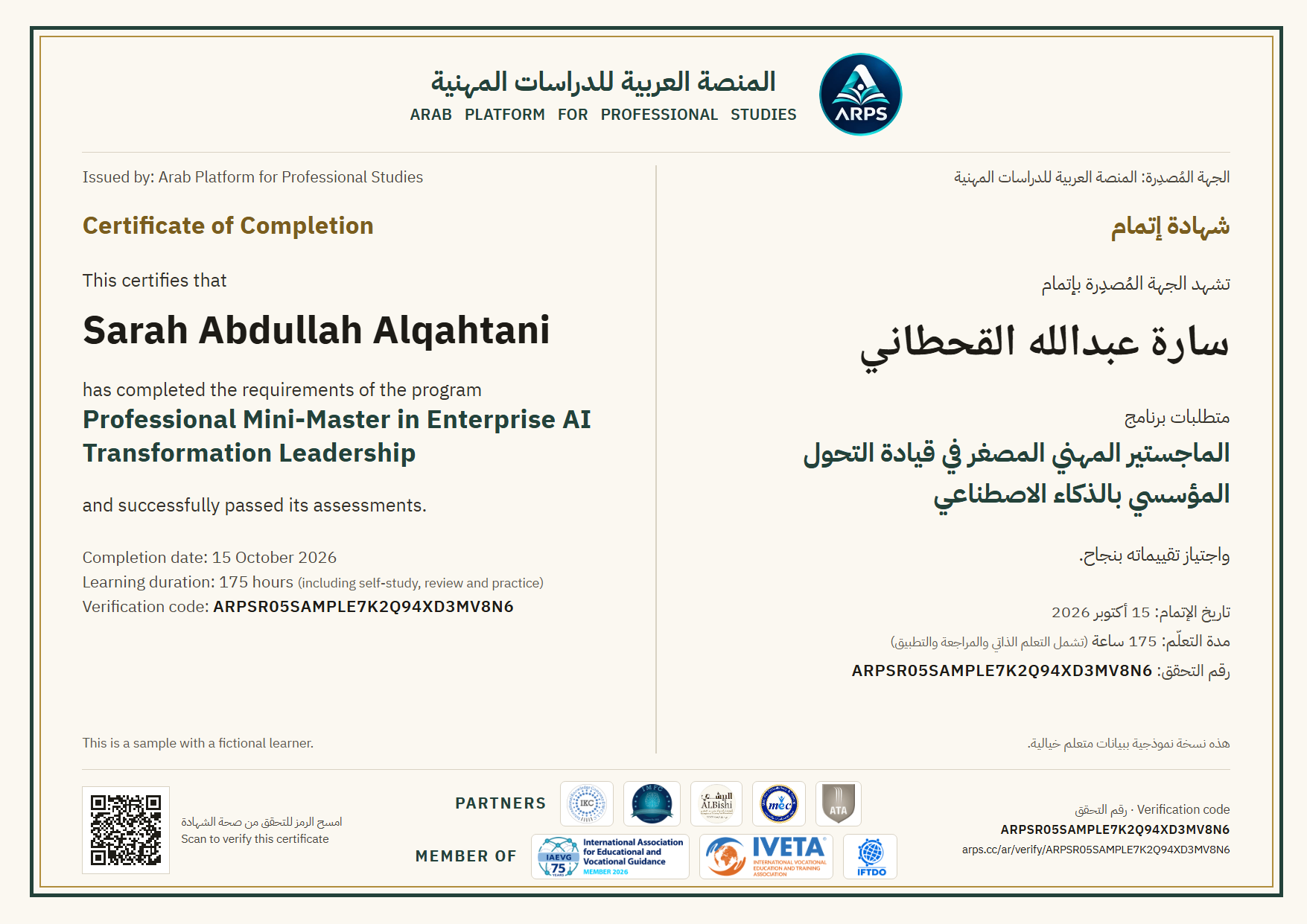
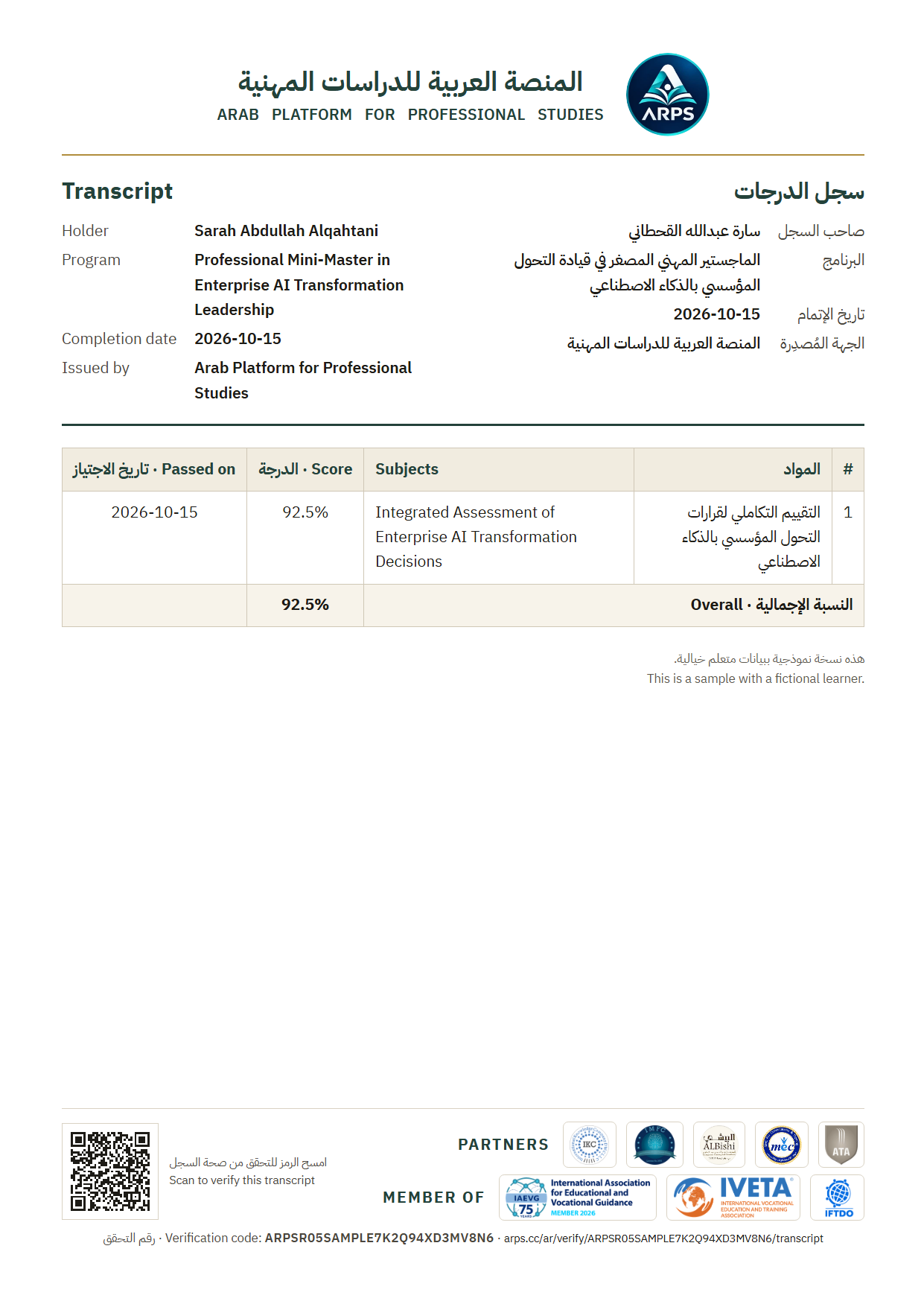
A sample from a real program in this track: Professional Mini-Master in Enterprise AI Transformation Leadership. The learner, scores and dates are fictional; opens in a new window.
Practise the fleet decision cycle: vehicle and demand records, safe assignment, maintenance and defects, journey risk, cost and performance review. Each module produces an inspectable register, calculation or memo from fictional cases.
An applied short diploma on airport capacity, service, revenue and coordination decisions. Five subjects and a capstone combine worked examples, exercises and bilingual fictional operating scenarios.
6 subjects
25 lessons
77 hours
Free
Professional Mini-Master
Career Development, Personal Skills & Productivity
An honest note: the professional mini-master is an intensive professional program; it is not an academic degree or a licence and is not equivalent to a university master's or MBA. The optional ARPS certificate is a training completion certificate showing you passed the program's assessments.