Short Diploma in Aviation Business and Airport Management
Short Diploma in Aviation Business and Airport Management is a free program on ARPS, the Arab Platform for Professional Studies. An applied short diploma on airport capacity, service, revenue and coordination decisions. Five subjects and a capstone combine worked examples, exercises and bilingual fictional operating scenarios.
Important notice: Independent education; not a university degree, aviation operating licence or endorsement by cited organizations.
Distinguish passenger, movement, freight and airline metrics in demand analysis.
Calculate passenger events and distinct people in a defined transfer case.
Identify missing data before sizing a processing point.
From lesson 1, readable now without an account: Value Chain, Stakeholders and Decision Rights
Imagine a flight arriving on time while its passengers wait a long time for bags.“The airport was late” is too broad to locate the fault: the journey is delivered by several organizations. The airport operator manages shared facilities such as the terminal, gates and apron under local arrangements. The airline sets its schedule and carries passengers; a contracted ground handler may service the aircraft and move bags. Air navigation, security and border agencies also have distinct powers that vary by country. The first management task is to map the service journey and ask at which handoff information, a bag or responsibility moved from one party to another.
A free account saves your progress and takes you straight to lesson 1.
Program facts
Study fee
Free
subjects
6
lessons
25
Estimated time
77 hours
Content last reviewed
Access period
60 days
Study language
Arabic and English
About the program
From aircraft arrival to the passenger journey, service depends on connected decisions by airport operators, airlines, handlers and public authorities. The program begins with value chains and traffic, revenue and cost measures, then examines runway, stand and terminal capacity and staged investment.
The third subject traces resource allocation, baggage and passenger experience. The fourth considers coordination, risk and disruption within safety and authority boundaries. The fifth connects performance and financial evidence to conditional decisions, distinguishing what figures show from what they cannot show. A capstone then covers handing over a terminal extension during live service. Cases and numbers are fictional teaching devices, not evidence about a particular airport or a substitute for approved operational training.
Practical relevance
Flow maps, capacity arithmetic and financial comparisons can be used in training cases and preliminary analysis within your role. Real decisions require local data, approved procedures and appropriate authority.
Why this program
A late flight or crowded terminal can appear to be one problem even though causes and decisions cross organizations and facilities. This program provides a way to map flows, choose meaningful denominators and compare options before judging.
Career relevance
Relevant to learners interested in airport services, aviation business, operating coordination and performance analysis. It builds a professional vocabulary for decisions and metrics; it promises neither employment nor qualification for a regulated operating role.
Career paths this program serves
This program is a step on the paths of the following occupations. Open a path to see its other programs in study order.
Map the aviation service chain and distinguish stakeholder decision rights.
Interpret demand, traffic, revenue and cost measures without mixing denominators.
Estimate capacity bottlenecks and compare staged allocation or investment options.
Diagnose baggage and resource flows and passenger experience using clear measures.
Coordinate risk and disruption response and escalation within authority.
Show all (7)
Make an integrated management decision that states assumptions and evidence limits.
Apply the program in a capstone on handing over a terminal extension during live service: work phasing, data recovery, conditional bid comparison and staged handover.
Learning outcomes (5)
Analyze aviation stakeholders, demand metrics, revenue and cost while distinguishing decision boundaries.
Estimate capacity constraints and interpret staged infrastructure and allocation options.
Diagnose operational flows and passenger experience using appropriate service evidence.
Coordinate stakeholders and respond to risk and disruption within safety procedures and authority.
Compare financial and operational performance and make a decision conditional on assumptions and constraints.
Who it is for
For learners and early career professionals seeking aviation business and airport management through service, capacity and performance decisions.
Relevant to airport operator, airline, ground-handling and commercial-service staff, plus planning, analysis and passenger-experience coordinators needing a shared vocabulary.
People moving from other service sectors can start without advanced aviation experience. It does not qualify air traffic controllers or grant licensed operating authority.
Prerequisites
No prior airport employment or advanced aviation experience is required; stakeholders, services and traffic measures are introduced before decision exercises.
Read simple tables, calculate percentages, multiply, divide and add minutes, while distinguishing observed figures from assumptions.
Use text or an ordinary calculator for exercises. No specialist software or real organizational data is needed; actual workplace use follows local procedures.
What it does not offer
This is not a route to operating, safety or air traffic credentials.
It does not replace local airport procedures or regulator and site training.
Connect service flow to stakeholders, decisions, demand, revenue and cost measures.
4 lessons · 5.5 hours
Value Chain, Stakeholders and Decision Rights2 hours
Demand, Networks and Traffic Types2 hours
Aeronautical and Non-aeronautical Revenue2 hours
Costs, Investment and Trade-offs2 hours
Subject 2
Capacity and Infrastructure Planning
Examine bottlenecks, capacity and staged resource or investment choices.
4 lessons · 5.5 hours
Demand Forecasting and Design Day2 hours
Runway, Apron and Gate Capacity2 hours
Terminal Capacity and Queues2 hours
Master Plan and Phased Expansion2 hours
Subject 3
Airport Operations and Passenger Experience
Trace the journey from resource allocation to baggage, complaints and experience measures.
4 lessons · 5.5 hours
Passenger Journey and Service Handoffs2 hours
Turnaround and Disruption Response2 hours
Baggage Flow and Recovery2 hours
Accessibility and Experience Measurement2 hours
Subject 4
Coordination, Safety and Continuity
Test coordination, risk and disruption response within safety authority.
4 lessons · 5.5 hours
Stakeholder Coordination and Information2 hours
Operational Risk and Reporting2 hours
Congestion and Airport Slots2 hours
Resilience and Continuity Plan2 hours
Subject 5
Financial Management, Performance and Integrated Decisions
Connect financial and operating measures to a justified, reviewable decision.
4 lessons · 5.5 hours
Operating Budget and Unit Economics2 hours
Airport Charges and Transparency2 hours
Performance Dashboard and Service Measures2 hours
Integrated Airport Service Decision2.5 hours
Subject 6
Capstone: Handover of a Terminal Extension during Live Service
A capstone that builds a handover file for a fictional terminal extension during live service, from fixing scope and reconciling records to work phasing, equipment acceptance and a closure memorandum.
5 lessons · 29 hours
Defining Project Scope and Reconciling the Service Ledger6 hours
Work Phasing and Service Team Coverage6 hours
Data Recovery and Handover from the Fallback Channel6 hours
Equipment Acceptance and Conditional Bid Comparison6 hours
Staged Handover Exercise and Closure Memorandum6 hours
Subjects unlock in sequence as you progress.
Strengths
Worked cases connect capacity, flow and passenger experience to responsibility boundaries.
Simple calculations identify denominator, assumption and limitation before a decision.
Guided exercises and subject assessments are distinct from lesson checks.
Five integrated revision summaries with links to primary institutional sources.
Evidence basis
Concepts draw on inspected public ICAO, IATA and ACI World pages and documents; cases and questions were originally authored for learning. Citation does not mean institutional endorsement or access to a complete paid manual.
Reference organizations
ICAO
IATA
ACI World
Methodology
Applied learning through original fictional cases, guided exercises, checks and summative questions. Links, calculations and both languages received self-review; this is not review by cited organizations or psychometric testing with learners.
How the route works
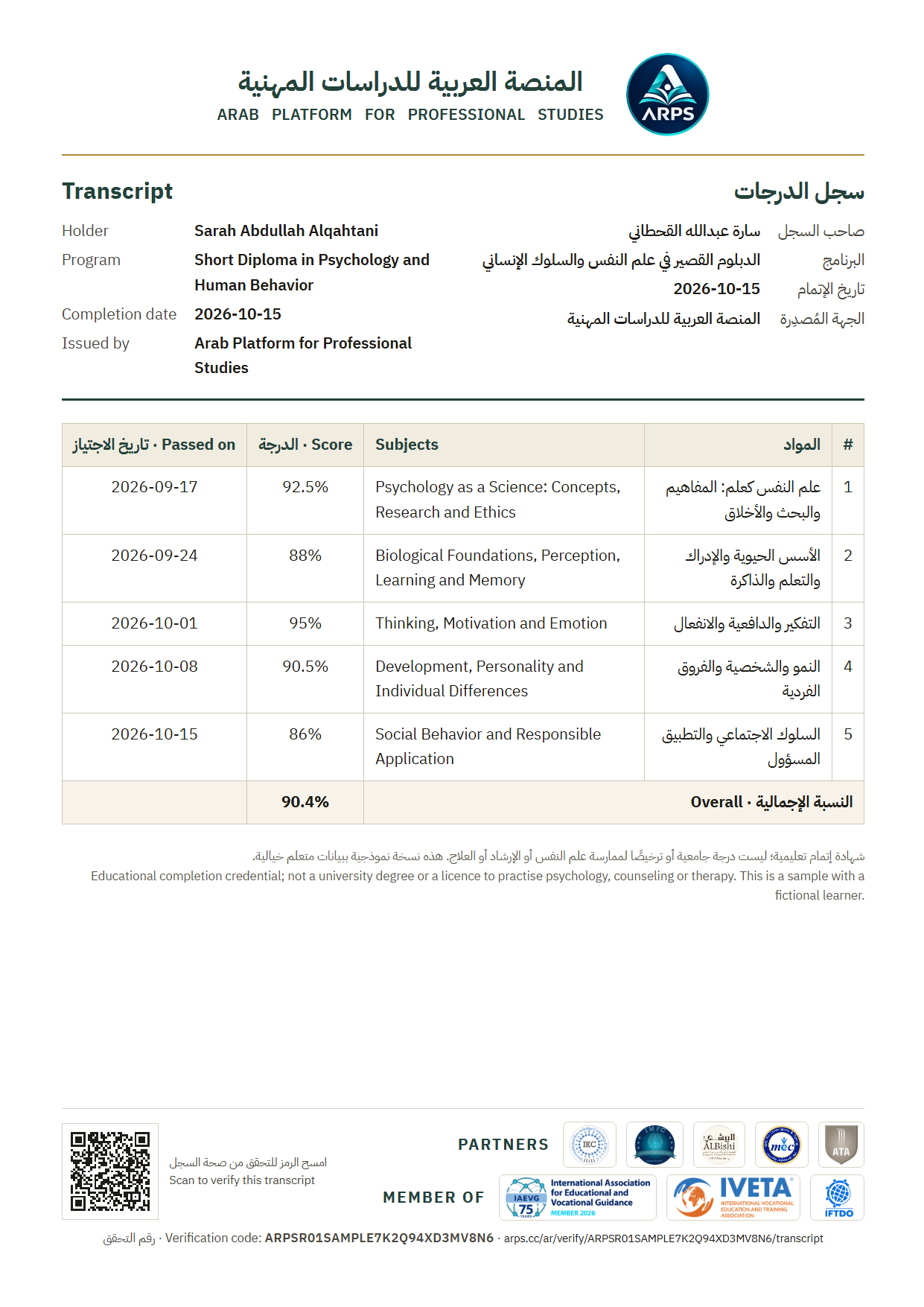
Short Diplomas are relatively comprehensive learning pathways that cover a major subject through five connected learning subjects and structured assessments, with a diploma transcript available with the credential.
Self-paced sequential study. Content unlocks progressively and each subject combines reading, examples, exercises, knowledge checks, and assessment.
Build integrated knowledge in a major subject.
Study through five clear, connected learning subjects.
Complete a defined assessment for each subject.
Receive a diploma transcript showing subjects and results when the credential is issued.
Assessment
Each Short Diploma contains five subjects, each with an approved assessment. A sixth final exam is not required when the five assessments adequately cover the learning outcomes.
Assessment attempts: 2 per assessment, 7 days apart
The pass mark is announced before the program is published.
Certificate
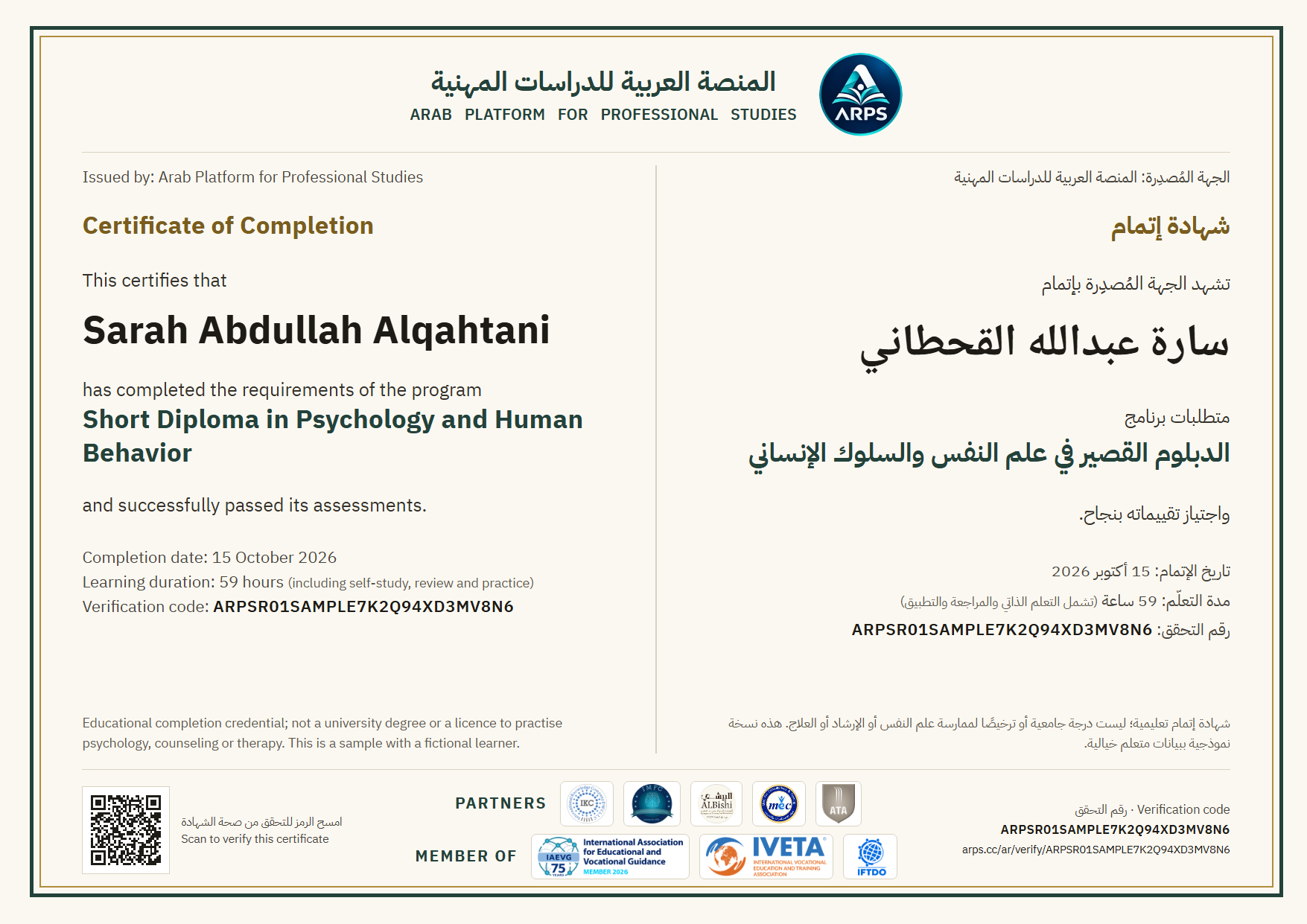
Successful completion makes the learner eligible for the Short Diploma certificate and Diploma Transcript under the credential policy.
A sample from a real program in this track: Short Diploma in Psychology and Human Behavior. The learner, scores and dates are fictional; opens in a new window.
Disclaimer: Training completion, not a university degree, professional licence or authority to operate an airport or aircraft.
Program questions
Will this qualify me for air traffic control or piloting?
No. It teaches business, management and service decisions and grants no aircraft or air traffic operating licence or training.
Do I need airport experience?
Advanced experience is not required. Traffic, capacity and simple calculations are explained in the lessons.
Are the case numbers from a real airport?
Teaching case numbers are explicitly fictional. They train reasoning and do not represent an airport or airline.
Does it cover the rules of a particular country?
No. Cases are general; contracts, procedures and authorities vary by country and airport. Consult local rules for real use.
How is learning assessed?
Each lesson includes a short check and each subject has a summative assessment from a separate bank, alongside exercises with guided answers.
Show all (8)
Is the credential endorsed by ICAO, IATA or ACI?
No. Citing their sources for learning does not imply sponsorship, endorsement or licensing.
Is Short Diploma in Aviation Business and Airport Management free, and do I get a certificate?
Yes. Short Diploma in Aviation Business and Airport Management is free on ARPS: every lesson, exercise and assessment is free, the first subject is open to read without an account, and the program is available in Arabic and English. Issuing a certificate is optional and has a published fee; it is a training completion certificate showing you passed the program's assessments, recognised by most private-sector organisations in the Gulf states and most Arab countries, and it strengthens your CV; confirming that a specific organisation accepts it remains your responsibility.
What other names is Short Diploma in Aviation Business and Airport Management known by?
The subject of this program is also known as: airport management, aviation management, aviation business, airport operations. Learners usually find it by searching for: airport management course, airport management course online, aviation management course free, airport operations training, how to work in airport management.
An applied introduction to the ship and cargo journey through a port: actors, berth windows, capacity, documents, safety boundaries, customer service and performance. Work through fictional cases with data, decisions and checkable outputs. This is a completion diploma, not a professional license.
Practise the fleet decision cycle: vehicle and demand records, safe assignment, maintenance and defects, journey risk, cost and performance review. Each module produces an inspectable register, calculation or memo from fictional cases.
This short diploma connects market-research design with consumer-behavior interpretation and evidence-bounded decisions. Six subjects progress from the research question through sampling, measurement, analysis, choice journeys, testing, and recommendation, ending with an applied market-research capstone.