Short Diploma in Maritime and Port Management is a free program on ARPS, the Arab Platform for Professional Studies. An applied introduction to the ship and cargo journey through a port: actors, berth windows, capacity, documents, safety boundaries, customer service and performance. Work through fictional cases with data, decisions and checkable outputs.
Important notice: Educational completion diploma; no professional licence or navigational or public-control authority.
Construct an actor-and-handoff map for a container vessel call, separating commercial promises, terminal handling, port coordination and public-authority clearance.
From lesson 1, readable now without an account: Service chain and call actors
A consignee asks why a container has not left the port although the ship reached the waiting area. Arrival is one event in a longer chain. The vessel may have a berth window while its discharge plan is incomplete, the cargo data have not reached the relevant authority, or the consignee has not arranged a landside pickup. To explain the delay, ask which step comes next, who can complete it, and what evidence shows completion. We will use a handoff map: a record of each transfer between actors, its required input, decision, output and time. It prevents a location update from being mistaken for permission to release cargo.
A free account saves your progress and takes you straight to lesson 1.
Program facts
Study fee
Free
subjects
6
lessons
24
Estimated time
71.5 hours
Content last reviewed
Access period
60 days
Study language
Arabic and English
About the program
Six subjects move from actor and data handoffs to vessel-call, handling and yard planning, then document and digital-message reconciliation, safety and service boundaries, and performance improvement, ending in an integrated port-call project. You produce timelines, calculation sheets, exception records and customer updates from supplied data. You learn why a confirmed discharge is different from public release and a gate slot. Each subject has its own summative assessment and result on the diploma transcript. Regional examples are fictional and do not state actual local rules or port performance.
Practical relevance
Each lesson leaves a visible work product: handoff map, timeline, capacity calculation, document comparison or improvement brief. Worked solutions and criteria let you check your reasoning without access to a real company's records or a live port system.
Why this program
The diploma connects carrier, agent, port body, terminal and public authority in one cargo journey instead of treating their jobs in isolation. It suits a new coordinator who needs to calculate time and capacity, reconcile records and direct unanswered questions to the right decision owner.
Career relevance
Useful foundational knowledge for shipping offices, freight services, port administration, customer service and entry-level analysis. It provides bounded educational practice, not eligibility for a particular position or authority to classify dangerous goods, direct navigation or make a public-control decision.
Career paths this program serves
This program is a step on the paths of the following occupations. Open a path to see its other programs in study order.
Map carrier, agent, port, terminal and authority roles along a cargo journey
Calculate berth waiting, handling capacity, average yard occupancy and gate schedules
Reconcile booking, transport and arrival-data versions and manage exceptions
Distinguish VGM and special-cargo information from authorized safety decisions
Interpret performance measures and recommend a bounded improvement with evidence
Manage an integrated port call from conflicting sources and a resource plan to a decision meeting and impact review
Learning outcomes (20)
The learner can construct an actor-and-handoff map for a container vessel call, separating commercial promises, terminal handling, port coordination and public-authority clearance.
The learner can construct a dated vessel-call event chain and distinguish estimated, confirmed and completed milestones.
The learner can translate a booking mix into a cargo-flow map without treating TEU, physical containers, moves and tonnes as interchangeable.
The learner can compare port governance responsibilities and design a service handoff that does not confuse infrastructure stewardship, commercial operation and public control.
The learner can draft a feasible berth-window plan from arrival, service, tide or draft restriction, and departure prerequisites without claiming navigational authority.
The learner can estimate handling time from move count, crane productivity and availability while distinguishing theoretical, planned and observed capacity.
The learner can estimate yard occupancy and gate demand from arrivals, dwell-time assumptions and appointment distribution without treating an average as a peak guarantee.
The learner can replan a vessel call after a bounded disruption, compare feasible options and issue a versioned update that preserves safety and customer uncertainty.
The learner can check consistency among booking, shipping instruction, transport document and delivery-order data without asserting that one document alone grants public clearance.
The learner can prepare an arrival-data checklist and separate submission, acknowledgement and authority decision states.
The learner can design a minimal reusable data map for a maritime single-window exchange, identifying owner, version, permitted recipient and correction path.
The learner can prioritize document and data exceptions by consequence, owner and evidence, then close them without erasing the original record.
The learner can identify a missing or inconsistent verified gross mass before loading and route correction without treating a declared weight as verified or a VGM as a loading guarantee.
The learner can recognize a dangerous-goods information gap and escalate it to qualified parties without assigning classification, stowage or emergency-response decisions to administrators.
The learner can respond to a customer complaint with an evidence-based status, responsible next step and update time without disclosing unsupported causes or promising clearance.
The learner can reconcile a port-service invoice to an agreed rate schedule and event record, separating arithmetic from contractual interpretation.
The learner can calculate and compare vessel waiting, turnaround and container dwell with explicit start/end events and data coverage.
The learner can build a segmented service dashboard with consistent denominators and identify when an aggregate hides a group deterioration.
The learner can diagnose a port-flow bottleneck by separating observed symptom, competing explanations, discriminating evidence and reversible first response.
The learner can synthesize a cross-functional port-call improvement brief from timeline, cargo, data, safety and service evidence with a bounded test and follow-up indicator.
Who it is for
New coordinators with carriers, agents and freight providers who handle voyage and cargo updates without making safety or public-control decisions. Customer-service staff benefit when they must answer after discharge is confirmed but exit remains open.
Entry-level port analysts and transport learners who want to connect ETA, crane moves, container dwell and gate appointments to workflow. It does not suit someone seeking advanced qualification for licensed navigational, engineering or legal tasks.
Prerequisites
You should be able to add, subtract and divide, read clock times and calculate across midnight. Familiarity with a shipment booking helps, but maritime terms are explained and previous port employment is not assumed.
Make small tables on paper or in a spreadsheet to compare times, box lists and charges. You need no employer account, live port system, navigational license or specialist legal knowledge. Exercise data are supplied.
What it does not offer
People seeking authorization to navigate a ship, operate cranes, classify dangerous goods or issue public clearance.
People needing interpretation of a specific local concession or transport contract, or an external professional credential.
This subject follows a vessel and its containers through handoffs. The carrier and agent communicate voyage and cargo data; a port body coordinates infrastructure; the terminal confirms handling and gate events; and a competent authority decides public-control requirements. A handoff map records inputs, decision owners
4 lessons · 10.5 hours
Service chain and call actors2.5 hours
Vessel-call sequence and times2.5 hours
Cargo measures and flows2.5 hours
Port governance and service responsibility3.5 hours
Subject 2
Vessel-call and capacity planning
Vessel-call planning begins with a confirmed event and the constraint preceding the next step. A berth window depends on arrival, berth availability and the earliest permitted service time, followed by preparation, handling and clearance; a schedule does not make a navigational decision. Estimate handling by
4 lessons · 10 hours
Berth-window dependencies2.5 hours
Handling capacity and crane availability2.5 hours
Yard dwell and gate appointments2.5 hours
Replanning after disruption3 hours
Subject 3
Documents and digital flows
Booking, shipping instructions, a transport document and a commercial delivery order perform different jobs. A document image alone does not prove transferable control or public release. Reconcile voyage, box and party identifiers using dated versions, and return correction to the authorized issuer. For arrival data,
4 lessons · 10 hours
Reconciling shipment documents2.5 hours
Arrival-data states2.5 hours
Single-window data reuse2.5 hours
Exception tracking and closure3 hours
Subject 4
Safety, service and accountability
Service management requires a clear boundary between a coordinator's information and the competent person's decision. Verified gross mass is a data prerequisite for loading a packed container under the applicable SOLAS rule, not a loading promise; an approximate emailed weight does not become VGM by
4 lessons · 10 hours
Verified gross mass2.5 hours
Dangerous-goods information boundaries2.5 hours
Customer communication during disruption2.5 hours
Reconciling service charges3 hours
Subject 5
Performance and integrated improvement
A useful metric starts by defining its start and end events. Berth wait differs from total vessel turnaround, while box dwell measures another population. Calculate each call before choosing mean or median, and disclose a missing timestamp rather than replacing it with zero. When comparing
4 lessons · 10 hours
Defining waiting and turnaround2.5 hours
Denominators and segmented dashboards2.5 hours
Diagnosing flow bottlenecks2.5 hours
Integrated port-call improvement brief3 hours
Subject 6
Integrated port-call operations project
The capstone integrates the diploma's skills in a training port call: a file with conflicting sources, a resource plan that withstands late information, a multi-party decision meeting simulation, and project handover with a pilot impact review.
4 lessons · 11.5 hours
A training call file with conflicting sources3 hours
A resource plan that withstands late information3 hours
Simulating a decision meeting across parties3 hours
Project handover and pilot impact review3 hours
Subjects unlock in sequence as you progress.
Strengths
Six assessed subjects connect ship and cargo from booking to gate
Numerical and document cases include worked answers
Clear boundary between administrative coordination and authorized decisions
One subject summative and result for each transcript entry
Evidence basis
Port governance and performance draw on World Bank and UNCTAD sources. IMO pages support data exchange, VGM and dangerous-goods boundaries; ICC and UNCITRAL support transport-document discussion. Regional cases use fictional training figures.
Reference organizations
World Bank
UNCTAD
IMO
ICC
UNCITRAL
Methodology
Original explanations, solved fictional cases, observable exercises and bilingual questions; assisted self-review does not imply source endorsement or learner testing.
How the route works
Short Diplomas are relatively comprehensive learning pathways that cover a major subject through five connected learning subjects and structured assessments, with a diploma transcript available with the credential.
Self-paced sequential study. Content unlocks progressively and each subject combines reading, examples, exercises, knowledge checks, and assessment.
Build integrated knowledge in a major subject.
Study through five clear, connected learning subjects.
Complete a defined assessment for each subject.
Receive a diploma transcript showing subjects and results when the credential is issued.
Assessment
Each Short Diploma contains five subjects, each with an approved assessment. A sixth final exam is not required when the five assessments adequately cover the learning outcomes.
Assessment attempts: 2 per assessment, 7 days apart
The pass mark is announced before the program is published.
Certificate
Successful completion makes the learner eligible for the Short Diploma certificate and Diploma Transcript under the credential policy.
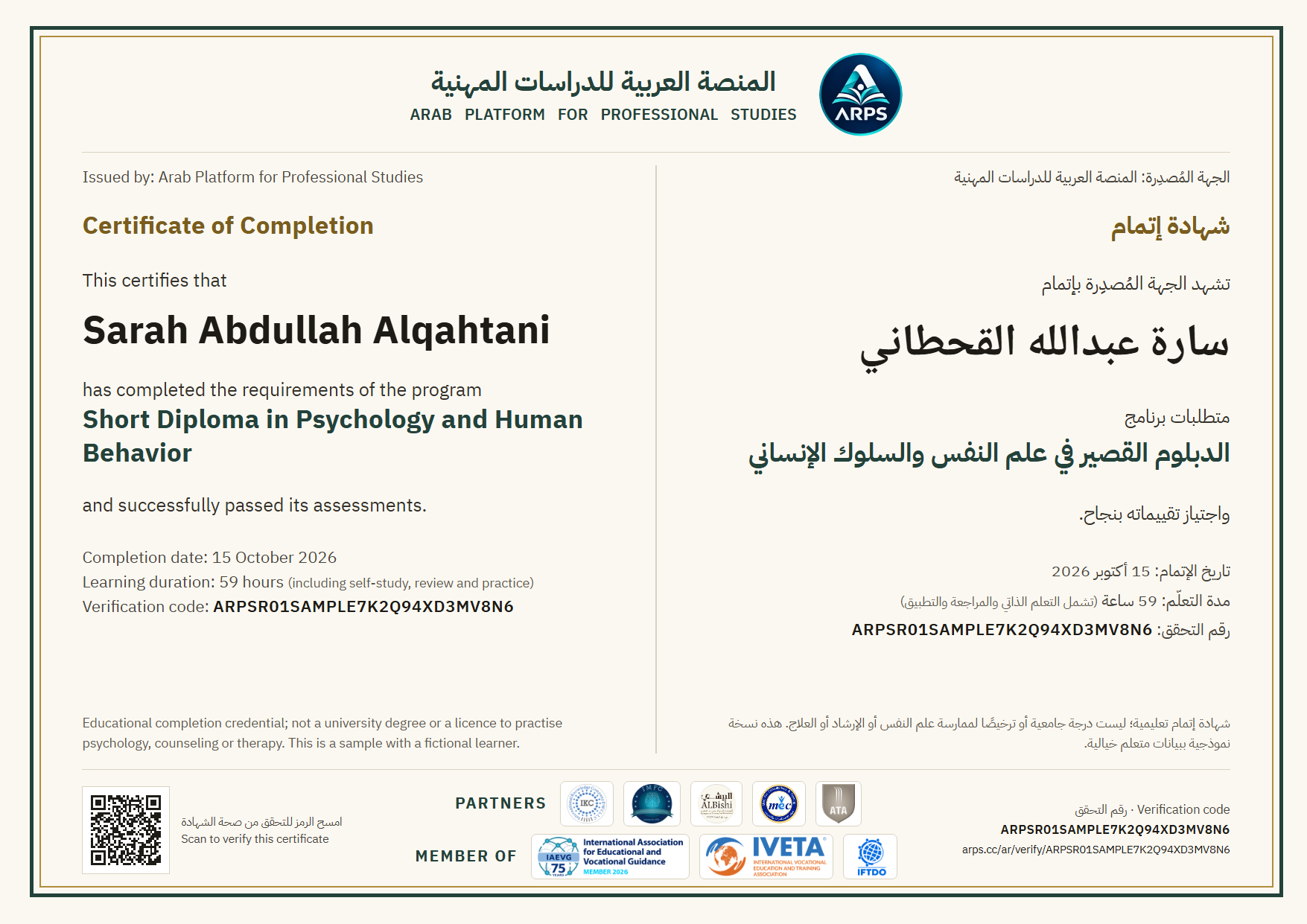
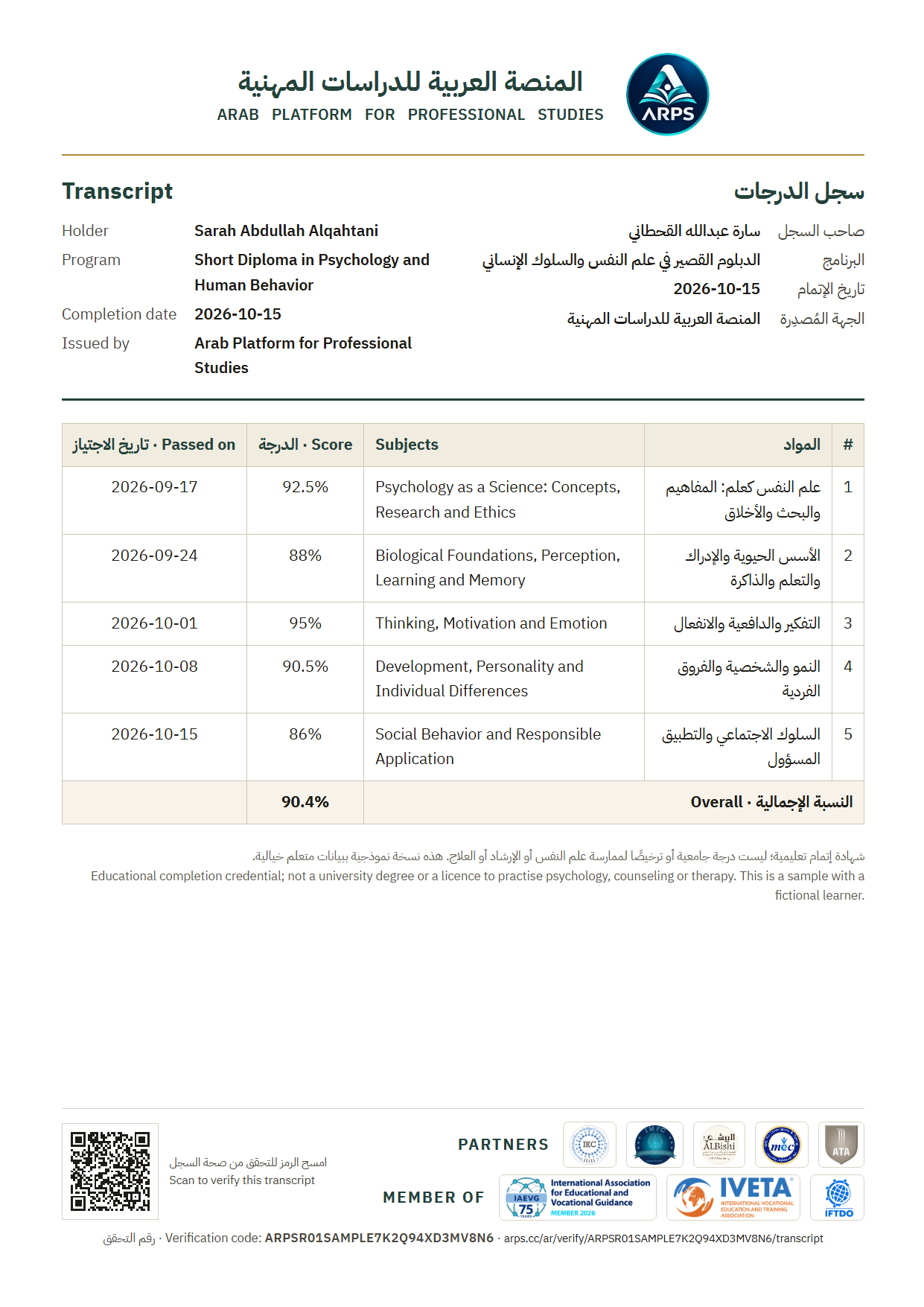
A sample from a real program in this track: Short Diploma in Psychology and Human Behavior. The learner, scores and dates are fictional; opens in a new window.
Disclaimer: A learning-completion diploma, not a navigational, operational or legal practice licence.
Program questions
Does the diploma grant a port-work license?
No. It is an educational completion diploma for bounded administrative understanding and does not authorize navigational, technical or public-control decisions.
Do I need maritime experience?
No advanced experience is assumed. Basic arithmetic and reading a simple timetable are enough to begin, and new terms are explained in lessons.
Are the Arab port examples real operating data?
No. Named cities provide fictional settings and the figures do not describe their actual performance or local law.
How is completion assessed?
Each subject has a separate summative assessment, and subject results appear on the diploma transcript under the route policy.
What are the study and access periods?
The route has a nominal 30-day study period and a 60-day access window. Activity minutes are editorial estimates for one pass, not accredited hours.
Show all (7)
Is Short Diploma in Maritime and Port Management free, and do I get a certificate?
Yes. Short Diploma in Maritime and Port Management is free on ARPS: every lesson, exercise and assessment is free, the first subject is open to read without an account, and the program is available in Arabic and English. Issuing a certificate is optional and has a published fee; it is a training completion certificate showing you passed the program's assessments, recognised by most private-sector organisations in the Gulf states and most Arab countries, and it strengthens your CV; confirming that a specific organisation accepts it remains your responsibility.
What other names is Short Diploma in Maritime and Port Management known by?
The subject of this program is also known as: port management, maritime management, shipping and port management, maritime transport. Learners usually find it by searching for: port management course, port management courses online free, maritime and port management course, shipping management course, port operations management.
An applied short diploma on airport capacity, service, revenue and coordination decisions. Five subjects and a capstone combine worked examples, exercises and bilingual fictional operating scenarios.
Practise the fleet decision cycle: vehicle and demand records, safe assignment, maintenance and defects, journey risk, cost and performance review. Each module produces an inspectable register, calculation or memo from fictional cases.
This short diploma connects market-research design with consumer-behavior interpretation and evidence-bounded decisions. Six subjects progress from the research question through sampling, measurement, analysis, choice journeys, testing, and recommendation, ending with an applied market-research capstone.