Specialist Preparation Program in Fleet Management
Specialist Preparation Program in Fleet Management is a free program on ARPS, the Arab Platform for Professional Studies. Practise the fleet decision cycle: vehicle and demand records, safe assignment, maintenance and defects, journey risk, cost and performance review. Each module produces an inspectable register, calculation or memo from fictional cases.
Create an auditable asset register and exception list from conflicting exports
From lesson 1, readable now without an account: Reconcile the vehicle register before planning
A fleet decision begins by defining the unit of analysis: one physical vehicle with a stable identifier, not one spreadsheet row or a plate number that may change. When merging dispatch and workshop exports, use a documented vehicle identification number or asset ID as the primary key, while retaining the plate and operating number as updateable fields. Two rows do not mean two vehicles if they share that key. Conversely, similar models or missing plates are not sufficient grounds to merge different vehicles. A usable register records vehicle class, capacity, odometer, availability status, observation date and source. These fields support a review of actual use and suitability: the job can be compared with the vehicle's size, distance and fuel use. Before calculating a fleet measure, count unique vehicles, distinguish active from out of service, and attach a date to each value. An uncertain value remains an exception with an owner and due date; it must not silently become zero or an estimate in a report.
A free account saves your progress and takes you straight to lesson 1.
Program facts
Study fee
Free
subjects
9
lessons
36
Estimated time
53 hours
Content last reviewed
Access period
30 days
Study language
Arabic and English
About the program
Begin by reconciling vehicle records and demand sources instead of relying on mismatched spreadsheet rows. Turn a request into payload, equipment and time constraints; test vehicle and driver eligibility and build a journey schedule that can be explained. Next, link planned maintenance to odometer and date, distinguish an open defect report from dispatch status, and verify repair before release.
Read incident and telematics evidence within its limits and specify a corrective action with an effectiveness test. Reconcile fuel, distance and cost; compare retention, replacement and technology options over a stated horizon and assumptions. Build a scorecard and decision memo linking each recommendation to evidence, unknowns and an authorised owner. Later modules add control of operating partners and spare parts, depot readiness and shift handover, and a capstone that opens a fleet for a new distribution centre. All training cases are fictional. Real fleet decisions require the organisation’s procedures, vehicle plans and current local requirements.
Practical relevance
Produce an asset and exception register, demand and assignment schedule, maintenance and release list, incident and corrective-action record, cost comparison, and final decision scorecard. Every exercise has inputs, a solution and review criteria. No real fleet data are needed.
Why this program
A vehicle can fit the load yet fail an open defect or delivery window. The program teaches you to keep constraints separate and order correction and escalation, so a good average or an “available” label cannot conceal a specific operational risk.
Career paths this program serves
This program is a step on the paths of the following occupations. Open a path to see its other programs in study order.
Build a trustworthy asset and duty profile from inconsistent fleet records.
Assign vehicles and journeys using capacity, suitability, availability and safety constraints.
Schedule and triage preventive maintenance and defects with auditable release decisions.
Manage driver and journey risk, incidents and corrective actions without replacing local legal advice.
Calculate normalized cost, energy and utilization measures and compare replacement options.
Show all (9)
Produce an evidence based fleet review, action register and escalation briefing.
Control operating partners and resources by admitting contractor vehicles, setting critical spare-parts stock and sharing standby vehicles between two depots.
Manage depot readiness by scheduling charging within a power limit, piloting a new service before expansion and handing over a shift during a communication outage.
Prepare a fleet operating dossier for a new distribution centre, from service boundaries and yard testing to a simulated live day and a thirty-day handover plan.
Learning outcomes (9)
Build a trustworthy asset and duty profile from inconsistent fleet records.
Assign vehicles and journeys using capacity, suitability, availability and safety constraints.
Schedule and triage preventive maintenance and defects with auditable release decisions.
Manage driver and journey risk, incidents and corrective actions without replacing local legal advice.
Calculate normalized cost, energy and utilization measures and compare replacement options.
Produce an evidence based fleet review, action register and escalation briefing.
Produce a documented decision dossier for control operating partners and resources with checked alternatives and authority boundaries.
Produce a documented decision dossier for depot readiness, variation and shift handover with checked alternatives and authority boundaries.
Produce a documented decision dossier for capstone: operate a new distribution-centre fleet with checked alternatives and authority boundaries.
Who it is for
Designed for fleet coordinators, dispatch supervisors, maintenance planners and operations analysts working with vehicle, trip and cost records. It suits staff preparing operational recommendations for an authorised decision owner who need to distinguish evidence from unresolved facts or required approvals. The fictional cases do not confer driving, technical inspection or safety-approval authority in any real organisation.
Prerequisites
Learners should be comfortable reading a vehicle table, dates and odometer readings, calculating percentages and per-kilometre costs, and comparing an arrival estimate with a service window. Engineering experience or professional licensure is not assumed; lessons explain needed inputs before solving cases. Activities use invented training data. For workplace use, consult the actual vehicle plan, safety procedure, delegated authority and current local requirements.
Fleet management starts with an auditable asset register, not a count of spreadsheet rows.
4 lessons · 4 hours
Reconcile the vehicle register before planning1 hours
Turn trip requests into an assignable duty profile1 hours
Measure vehicle utilization with the right denominator58 min
Data ownership and the exception register1 hours
Subject 2
Vehicle assignment and journeys
Pass each job through independent constraints: payload, equipment, vehicle readiness, driver eligibility and arrival time.
4 lessons · 4.5 hours
Vehicle and driver eligibility matrix for a job1 hours
Schedule a safe journey within service windows1 hours
Reassign work after a journey disruption1 hours
Close a journey against proof of service1 hours
Subject 3
Maintenance and availability
Start maintenance with the vehicle’s own time and odometer plan, including what the next job will add; being below the threshold today is insufficient when tomorrow’s trip crosses it.
4 lessons · 4.5 hours
Build a due-maintenance list1 hours
Triage defect reports and hold a vehicle1 hours
Verify repair closure before release1 hours
Analyze downtime and repeat defects1 hours
Subject 4
Safety and incident control
A safe journey decision combines vehicle condition, route, driver readiness and customer window.
4 lessons · 4.5 hours
Pre-dispatch journey risk decision1 hours
Document an incident or near miss1 hours
A corrective action with an effectiveness test1 hours
Interpret telematics alerts without unfair driver inference1 hours
Subject 5
Cost, energy and asset decisions
Reconcile fuel and distance before calculating a rate: use one measurement period, verify start and end readings, and remove a duplicate receipt by transaction ID without deleting the real fueling.
4 lessons · 4.5 hours
Reconcile fuel and distance1 hours
Operating cost per kilometre without double counting1 hours
Compare retain, replace and shared-capacity options1 hours
Sensitivity in a fleet technology transition1 hours
Subject 6
Operational review and improvement
A useful fleet scorecard names each measure, denominator and period: use of available days differs from availability over all scheduled days.
4 lessons · 4.5 hours
A fleet scorecard with safe denominators1 hours
Interpret a performance trend with a recording fault1 hours
Prioritize an improvement backlog by risk and evidence1 hours
An integrated fleet decision memo1 hours
Subject 7
Control operating partners and resources
This module adds controls for work depending on partners and shared resources. Start with contractor admission based on arriving equipment and site timing, separating loading responsibility from commercial charges. Then distinguish physical, serviceable, reserved and inbound parts and calculate a reorder point with lead-time and obsolescence consequences. Finally, test shared standby across two depots, including attendance, service restoration and simultaneous requests. Outputs are an admission card, inventory worksheet and sharing agreement with priorities and limits. Cases are fictional and arithmetic is reproducible. Equipment and repair suitability stay with qualified specialists while the fleet role prepares evidence, options and decision times. These outputs connect to the operating schedule rather than creating independent promises for each team.
3 lessons · 5.5 hours
Accept a contractor vehicle at the depot2 hours
Set critical spare-parts inventory2 hours
Share standby vehicles between two depots2 hours
Subject 8
Depot readiness, variation and shift handover
Readiness can change outside the vehicle itself. The first lesson balances vehicle energy, site power and departure times, then tests charger faults and session progress. The second designs a new-service pilot with a decision question, representative cases and bounded expansion, distinguishing configuration change from duty mix. The third transfers open-file ownership between shifts during an outage and verifies command effects before repetition. Outputs include an energy schedule, trial card and acknowledged handover/reconciliation log. Every activity supplies a solution and checking criteria. Electrical work and reserved approvals remain under their qualified authorities. Learners connect time, evidence and responsibility so they can identify currently supported operations and the additional action needed before a promise.
3 lessons · 5.5 hours
Schedule charging under a depot power limit2 hours
Pilot a new service before expansion2 hours
Hand over a shift during a communication outage2 hours
Subject 9
Capstone: operate a new distribution-centre fleet
The capstone builds a new distribution-centre dossier from scope to first-month handover. Define service, assumptions and owner approvals, then test yard and pedestrian/vehicle movements. Combine shared resources in an opening schedule and check equipment delay and vehicle-return effects. Run sequential event cards, revising decisions according to information available at each moment. Compare trial outcomes with the plan while reconciling scope changes, cost denominators and service proof. Finish with alternatives, a conditional recommendation and a thirty-day action register with owners, dates and closure criteria. Deliver a complete decision dossier and usable follow-up plan. Fictional practice grants no real operating authority; site, vehicle and service acceptance remain with their designated owners.
6 lessons · 11.5 hours
Project brief and acceptable service boundaries2 hours
Test the depot yard before opening2 hours
Allocate opening-day resources under demand pressure2 hours
Simulate live-day events and revise the plan2 hours
Evaluate the trial and decide service continuation2 hours
Present the depot dossier and transfer a thirty-day plan2 hours
Subjects unlock in sequence as you progress.
Strengths
Reconciled fleet records and explicit performance denominators
Assignment, maintenance and safety matrices that reveal binding constraints
Cost and sensitivity comparisons ending in reviewable decision memos
Evidence basis
General principles draw on original government guidance for vehicle suitability, journeys, maintenance and fleet-cost methodology. Educational examples and calculations are authored for this program; these sources are not presented as universal local law.
Methodology
The program connects vehicle records, demand, journeys, maintenance and cost through recomputable cases and decisions with explicit limits.
Assessment
Assessments follow the program blueprint and may use module assessments, a final assessment, or a combination, under the approved attempt policy.
Assessment attempts: 2 per assessment, 7 days apart
The pass mark is announced before the program is published.
Certificate
The credential confirms completion and successful assessment; it does not represent professional licensure unless explicitly and lawfully stated.
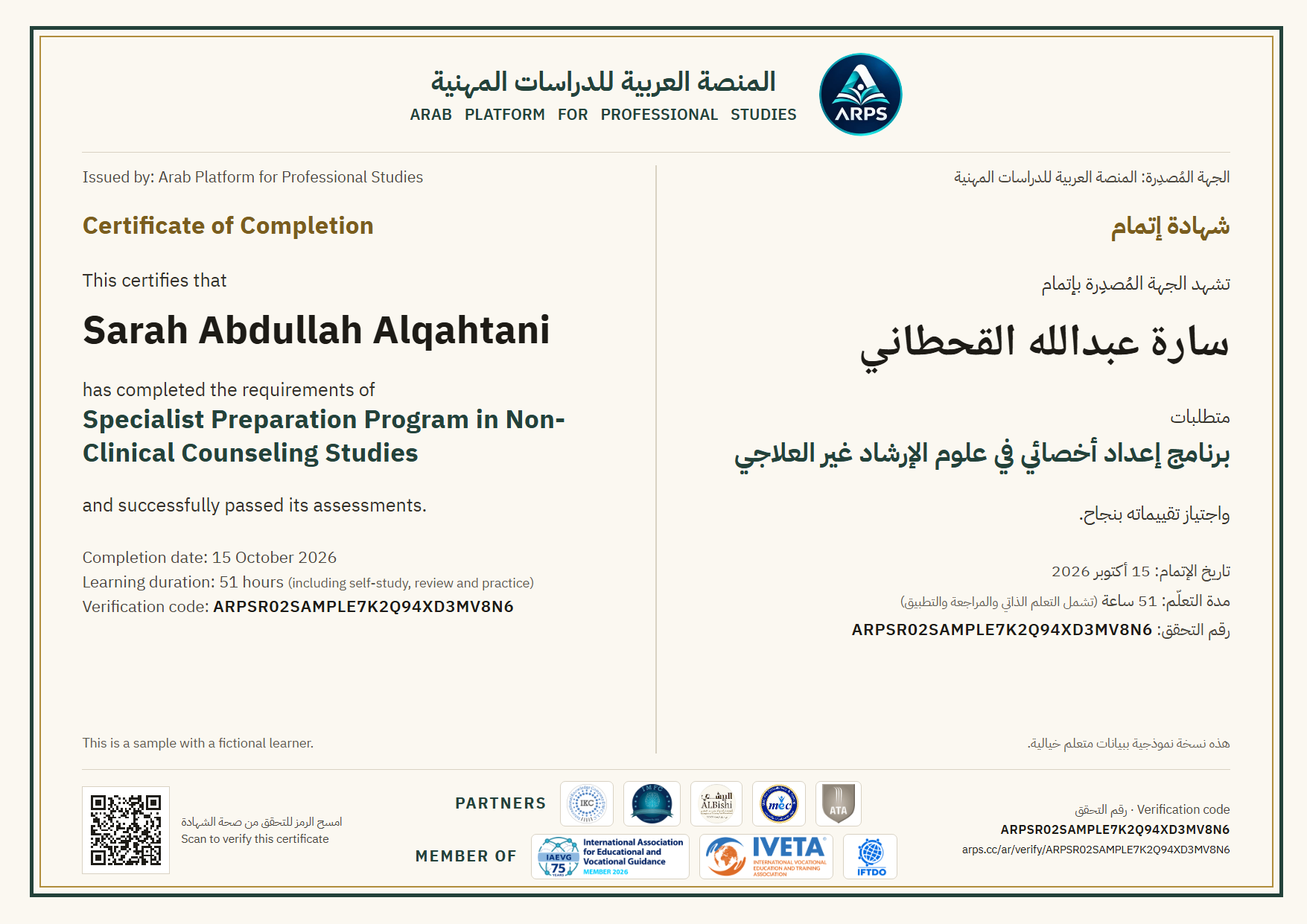
A sample from a real program in this track: Specialist Preparation Program in Non-Clinical Counseling Studies. The learner, scores and dates are fictional; opens in a new window.
No. It prepares bounded specialist tasks and grants no professional licence or authority to approve a vehicle’s safety.
Do exercises require workplace data?
No. Lessons supply complete fictional inputs, solutions and checks. Do not upload real driver or vehicle records for practice.
Will I make an actual vehicle purchase decision?
You practise a conditional comparison for an authorised manager, including service constraints, cost and sensitivity. Real approval requires organisational data and authority.
How is an open safety defect handled?
It remains visible and blocks the relevant release until inspected and closed with evidence under organisational procedure; an available label alone does not clear it.
Do named-city examples state local legal rules?
No. Places are hypothetical settings only; check current local requirements before real application.
Show all (8)
How am I assessed?
Each lesson has a knowledge check and each module a decision-based assessment using case facts, calculations, limits and escalation.
Is Specialist Preparation Program in Fleet Management free, and do I get a certificate?
Yes. Specialist Preparation Program in Fleet Management is free on ARPS: every lesson, exercise and assessment is free, the first subject is open to read without an account, and the program is available in Arabic and English. Issuing a certificate is optional and has a published fee; it is a training completion certificate showing you passed the program's assessments, recognised by most private-sector organisations in the Gulf states and most Arab countries, and it strengthens your CV; confirming that a specific organisation accepts it remains your responsibility.
What other names is Specialist Preparation Program in Fleet Management known by?
The subject of this program is also known as: fleet management, vehicle fleet management, fleet operations. Learners usually find it by searching for: fleet management course, fleet manager training, fleet maintenance management, free fleet management course.
An applied short diploma on airport capacity, service, revenue and coordination decisions. Five subjects and a capstone combine worked examples, exercises and bilingual fictional operating scenarios.
An applied introduction to the ship and cargo journey through a port: actors, berth windows, capacity, documents, safety boundaries, customer service and performance. Work through fictional cases with data, decisions and checkable outputs. This is a completion diploma, not a professional license.
Learn the specialist tasks of innovation management, from an evidenced opportunity to a bounded experiment, decision and operating handover. Produce job aids, evidence logs, calculations and decision briefs using fictional bilingual cases.
Turn software requirements into checkable acceptance conditions and reproducible tests. Record execution and defects, then write an evidence bounded release recommendation. The program covers design, risk, accessibility, authorization, performance and automation.
10 subjects
40 lessons
53.5 hours
Free
Next step: a professional certification or a mini-master
Programs in the same domain that prepare you for an international certification exam or form a professional mini-master, also free.