

From lesson 1, readable now without an account: Classifying a Total Rewards Offer
Program facts
- Study fee
- Free
- subjects
- 7
- lessons
- 26
- Estimated time
- 66.5 hours
- Content last reviewed
- Access period
- 60 days
- Study language
- Arabic and English
About the program
How can a reward mix serve a defined objective without presenting a conditional bonus as guaranteed income or a benefit premium as cash received by an employee? The programme begins with total rewards and job evaluation, then moves to matching jobs with market evidence and calculating salary-range position. It teaches a bounded incentive curve, tests measures for unintended behaviour, and examines benefit cost, eligibility and communication. The final subject separates a descriptive pay difference from its unproved cause and brings components together in a cost model. Every case contains data, a worked route, a learner task and limits. The invented amounts make no claim about a local market. This is an educational completion diploma, not professional authorisation or country-specific legal advice.
Practical relevance
Use the match, range and cost worksheets as thinking models for authorised work only after replacing invented figures with reliable organisational evidence and checking policy, contract and local jurisdiction.
Why this program
Base pay, incentive and benefits appear in one offer but have different cost units and payment conditions. This programme connects them to job evidence, workforce need and budget, then distinguishes what data support from what still needs verification and approval.
Career relevance
Designed for people who contribute to reward analysis or review pay and benefit proposals with HR teams. It builds calculation, questioning and decision-record skills without promising employment, promotion or licensed-practice eligibility.
Career paths this program serves
This program is a step on the paths of the following occupations. Open a path to see its other programs in study order.
What you will learn
- Classify fixed cash, variable opportunity and benefit cost without double counting.
- Evaluate job evidence, match a market benchmark and calculate pay position.
- Test an incentive curve, performance measure and payout pool.
- Model benefit cost and eligibility and compare alternatives.
- Review a pay difference, approval authority and integrated recommendation.
Learning outcomes (26)
- classify an offer's reward elements by what the employee actually receives, then relate the mix to a stated objective without counting a component twice.
- turn a job description into evidence about work requirements before comparing roles, keeping job value distinct from an incumbent's performance.
- apply a published point scale to job evidence, then test a disputed input before proposing a preliminary ranking.
- write a decision brief connecting a workforce objective to costed reward components, with a named decision owner, missing evidence and limits on the conclusion.
- judge whether a benchmark job is fit for a market comparison using duties, scope, pay measure and reference period rather than title alone.
- calculate a median and mean for comparable pay observations and test sensitivity to an extreme value without deleting it merely because its effect is inconvenient.
- calculate position within a job grade's salary range while keeping an arithmetic indicator separate from a decision about an employee.
- recommend base-pay adjustments within a stated ceiling, documenting priorities, the cost denominator and fairness checks before approval.
- separate incentive eligibility, target opportunity and actual payout from base pay using one consistent calculation basis.
- turn a defined performance result into a payout factor under a threshold, target and cap, checking boundary behaviour before communicating an incentive.
- detect unintended behaviour created by an incentive measure, then redefine its numerator, denominator and measurement window to preserve the intended outcome.
- reconcile preliminary incentive amounts with a written plan cap and financial provision, then explain the payout without promising an unapproved sum.
- build a benefits inventory that separates employee need, eligibility, employer cost and usable value to a beneficiary.
- estimate a benefit's cost across take-up scenarios while separating eligible headcount, enrolled users and setup charges.
- compare benefit options under stated criteria and a budget, then test whether the recommendation changes when criterion weights change.
- turn complex benefit terms into a clear notice that distinguishes confirmed facts, conditions and unresolved points, with a route for questions and disputes.
- build a descriptive pay comparison with compatible work and denominator, documenting what a calculated difference cannot establish.
- turn a descriptive pay difference into testable explanations and a specific escalation recommendation without presenting an unproved cause as fact.
- map approval of a reward decision and an out-of-range exception, leaving an audit trail that prevents unauthorised or duplicate implementation.
- combine the five subjects into a bounded, costed reward recommendation that distinguishes guaranteed from conditional value and exposes missing fairness and approval decisions.
- Reconciling eligibility across transfers and working-time changes
- Matching a benefits invoice to the coverage ledger
- Building a capstone ledger from conflicting sources
- Funding alternatives over two years under uncertainty
- Testing a simulated payment cycle before release
- Presenting a committee decision and evaluating its later effect
Who it is for
- The diploma is for early-career HR staff handling pay and benefits, new reward analysts and team managers who review a proposed rise, incentive or cover arrangement. Cases ask for bounded decisions with an approval owner; they do not presume the learner can implement organisational policy independently.
- It also suits learners who want to compare option costs, interpret simple pay data and check an employee message before release. No advanced professional background or attachment to a particular labour market or legal system is required.
Prerequisites
- No advanced experience in compensation and benefits is required. A basic understanding of HR work cycles helps: what a job description, employment contract, salary and benefit eligibility mean. Terms are explained when introduced, and no knowledge of one country's employment law is assumed.
- Learners should be willing to add simple amounts, calculate percentages, read a short table and distinguish an observed fact from an assumption in a training case. Every calculation can be followed step by step without specialist software.
What it does not offer
- Does not grant external accreditation or authority to implement an employer's pay policy without qualified review.
- Does not settle tax or legal rights in any country or replace market research and specialist advice for an individual case.
Curriculum
- Subject 1 Open for free
Reward strategy and job value
Subject 1 applies reward strategy and job value across four distinct skills and worked fictional cases.
4 lessons · 8 hours
- Classifying a Total Rewards Offer 2 hours
- Evidence from Job Descriptions 2 hours
- A Disclosed Point-Factor Comparison 2 hours
- A Bounded Reward Design Brief 2 hours
- Subject 2
Base pay and salary structure
Subject 2 applies base pay and salary structure across four distinct skills and worked fictional cases.
4 lessons · 8 hours
- Selecting a Defensible Market Match 2 hours
- Interpreting a Market Reference 2 hours
- Reading a Salary Range 2 hours
- Costed Pay Adjustments 2 hours
- Subject 3
Variable pay and incentive design
Subject 3 applies variable pay and incentive design across four distinct skills and worked fictional cases.
4 lessons · 7.5 hours
- Incentive Eligibility and Target Opportunity 2 hours
- A Bounded Payout Curve 1.5 hours
- Testing Incentive Measures for Gaming 2 hours
- Reconciling an Incentive Pool 2 hours
- Subject 4
Benefits, cost and employee experience
Subject 4 applies benefits, cost and employee experience across four distinct skills and worked fictional cases.
4 lessons · 7.5 hours
- Benefit Purpose, Eligibility and Cost 2 hours
- Benefit Cost and Take-Up Scenarios 1.5 hours
- Selecting between Benefit Options 2 hours
- Explaining Benefits without False Promises 2 hours
- Subject 5
Fairness, governance and integrated decisions
Subject 5 applies fairness, governance and integrated decisions across four distinct skills and worked fictional cases.
4 lessons · 7.5 hours
- A Compatible Descriptive Pay Comparison 2 hours
- Investigating Rather than Asserting a Cause 2 hours
- Approval and Exception Controls 1.5 hours
- A Costed Total-Reward Recommendation 2 hours
- Subject 6
Eligibility-cycle and provider reconciliations
This subject follows events within a reward cycle rather than relying on a single salary snapshot. You construct a timeline linking transfers, working fraction and incentive target to the effective plan, rebuild opportunity and test overlaps, rounding and later corrections. You then reconcile a benefits invoice by covered population, price and service month, distinguishing earlier credits from current service cost. Fictional cases provide reproducible calculations and two separate exercises per lesson. Outputs are a period ledger and reconciliation note identifying supported facts, unresolved questions and follow-up owners. The tools preserve the distinction between correct arithmetic and approval readiness, while keeping employee promises within the actual governing terms.
2 lessons · 6.5 hours
- Reconciling eligibility across transfers and working-time changes 3.5 hours
- Matching a benefits invoice to the coverage ledger 3.5 hours
- Subject 7
Capstone: closing an integrated reward cycle
This capstone develops a connected project for a fictional eighty-person organisation. First reconcile population, pay and eligibility sources, resolving duplicates and conflicts. Then cost alternatives over two years and test launch timing, price and participation. Next design a simulated payment cycle exposing distribution, date, resubmission and interrupted-receipt errors, retaining its observed results and limits. Finish with a committee note and ninety-day follow-up distinguishing implementation, understanding, use and causal effect. Each stage supplies specified inputs, worked outputs and two exercises with separate feedback. The final pack combines the data ledger, funding bridge, test evidence and follow-up decision. It remains a learning simulation; actual rights, funding and execution require authorised owners and competent review.
4 lessons · 13.5 hours
- Building a capstone ledger from conflicting sources 3.5 hours
- Funding alternatives over two years under uncertainty 3.5 hours
- Testing a simulated payment cycle before release 3.5 hours
- Presenting a committee decision and evaluating its later effect 3.5 hours
Subjects unlock in sequence as you progress.
Strengths
- Twenty-six lessons connect skills with worked cases and data-bearing exercises with checkable outputs.
- Five foundational subjects are followed by reconciliations and a capstone, with assessments linking pay, incentive, benefits, funding and implementation.
- Visible arithmetic and assumptions keep employer cost separate from employee income.
Evidence basis
General concepts are linked to used professional and institutional sources at relevant points. Numeric cases are fictional, and a legal rule from one jurisdiction is not transferred to learners elsewhere. Review is editorial self-review, not learner testing or endorsement by cited organisations.
Reference organizations
- WorldatWork
- International Labour Organization
- U.S. Bureau of Labor Statistics
- CIPD
Frameworks used
- WorldatWork Total Rewards model (public overview) — Current public model overview, checked 2026-10-23
Methodology
Concepts use original cases and exercises with solutions and checking criteria. Arabic and English content and calculations received author self-review; cited bodies are not claimed as authors or endorsers.
How the route works
Short Diplomas are relatively comprehensive learning pathways that cover a major subject through five connected learning subjects and structured assessments, with a diploma transcript available with the credential.
Self-paced sequential study. Content unlocks progressively and each subject combines reading, examples, exercises, knowledge checks, and assessment.
- Build integrated knowledge in a major subject.
- Study through five clear, connected learning subjects.
- Complete a defined assessment for each subject.
- Receive a diploma transcript showing subjects and results when the credential is issued.
Assessment
Each Short Diploma contains five subjects, each with an approved assessment. A sixth final exam is not required when the five assessments adequately cover the learning outcomes.
Assessment attempts: 2 per assessment, 7 days apart
The pass mark is announced before the program is published.
Certificate
Successful completion makes the learner eligible for the Short Diploma certificate and Diploma Transcript under the credential policy.
Every certificate has a public verification code. Verify a certificate
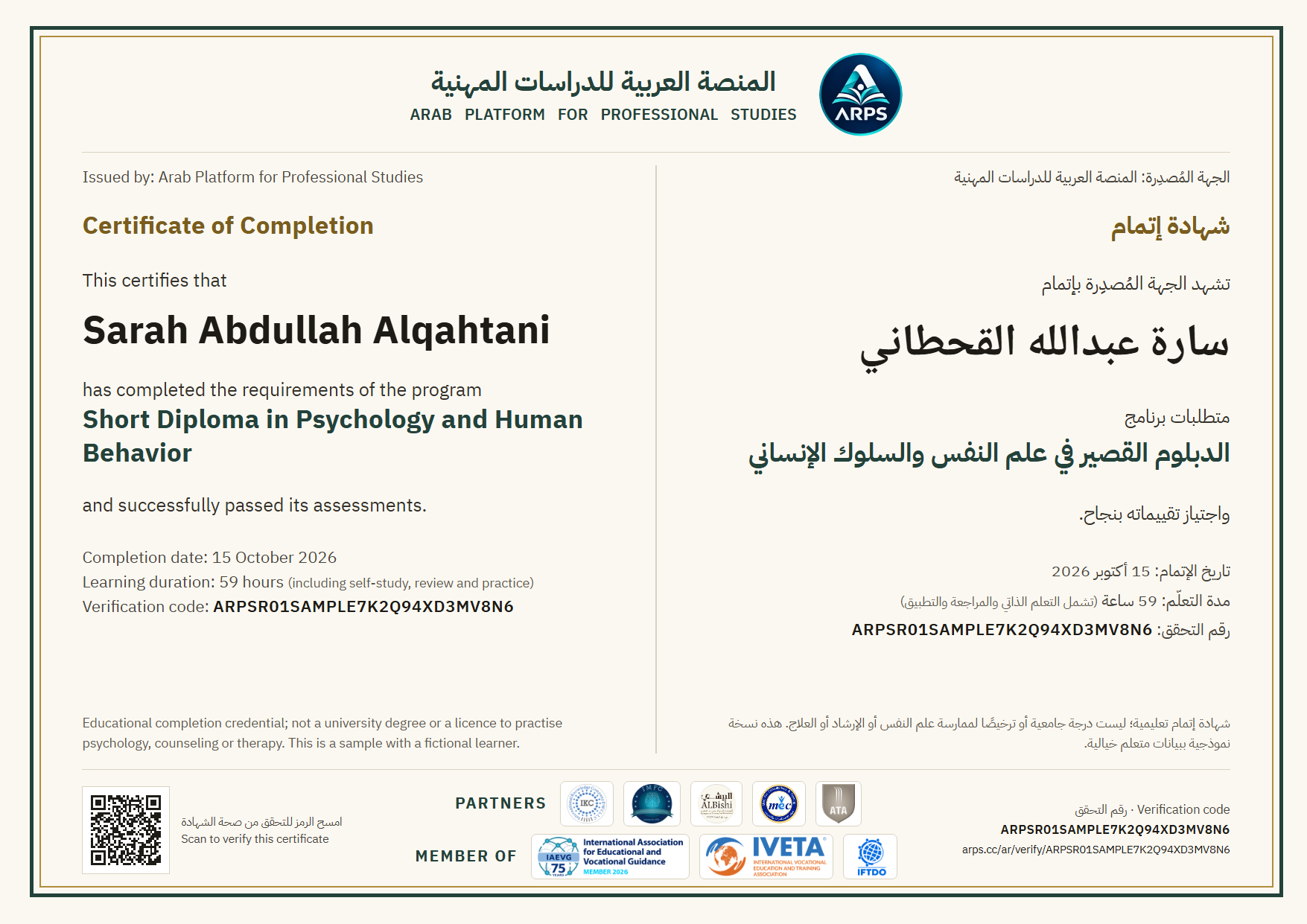
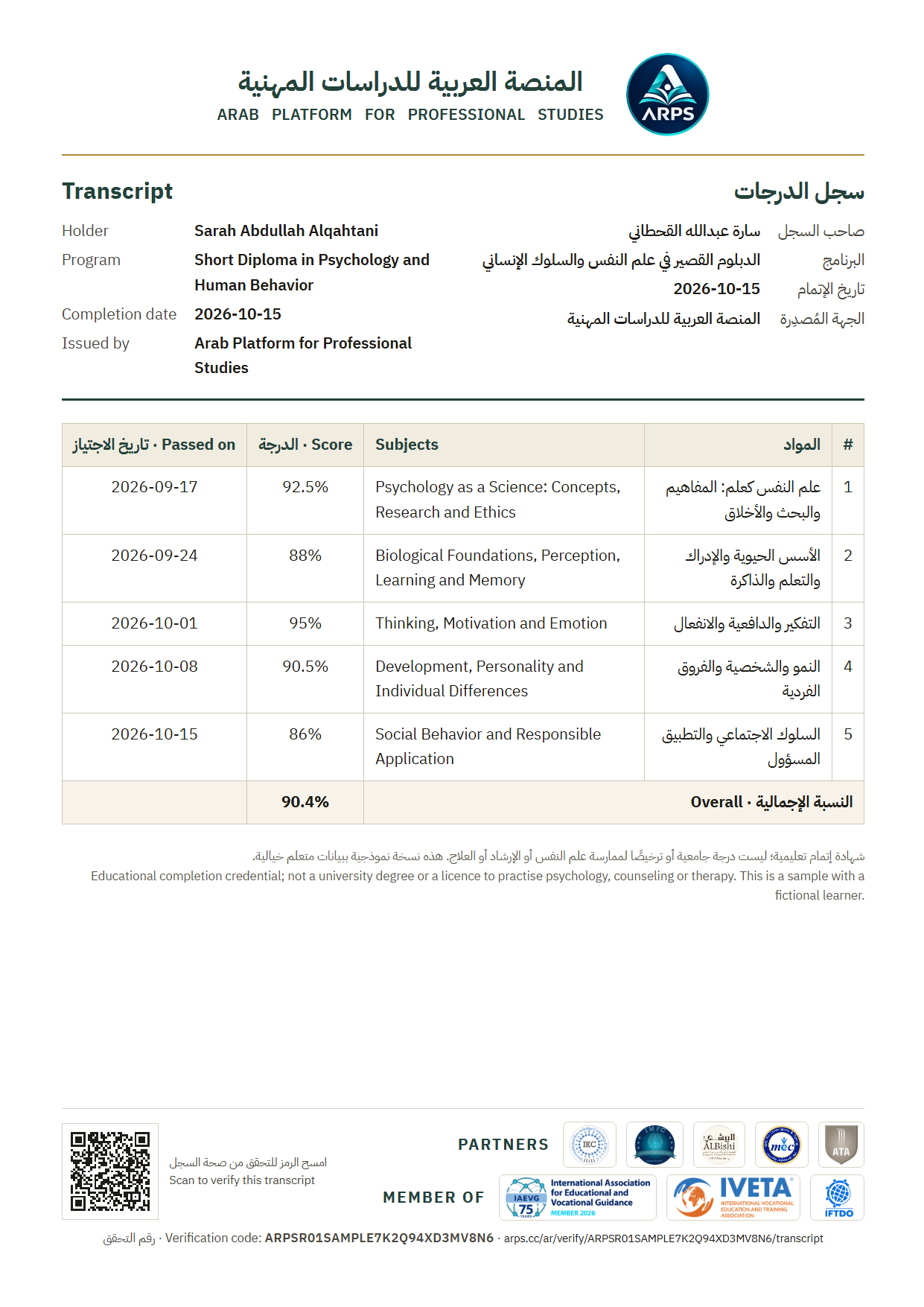
A sample from a real program in this track: Short Diploma in Psychology and Human Behavior. The learner, scores and dates are fictional; opens in a new window.
Verification example: a real issued certificate
Disclaimer: Educational completion, not a university degree or professional licence.
Program questions
Will this give me a ready salary structure for my employer?
It teaches first-pass calculations and review using a teaching scale. Real use requires suitable job and market evidence, policy, authority and local review.
Do the cases state country-specific benefit law?
No. Cities appear in fictional scenarios. Contracts and local requirements must be checked before any entitlement is announced.
Will I receive an accredited professional certificate?
The certificate records educational completion under programme policy. It is not a professional licence or external accreditation from the cited organisations.
How is study time estimated?
The editorial estimate counts reading in one language, doing each exercise once and taking one assessment per subject. Retakes and optional revision are outside the counted time and no accredited hours are asserted.
May I use the training pay figures for a real decision?
No. Case amounts, people and cities are invented to teach a method. A real decision needs current evidence suitable for the job, employer and market, plus approval from the authorised owner.
Show all (7)
Is Short Diploma in Compensation and Benefits free, and do I get a certificate?
Yes. Short Diploma in Compensation and Benefits is free on ARPS: every lesson, exercise and assessment is free, the first subject is open to read without an account, and the program is available in Arabic and English. Issuing a certificate is optional and has a published fee; it is a training completion certificate showing you passed the program's assessments, recognised by most private-sector organisations in the Gulf states and most Arab countries, and it strengthens your CV; confirming that a specific organisation accepts it remains your responsibility.
What other names is Short Diploma in Compensation and Benefits known by?
The subject of this program is also known as: compensation and benefits, total rewards, pay and benefits, C&B. Learners usually find it by searching for: compensation and benefits course online, compensation and benefits course free, total rewards training, salary structure design, compensation and benefits specialist skills.
What learners say
What learners say
Articles related to this program
All articlesProfessionals in this domain
Connect with certified consultants, trainers, coaches and specialists in the same domain across the ARPS communities.
Related programs
Programs from the same field or route that may complement what you learn here.

Human Resources & Organizational Development
Short Diploma in Human Resource Management
A foundational, applied diploma showing how HRM connects organisational needs with workforce planning, role design, recruitment and selection, performance, learning, reward, engagement, people data and ethics. Cases are fictional and country-neutral, with no advanced prior experience assumed.
Free
Human Resources & Organizational Development
Short Diploma in Learning and Development
A foundational diploma that connects learning-needs analysis with objectives, design, facilitation, learning transfer, evaluation and organizational capability. Learners practice making explainable, measurable L&D decisions rather than simply scheduling courses or collecting satisfaction surveys.
Free
Human Resources & Organizational Development
Short Diploma in Workforce Planning and HR Analytics
A short diploma linking service demand to workforce capacity and skills, then using trustworthy HR analytics to review decisions.
Free
Human Resources & Organizational Development
Specialist Preparation Program in Human Resource Management
Practice operational HR specialist tasks from service triage and workforce planning to selection, onboarding, performance, development, rewards, employee relations and people analytics, with reviewable work products and explicit authority limits.
Free