Short Diploma in Disability and Inclusion Studies is a free program on ARPS, the Arab Platform for Professional Studies. An applied introduction to disability and inclusion studies across rights, access, education, work and participatory inquiry. Learners identify barriers in a service journey, compare responses and test outcomes without reducing a person to a diagnosis.
Important notice: Independent education; a completion certificate is not a university degree, professional licence or endorsement by cited organizations.
Classify case facts as body function, activity, participation or environmental factor and state what remains unknown.
Prioritize a testable barrier-removal decision from the affected person's perspective.
From lesson 1, readable now without an account: Reading participation and barriers without reducing a person to a diagnosis
Disability studies begin with a practical question: what does the person want to do, and what in this setting enables or obstructs participation? A diagnostic label cannot answer this on its own. The World Health Organization's International Classification of Functioning, Disability and Health includes body functions, activities, participation and environmental factors. It is a framework for description and analysis, not a license to diagnose someone or a machine that selects a response from one category. In a service case, distinguish reported facts from our interpretation. A person may report difficulty walking and the site may have only a stepped entrance. Those two facts do not establish all of the person's preferences or what they could do in another environment.
A free account saves your progress and takes you straight to lesson 1.
Program facts
Study fee
Free
subjects
6
lessons
24
Estimated time
68 hours
Content last reviewed
Access period
60 days
Study language
Arabic and English
About the program
The program starts by separating a person's circumstances from barriers created by places and processes, then follows an accessibility journey across physical, digital and communication channels. Learning, recruitment and services provide distinct settings in which decisions need clear authority and limits. Learners develop participation and measurement methods that protect privacy and use appropriate denominators. The final subject asks them to examine a case file, distinguish known from unknown, compare alternatives and assign an implementation owner, checkpoint and fallback. Teaching cases and numbers are fictional and are not population or market data. This is a training completion diploma under the platform policy; it does not authorize regulated practice or clinical or legal judgments.
Practical relevance
Each lesson ends with a case-based practice and checkable output, such as a user-journey map, digital-form review, rate with an explicit denominator, or implementation plan with an owner and measure.
Why this program
A service may look accessible at its entrance yet fail at booking or communication. This program connects disability concepts with service decisions that can be tested with people who use the service, separating general improvement from individual arrangements.
Career relevance
Education, service, community and human-resource coordinators can use the material to identify participation barriers and ask better questions about arrangements and follow-up. It makes no employment, promotion or specialist-practice promise.
Career paths this program serves
This program is a step on the paths of the following occupations. Open a path to see its other programs in study order.
This subject begins with someone who wants to join an activity but encounters a barrier in the environment or procedure
This subject follows a service journey from finding information to completing a task, so an improved entrance alone cannot establish that booking or communication works
This subject applies inclusion decisions in three settings with shared principles but different outputs: learning and assessment, recruitment and onboarding, and service referral
One person's account does not represent everyone, but it can identify a specific barrier worth addressing
The final subject brings earlier decisions into one case file: what was measured, what people reported and what remains an untested explanation? Learners record facts before comparing options, then state weights while separating privacy and safety conditions that a high score cannot override
Operate an inclusive lending service through purchasing tests, supported choice, disruption, handover and review.
Learning outcomes (10)
Analyze participation by separating function, activity and environmental barriers, and compare disability perspectives without inferring a diagnosis.
Form a bounded response to an access request and a participation indicator grounded in the person's choice and outcome evidence.
Map an accessibility journey across service touchpoints and review a digital task using perceivable, operable, understandable and robust principles.
Choose a usable communication format and distinguish general-design improvement from an individual arrangement that needs testing.
Remove an assessment access barrier while preserving the measured skill, and check candidate and new-employee access to their tasks.
Coordinate a service and referral with minimal data and a follow-up owner while preserving the person's decision role.
Design varied participation and distinguish people, requests and events when choosing the denominator for a rate.
Collect task experience privately and build a baseline, indicator and correction trigger while interpreting comparison limits.
Sort case facts from inferences and unknowns, then compare options using criteria, weights and hard limits.
Translate a recommendation into implementation, outcome review and referral that respect the team's practice boundaries.
Who it is for
This program serves learners seeking an interdisciplinary foundation in disability and inclusion, and staff in education, services, community work or recruitment who help design or review user experience. No clinical or legal qualification is assumed. Learners should be willing to ask people about their own experience respectfully, examine bounded cases and write decisions with explicit evidence and limits rather than speak for all disabled people.
Prerequisites
No previous disability or accessibility specialization is required. Learners should be able to read a short service case, compare options, calculate a simple fraction or percentage and explain a decision briefly. The program introduces terms as needed and supplies exercise solutions. Anyone working in a regulated setting must check the competent authority's procedure before turning a teaching example into a professional or legal decision.
What it does not offer
Not a substitute for specialist clinical, legal or technical training and does not grant a practice licence.
This subject begins with someone who wants to join an activity but encounters a barrier in the environment or procedure. Learners distinguish evidence about function, activity and participation from an explanation that has not been established. They compare individual, social and rights perspectives without dismissing bodily experience or treating diagnosis as the answer to every question. They then respond to a specific access request by acknowledging it, checking resources and timing, and agreeing a usable option without making an unsupported local legal claim. The subject ends with a participation outcome chosen with the person and an indicator that separates registration from actual attendance while stating sample and inference limits.
4 lessons · 8.5 hours
Reading participation and barriers without reducing a person to a diagnosis2 hours
How models of disability change a service decision2 hours
Responding to an access request: equality, choice and decision limits2 hours
From participant voice to a measurable participation outcome2 hours
Subject 2
Accessibility and universal design
This subject follows a service journey from finding information to completing a task, so an improved entrance alone cannot establish that booking or communication works. Learners review a digital form through perceivable, operable, understandable and robust principles, then retest with a keyboard and assistive technology through the actual task result. They examine messages: which details are essential, which format the recipient chooses and how someone can correct an error. Finally, they compare general design with individual arrangements. An upstream improvement can reduce recurring barriers, while a specific request still needs a response and test. The output is a touchpoint map and sequenced repairs with verification evidence.
4 lessons · 8.5 hours
Mapping the accessibility journey from information to participation2 hours
Reviewing a digital task with the four accessibility principles2 hours
Communicating information through channels the recipient can choose2 hours
How general design and individual adjustment work together2 hours
Subject 3
Inclusive learning, work and services
This subject applies inclusion decisions in three settings with shared principles but different outputs: learning and assessment, recruitment and onboarding, and service referral. In education, learners separate the skill being assessed from the response channel and remove an access barrier without silently changing performance criteria. In recruitment and onboarding, they test entry routes and instruction formats and examine task requirements instead of inferring ability from diagnosis. In services, they define referral purpose, the person's agreement and the minimum necessary information. The subject closes with a cross-agency handoff: a contact owner, next step and completion check, while the person remains central to what is shared and with whom.
4 lessons · 8.5 hours
Making learning and assessment accessible from the actual task2 hours
Recruitment and onboarding without diagnostic assumptions2 hours
Service access with privacy and referral boundaries2 hours
Coordinating systems while the person remains central2 hours
Subject 4
Participation, data and evaluation
One person's account does not represent everyone, but it can identify a specific barrier worth addressing. This subject builds participation through varied times and channels and records who was missed. Learners distinguish people, requests and events, choosing numerators and denominators that match the question rather than producing a misleading percentage. They draft accessible task questions without unnecessary diagnostic data and check re-identification risk before reporting results from a small group. Finally, they define a baseline, indicator and review trigger and compare rates cautiously when groups differ. Improvement in a numerical indicator does not remove the need to investigate a single safety report or hear experience missed by the count.
4 lessons · 8.5 hours
Designing participation without treating one person as everyone2 hours
People, requests and events: choosing a denominator before a rate2 hours
Accessible questions and data that do not expose contributors2 hours
A baseline, indicator and correction trigger2 hours
Subject 5
Integrated application and practice limits
The final subject brings earlier decisions into one case file: what was measured, what people reported and what remains an untested explanation? Learners record facts before comparing options, then state weights while separating privacy and safety conditions that a high score cannot override. They translate a recommendation into an owner, action, checkpoint, success criterion and fallback if the new route fails. After implementation, they recalculate the appropriate indicator and examine remaining barriers and causal limits. They finish by distinguishing fixes the service team can make from decisions that need referral to a competent authority, without claiming clinical or legal powers.
4 lessons · 8.5 hours
An integrated case file: facts, experience and unknowns2 hours
Comparing options with stated criteria and non-negotiable limits2 hours
Implementing a recommendation with owner, checkpoint and fallback2 hours
Reviewing effects and practice boundaries after implementation2 hours
Subject 6
Capstone: operating an inclusive lending service
The capstone tests purchasing, supported choice, disruption alternatives and operational handover in a fictional lending service. Learners connect practical records and check evidence, authority and complaint paths before closure.
4 lessons · 19 hours
From supplier pitch to testable purchasing specification5 hours
Supporting choice and consent when team voices differ5 hours
Maintaining an accessible service through disruption5 hours
An operational handover and reviewable complaint pathway5 hours
Subjects unlock in sequence as you progress.
Strengths
Case-based practice and worked feedback in every lesson.
Five subject summatives and one capstone summative, separated from practice questions.
Clearly fictional numbers and explicit limits on claims and authority.
Evidence basis
Listed primary sources are used only within their documented scope; teaching cases and numbers are fictional and do not imply endorsement.
Reference organizations
WHO
W3C
UNESCO
ILO
Frameworks used
ICF functioning framework — WHO beginner's guide, 2002
Methodology
Original lessons connect explanation, worked cases, solved exercises and separate assessments while stating source and fictional-data limits.
How the route works
Short Diplomas are relatively comprehensive learning pathways that cover a major subject through five connected learning subjects and structured assessments, with a diploma transcript available with the credential.
Self-paced sequential study. Content unlocks progressively and each subject combines reading, examples, exercises, knowledge checks, and assessment.
Build integrated knowledge in a major subject.
Study through five clear, connected learning subjects.
Complete a defined assessment for each subject.
Receive a diploma transcript showing subjects and results when the credential is issued.
Assessment
Each Short Diploma contains five subjects, each with an approved assessment. A sixth final exam is not required when the five assessments adequately cover the learning outcomes.
Assessment attempts: 2 per assessment, 7 days apart
The pass mark is announced before the program is published.
Certificate
Successful completion makes the learner eligible for the Short Diploma certificate and Diploma Transcript under the credential policy.
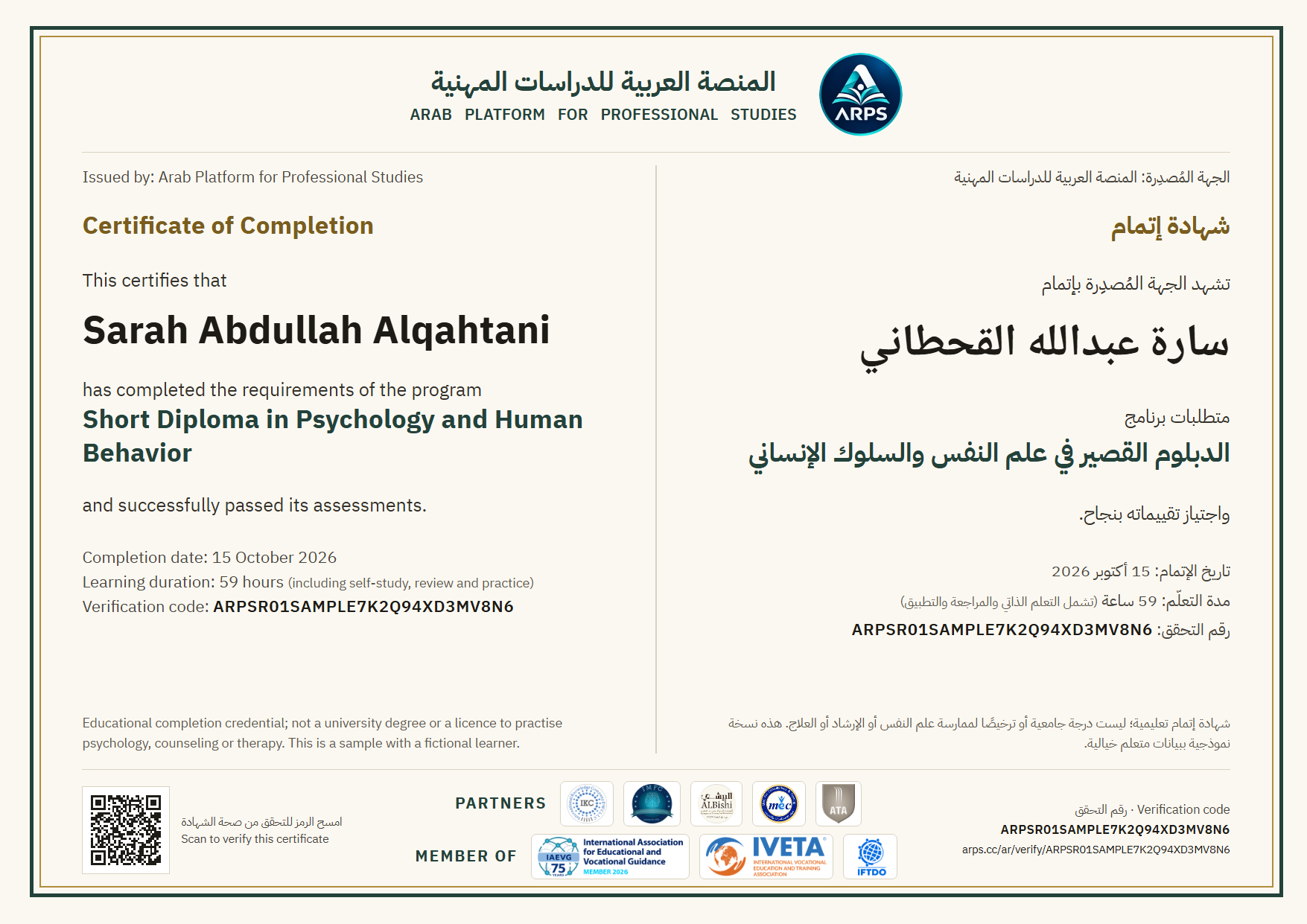
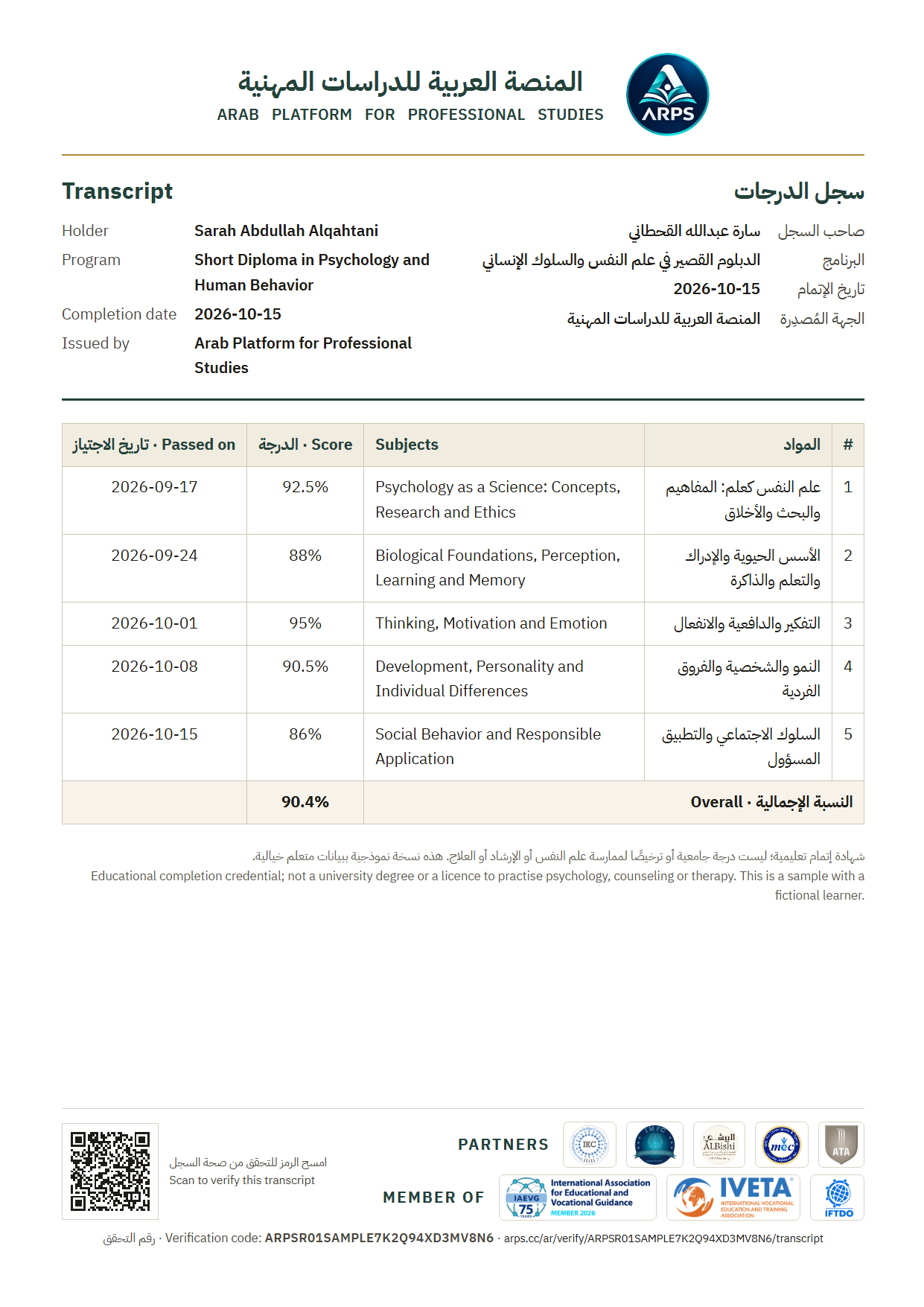
A sample from a real program in this track: Short Diploma in Psychology and Human Behavior. The learner, scores and dates are fictional; opens in a new window.
Disclaimer: Training completion; not a university degree, professional licence, or clinical or legal authorization.
Program questions
Does this program grant a professional licence?
No. It is training completion and does not replace competent authority requirements.
Are the cases field research?
No. Cases and numbers are fictional for learning, with limits stated in the lessons.
How is learning assessed?
There are self-check exercises and practice questions, followed by a separate summative assessment for each subject.
Do I need previous experience?
No specialization is assumed; learners need to read a case, calculate a simple rate and explain a decision.
Do I need real people's data?
No. Exercises supply fictional cases, and the method can be applied to a general context without exposing personal information.
Show all (7)
Is Short Diploma in Disability and Inclusion Studies free, and do I get a certificate?
Yes. Short Diploma in Disability and Inclusion Studies is free on ARPS: every lesson, exercise and assessment is free, the first subject is open to read without an account, and the program is available in Arabic and English. Issuing a certificate is optional and has a published fee; it is a training completion certificate showing you passed the program's assessments, recognised by most private-sector organisations in the Gulf states and most Arab countries, and it strengthens your CV; confirming that a specific organisation accepts it remains your responsibility.
What other names is Short Diploma in Disability and Inclusion Studies known by?
The subject of this program is also known as: disability studies, disability inclusion, inclusive practice, disability and inclusion. Learners usually find it by searching for: disability inclusion courses, disability inclusion training online, disability inclusion training free, inclusive education training, disability rights course.
A practical foundation in population data: define who is counted and when, calculate structure and change, build a short conditional scenario, and turn a bounded finding into a reviewable service decision.
Learn to diagnose social protection gaps, weigh evidence and alternatives, and write conditional, implementable recommendations within an advisory role.
This short diploma connects market-research design with consumer-behavior interpretation and evidence-bounded decisions. Six subjects progress from the research question through sampling, measurement, analysis, choice journeys, testing, and recommendation, ending with an applied market-research capstone.
6 subjects
24 lessons
62.5 hours
Free
Next step: a professional certification or a mini-master
Programs in the same domain that prepare you for an international certification exam or form a professional mini-master, also free.