Specialist Preparation Program in Employee Experience and Engagement
Specialist Preparation Program in Employee Experience and Engagement is a free program on ARPS, the Arab Platform for Professional Studies. Map employee journeys, listen responsibly, test changes and make bounded decisions with correct denominators and privacy safeguards. Starting with a broad engagement request, learners build a scope brief and journey map, then test interpretations of comments and service data.
Draft a brief specifying population, journey point, evidence, decision owner, output and authority boundary.
From lesson 1, readable now without an account: From a vague experience request to an executable brief
An employee experience specialist may receive a request to “increase engagement this quarter.” That expresses an ambition, but identifies neither whose experience should change, nor the moment in the work journey, nor the decision the evidence will support. Employee experience spans interactions such as joining, gaining tools, speaking with a manager and moving between roles. Engagement concerns the employee's relationship with work conditions and the ability to influence them; it is not interchangeable with satisfaction with a single event. The specialist names a testable problem before choosing a survey or an activity. The role can improve evidence gathering and facilitate an authorized decision, but cannot promise a change to staffing or compensation policy without its owner.
An operational brief has seven linked fields. First, define the population, for example recent joiners in a service team since the start of a quarter, rather than “all employees.” Second, identify a journey point, such as receiving system access in week one, rather than undefined “culture.” Third, state the observed symptom and its source, keeping a service log distinct from one person's account. Fourth, state a hypothesis to test: delayed access might postpone productive work. A hypothesis is not an established cause. Fifth, specify the specialist's deliverable, such as an access request map and an improvement recommendation. Sixth, name the decision owner and the person who can change the step. Seventh, state the data limits, deadline and acceptance check. Missing case counts or dates should remain unverified until suitable records are obtained.
Select a measure after defining the decision. If the issue is delay, elapsed time from an approved access request to confirmed activation may fit that touchpoint, provided the start and end are defined and cancelled requests are handled transparently. An overall engagement score alone cannot locate the failed access step. An employee account of the impact can be considered alongside the service record to examine the sequence; the coincidence does not prove that delay caused lower engagement. Keep individual records with authorized custodians and share a summary that does not expose a person or comment in a small group. Privacy rules vary by location and organization, so route questions about legal basis and retention to the responsible function.
Test the draft brief with three questions. Could a colleague identify the information to collect without inventing it? Could the process owner accept or reject the deliverable using a stated check? Is any proposed decision outside the specialist's authority and therefore in need of escalation? Repair a field when the answer is no. “Run a companywide survey and then launch a recognition event” is a weak brief when the friction point is still unknown. So is a promise of a higher engagement percentage without a baseline or verification path. A useful brief is a small work contract linking the employee need, the evidence and the decision while keeping inference limits visible. It is short enough to use, but sufficiently precise to expose who must act next.
A free account saves your progress and takes you straight to lesson 1.
Program facts
Study fee
Free
subjects
9
lessons
40
Estimated time
51.5 hours
Content last reviewed
Access period
30 days
Study language
Arabic and English
About the program
Starting with a broad engagement request, learners build a scope brief and journey map, then test interpretations of comments and service data. They design listening channels and original survey items, improve onboarding and internal moves, and close the feedback loop. They then deliver a limited intervention, decision dashboard and review plan that respect privacy and authority. Later subjects use small research to locate service failure and adapt responses to different work conditions, and a capstone improves an internal service across two sites.
Practical relevance
Outputs are briefs, maps, logs and decision memos adaptable to an employee service after local policy review. Fictional cases need no real employee data.
Why this program
The lessons teach the specialist work between collecting voice and changing a service: define the problem, solve a case, check the denominator and refer risk. One evolving operating path replaces generic engagement tips.
Career paths this program serves
This program is a step on the paths of the following occupations. Open a path to see its other programs in study order.
Map a defined employee journey and produce a bounded problem, priority and authorized decision.
Design voice channels and original items, protect replies and interpret denominators and limits.
Check onboarding and moves, then infer bounded opportunities from departure signals.
Close the voice loop, design a limited intervention and record manager and representative participation.
Define metrics, compare results cautiously and make a continue, modify or stop decision.
Show all (9)
Control data access, voice coverage and handover, then solve an integrated experience case.
Run small research that locates service failure: recruit interviews without claiming representation, test question comprehension, code employee accounts and recover a disrupted service.
Adapt responses to different work conditions, such as request pressure, multiple channels, recognizing contribution and requesting a vendor fix.
Apply the program in a capstone that improves an internal service across two sites, from charter and evidence to phased rollout and handover.
Learning outcomes (9)
Map a defined employee journey and produce a bounded problem, priority and authorized decision.
Design voice channels and original items, protect replies and interpret denominators and limits.
Check onboarding and moves, then infer bounded opportunities from departure signals.
Close the voice loop, design a limited intervention and record manager and representative participation.
Define metrics, compare results cautiously and make a continue, modify or stop decision.
Control data access, voice coverage and handover, then solve an integrated experience case.
Small research that locates service failure through a reviewable decision file.
Practical responses to different work conditions through a reviewable decision file.
Capstone: improve an internal service across two sites through a reviewable decision file.
Who it is for
Early-career HR and employee experience specialists, onboarding and employee voice coordinators, internal service staff, and team leaders who need checkable operating aids. It suits people who own or support a defined process step and can refer decisions beyond their authority. It does not provide independent strategic consultancy or legal privacy qualification, and it does not presume entitlement to raw employee responses.
Prerequisites
Be able to read a simple service log containing request dates and states, calculate a rate from an explicit numerator and denominator, and write a short professional summary. Basic familiarity with manager, HR and employee service roles helps, as does separating one account from a group result. The program requires no professional license or access to real employee records; fictional cases supply the information needed for every exercise.
Define a brief, map onboarding, formulate a bounded problem and prioritize friction while escalating risk.
4 lessons · 2.5 hours
From a vague experience request to an executable brief42 min
Map onboarding through the first independent task40 min
From employee voice to a testable problem statement40 min
Prioritize journey friction and choose the next action40 min
Subject 2
Employee voice and actionable measurement
Choose listening channels, design original items, protect replies and interpret denominators without unsupported causal claims.
4 lessons · 2.5 hours
Choose an employee voice channel40 min
Write original, actionable voice items40 min
Collect voice data while protecting trust and privacy40 min
Read responses without claiming causality38 min
Subject 3
Onboarding, moves and departure
Check first-task readiness, manager expectations, internal transfers and the limits of departure evidence.
4 lessons · 2.5 hours
Check onboarding readiness and first-task blockers40 min
Design the new manager touchpoint38 min
Manage an internal role move without losing context38 min
Interpret departure signals without reducing causes40 min
Subject 4
Turn voice into intervention and participation
Close the voice loop, trial a work-condition change and record manager and representative participation accurately.
4 lessons · 2.5 hours
Close the employee voice loop38 min
Design an intervention on a changeable work condition40 min
Enable a manager to hold a real listening conversation38 min
Manage representative participation and its influence38 min
Subject 5
Measure intervention and build a decision board
Define measures, examine comparisons, build a decision dashboard and select continuation, revision or stopping.
4 lessons · 2.5 hours
Define journey and engagement measures precisely38 min
Compare before and after with inference limits38 min
Build a dashboard that leads to action38 min
Choose continuation, modification or stop38 min
Subject 6
Specialist governance and integrated case
Control access, inspect voice coverage, hand over an operating aid and solve an integrated experience case.
4 lessons · 3 hours
Control data access and escalation38 min
Manage voice coverage and response bias38 min
Handover an operating aid that survives owner change38 min
Solve an integrated employee experience and engagement case1 hours
Subject 7
Small research that locates service failure
Recruit contrasting interviews, test question interpretation, code accounts and recover a service after a missed promise.
4 lessons · 7.5 hours
Recruit interviews without claiming representation2 hours
Test question comprehension before survey rollout2 hours
Code employee accounts while preserving disagreement2 hours
Recover a service after a missed response promise2 hours
Subject 8
Practical responses to different work conditions
Examine request pressure, align messages, review recognition and prepare a safe reproducible vendor fault.
4 lessons · 7.5 hours
Read request pressure through its timing2 hours
Keep service meaning across communication channels2 hours
Recognize contribution without harming cooperation2 hours
Request a vendor fix with safe test data2 hours
Subject 9
Capstone: improve an internal service across two sites
Develop an expense-service charter, evidence, intervention, prototype, rollout, category comparison and tested handover.
8 lessons · 15.5 hours
Charter a two-site expense service project2 hours
Build evidence when records and accounts disagree2 hours
Select an intervention with both site representatives2 hours
Prototype an understandable expense status2 hours
Plan a phased rollout around ongoing work2 hours
Review results when the request mix changes2 hours
Hold a decision hearing on contradictory evidence2 hours
Handover through a colleague test and later review2 hours
Subjects unlock in sequence as you progress.
Strengths
Checkable scope brief and journey map
Original listening items and explicit denominators
Onboarding readiness and owned transfer handover
Limited intervention and truthful return message
Metric dictionary and privacy guarded decision board
Integrated case with reproducible handover
Evidence basis
Concepts use bounded professional guidance, research and an accessible standards abstract with each source's limit recorded. No protected scale is reproduced and no one jurisdiction's guidance is presented as universal law.
Reference organizations
CIPD
ISO
Gallup
Acas
ICO
Methodology
Fictional cases use explicit denominators, worked application and review decisions for each skill.
Assessment
Assessments follow the program blueprint and may use module assessments, a final assessment, or a combination, under the approved attempt policy.
Assessment attempts: 2 per assessment, 7 days apart
The pass mark is announced before the program is published.
Certificate
The credential confirms completion and successful assessment; it does not represent professional licensure unless explicitly and lawfully stated.
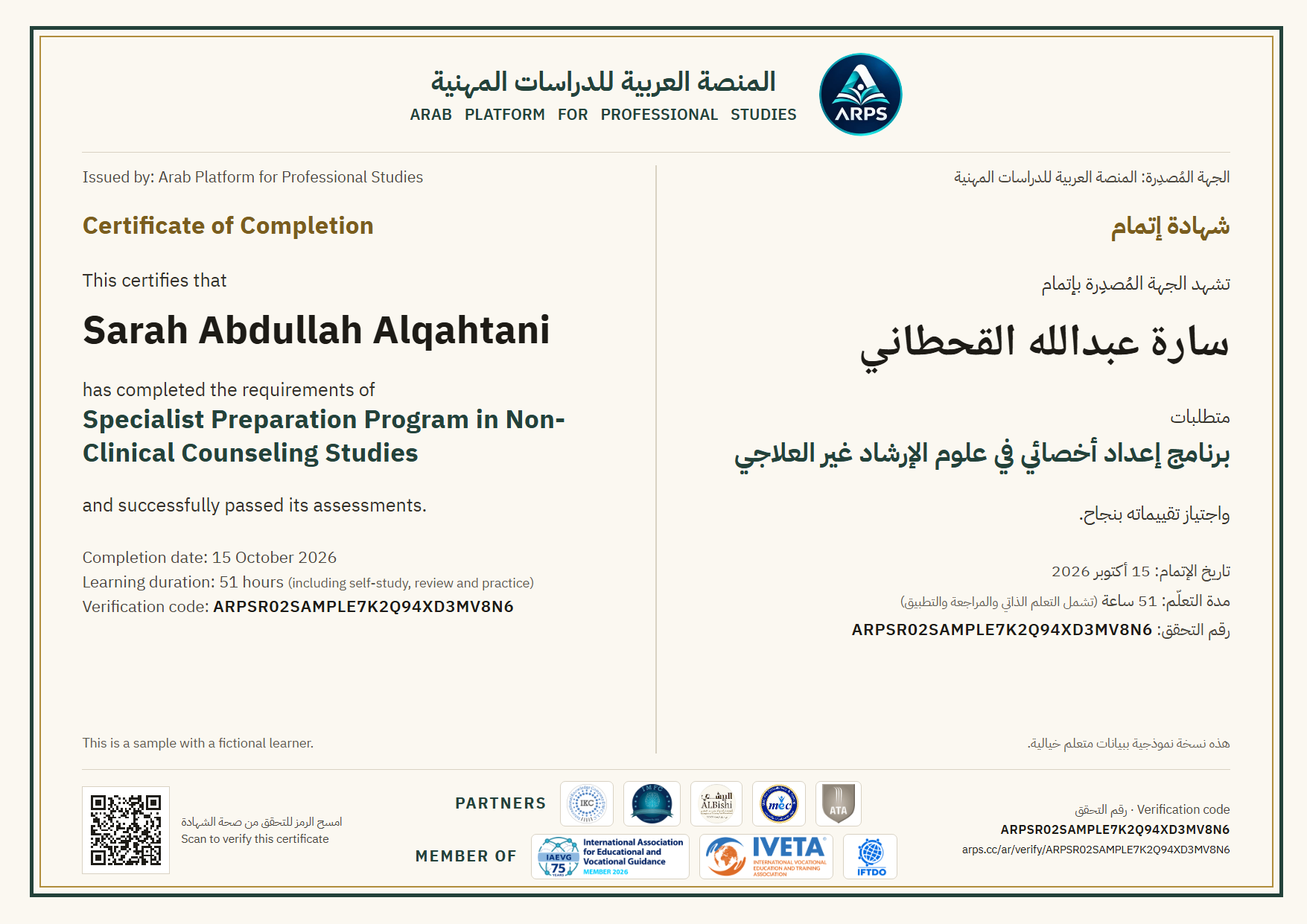
A sample from a real program in this track: Specialist Preparation Program in Non-Clinical Counseling Studies. The learner, scores and dates are fictional; opens in a new window.
No. The exercises provide sufficient fictional data.
Does this grant a professional license?
No. It assesses bounded specialist tasks.
May I use survey responses to evaluate individuals?
Individual data require an appropriate purpose, authority and local review; this program teaches bounded, safe analysis.
How do I check a comparison between teams?
Check the denominator, channel coverage, period and measure definition before interpreting the difference.
Do exercises include intervention decisions?
Yes. You frame a bounded decision with an action owner, review date and stop condition.
Show all (8)
What does the final case produce?
The case brings together a journey map, voice signals, impact measure and data limits in a reviewable decision memo.
Is Specialist Preparation Program in Employee Experience and Engagement free, and do I get a certificate?
Yes. Specialist Preparation Program in Employee Experience and Engagement is free on ARPS: every lesson, exercise and assessment is free, the first subject is open to read without an account, and the program is available in Arabic and English. Issuing a certificate is optional and has a published fee; it is a training completion certificate showing you passed the program's assessments, recognised by most private-sector organisations in the Gulf states and most Arab countries, and it strengthens your CV; confirming that a specific organisation accepts it remains your responsibility.
What other names is Specialist Preparation Program in Employee Experience and Engagement known by?
The subject of this program is also known as: employee experience, employee engagement, staff engagement, EX. Learners usually find it by searching for: employee engagement courses online, employee engagement courses free, employee experience course, staff engagement courses, employee engagement strategies.
Practice operational HR specialist tasks from service triage and workforce planning to selection, onboarding, performance, development, rewards, employee relations and people analytics, with reviewable work products and explicit authority limits.
Learn to run a defined talent acquisition and selection cycle: establish need, analyze work, attract, screen, assess, recommend, and communicate with candidates.
Diagnose workplace performance gaps, design suitable practice, deliver across shifts, and evaluate learning and workplace use within a specialist role.