PMI Agile Certified Practitioner (PMI-ACP) Preparation is a free program on ARPS, the Arab Platform for Professional Studies. Independent PMI-ACP preparation across Mindset, Leadership, Product and Delivery. Learners reason through original cases and alternatives; only PMI administers the official exam and awards the credential.
Important notice: Independent agile-practitioner preparation; this is not PMI's official exam and does not award the PMI-ACP credential.
The learner designs a small slice to test a value assumption and predefines the measure, threshold, and next decision instead of building the entire solution before learning.
The learner classifies the uncertainty in a working situation, selects a defensible response, and reclassifies when evidence changes.
From lesson 1, readable now without an account: Early Value and Assumption Testing
When a product owner asks for a large feature, the first question is not how to finish every requested item. Ask which assumption, if false, would make most of that work wasteful. An early experiment is a bounded piece of work designed to reduce a specific uncertainty. It is neither an unfinished version of the final product nor a promise that the first release will succeed. Identify the user, the behavior you expect, and the evidence you can collect without exposing anyone to unacceptable harm. Choose the smallest usable increment or an honest test of the decision to buy or complete a task. If failure is costly or privacy is involved, use a closed prototype or observe a task instead of making a public release. Match the test's exposure to its risk.
A free account saves your progress and takes you straight to lesson 1.
Program facts
Study fee
Free
subjects
8
lessons
32
Estimated time
74 hours
Content last reviewed
Access period
30 days
Study language
Arabic and English
About the program
Eight modules contain thirty-two lessons. The twenty-four task lessons are preserved and eight extended decision laboratories add experimentation, leadership, product value and delivery practice. The additions include worked cases, distinct self-check exercises with feedback and original bilingual questions. Learning retains the short diagnostic and adds two comprehensive internal mocks, each with sixty questions, ninety minutes and domain quotas. These internal forms differ from the issuer’s 120-item exam and do not predict its score. Learning time is an editorial estimate separate from certification eligibility hours.
Practical relevance
Learners produce an experiment sheet, a working agreement, a product slice and a flow decision report from hypothetical data. Applications require a stated denominator, a bounded decision and verification criterion, with worked guidance available after the attempt.
Why this program
Agile choices can look sound outside their context: running an experiment while immediate harm continues, or improving speed while customers receive wrong messages. This program asks learners to identify the deciding evidence, compare plausible professional alternatives and explain what would change the choice. It follows PMI's current domains without reducing practice to a single framework.
Career relevance
The skills support product and delivery practitioners and team leaders who refine work, interpret flow measures, facilitate disagreement and protect customers. Completion does not confer a job title or PMI accreditation; exam eligibility remains subject to PMI's published conditions.
Career paths this program serves
This program is a step on the paths of the following occupations. Open a path to see its other programs in study order.
Classify uncertainty and test a value assumption with suitable exposure.
Facilitate teams, transfer knowledge and investigate causes without blame.
Slice product work and measure outcomes with accuracy and privacy guardrails.
Read flow and improve work in progress using customer evidence.
Learning outcomes (4)
Choose an agile response suited to uncertainty, test assumptions and adapt work from user evidence while preserving transparency and safety.
Facilitate team collaboration and delegated decisions, investigate impediments, transfer knowledge and connect choices to a measurable value vision.
Refine the product backlog into value slices, set an increment goal, make work visible and verify user outcomes with quality guardrails.
Measure delivery flow, distinguish risks from active issues, improve work in progress and use customer feedback without hiding defects.
Who it is for
Product and service practitioners who participate in increment planning, experimentation and delivery and want to connect their experience with current PMI-ACP domains.
Team facilitators, delivery leads and business analysts who need to explain trade-offs, calculations and plausible alternatives across more than one agile approach.
Prospective external-certification candidates seeking independent preparation with a clear distinction between learning, this short diagnostic, PMI's official examination and PMI's eligibility rules.
Prerequisites
Some practical experience on a team delivering increments or repeated service improvements, and the ability to describe a user problem and team decision clearly.
Willingness to read simple case data and calculate percentages and elapsed time from stated denominators; no prior certificate or single-framework allegiance is required.
Time to complete written applications and check current official sources before making any decision about PMI exam eligibility or registration.
What it does not offer
Anyone seeking automatic PMI exam registration or a PMI-ACP credential issued by this platform.
An agile mindset begins with a testable question about user value, not adoption of a particular ceremony. State an assumption, outcome, threshold, and harm boundary, then build a small slice that reveals whether the direction is sound. Match response to causal clarity: use a procedure for a known problem, expert analysis where evidence can uncover a cause, a safe probe where patterns emerge through action, and stabilization first during a crisis. Give the team a shared goal, a clear completion boundary, and workable coordination across teams. Expose blockers and learning through interpretable measures, and encourage early reporting with accountability for repair. Shorten the interval from experiment to review without dropping user protection. When evidence changes priority, reallocate finite capacity and share the needed skill. Check the outcome instead of treating publication of a change as proof of success.
7 lessons · 6.5 hours
Early Value and Assumption Testing40 min
Classifying Complexity and Choosing a Response40 min
Collaboration and Cross-Team Agreements40 min
Transparent Progress Without Metric Gaming38 min
Psychological Safety and Accountability40 min
Shortening the Feedback Loop40 min
Adaptation and Shared Skills1.5 hours
Subject 2
Leadership and Agile Collaboration
Agile leadership transfers a defined decision to a team that understands its goal and limits, then supplies support suited to the gap: training a skill, coaching through questions, or mentoring a longer path. For recurring problems, separate symptoms from candidate causes, compare conflicting evidence, and test a remedy while measuring speed and quality together. Turn a lesson into knowledge another team can find and apply, with a version boundary and review. Reinforce behavior that connects a usable increment with customer learning rather than rewarding card or meeting counts alone. Use product vision to choose between competing work and explain deferral. In conflict, hear interests and evidence, distinguish a safe demonstration from live operation where necessary, and record the decision condition, owner, and follow-up date. Quiet agreement without shared meaning is not resolution.
6 lessons · 5.5 hours
Coaching and Decision Delegation40 min
Cause Analysis and Impediment Resolution40 min
Transferable Working Knowledge40 min
Leading for Value and Incentives38 min
Vision and Trade-Off Priorities40 min
Facilitating Conflict and Decisions1.5 hours
Subject 3
Product, Value and Prioritization
Product management starts with a user need before sizing a large request. Clarify the story through acceptance examples, split it into a slice that offers value while protecting data, and treat sizing disagreement as a difference in assumptions rather than a number to average. Choose an increment goal users can inspect and state its boundary honestly: passing a build test alone does not prove comprehension or value. Visualize work with entry and exit rules and an update policy, exposing queues and item age instead of only completed card counts. Define value through an outcome measure with an explicit denominator and quality and privacy guardrails. Opening a page is not understanding it; avoiding support contact does not establish the page caused that behavior. When source data is stale, repair accuracy before expansion, then test where the value chain broke in the next increment.
4 lessons · 4 hours
Backlog Refinement and Value Slicing40 min
Increment Goal and Acceptance40 min
Making Product Work Visible38 min
Measuring and Protecting Product Value1.5 hours
Subject 4
Delivery, Flow and Improvement
Agile delivery begins with a small increment that exposes an important customer question early, then brings feedback into the team's next decision. Choose a measure for its audience: cycle time for completed work, age for open work, throughput in a defined window, and a user outcome; a tiny-sample mean is not a promise. Distinguish a realized impediment from a potential risk, contain harm, remove cause, and monitor recurrence. Map value flow from request to benefit, separating touch time from queues without calling a necessary protection test waste. Trial a defined improvement with baseline, quality guardrail, and retain-or-revert decision. Involve task users in defining acceptance and checking understanding. Set work-in-progress and interruption rules against finishing capacity, then inspect item age and defects rather than the board's appearance alone.
7 lessons · 6 hours
Early Delivery from Feedback38 min
Reading Delivery Measures40 min
Risks and Active Impediments38 min
Finding Waste in the Value Stream38 min
Continuous Improvement Experiments38 min
Customer Engagement with Sound Evidence38 min
Controlling Work in Progress and Flow1.5 hours
Subject 5
Evidence and Adaptive Work
Test sample bias and separate group measurements, then compare routine and urgent service policies. Produce a bounded experiment and a service agreement exposing waiting effects.
2 lessons · 11 hours
Sampling Bias Before Investment5.5 hours
Tailoring Two Service Paths5.5 hours
Subject 6
Leadership Across Boundaries
Bound supplier delegation and escalation, then address expert overload and incentive effects. Produce authority limits and a knowledge-transfer plan that tracks work behavior.
2 lessons · 11 hours
Delegation with an External Supplier5.5 hours
Recovery from Incentive Pressure5.5 hours
Subject 7
Value Decisions Across User Groups
Order investments under dependencies and deadlines and expose accessibility barriers hidden by averages. Produce option comparisons and acceptance criteria testing task correctness and understanding.
2 lessons · 11 hours
Ordering Investment Under Cost and Time Constraints5.5 hours
Accessibility and Value Across Segments5.5 hours
Subject 8
Flow Forecasting and Release Quality
Build a conditional flow forecast, separating scenarios from guarantees, then test increment quality and recovery. Produce a forecast report and a bounded release plan with stop conditions.
2 lessons · 11 hours
Forecasting from Flow-Time Distributions5.5 hours
Increment Quality and Reversible Releases5.5 hours
Subjects unlock in sequence as you progress.
Strengths
One focused lesson for each of the 24 outline tasks.
Hypothetical regional cases and checkable applied outputs.
Clear separation of practice, internal diagnosis and external examination.
Primary sources for outline and methods with review dates.
Evidence basis
PMI's official outline governs exam-domain scope; primary sources for principles and methods support the teaching. Check PMI directly for current eligibility conditions. The cases and quantities here are hypothetical learning data.
Reference organizations
Project Management Institute
Authors of the Manifesto for Agile Software Development
Kanban Guides contributors
Methodology
Primary-source comparison with original applied cases.
How the route works
Professional Certification Preparation programs help learners prepare for a recognized external certification through structured knowledge, review, practice questions, and readiness assessments. Arab Platform for Professional Studies (ARPS) does not administer the certification owner's official exam.
Structured self-paced study aligned to the current external certification scope, with knowledge review, practice questions, readiness checks, and internal mock assessments.
Focused preparation for a specific external certification.
Content aligned to the current official exam scope when available.
Practice questions and internal readiness assessments.
Clear separation between Arab Platform for Professional Studies (ARPS) preparation and the official external exam.
Assessment
The route includes an internal assessment for Arab Platform for Professional Studies (ARPS) completion eligibility and separate mock/readiness assessments that are not the external official exam.
Assessment attempts: 2 per assessment, 7 days apart
The pass mark is announced before the program is published.
Certificate
The Arab Platform for Professional Studies (ARPS) credential confirms completion of the preparation program only; the target professional certification requires passing the external issuer's examination under its rules.
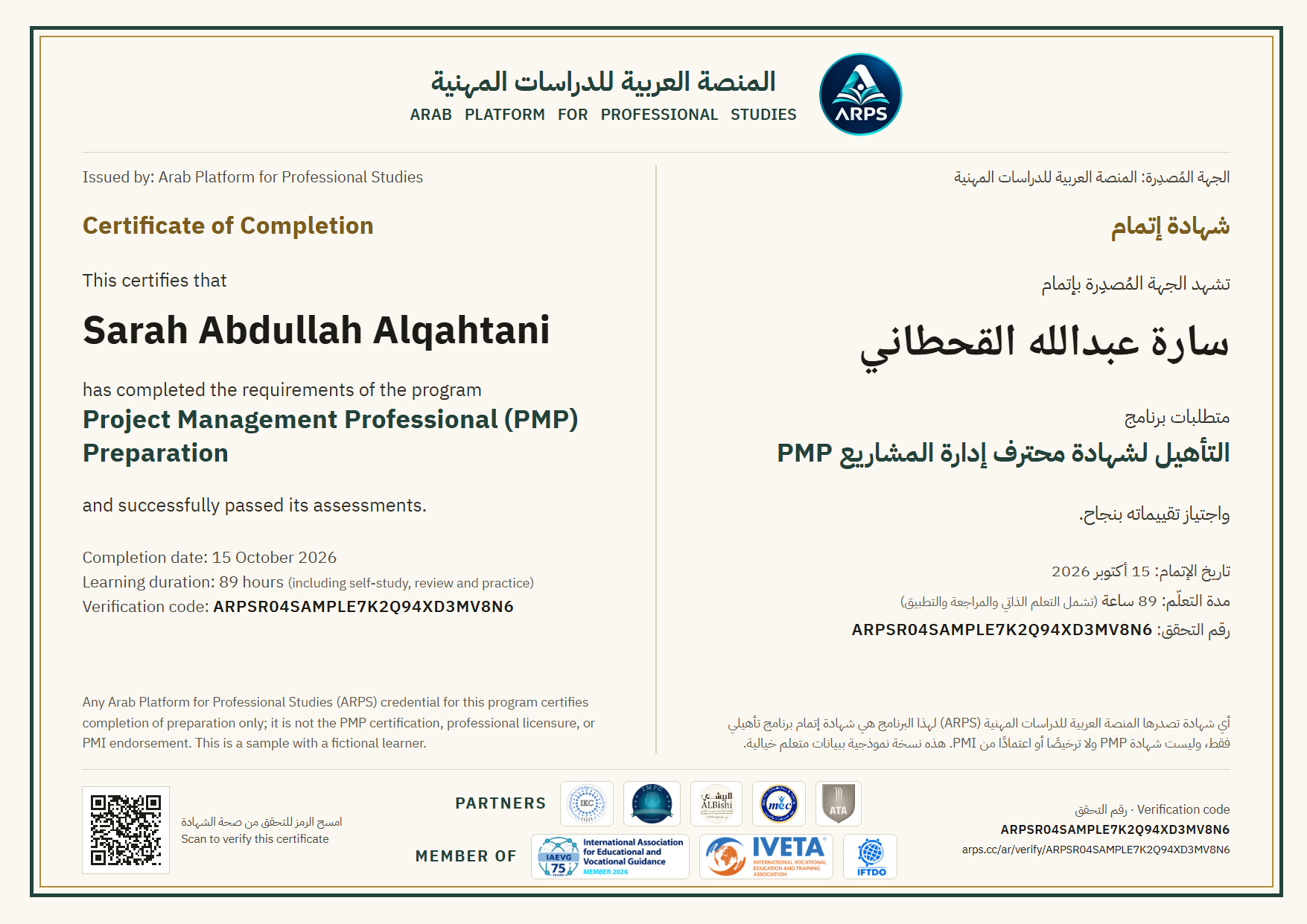
A sample from a real program in this track: Project Management Professional (PMP) Preparation. The learner, scores and dates are fictional; opens in a new window.
Disclaimer: Any internal completion credential records this preparation only; it is not PMI-ACP, professional licensure or PMI endorsement.
Program questions
Does this award PMI-ACP?
No. PMI alone administers its examination and awards PMI-ACP. This is independent preparation.
Is the readiness diagnostic equivalent to the official exam?
No. It draws 20 original items from a short internal bank and does not predict an official score.
Where should I check exam requirements?
Read PMI's current certification page and exam outline before applying; conditions can change after this material was checked.
Are estimated learning minutes PMI eligibility training hours?
No. They are internal study-work estimates from lessons, exercises and assessments. PMI sets official training conditions.
Is this program limited to Scrum?
No. Lessons compare decisions across agile approaches according to the PMI-ACP outline.
Show all (7)
Is PMI Agile Certified Practitioner (PMI-ACP) Preparation free, and do I get a certificate?
Yes. PMI Agile Certified Practitioner (PMI-ACP) Preparation is free on ARPS: every lesson, exercise and assessment is free, the first subject is open to read without an account, and the program is available in Arabic and English. Issuing a certificate is optional and has a published fee; it is a training completion certificate showing you passed the program's assessments, recognised by most private-sector organisations in the Gulf states and most Arab countries, and it strengthens your CV; confirming that a specific organisation accepts it remains your responsibility.
What other names is PMI Agile Certified Practitioner (PMI-ACP) Preparation known by?
The subject of this program is also known as: PMI-ACP, agile project management, PMI Agile Certified Practitioner, agile practitioner. Learners usually find it by searching for: PMI-ACP exam prep, PMI-ACP exam prep course, PMI-ACP exam content outline, PMI-ACP practice questions, agile exam preparation self study, what is PMI-ACP certification, PMI-ACP exam requirements, PMI-ACP course in Arabic.
Bilingual PSPO I preparation explaining Scrum and Product Owner decisions through worked cases, exercises and original questions. The official assessment and credential remain with Scrum.org.
Bilingual preparation for project-management decisions and the PMP exam. The design starts with PMI’s official outline and combines people, planning, delivery and business-environment decisions with calculations and explained practice. This is independent preparation, not PMI’s exam or the PMP credential.
An honest note: we prepare you for the exam; we do not award the certification. Only the body that owns a certification awards it, once you meet its requirements and pass its official exam, and you register and pay for the exam with that body. The optional ARPS certificate is a training completion certificate recognised by most private-sector organisations in the Gulf states and most Arab countries, and it strengthens your CV alongside the certification.