Professional Scrum Product Owner I (PSPO I) Preparation
Professional Scrum Product Owner I (PSPO I) Preparation is a free program on ARPS, the Arab Platform for Professional Studies. Bilingual PSPO I preparation explaining Scrum and Product Owner decisions through worked cases, exercises and original questions. The official assessment and credential remain with Scrum.org.
Important notice: Independent preparation. Arab Platform for Professional Studies (ARPS) does not administer the official PSPO I assessment, award Scrum.org certification or claim its endorsement.
Separate observation, assumption and decision in a complex product situation
From lesson 1, readable now without an account: Empiricism: from a usage signal to an inspectable product decision
A Product Owner works where users' responses cannot be known in advance through a detailed plan alone. The Scrum Guide describes empiricism as making decisions based on what is observed and connects it with transparency, inspection and adaptation. Empiricism does not mean random experiments or the absence of a goal. State the result sought, produce a usable Increment that can be inspected, compare evidence with an explicit expectation, and adapt a decision when needed. For PSPO I reasoning, distinguish a rule of the Scrum framework from a complementary measurement technique chosen by an organization. Scrum defines accountabilities, events, artifacts and commitments; it does not prescribe one dashboard or one backlog ordering algorithm.
A free account saves your progress and takes you straight to lesson 1.
Program facts
Study fee
Free
subjects
6
lessons
24
Estimated time
49 hours
Content last reviewed
Access period
30 days
Study language
Arabic and English
About the program
Six modules and twenty-four lessons connect empiricism, accountabilities, events, artifacts, value and the Product Backlog to forecasting and release. Learners inspect a case, complete an exercise with feedback and explain both strong and weak answer choices. The internal readiness mock does not reproduce every feature of the official assessment.
Practical relevance
Fictional digital-service cases state their assumptions and do not present invented city statistics or practices as real local facts.
Why this program
A PSPO I candidate needs to explain why a decision changes when user evidence, Done status or decision ownership changes. A memorized term alone will not resolve a conflicting product case.
Career relevance
Product Owners and product contributors can use the reasoning to explain backlog ordering and communicate with a Scrum Team and stakeholders. The program promises neither a role nor a pass.
Career paths this program serves
This program is a step on the paths of the following occupations. Open a path to see its other programs in study order.
Separate evidence, assumptions and Scrum accountabilities.
Use Scrum events and self-management in team decisions.
Inspect artifacts, commitments and Done.
Connect vision and Product Goal to inspectable value.
Order the Product Backlog using customer evidence.
Build a conditional forecast, release decision and revision plan.
Learning outcomes (6)
Distinguish observations, assumptions, Scrum decisions and Product Owner accountability.
Apply self-management and Scrum events to team and stakeholder decisions.
Inspect artifacts and commitments and decide whether work meets Done.
Formulate a Product Vision and Goal and inspectable value measures.
Order and clarify the Product Backlog using customer evidence.
Build a conditional forecast, release decision and PSPO I revision plan.
Who it is for
PSPO I candidates seeking a structured Arabic and English review with original practice questions and explanations for every choice. Product contributors who order a backlog, interpret an experiment or discuss a release with a Scrum Team can also use the cases. The course expects curiosity and willingness to test assumptions, not a specific job title or fixed experience threshold.
Prerequisites
A basic idea of a digital product, its users and iterative team work is enough. The course explains required Scrum terms. Product experience helps but is not an enrollment condition. No prior Scrum credential or Product Owner title is needed.
Reading a simple percentage and small table helps with exercises; calculations are explained before practice. No paid analytics tool is required. Scrum.org determines its assessment conditions and fees.
What it does not offer
Awarding PSPO I or administering Scrum.org’s official assessment.
Memorizing official items, promising a pass or claiming issuer endorsement.
Product ownership begins by separating observation, assumption and the decision that evidence must inform. Applied decisions and inspection.
4 lessons · 7 hours
Empiricism: from a usage signal to an inspectable product decision1.5 hours
Inspection and adaptation when experiment conditions change1.5 hours
Who decides product value and who chooses implementation?1.5 hours
When does more output mean progress toward product value?1.5 hours
Subject 2
Team, self-management and Scrum events
Self-management does not mean a lack of decisions. Applied decisions and inspection.
4 lessons · 7 hours
Goal and boundaries under deadline pressure1.5 hours
One Product Owner and many voices1.5 hours
Planning from why before distributing how1.5 hours
Two inspection events, two different decisions1.5 hours
Subject 3
Artifacts, commitments and Definition of Done
Scrum's three artifacts make work and inspection visible. Applied decisions and inspection.
4 lessons · 7 hours
Product Goal is the Product Backlog commitment1.5 hours
Sprint Backlog is an emergent plan committed to the Sprint Goal1.5 hours
A usable Done Increment, then a separate value decision1.5 hours
Quality is not optional at Sprint end1.5 hours
Subject 4
Vision, strategy and product value
A Product Vision names the beneficiary, need and desired direction. Applied decisions and inspection.
4 lessons · 7 hours
Product Vision: why does the product exist and for whom?1.5 hours
From organization strategy to an inspectable Product Goal1.5 hours
Measure product value rather than only counting features1.5 hours
A small experiment and a decision sized to the evidence1.5 hours
Subject 5
Product Backlog and customers
Product Backlog ordering is a value decision under constraints, risk and learning, not an automatic ranking by stakeholder volume or a single score. Applied decisions and inspection.
4 lessons · 7 hours
Why might an invisible repair lead a visible feature?1.5 hours
From vague request to discussable backlog item1.5 hours
Refine the Product Backlog without freezing a specification1.5 hours
Who requests the feature, who uses it and who bears its effects?1.5 hours
Subject 6
Forecasting, release and assessment readiness
When launch evidence conflicts, the Product Owner makes the trade-off, assumptions, risks, dissent and each decision owner visible. Applied decisions and inspection.
4 lessons · 7 hours
One decision with visible dissent and a review trigger1.5 hours
A forecast is not a promise: how do we answer a timing question?1.5 hours
When and for whom should a Done Increment be released?1.5 hours
Readiness is diagnosed by reasoning, not one percentage1.5 hours
Subjects unlock in sequence as you progress.
Strengths
Product cases connect evidence to a decision.
Exercises have observable outputs and explained solutions.
Original bilingual questions explain each option.
Evidence basis
The official guide anchors Scrum rules; the issuer page anchors assessment facts; value measurement and forecasting are presented as complementary practices.
Reference organizations
Scrum.org
Scrum Guides
Frameworks used
Scrum Guide — November 2020
Methodology
Instruction connects cases, exercises and original questions while separating Scrum rules from optional product techniques.
How the route works
Professional Certification Preparation programs help learners prepare for a recognized external certification through structured knowledge, review, practice questions, and readiness assessments. Arab Platform for Professional Studies (ARPS) does not administer the certification owner's official exam.
Structured self-paced study aligned to the current external certification scope, with knowledge review, practice questions, readiness checks, and internal mock assessments.
Focused preparation for a specific external certification.
Content aligned to the current official exam scope when available.
Practice questions and internal readiness assessments.
Clear separation between Arab Platform for Professional Studies (ARPS) preparation and the official external exam.
Assessment
The route includes an internal assessment for Arab Platform for Professional Studies (ARPS) completion eligibility and separate mock/readiness assessments that are not the external official exam.
Assessment attempts: 2 per assessment, 7 days apart
The pass mark is announced before the program is published.
Certificate
The Arab Platform for Professional Studies (ARPS) credential confirms completion of the preparation program only; the target professional certification requires passing the external issuer's examination under its rules.
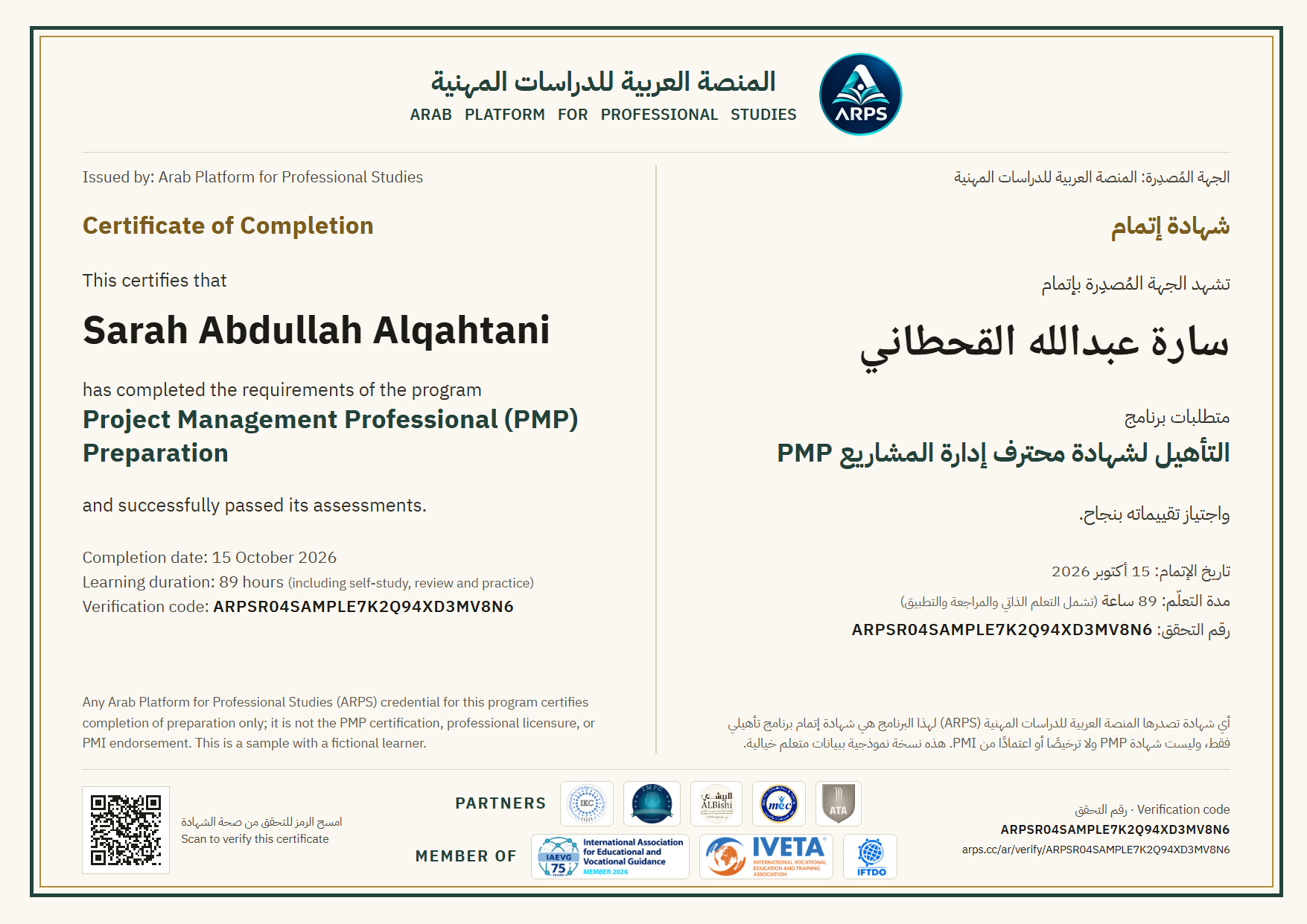
A sample from a real program in this track: Project Management Professional (PMP) Preparation. The learner, scores and dates are fictional; opens in a new window.
Disclaimer: This independent program does not administer Scrum.org’s official assessment or award its certification.
Program questions
Does study award PSPO I?
No. Scrum.org alone administers its official assessment and credential.
Are the practice items official?
No. They are original cases for learning distinctions.
Does the mock predict a pass?
No. It identifies internal revision needs and is not an issuer result.
What does forecasting cover?
A conditional range from completed work and stated assumptions, not a guaranteed date.
What does Done mean here?
An Increment meets its Definition of Done; an announcement date alone does not decide it.
Show all (7)
Is Professional Scrum Product Owner I (PSPO I) Preparation free, and do I get a certificate?
Yes. Professional Scrum Product Owner I (PSPO I) Preparation is free on ARPS: every lesson, exercise and assessment is free, the first subject is open to read without an account, and the program is available in Arabic and English. Issuing a certificate is optional and has a published fee; it is a training completion certificate showing you passed the program's assessments, recognised by most private-sector organisations in the Gulf states and most Arab countries, and it strengthens your CV; confirming that a specific organisation accepts it remains your responsibility.
What other names is Professional Scrum Product Owner I (PSPO I) Preparation known by?
The subject of this program is also known as: Professional Scrum Product Owner, Scrum Product Owner, PSPO, product owner. Learners usually find it by searching for: pspo i exam prep, pspo 1 exam prep, pspo practice questions, product owner responsibilities, what is professional scrum product owner, PSPO I exam requirements, PSPO I course in Arabic, PSPO I prep online free.
Independent PMI-ACP preparation across Mindset, Leadership, Product and Delivery. Learners reason through original cases and alternatives; only PMI administers the official exam and awards the credential.
Bilingual preparation for project-management decisions and the PMP exam. The design starts with PMI’s official outline and combines people, planning, delivery and business-environment decisions with calculations and explained practice. This is independent preparation, not PMI’s exam or the PMP credential.
An honest note: we prepare you for the exam; we do not award the certification. Only the body that owns a certification awards it, once you meet its requirements and pass its official exam, and you register and pay for the exam with that body. The optional ARPS certificate is a training completion certificate recognised by most private-sector organisations in the Gulf states and most Arab countries, and it strengthens your CV alongside the certification.