Professional Scrum Master I (PSM I) Preparation is a free program on ARPS, the Arab Platform for Professional Studies. Independent PSM I preparation with Scrum Guide instruction, worked cases and explained practice in Arabic and English. Seven modules and 29 lessons cover empiricism and Scrum values, accountabilities, events, artifacts, facilitation and product value.
The learner distinguishes an assumption-led decision from one grounded in inspectable evidence and designs a small next step that exposes the next risk.
From lesson 1, readable now without an account: Complex work and empirical control
Complex work and empirical control
Imagine a team building a clinic appointment service. Marketing believes customers want text reminders; reception staff believe changing an appointment is the real problem. Either view may be useful, but a person's position does not make a claim about customer behavior true. In complex work, user needs, operating practices and technical constraints interact, so the team may not know in advance which design will work. Scrum helps the team work in short cycles, produce a usable Increment in each Sprint, inspect the result and adapt its plan. A cycle does not remove planning. It makes the plan responsive to what the team learns.
A free account saves your progress and takes you straight to lesson 1.
Program facts
Study fee
Free
subjects
7
lessons
29
Estimated time
55.5 hours
Content last reviewed
Access period
30 days
Study language
Arabic and English
About the program
Seven modules and 29 lessons cover empiricism and Scrum values, accountabilities, events, artifacts, facilitation and product value. Each lesson explains a distinct decision, works through a case, asks the learner to apply it and checks understanding. Internal assessment and readiness practice are separate from Scrum.org’s official assessment.
Practical relevance
Fictional appointment-service and digital-product cases connect Product Goal, Sprint Goal, Increment and Definition of Done to daily choices.
Why this program
Scrum questions require reasoning about accountability, goals and Increment quality rather than recalling event names alone. The cases distinguish observations from unsupported interpretations and support a suitable adaptation.
Career relevance
The material helps product team members and PSM I candidates explain decisions and tradeoffs. Completion neither awards a Scrum.org credential nor guarantees a career outcome.
Career paths this program serves
This program is a step on the paths of the following occupations. Open a path to see its other programs in study order.
The learner distinguishes an assumption-led decision from one grounded in inspectable evidence and designs a small next step that exposes the next risk. The learner exposes a misleading Increment status and chooses what to inspect and adapt instead of treating events as reporting rituals. The learner chooses a small usable Increment that exposes a value risk and distinguishes it from splitting phases without an inspectable result. The learner explains how commitment, focus, openness, respect and courage shape a disputed Sprint decision without treating the values as slogans.
The learner diagnoses specialist handoffs and reorganizes work around a Done Increment from one team without inventing sub-teams inside the Scrum Team. The learner orders conflicting requests toward a Product Goal and explains why writing items may be delegated while accountability for value remains with the Product Owner. The learner adapts Developers' daily plan after new evidence while preserving the Sprint Goal and Definition of Done without waiting for a manager to assign tasks. The learner chooses an intervention that removes an organizational impediment and improves team effectiveness without having the Scrum Master do others' work for them.
The learner distinguishes scope adaptation from Sprint cancellation and applies the condition of an obsolete Sprint Goal and the Product Owner's cancellation authority. The learner formulates a valuable Sprint Goal and chooses feasible scope and an initial plan without turning items into an inflexible promise. The learner turns an integration failure into inspection of Sprint Goal progress and an adapted daily plan rather than individual activity reporting. The learner uses an actual Increment and environmental change with stakeholders to justify a Product Backlog adaptation rather than a slide-based approval ritual. The learner turns a recurring work-process problem into a measurable improvement experiment followed through in the next Sprint.
The learner connects work ordering to one inspectable Product Goal and distinguishes commitment to that goal from a changing requirements list. The learner distinguishes the Sprint Goal commitment from a forecast of every item and adapts Developers' plan while making changes visible. The learner judges whether work enters an Increment under the shared Definition of Done and distinguishes product quality from an item's acceptance conditions. The learner checks integration of two Done Increments before a release choice and separates usability from the timing of customer availability.
The learner returns Sprint work allocation to the team while clarifying goals and legitimate outside constraints rather than equating autonomy with no accountability. The learner designs a short conversation that hears conflicting evidence and reaches a participant-owned decision without the facilitator imposing the outcome. The learner chooses coaching questions that expose team assumptions and recognizes when the Scrum Master should teach a specific Scrum rule instead of leaving a misconception uncorrected. The learner diagnoses a recurring organizational dependency and distinguishes one-off rescue from changing the waiting system with an inspectable result.
The learner chooses an outcome measure linked to the Product Goal and explains its limits instead of treating feature count as product value. The learner splits a large item into an inspectable value slice and clarifies enough detail without imposing a Definition of Ready as a Scrum rule. The learner builds a forecast range from past delivery and visible dependencies, distinguishing an updateable forecast from a fixed release promise. The learner separates influential requests from evidenced user needs and designs collaboration that lets the Product Owner make a reasoned value trade-off.
The learner classifies a common practice as a Scrum Guide element or optional technique and judges whether its use serves the purpose or hides a problem. The learner sequences interventions when Sprint Goal, quality, a stakeholder request and an organizational impediment collide, identifying each decision owner and its evidence. The learner decomposes a situational question into fact, rule, decision and accountable party, testing each option against constraints rather than familiar wording. The learner converts errors on original practice items into a plan that revisits a specific rule and applies it to a new case, while separating internal readiness from the Scrum.org assessment.
Who it is for
PSM I candidates who want a structured review of the Scrum Guide and official focus areas with original questions that require a decision and its constraint rather than terminology recall alone.
Scrum Team members and people working with a Product Owner or Scrum Master on digital services who need to inspect Sprint Goals, Increment quality and product value in practice. Every lesson and question has an equivalent Arabic version.
Prerequisites
No prior Scrum study is required: the program introduces empiricism, the team and events before applying them in cases. Experience in team or digital-service work helps with examples but is not an entry requirement.
Learners need time to read in their chosen locale, make simple calculations and inspect why each answer option succeeds or fails. This is internal preparation and does not determine eligibility for Scrum.org’s external assessment.
What it does not offer
Awarding the official PSM I certification or guaranteeing its result.
Reproducing official Scrum.org questions or presenting an internal mock as its exam.
When a team works on a problem whose outcome cannot be known in advance, it separates what it observed from what it suspects and what it proposes to do. It states an inspectable hypothesis, creates a small usable Increment, compares the result with its expectation and adapts. Transparency is necessary: calling incomplete work Done gives everyone a false object to inspect, and more meetings do not repair the underlying information. Incremental delivery is not splitting a design document into fragments; an Increment is useful, integrated and meets the Definition of Done. The Scrum values guide difficult choices. Commitment serves the goal, focus resists side requests that do not help it, openness welcomes evidence, respect allows a defect to be discussed without blaming its author, and courage prevents an unsupported success claim.
4 lessons · 9 hours
Complex work and empirical control2 hours
Transparency, inspection and adaptation2 hours
Iterative and incremental delivery2 hours
Five Scrum values in a difficult decision2 hours
Subject 2
Scrum Team and accountabilities
A Scrum Team is one cross-functional, self-managing unit with one Product Owner, a Scrum Master and Developers. Cross-functionality does not require every person to master every skill. The team as a whole can create a Done Increment without permanent handoffs among subteams. The Product Owner is accountable for maximizing value and managing Product Backlog order. They may delegate work but retain accountability, and stakeholder input does not turn ordering into an automatic vote. Developers decide how to create the Increment, maintain the Sprint plan and instill quality.
4 lessons · 9 hours
One cross-functional Scrum Team2 hours
Product Owner accountability and product value2 hours
Developers and the Sprint plan2 hours
Scrum Master service to team and organization2 hours
Subject 3
Events and Sprint decisions
The Sprint is a fixed timebox of no more than one month in which the team creates a usable Increment. The Sprint Goal guides decisions as work details change. A temporary provider problem need not cancel a Sprint while the goal remains valuable; only the Product Owner may cancel it when the goal becomes obsolete. Sprint Planning connects three questions: why this Sprint is valuable, what can be done, and how Developers will do the selected work. Its result is a goal, selected items and an initial plan, not a frozen task contract. During the Sprint, Developers use the Daily Scrum to inspect progress toward the goal and adapt the Sprint Backlog. It is not a status report to the Scrum Master, and adaptation may occur outside the meeting.
5 lessons · 11 hours
The Sprint as a learning container2 hours
Sprint Planning: why, what and how2 hours
Daily Scrum and plan adaptation2 hours
Sprint Review with stakeholders2 hours
Sprint Retrospective and improvement2 hours
Subject 4
Artifacts, commitments and quality
Scrum's three artifacts carry distinct commitments. The Product Backlog is emergent and ordered, with the Product Goal describing a future product state; reordering two items does not automatically change that goal. Developers own the Sprint Backlog, which contains the Sprint Goal, selected items and an adaptable delivery plan. When a subtask stalls, the team first asks whether the Sprint Goal remains reachable, then adapts the plan and discusses scope with the Product Owner when needed. The Increment is an integrated, usable result committed to the Definition of Done. Finished coding or a locally successful interface is insufficient if a required integration or accessibility check fails. Multiple Increments may arise in a Sprint, and a Done Increment can be released before the Sprint Review; that event provides inspection, not release permission.
4 lessons · 9 hours
Product Backlog and Product Goal2 hours
Sprint Backlog and Sprint Goal2 hours
Increment and Definition of Done2 hours
Cumulative Increments and release decisions2 hours
Subject 5
Developing people and teams
Self-management gives Developers the internal decision about who does what, when and how, but does not erase the Product Owner or legitimate organizational constraints. Integrated skills let the team shift effort when a defect emerges instead of waiting for a manager to reassign tasks. In disagreement, the Scrum Master facilitates participation: clarify the goal and constraints, ask for evidence and assumptions, and leave the decision with those accountable. Equal speaking time is not enough if consequential quality evidence remains unheard. Coaching differs from direct teaching. If the team does not know a clear Scrum rule, explain it. If it faces a recurring problem with uncertain causes, questions can expose its hypotheses and help it design an experiment it owns.
4 lessons · 4.5 hours
Self-management and decision boundaries46 min
Facilitation under disagreement44 min
Coaching versus teaching and solving for others2 hours
Impediments and organizational influence46 min
Subject 6
Managing products with agility
Product value is not a feature count or task-closing speed. The Product Owner starts with the Product Goal and intended customer outcome, then inspects behavior or impact with a known denominator. A rarely used feature may be valuable to a small group if it solves a critical problem, while many shipped features may leave customers struggling. The Product Owner manages an emergent Product Backlog and collaborates with Developers to refine ambiguous items into valuable slices; those who will do the work size it. Refinement is ongoing work, not a prescribed fifth event. Release planning turns current knowledge into a conditional forecast, not a guaranteed date because it appears on a calendar.
4 lessons · 4.5 hours
Product value and customer outcomes2 hours
Product Backlog management and refinement44 min
Empirical forecasting and release planning44 min
Stakeholders and customers44 min
Subject 7
Integrated application and assessment readiness
For a situational question, identify the observed fact, relevant goal, accountable person and Increment state before comparing options. Ask whether the Sprint Goal is still valuable, whether work meets the Definition of Done, who orders the Product Backlog, and who determines implementation. Several practices may be useful generally, but the case constraint decides the best next action. Do not remove a prescribed event or commitment because the team uses a Kanban board or story points; these are optional complementary practices. In the integrated payment case, most tests passing cannot excuse transactions that display success without recording the settlement required by the Definition of Done.
4 lessons · 4 hours
Framework rules versus complementary practices2 hours
Integrated case of a troubled Sprint46 min
Reasoning through constrained situational questions46 min
Error-based readiness plan46 min
Subjects unlock in sequence as you progress.
Strengths
Thirteen official focus areas linked to specific teaching decisions.
Worked cases, exercises and explained checks in every lesson.
Clear separation of internal learning assessment from the external credential.
Evidence basis
Framework facts use the 2020 Scrum Guide; focus scope and assessment details use official Scrum.org pages checked on 24 October 2026.
Reference organizations
Scrum.org
Methodology
Original explanation, cases and practice mapped to official focus areas
How the route works
Professional Certification Preparation programs help learners prepare for a recognized external certification through structured knowledge, review, practice questions, and readiness assessments. Arab Platform for Professional Studies (ARPS) does not administer the certification owner's official exam.
Structured self-paced study aligned to the current external certification scope, with knowledge review, practice questions, readiness checks, and internal mock assessments.
Focused preparation for a specific external certification.
Content aligned to the current official exam scope when available.
Practice questions and internal readiness assessments.
Clear separation between Arab Platform for Professional Studies (ARPS) preparation and the official external exam.
Assessment
The route includes an internal assessment for Arab Platform for Professional Studies (ARPS) completion eligibility and separate mock/readiness assessments that are not the external official exam.
Assessment attempts: 2 per assessment, 7 days apart
The pass mark is announced before the program is published.
Certificate
The Arab Platform for Professional Studies (ARPS) credential confirms completion of the preparation program only; the target professional certification requires passing the external issuer's examination under its rules.
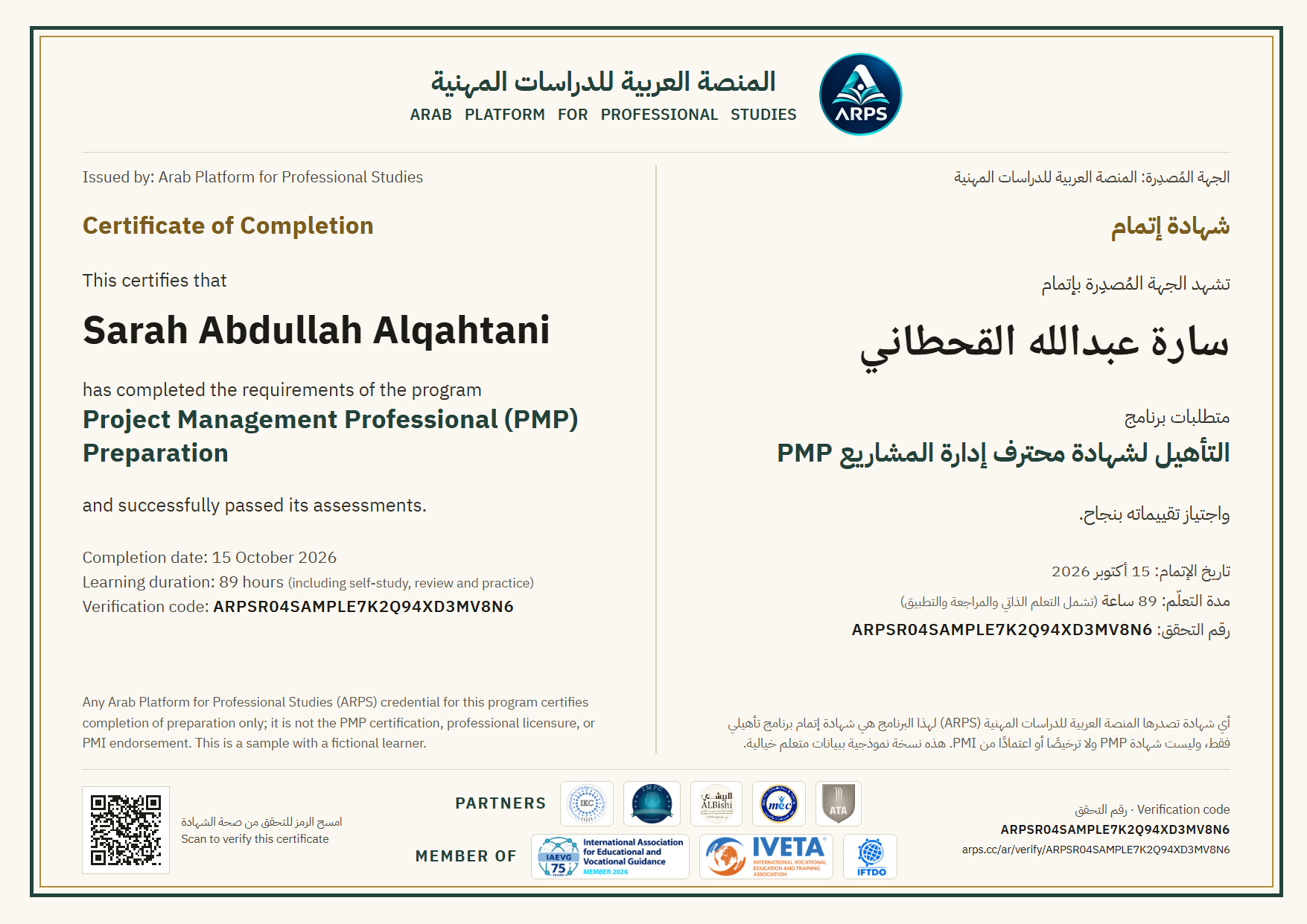
A sample from a real program in this track: Project Management Professional (PMP) Preparation. The learner, scores and dates are fictional; opens in a new window.
Disclaimer: Independent preparation. Arab Platform for Professional Studies (ARPS) does not administer the official Scrum.org assessment, award PSM I, or claim Scrum.org endorsement.
Program questions
Is this the PSM I credential?
No. Scrum.org administers its own assessment and awards the external certification.
What defines the study scope?
The official PSM I suggested reading page and the 2020 Scrum Guide, checked against the current assessment page.
How should I use a mock result?
Review option explanations and the focus areas you missed; an internal result does not guarantee an official pass.
Does translation count as another question?
No. Arabic and English are two versions of one logical question group.
Does the program cover practices outside Scrum?
It explains when a practice complements the framework and separates core Scrum rules from local choices.
Show all (7)
Is Professional Scrum Master I (PSM I) Preparation free, and do I get a certificate?
Yes. Professional Scrum Master I (PSM I) Preparation is free on ARPS: every lesson, exercise and assessment is free, the first subject is open to read without an account, and the program is available in Arabic and English. Issuing a certificate is optional and has a published fee; it is a training completion certificate showing you passed the program's assessments, recognised by most private-sector organisations in the Gulf states and most Arab countries, and it strengthens your CV; confirming that a specific organisation accepts it remains your responsibility.
What other names is Professional Scrum Master I (PSM I) Preparation known by?
The subject of this program is also known as: PSM I exam preparation, PSM 1 prep, Scrum Master exam prep. Learners usually find it by searching for: free PSM I prep course, Scrum Guide study, PSM I practice questions, Scrum Master exam preparation online, what is PSM I certification, PSM I exam requirements, PSM I course in Arabic.
Independent PMI-ACP preparation across Mindset, Leadership, Product and Delivery. Learners reason through original cases and alternatives; only PMI administers the official exam and awards the credential.
Bilingual PSPO I preparation explaining Scrum and Product Owner decisions through worked cases, exercises and original questions. The official assessment and credential remain with Scrum.org.
Bilingual preparation for project-management decisions and the PMP exam. The design starts with PMI’s official outline and combines people, planning, delivery and business-environment decisions with calculations and explained practice. This is independent preparation, not PMI’s exam or the PMP credential.
An honest note: we prepare you for the exam; we do not award the certification. Only the body that owns a certification awards it, once you meet its requirements and pass its official exam, and you register and pay for the exam with that body. The optional ARPS certificate is a training completion certificate recognised by most private-sector organisations in the Gulf states and most Arab countries, and it strengthens your CV alongside the certification.