Short Diploma in Business Process Management is a free program on ARPS, the Arab Platform for Professional Studies. Follow requests through to service outcomes. Learn boundaries, mapping, elapsed time, rework and controlled improvement. Five core subjects and an applied capstone include fictional exercises and assessments. This is foundational learning without professional licensing or claimed accredited hours.
Important notice: Independent foundational learning and training completion; no university degree, professional licence or endorsement by cited sources.
Define process boundaries and supplier-input-output-customer links for a service request.
From lesson 1, readable now without an account: What is a process, and what procedure carries it out?
When a service manager asks to improve ‘request procedures’, first identify the work linking a beneficiary's need to an outcome they can receive. A process joins activities that transform inputs into an intended result. A procedure tells people how to perform a particular task or handle a defined condition within that work. One process may use several procedures; a procedure can also appear in several processes. A department name is rarely a sound end-to-end boundary: a request may move through intake, validation, fulfilment and notification while the customer experiences one journey. A written procedure is evidence of the prescribed method, not proof of the path actual cases follow. Compare it with case records and staff observation before calling a diagram the current state.
A free account saves your progress and takes you straight to lesson 1.
Program facts
Study fee
Free
subjects
6
lessons
24
Estimated time
76.5 hours
Content last reviewed
Access period
60 days
Study language
Arabic and English
About the program
Produce a boundary card, flow map and measures with explicit denominators. Trial a bounded change and review outcomes. The capstone adds capacity scheduling, handoff reconciliation, decision tests and temporary-operation recovery, with outputs a colleague can inspect.
Practical relevance
Build operating tools from fictional cases. Real application requires organisational data, definitions and authority.
Why this program
Closing at assignment may conceal a requester still waiting; learn to expose that difference through evidence.
Career relevance
Useful for operations, service and quality staff describing and reviewing work, without employment or professional-authority promises.
Career paths this program serves
This program is a step on the paths of the following occupations. Open a path to see its other programs in study order.
Define a process boundary, outcome and owner from request to communicated result.
Map actual flow, decisions and exceptions while separating work from waiting.
Define elapsed-time, throughput and rework measures with valid cohorts and units.
Test a bounded improvement that protects acceptance conditions and measures adverse effects.
Control process ownership, procedure versions and outcome review in one decision file.
Learning outcomes (24)
Apply what is a process, and what procedure carries it out? to a case and justify the decision.
Apply defining boundaries, inputs and outputs with sipoc to a case and justify the decision.
Apply process ownership and cross-team handoffs to a case and justify the decision.
Apply selecting a process for improvement without mistaking a score for evidence to a case and justify the decision.
Apply recovering actual flow from conflicting evidence to a case and justify the decision.
Apply mapping decisions and exceptions with basic bpmn elements to a case and justify the decision.
Apply seeing waits and rework in a value stream to a case and justify the decision.
Apply turning a map into an executable controlled procedure to a case and justify the decision.
Apply defining a measure before calculating it to a case and justify the decision.
Apply elapsed time and throughput from case records to a case and justify the decision.
Apply rework: count cases, then segment them to a case and justify the decision.
Apply testing a bottleneck hypothesis before buying a remedy to a case and justify the decision.
Apply choosing simplification while protecting a necessary control to a case and justify the decision.
Apply designing future state while preserving acceptance conditions to a case and justify the decision.
Apply designing a bounded improvement trial with a predeclared decision rule to a case and justify the decision.
Apply deciding to expand or roll back from trial results to a case and justify the decision.
Apply who owns the outcome, measure and change? to a case and justify the decision.
Apply controlling a procedure version and training its users to a case and justify the decision.
Apply reviewing measures and escalating meaningful deviations to a case and justify the decision.
Apply an integrated decision file for one process to a case and justify the decision.
Build a capacity schedule exposing batch timing, priority and usable capability.
Reconcile linked handoff records, duplicates and corrections through relevant evidence.
Test acceptance boundaries, rule conflicts and decision authority.
Design temporary operation and recovery preventing lost cases and repeated effects.
Who it is for
The diploma suits beginners and operations, service, quality or improvement staff who need to connect process mapping with outcome measurement and ownership. Cases are useful across service, education and administrative settings without assuming one industry. It does not prepare an advanced independent consultant or grant professional authority, and it cannot replace an organisation's training on its own real procedures.
Prerequisites
No advanced experience or professional licence is required. Learners should be able to read a short service description, follow a request through several steps, and perform simple addition, division and percentages, using a calculator if helpful. They will write a decision table and inspect fictional case records. Paid diagramming software and access to an employer's data are unnecessary.
What it does not offer
It is not a professional licence, accreditation or training on any one employer's procedures.
It does not replace advanced specialist preparation in process modelling or operations consulting.
This subject begins with a beneficiary's need and a communicated result. Learners distinguish an ongoing process from a procedure governing a repeated step and a bounded project that changes the process. A fictional request case supports a boundary card with trigger, acceptable input, output and endpoint, showing why assignment is not fulfilment. SIPOC then identifies suppliers, inputs and receivers, while a purchasing example separates a decision process from the wider fulfilment journey. Learners allocate outcome ownership and handoff acceptance across teams without confusing a process owner with every activity performer. A weighted priority comparison exposes assumptions and sensitivity to criteria. Its final decision separates routine investigation from immediate containment of a serious constraint. The output is a compact process charter and a justified, evidence-limited improvement priority.
4 lessons · 10 hours
What is a process, and what procedure carries it out?2.5 hours
Defining boundaries, inputs and outputs with SIPOC2.5 hours
Process ownership and cross-team handoffs2.5 hours
Selecting a process for improvement without mistaking a score for evidence2 hours
Subject 2
Current State, Mapping and Procedure
Learners reconstruct what actually happened from event records, a published procedure and an interview that may disagree with both. They distinguish an absent logged event from an absent review and mark unresolved branches for verification. Using BPMN elements, they represent start, tasks, exclusive decisions, rework loops and meaningful endpoints without claiming that a proposed model proves execution. A value-stream view then separates active work, waiting and information transfer; a calculated future-state change retains required checking rather than deleting it for speed. Finally, learners turn the map into an executable procedure with input acceptance, ordered actions, exceptions, evidence record, owner and controlled version. They test ordinary and incomplete cases and examine how a changed return definition breaks an unqualified trend comparison. The output is a traceable current-state map and tested procedure.
4 lessons · 10 hours
Recovering actual flow from conflicting evidence2.5 hours
Mapping decisions and exceptions with basic BPMN elements2.5 hours
Seeing waits and rework in a value stream2 hours
Turning a map into an executable controlled procedure2 hours
Subject 3
Performance Measurement and Bottleneck Diagnosis
The subject starts with a measure card specifying unit, numerator, denominator, window and start and end events. Learners calculate an arrival-cohort on-time share and a completed-case share, treating open cases according to whether their deadline has elapsed. They distinguish mean and median elapsed time from throughput during a work window, and inspect a long case without deleting it for convenience. Rework analysis counts unique affected cases separately from repeated return events and computes channel-specific rates with their own denominators. A case-mix change shows why a rate gap does not establish channel causation. Finally, learners compare arrivals, valid stage capacity and a daily queue to test a bottleneck hypothesis, while checking whether a speed trial passes invalid work downstream. The output is an auditable measure set and conditional diagnosis.
4 lessons · 10 hours
Defining a measure before calculating it2 hours
Elapsed time and throughput from case records2 hours
Rework: count cases, then segment them2 hours
Testing a bottleneck hypothesis before buying a remedy2 hours
Subject 4
Redesign and Controlled Trial
Learners compare remedies for a specific defect instead of removing steps merely to shorten a map. Missing address at entry and address loss during system transfer call for different interventions, both retaining eligibility review. They design future-state branches for incomplete, ineligible, eligible and failed-delivery cases and migrate old records without calling every assignment a completion. A trial card is written before results: comparison cohort, return definition, abandonment measure, eligibility stopping rule and expansion decision. The closing case improves missing-data returns but lacks a review event for one request. Learners pause expansion and inspect manual evidence rather than declaring either an unproved violation or unconditional success. Its output is a controlled future-state design, observable trial and evidence-limited decision.
4 lessons · 10 hours
Choosing simplification while protecting a necessary control2 hours
Designing future state while preserving acceptance conditions2 hours
Designing a bounded improvement trial with a predeclared decision rule2 hours
Deciding to expand or roll back from trial results2 hours
Subject 5
Process Governance and Continuous Improvement
This subject links the beneficiary outcome to a process owner, measure analyst, procedure custodian and system implementer. Reopened requests after assignment are examined case by case, separating delivered-but-uncommunicated outcomes from genuinely unfulfilled work. Learners control a new procedure version by withdrawing obsolete copies, training performers and checking actual use rather than attendance alone. Weekly rework counts are pooled with their proper denominators, and a predeclared trend trigger launches investigation while a single stuck requester receives immediate attention. The integrated final case produces a boundary, SIPOC, process branches, correctly scoped measures and a conditional trial recommendation. It identifies who will act on open cases, when results will be reviewed and what evidence could change the decision. The outcome is a reviewable operating system for one process.
4 lessons · 11 hours
Who owns the outcome, measure and change?2 hours
Controlling a procedure version and training its users2 hours
Reviewing measures and escalating meaningful deviations2 hours
An integrated decision file for one process3.5 hours
Subject 6
Capstone: operating a service under variable demand and disruption
Learners build a service operating project under changing arrivals, limited resources and conflicting handoff records. A capacity schedule first exposes arrival timing and priority effects. A reconciliation register separates sending, receipt, responsibility acceptance, execution and outcome notification. Decision tests then examine numerical boundaries, missing inputs, overlapping conditions and authority. A temporary operating plan concludes the project, followed by a return process preventing lost cases and duplicate effects. Four outputs connect through a shared request identifier and named responsibility. Practice includes calculations, case walkthroughs and colleague handover, with independent feedback explaining inputs, decisions and knowledge limits. Learners distinguish established facts from questions needing follow-up and submit a reusable pack without implying external accreditation.
4 lessons · 25.5 hours
Allocating capacity across uneven demand periods6 hours
Reconciling case records across a handoff6 hours
Testing acceptance boundaries and exceptions6 hours
Running a temporary service and restoring normal operation6 hours
Subjects unlock in sequence as you progress.
Strengths
Five subjects follow the process from definition through governance.
Worked decisions and calculations with feedback-bearing exercises.
Clear separation of log evidence from reality and observed change from presumed cause.
Evidence basis
Foundational concepts use process-modelling standards and primary professional guidance within recorded access limits. Cases are fictional; self-review implies no publisher endorsement.
Reference organizations
Object Management Group
APQC
International Organization for Standardization
Lean Enterprise Institute
American Society for Quality
Frameworks used
APQC Process Classification Framework, for category orientation only — 8.0
SIPOC high-level boundary aid — public guidance checked 2026-10-23
Methodology
Progressive teaching, fictional worked cases, output-bearing exercises with feedback and one summative assessment per subject. Review is self-review, not learner testing or external endorsement.
How the route works
Short Diplomas are relatively comprehensive learning pathways that cover a major subject through five connected learning subjects and structured assessments, with a diploma transcript available with the credential.
Self-paced sequential study. Content unlocks progressively and each subject combines reading, examples, exercises, knowledge checks, and assessment.
Build integrated knowledge in a major subject.
Study through five clear, connected learning subjects.
Complete a defined assessment for each subject.
Receive a diploma transcript showing subjects and results when the credential is issued.
Assessment
Each Short Diploma contains five subjects, each with an approved assessment. A sixth final exam is not required when the five assessments adequately cover the learning outcomes.
Assessment attempts: 2 per assessment, 7 days apart
The pass mark is announced before the program is published.
Certificate
Successful completion makes the learner eligible for the Short Diploma certificate and Diploma Transcript under the credential policy.
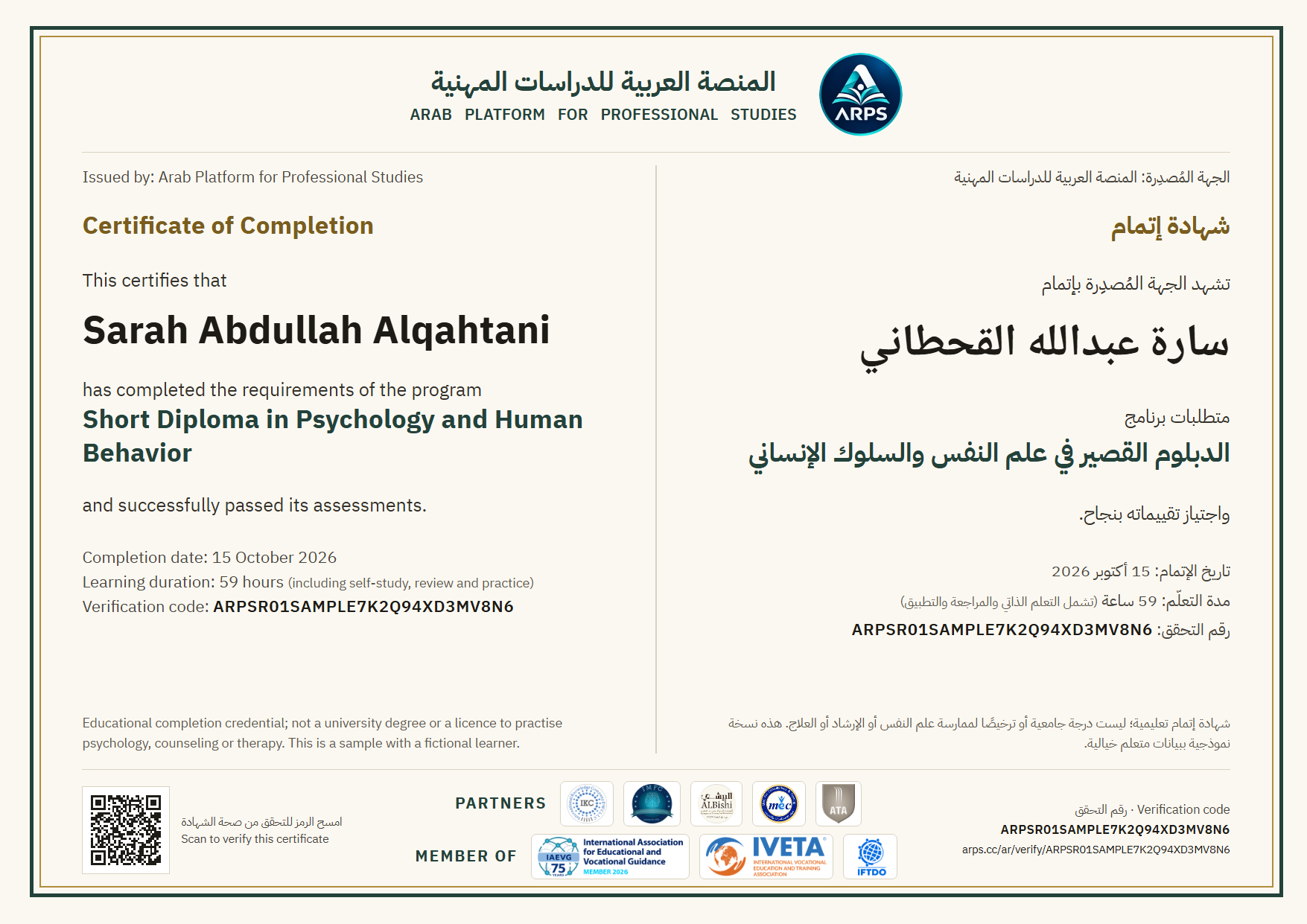
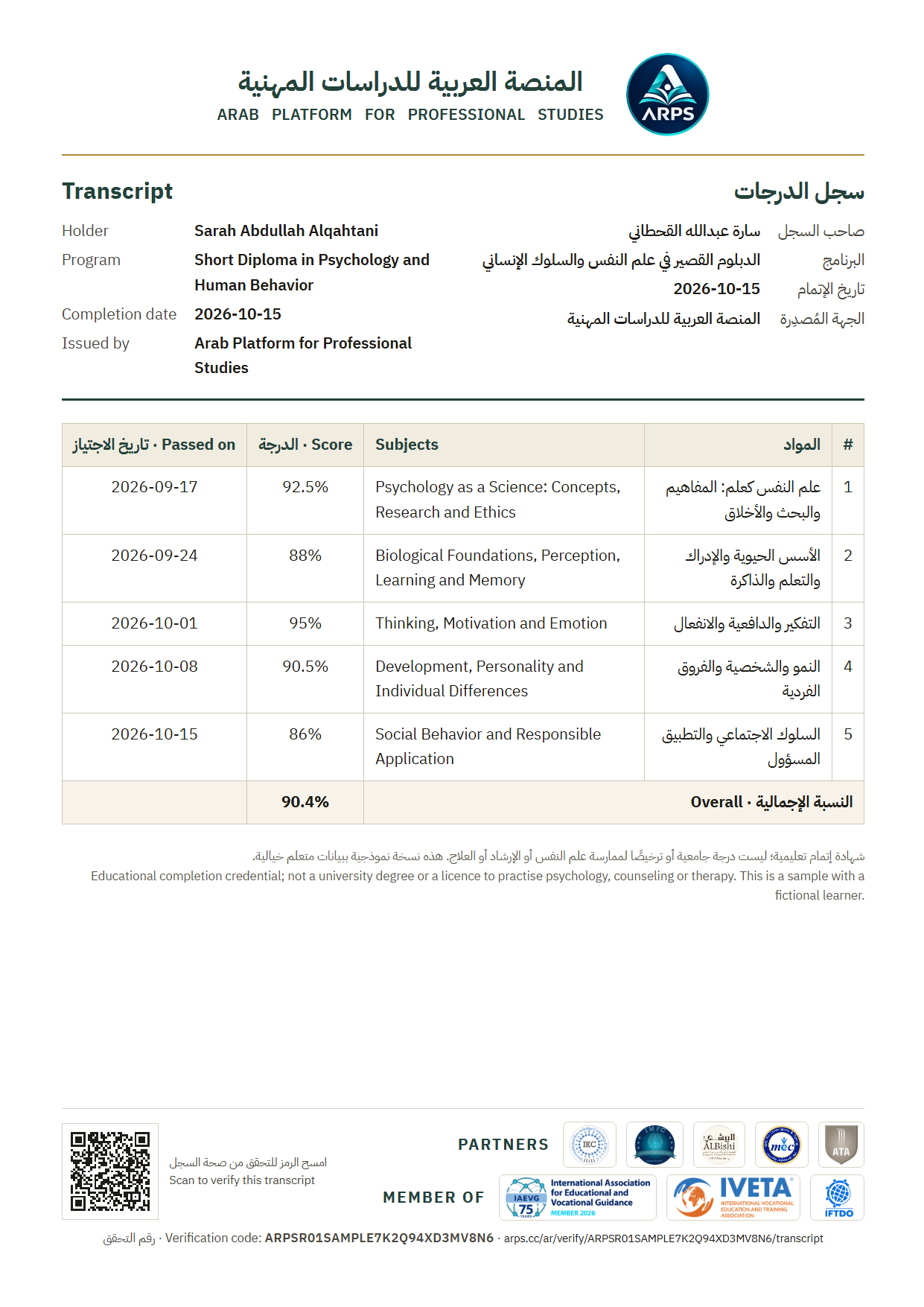
A sample from a real program in this track: Short Diploma in Psychology and Human Behavior. The learner, scores and dates are fictional; opens in a new window.
Disclaimer: Training completion, not a university degree or professional licence.
Program questions
Does the program teach full BPMN modelling?
It uses elementary events, tasks, gateways and messages for process reasoning; it does not claim mastery of the full specification or a specialist credential.
Are city cases records from real organisations?
No. Named cities are teaching context, and figures are invented for calculation and decisions, not actual organisational performance.
How do the five subjects differ?
They move from boundaries and ownership to mapping, measurement, bounded improvement and procedure control.
Do exercises require employer data?
No. Exercises provide fictional case data in the lessons. Applying the method at work later requires suitable permission and actual data.
How do subject assessments differ from lesson exercises?
Exercises produce maps and decision cards with guided feedback. Each subject summative tests decisions in new cases under the central passing policy.
Show all (7)
Is Short Diploma in Business Process Management free, and do I get a certificate?
Yes. Short Diploma in Business Process Management is free on ARPS: every lesson, exercise and assessment is free, the first subject is open to read without an account, and the program is available in Arabic and English. Issuing a certificate is optional and has a published fee; it is a training completion certificate showing you passed the program's assessments, recognised by most private-sector organisations in the Gulf states and most Arab countries, and it strengthens your CV; confirming that a specific organisation accepts it remains your responsibility.
What other names is Short Diploma in Business Process Management known by?
The subject of this program is also known as: business process management, BPM, process improvement. Learners usually find it by searching for: business process management course, BPM training, process mapping course, free BPM course.
A foundational diploma of five core subjects, an applied subject and a capstone in procurement and supplier management, covering need and specification, supply-market analysis, supplier selection, negotiation, contract management, performance, risk and ethics, then spend data and purchase-cycle controls.
A foundational diploma explaining how materials, services and information move from suppliers to customers, and how demand, inventory, sourcing, logistics and risk decisions trade off service, cost and resilience.
A foundational diploma connecting needs and system boundaries with requirements, architecture, verification, technical management and operation through a fictional maintenance service with worked decisions.
A foundational applied diploma that connects Lean, Six Sigma, and operational excellence in one pathway: customer value, waste, flow, variation, DMAIC, trustworthy measurement, root-cause analysis, process capability, improvement, and control.
6 subjects
25 lessons
66 hours
Free
Next step: a professional certification or a mini-master
Programs in the same domain that prepare you for an international certification exam or form a professional mini-master, also free.