Short Diploma in Systems Engineering and Systems Management
Short Diploma in Systems Engineering and Systems Management is a free program on ARPS, the Arab Platform for Professional Studies. A foundational diploma connecting needs and system boundaries with requirements, architecture, verification, technical management and operation through a fictional maintenance service with worked decisions.
Important notice: Foundational training completion; it grants no licence or authorization for regulated engineering practice.
Draw a system boundary and identify stakeholders and flows.
From lesson 1, readable now without an account: System Boundary and Stakeholders
The system of interest is not everything visible in a situation. It is the set of elements we intend to design or change for a defined purpose, with explicit interfaces to what remains outside. Elements may include software, people, procedures and equipment. The boundary depends on the decision being studied. For a maintenance booking service, the request store, dispatch logic and operator screen may sit inside; a municipal communications network and contractor vehicles may remain in the environment. External does not mean irrelevant: each crossing still needs an owner and an observable contract. SEBoK introduces the system's purpose, boundary, environment and stakeholders as connected concerns across its life cycle. Our diagram is therefore a decision tool, not a drawing of every technology in the city.
A free account saves your progress and takes you straight to lesson 1.
Program facts
Study fee
Free
subjects
6
lessons
24
Estimated time
86.5 hours
Content last reviewed
Access period
60 days
Study language
Arabic and English
About the program
Learners move from stakeholder needs to verifiable requirements, decompose functions, define interfaces and compare architecture alternatives. They test element integration and distinguish specification verification from validation of usefulness. They manage baseline change, risk and measures, then decide operational transition, incident repair and retirement of an old system, closing with a learning-device lending service capstone. Every case figure is for learning; the limits of its evidence are stated before a decision is carried forward.
Practical relevance
Boundary, trace and verification methods can be adapted to a small service or internal system using its own data and roles. Fictional thresholds must not be adopted in a real project without stakeholder review and measurement.
Why this program
Individual components can pass while a case disappears at an interface, a crew receives duplicate orders, or an operator cannot find pending work. This program connects purpose, evidence and decision throughout the life cycle rather than presenting process names in isolation.
Career relevance
Useful for roles contributing to system needs analysis, development coordination, operation and evidence review. It supports structured engineering questions but grants no professional authorization or formal design sign-off.
Career paths this program serves
This program is a step on the paths of the following occupations. Open a path to see its other programs in study order.
Define a system boundary, stakeholder needs and verifiable requirements.
Decompose functions, specify interfaces and compare architecture alternatives.
Plan integration, verify requirements and validate usefulness in context.
Manage baselines, change, risk and technical performance measures.
Assess operational readiness, incident response and retirement of an old system.
Design a learning-device lending service in a capstone: estimating capacity, reconciling device custody, running a representative trial and making an evidenced continuation decision.
Learning outcomes (24)
Draw a system boundary and identify stakeholders and flows.
Turn a need into a verifiable requirement with threshold and context.
Trace need, requirement, test and change decision.
Decompose and allocate service functions including failures.
Define an interface contract and analyze a data-format change.
Calculate an architecture trade and its sensitivity to assumptions.
Sequence integration and record and retest interface faults.
Build a verification matrix with component results and evidence limits.
Validate a use path from user behaviour, not component success alone.
Analyze a change request against a baseline and dependencies.
Record technical risks with triggers, responses, owners and tests.
Measure technical performance with stable denominators and corrective action.
Decide operational transition using readiness and rollback evidence.
Analyze an operational incident and separate facts from hypotheses.
Integrate need, trace, integration and operation in a retirement decision.
Reconcile conflicting needs into separate registration and dispatch acceptance boundaries.
Allocate a system quality target across elements and interfaces and test the full path.
Link integration, verification and validation evidence in a bounded acceptance argument.
Govern a technical decision across team dependencies and reopening triggers.
Transfer support knowledge with testable diagnosis and escalation.
Designing a Lending Service Under Variable Demand
Reconciling Device Custody Across Records and Reality
Building a Representative Trial Before Service Expansion
Preparing the Operating Team and Continuation Decision
Who it is for
For learners and early-career professionals who help analyse or coordinate a moderately complex service or product: development coordinators, requirements analysts, operations supervisors, quality and support staff, and people making bounded technical decisions in public or private organizations. It suits those seeking a connected life cycle foundation. It does not assume authority to license engineering practice or approve a high-risk product.
Prerequisites
No licensed engineering background or particular modelling tool is required. You should be comfortable reading a short work case, arranging inputs and outputs in a table, calculating a basic percentage and comparing it with a stated threshold. The lessons follow report and order identifiers across several decisions, so willingness to track a case carefully matters more than prior systems engineering vocabulary.
What it does not offer
Not preparation for a named professional certification, supervised field practice or formal engineering sign-off.
Does not provide performance thresholds or legal advice applicable to every country or sector.
Frame the service boundary, turn a reporting need into a traced requirement and test, then reconcile fast registration with safe dispatch through separate acceptance boundaries.
4 lessons · 12.5 hours
System Boundary and Stakeholders2.5 hours
From Need to Verifiable Requirement2.5 hours
Trace a Need to an Acceptance Decision2.5 hours
Reconciling Conflicting Needs and Acceptance Boundaries2.5 hours
Subject 2
Architecture, Interfaces and Trades
Decompose functions, control interface contracts and compare architecture options. Allocate speed and dependability across the path, including waits and shared failures.
4 lessons · 12 hours
Functional Decomposition and Allocation2.5 hours
Interface Contract and Data Change2.5 hours
Architecture Trade Study and Sensitivity2.5 hours
Allocating Quality Attributes Across the Architecture2.5 hours
Subject 3
Integration, Verification and Validation
Stage integration and choose verification and validation evidence. Join results by case and component version so acceptance stays within what was shown.
4 lessons · 12 hours
Integration Plan That Exposes Interface Faults Early2.5 hours
Verification Matrix and Evidence Limits2.5 hours
Validate the System in Use2.5 hours
Building an Acceptance Evidence Thread from Component to Use2.5 hours
Subject 4
Technical Management, Change and Risk
Control change, risk and technical measures under stable definitions. Record decision owners, dependencies and evidence triggers for review.
4 lessons · 12 hours
Baseline and Change Impact2.5 hours
Risk Register, Trigger and Response2.5 hours
Technical Performance Measurement and Action2.5 hours
Governing Decisions and Dependencies Across Teams2.5 hours
Subject 5
Operations, Support and Life Cycle Decisions
Plan transition and rollback, investigate incidents and retirement, then test whether duty staff can diagnose pending orders and escalate without duplicate work.
4 lessons · 12 hours
Transition to Operations and Rollback Readiness2.5 hours
Operational Incident Analysis and Repair Check2.5 hours
Life Cycle Decision from Need to Retirement2.5 hours
Transferring Knowledge for Sustainable Operational Support2.5 hours
Subject 6
Capstone: A Learning Device Lending Service
Design a device lending service, calculate capacity, reconcile custody and test users. Combine operations and cost into an evidence-bound continuation decision.
4 lessons · 27.5 hours
Designing a Lending Service Under Variable Demand6 hours
Reconciling Device Custody Across Records and Reality6 hours
Building a Representative Trial Before Service Expansion6 hours
Preparing the Operating Team and Continuation Decision6 hours
Subjects unlock in sequence as you progress.
Strengths
A continuing maintenance case shows how decisions change when evidence or denominators change.
Two worked activities per lesson and a separate assessment for every subject.
Diverse primary references are used within stated access and claim limits.
Evidence basis
Life cycle concepts are grounded in the public ISO abstract, SEBoK guidance and published NASA engineering guidance. The full paywalled standard is not claimed as read. Case figures are fictional and citations imply no publisher endorsement.
Reference organizations
ISO
SEBoK Editorial Board
NASA
Frameworks used
SEBoK — 2.14
Methodology
A defined concept leads to a worked case, observable practice output and bounded decision, assessed per subject.
How the route works
Short Diplomas are relatively comprehensive learning pathways that cover a major subject through five connected learning subjects and structured assessments, with a diploma transcript available with the credential.
Self-paced sequential study. Content unlocks progressively and each subject combines reading, examples, exercises, knowledge checks, and assessment.
Build integrated knowledge in a major subject.
Study through five clear, connected learning subjects.
Complete a defined assessment for each subject.
Receive a diploma transcript showing subjects and results when the credential is issued.
Assessment
Each Short Diploma contains five subjects, each with an approved assessment. A sixth final exam is not required when the five assessments adequately cover the learning outcomes.
Assessment attempts: 2 per assessment, 7 days apart
The pass mark is announced before the program is published.
Certificate
Successful completion makes the learner eligible for the Short Diploma certificate and Diploma Transcript under the credential policy.
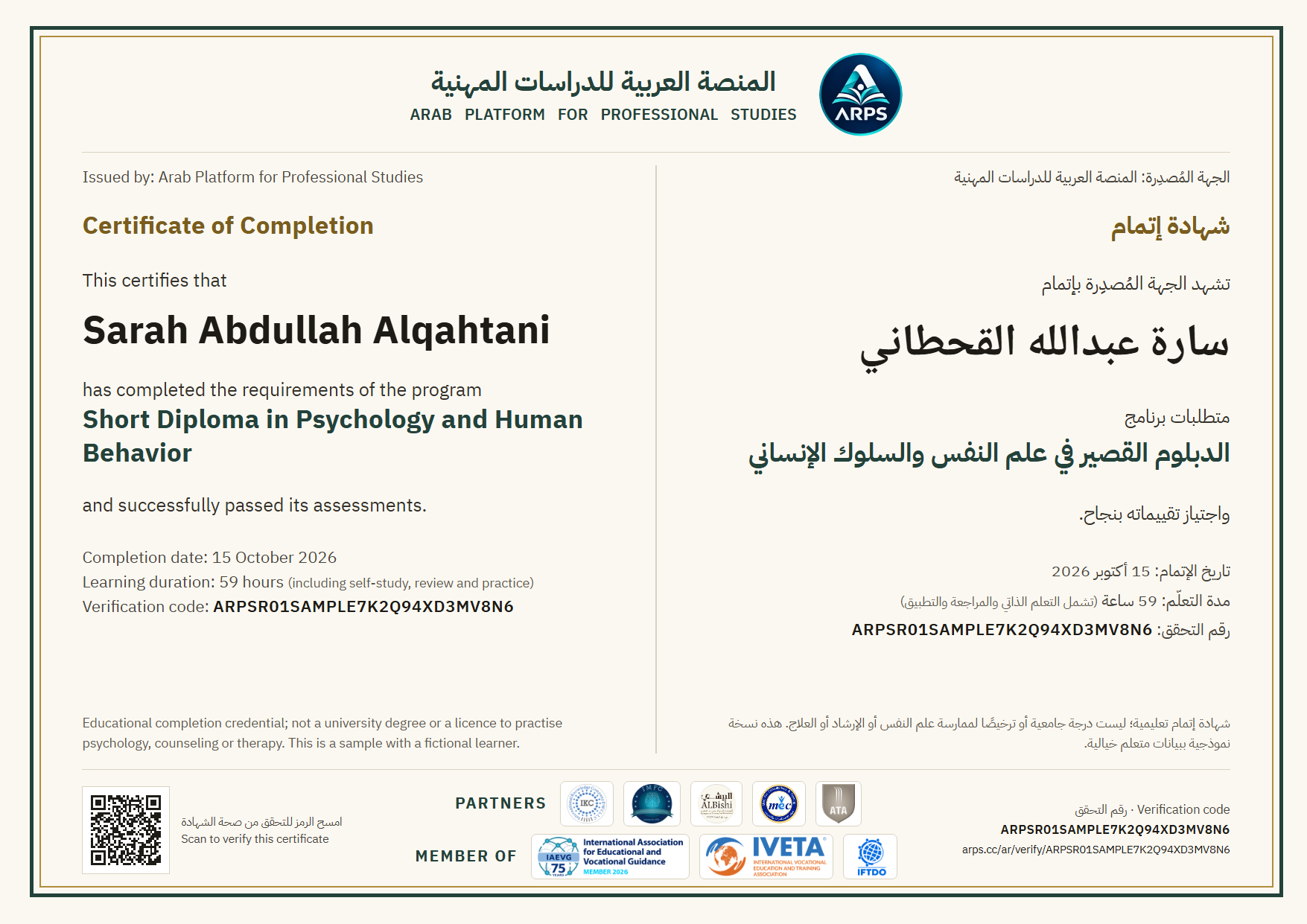
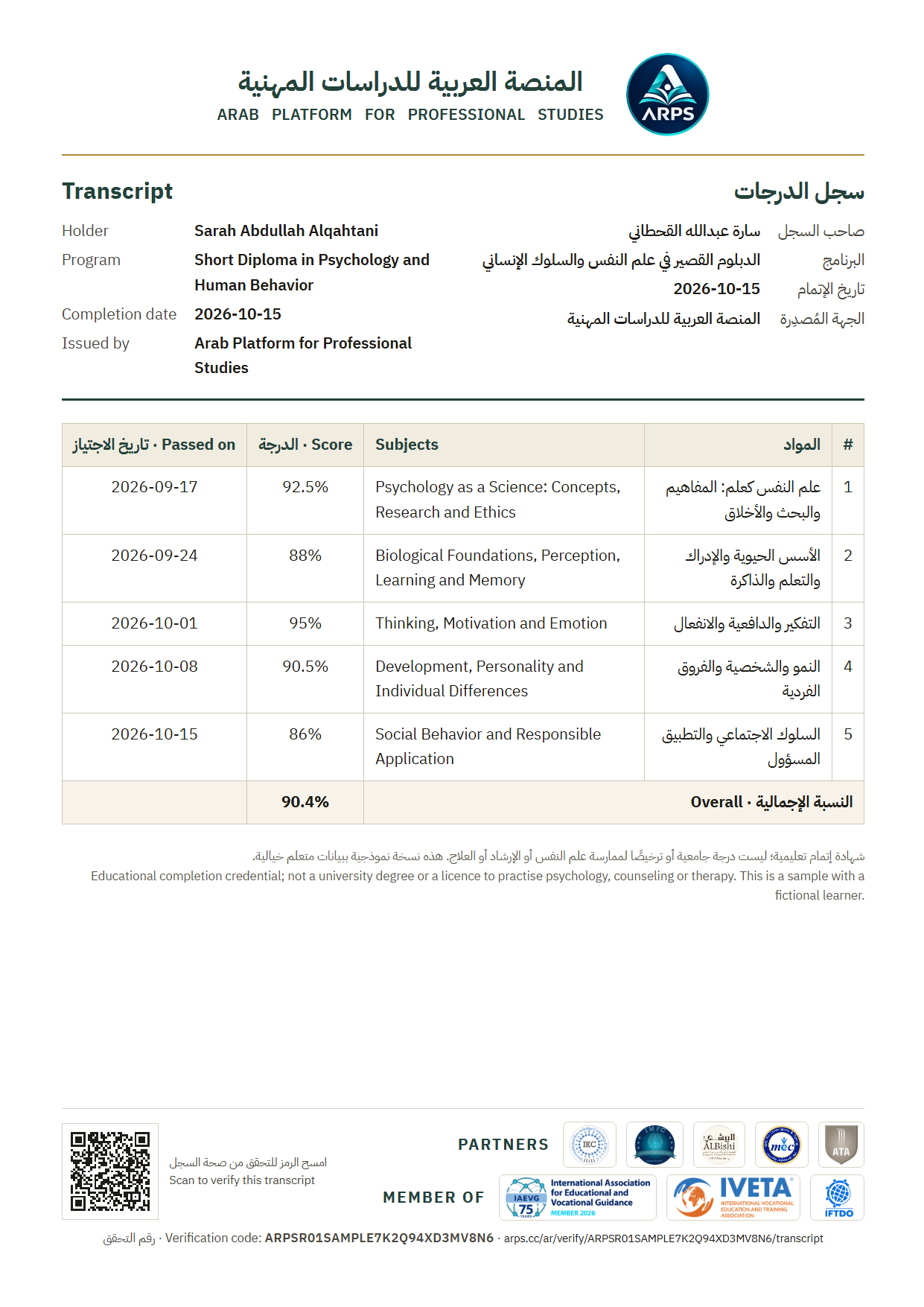
A sample from a real program in this track: Short Diploma in Psychology and Human Behavior. The learner, scores and dates are fictional; opens in a new window.
Disclaimer: Training completion in systems engineering and management foundations; not a professional certification, engineering licence or university degree.
Program questions
Is this a professional systems engineering certification?
No. It is foundational assessed training completion, not a professional issuer credential or a licence to practice.
Can I use the case numbers in my own project?
They are training inputs for reasoning and calculation. Establish your own measures, stakeholders and context before setting a real threshold.
How is each subject assessed?
Each lesson has a short learning check, and each subject ends with a separate assessment. Subject results are recorded under the program completion policy.
How long is study and access?
The nominal duration is thirty days and access lasts sixty days under the attached enrollment policy.
Are official hours awarded?
No official learning hours are specified; activity timing is an internal teaching estimate.
Show all (10)
What follows an unsuccessful subject assessment?
The assessment policy allows two attempts with a seven-day wait between attempts.
Do I need specialist modeling software?
No. Reading case tables and basic percentages is enough; activities can be done on paper or in a simple table.
How does this differ from licensed practice?
The subjects teach evidence based reasoning for bounded training decisions; they grant no professional sign-off or high-risk system approval.
Is Short Diploma in Systems Engineering and Systems Management free, and do I get a certificate?
Yes. Short Diploma in Systems Engineering and Systems Management is free on ARPS: every lesson, exercise and assessment is free, the first subject is open to read without an account, and the program is available in Arabic and English. Issuing a certificate is optional and has a published fee; it is a training completion certificate showing you passed the program's assessments, recognised by most private-sector organisations in the Gulf states and most Arab countries, and it strengthens your CV; confirming that a specific organisation accepts it remains your responsibility.
What other names is Short Diploma in Systems Engineering and Systems Management known by?
The subject of this program is also known as: systems engineering, systems management, MBSE. Learners usually find it by searching for: systems engineering course, systems engineering fundamentals, systems lifecycle management, free systems engineering course.
Follow requests through to service outcomes. Learn boundaries, mapping, elapsed time, rework and controlled improvement. Five core subjects and an applied capstone include fictional exercises and assessments. This is foundational learning without professional licensing or claimed accredited hours.
A foundational diploma of five core subjects, an applied subject and a capstone in procurement and supplier management, covering need and specification, supply-market analysis, supplier selection, negotiation, contract management, performance, risk and ethics, then spend data and purchase-cycle controls.
A foundational diploma explaining how materials, services and information move from suppliers to customers, and how demand, inventory, sourcing, logistics and risk decisions trade off service, cost and resilience.
A foundational applied diploma that connects Lean, Six Sigma, and operational excellence in one pathway: customer value, waste, flow, variation, DMAIC, trustworthy measurement, root-cause analysis, process capability, improvement, and control.
6 subjects
25 lessons
66 hours
Free
Next step: a professional certification or a mini-master
Programs in the same domain that prepare you for an international certification exam or form a professional mini-master, also free.