Short Diploma in Media and Film Studies is a free program on ARPS, the Arab Platform for Professional Studies. This diploma studies how media messages and film scenes are constructed and how different audiences may read them. Six subjects progress from source and representation to shot, sound and edit, then to a short scene plan, a revision when contrary evidence.
Important notice: Independent education; not a university degree, professional licence or endorsement by cited organizations.
Separate what a media item visibly or audibly presents from inferences about producer, purpose and audience, then test an alternative reading.
From lesson 1, readable now without an account: From an observed media text to a qualified account of purpose and audience
When you examine a media item, begin with details another reader could locate in the item itself. These are observations: a written line, a shot, a sound, a duration, a sequence or an identified publisher. An inference is the interpretation you build from those details. The organizer's logo and the imperative 'Do not miss' support calling the short clip promotional. They do not prove how every viewer felt or what every person involved in filming intended. Precision does not require hesitation in every sentence. It requires naming the strength of the evidence and what remains to be checked. Media study treats the message as a made and selected text, not a transparent view of an entire event.
A free account saves your progress and takes you straight to lesson 1.
Program facts
Study fee
Free
subjects
6
lessons
24
Estimated time
62 hours
Content last reviewed
Access period
60 days
Study language
Arabic and English
About the program
When a bulletin reports a room opening and a teaser promises a screening, what do the words and images actually establish? Learners separate observation from inference, test a claim’s source and denominator, and analyze how framing, sound and shot order shape interpretation. They then outline a short sequence within time, rights and accessibility constraints, and revise news and promotional language when new evidence changes the release decision. Cases and figures are explicitly invented for learning; they describe no real institution or audience.
Practical relevance
Exercises produce claim ledgers, shot and sound plans, rights and access decisions, and bounded publication text. The method can transfer to a new clip or article after its own sources and conditions have been checked.
Why this program
The program connects media and film study through decisions that can be inspected: what an item says, what it invites the viewer to infer, which evidence is missing, and how production and distribution alter meaning. Learners repeatedly test the boundary between what is on screen and what is established outside it.
Career relevance
The material supports early work in educational, cultural and media settings by improving critical reading before a clip is used in a lesson, screening or content project. It does not promise a professional qualification or equipment proficiency.
Career paths this program serves
This program is a step on the paths of the following occupations. Open a path to see its other programs in study order.
Distinguish an observed media feature from an inference about maker, purpose and audience.
Test a media claim against source, denominator and limits of generalization.
Explain effects of shot scale, light, sound and editing without treating symbols as universal.
Plan a feasible short scene with time, rights and access constraints.
Revise news, promotional and dramatic accounts when contrary evidence arrives.
Complete a documentary project from oral testimony and screening data to disclosure of synthetic imagery and preservation.
Learning outcomes (5)
Distinguish form, institution, purpose and audience in a bounded case
Verify a bounded media claim and compare whose perspective is represented
Explain how concrete formal choices shape a scene interpretation
Plan a short audiovisual sequence with evidence, rights and access constraints
Defend a cross-media interpretation and revise it under contrary evidence
Who it is for
The diploma suits beginners in media and film study, teachers who want to read a scene with learners, and people beginning work in cultural or content projects. It helps anyone who can describe what they saw and now wants to test a reading against sources and stated limits. Both language paths teach the same skills without requiring professional experience or production equipment.
Prerequisites
You need to read a short article in Arabic or English and watch a brief scene, or use its written description. The activities ask for simple ratios such as 35 out of 50, comparison of dates or shot times, and a short reason for a decision. No prior production experience, editing software or personal camera is required.
What it does not offer
This is not a licence to practise journalism or filmmaking and does not train operation of a named camera or editing application. Fictional examples do not clear actual publication rights; rights discussion is not local legal advice.
This subject begins by reading a media message on two levels: what can be observed in the item and what is inferred about purpose and audience. An invented film-festival bulletin is compared with a promotional clip, preserving the distinction between entries and unique people. Learners then connect funding and distribution choices to what a webpage, short clip and live screening can actually deliver, separating reach from understanding. Two photographs of a library opening make cropping, timing and absent context concrete without assuming the photographer's intent. The subject closes by distinguishing a news item, documentary, fictional scene and hybrid reconstruction, with an in-scene disclosure decision. Exercises produce an evidence-and-alternative table, a distribution plan, a corrected caption and a reconstruction card.
4 lessons · 8.5 hours
From an observed media text to a qualified account of purpose and audience2 hours
Funding, platform affordances and distribution choice2 hours
Framing, cropping and what remains outside the image2 hours
Media genre and its contract with viewers2 hours
Subject 2
Sources, evidence and representation
This subject examines the evidence a media item needs and the limits of whose experience it represents. A claim that a library will close 'permanently' is split into scope, duration and service, then a dated notice, undated photograph and unverified message enter a claim ledger that can be updated one row at a time. An invented survey gives 35 of 50 respondents and 50 of 200 invitees; learners calculate both rates without applying a respondent proportion to an entire festival audience. In a screening-room clip they code who speaks and who merely appears, accounting for known speaking time without inventing a voice for the remainder. Finally, a restoration-delay report is weighed against the risk of identifying a volunteer whom the evidence does not blame. Outputs are claim, denominator, voice and bounded-release records.
4 lessons · 8.5 hours
From a claim to an auditable verification chain2 hours
The denominator before the percentage: reading audience figures2 hours
Who speaks and who appears: representing participants2 hours
Public value and privacy in a bounded publication decision2 hours
Subject 3
The language of image, sound and editing
This subject shows how moving images construct information and expectation that can be analyzed rather than decoded through fixed symbols. A student arriving at a screening room provides four shots whose scale, angle and duration total twenty-six seconds; the camera does not reveal her private anxiety. Two stagings of the same dialogue alter performer position, light and a closed box without proving the box's contents. A sound scene distinguishes footsteps, chime and speech within the story world from a score added for viewers, then assigns captions and visual description where key information would otherwise disappear. Finally, six door-and-screen shots are ordered for action clarity and for deliberate discontinuity without claiming a projector started. Learners produce timing, sound, staging and editing decision records.
4 lessons · 8.5 hours
Shot scale, angle and duration2 hours
Mise-en-scène: arranging people and objects within the frame2 hours
Scene sound, captions and visual description2 hours
Editing for clear action and purposeful discontinuity2 hours
Subject 4
From idea to responsible scene
The subject moves from analyzing film to planning a responsible scene under explicit constraints. Learners turn a two-minute poster-preservation purpose into four timed beats, pairing each approved image with information and a procedure bounded by specialist judgment. A ninety-minute shoot is then scheduled around a known chime, preserving the archivist interview and room reset while trimming optional footage after a late arrival. Asset review distinguishes room-only poster permission, music with unknown terms and two differently scoped participant approvals, producing substitutes for a webpage cut. A short screening notice then carries its time and alternative entrance through synchronized captions, descriptive text and visual description. Playback checks catch an inconsistent door update. Each decision has an observable output, fallback and stated limit.
4 lessons · 8.5 hours
From a film purpose to a scene outline2 hours
A shot list and schedule that survive changing conditions2 hours
Material rights and participant consent before release2 hours
Designing a film whose information travels by more than one route2 hours
Subject 5
Interpretation, audiences and integrated evaluation
The final subject combines audience interpretation, news evidence and film language in revisable judgments. Six reactions to a closed-box shot are separated into expectations and claims of actual delivery; two groups asked different prompts cannot stand for a wider audience. A documentary line alleging an all-month closure caused by a projector is audited against a one-day image, repair invoice, five-day schedule and later screening. A report about postponement is compared with a labeled fictional scene that adds an allegation the report cannot support, and the fiction notice remains on excerpts. In the capstone, a failed sound test arrives after a confident screening announcement. Learners update the bulletin, teaser and publishing locations according to Thursday's outcome, using a before-and-after map that identifies what changed and what remains unknown.
4 lessons · 8.5 hours
Different audience readings of the same evidence2 hours
A documentary claim across image, narration and source2 hours
A news item and a dramatic scene about one event2 hours
Revising an integrated media argument after contrary evidence2 hours
Subject 6
Community memory film: from testimony to preservation
A capstone film project on an invented community memory: editing oral testimony, turning screening records into an honest graphic, disclosing synthetic imagery and preserving the film for restoration.
4 lessons · 13 hours
Edit an oral account without changing its speaker3 hours
Turn screening records into an honest graphic3 hours
Disclose synthetic imagery before it enters a documentary3 hours
Preserve a film so another team can restore it3.5 hours
Subjects unlock in sequence as you progress.
Strengths
Six linked subjects take a message from initial reading to revision and a documentary capstone.
Explicitly fictional cases have inputs, figures and worked conclusions that can be checked.
Exercises specify tangible outputs and alternatives, with a separate summative assessment for each subject.
Evidence basis
Principles draw on UNESCO, W3C, WIPO, Pew and originating film-education, ethics and paper-preservation sources. A citation supports a bounded concept, not invented case facts or a universal legal rule.
Reference organizations
UNESCO
W3C Web Accessibility Initiative
WIPO
Pew Research Center
Methodology
Original explanation, invented cases, two exercises per lesson and one assessment per subject; review is assisted self-review, not external accreditation.
How the route works
Short Diplomas are relatively comprehensive learning pathways that cover a major subject through five connected learning subjects and structured assessments, with a diploma transcript available with the credential.
Self-paced sequential study. Content unlocks progressively and each subject combines reading, examples, exercises, knowledge checks, and assessment.
Build integrated knowledge in a major subject.
Study through five clear, connected learning subjects.
Complete a defined assessment for each subject.
Receive a diploma transcript showing subjects and results when the credential is issued.
Assessment
Each Short Diploma contains five subjects, each with an approved assessment. A sixth final exam is not required when the five assessments adequately cover the learning outcomes.
Assessment attempts: 2 per assessment, 7 days apart
The pass mark is announced before the program is published.
Certificate
Successful completion makes the learner eligible for the Short Diploma certificate and Diploma Transcript under the credential policy.
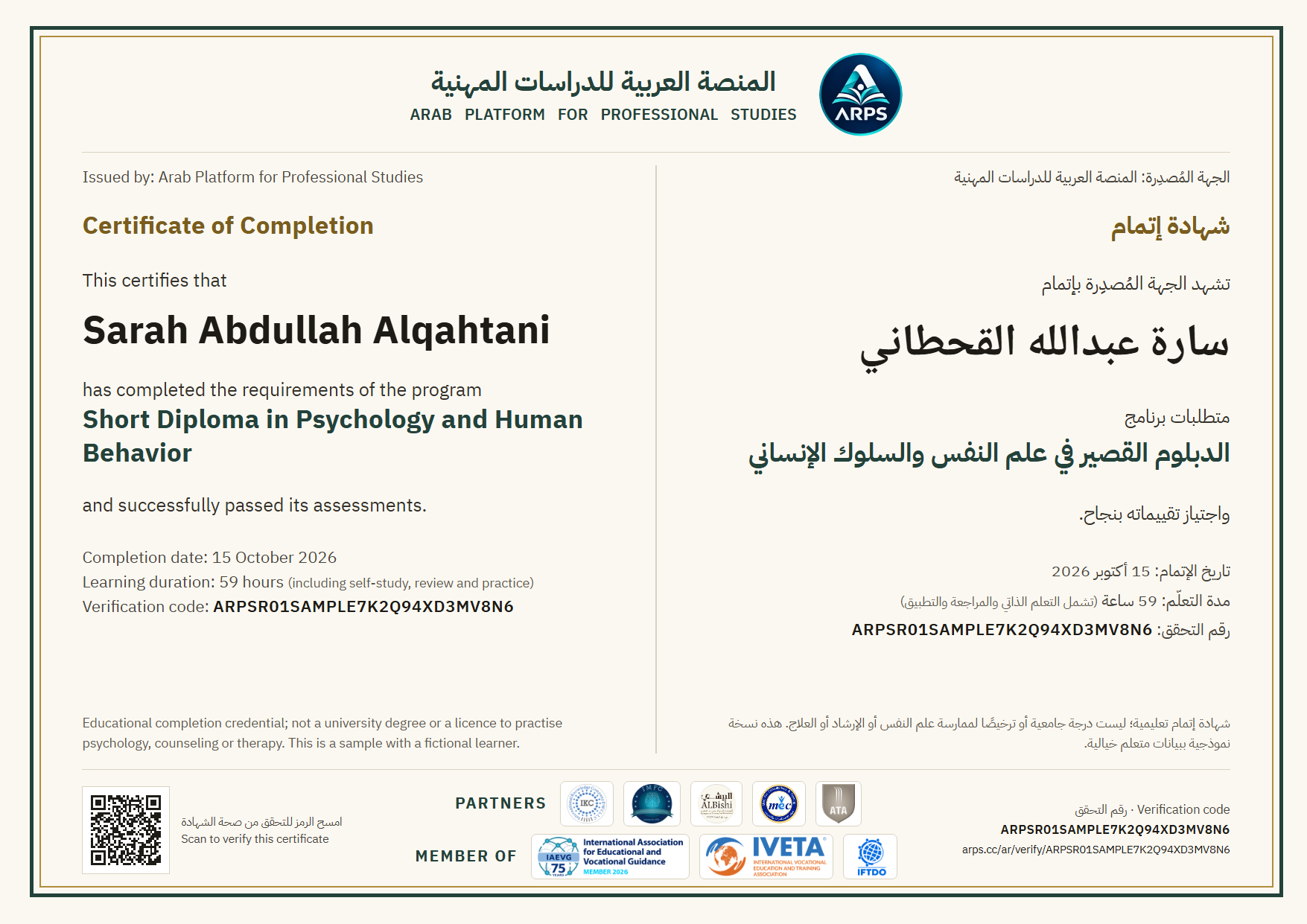
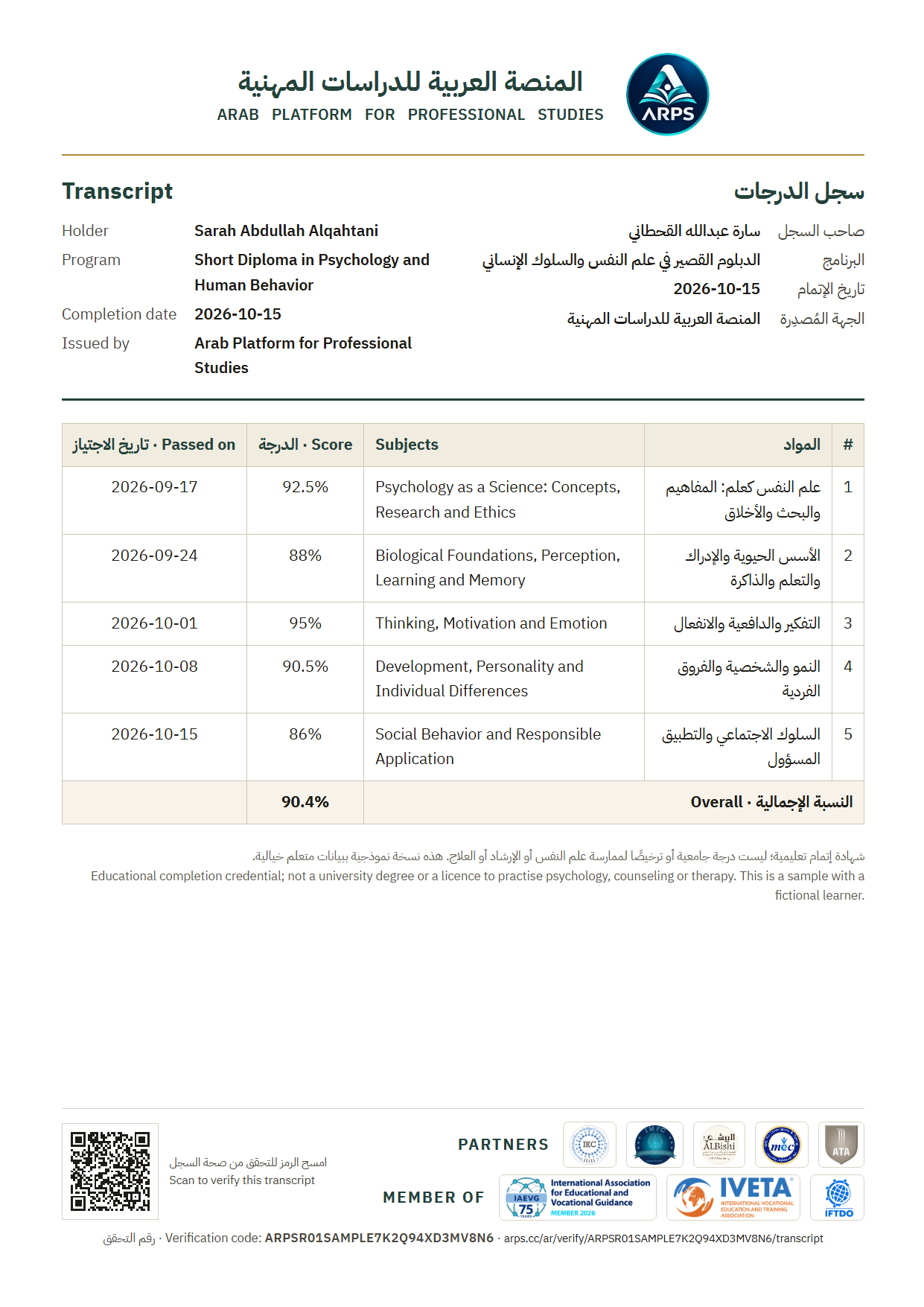
A sample from a real program in this track: Short Diploma in Psychology and Human Behavior. The learner, scores and dates are fictional; opens in a new window.
Disclaimer: Training completion, not a university degree or professional licence.
Program questions
Do I need a camera?
No; exercises use written cases for analysis and planning.
Are official credit hours awarded?
No official learning hours are stated for this route.
Does this teach my country’s law?
It teaches permission-scope questions, not any national law.
Is this journalism specialization?
News is one form compared with documentary, drama and film.
Are the cases real?
Places, figures and records are explicitly fictional.
Show all (10)
How is learning assessed?
Each subject has a summative; each lesson has a check and two exercises.
Are both languages equivalent?
Both teach the same intended skills, case facts and results.
Can the method transfer to another film?
Yes, after checking its sources, rights, audience and context.
Is Short Diploma in Media and Film Studies free, and do I get a certificate?
Yes. Short Diploma in Media and Film Studies is free on ARPS: every lesson, exercise and assessment is free, the first subject is open to read without an account, and the program is available in Arabic and English. Issuing a certificate is optional and has a published fee; it is a training completion certificate showing you passed the program's assessments, recognised by most private-sector organisations in the Gulf states and most Arab countries, and it strengthens your CV; confirming that a specific organisation accepts it remains your responsibility.
What other names is Short Diploma in Media and Film Studies known by?
The subject of this program is also known as: media studies, film studies, film analysis. Learners usually find it by searching for: media and film studies course, film studies course online, film analysis course, introduction to media studies, free film studies course.
A short diploma in English for work, built around real professional tasks: writing clear messages, participating in meetings, summarising information, giving presentations and negotiating with accurate, respectful language. The focus is workplace use, not an external certificate exam.
Turn product or process evidence into documentation that helps a defined reader complete a task. Build a reader brief and source ledger, write procedures, examples, and change notes, then check accuracy, accessibility, and limits before handoff.