Short Diploma in Translation and Localization is a free program on ARPS, the Arab Platform for Professional Studies. A foundation diploma joining translation briefs, terminology, interface localization, revision and a traceable bilingual delivery packet. Across six subjects you work through fictional briefs, service copy, interface resources and revision cases.
Important notice: A short training completion diploma, not a translator licence or professional accreditation.
Extract audience, purpose, binding facts and open questions from a short translation brief.
Produce an Arabic target text that preserves meaning, action and date, justifying two editorial choices.
Distinguish release-blocking ambiguity from a style preference that can be revised later.
From lesson 1, readable now without an account: Read the Brief Before Translating the Sentence
Before choosing a word, find out what the reader must do
Imagine receiving an English event notice: Join the evening tour on 14 May. Reserve your place by 12 May. Entry is free for registered visitors. Starting with one-word replacements may produce a fluent-looking Arabic notice, yet it leaves important questions unanswered. Who will read it? Does reserve open a request that will later be confirmed, or does the button complete a booking? How much room does the mobile card provide for a date? The task is to preserve information and a usable action for a specific audience, not to collect dictionary equivalents. First link the source to its readers and medium in a brief. Then draft and test each target sentence for changed obligations, dates and conditions. The European Commission's EMT framework places source analysis and communicative needs alongside translation choices, research and revision. We use those categories to organize a foundation lesson; this diploma does not claim equivalence to an EMT degree or qualification.
A free account saves your progress and takes you straight to lesson 1.
Program facts
Study fee
Free
subjects
6
lessons
24
Estimated time
76.5 hours
Content last reviewed
Access period
60 days
Study language
Arabic and English
About the program
Across six subjects you work through fictional briefs, service copy, interface resources and revision cases. Compare source with target, preserve restrictions, numbers and variables, and separate locale data from its displayed form. A delivery packet connects Arabic and English targets with term decisions, issue records and open questions, and a capstone applies the skills to audio, wayfinding, plain language and image alternatives. Each lesson has two exercises with guided feedback; every subject ends with an assessment and a transcript result.
Practical relevance
Use its inventory, brief, term log and issue report on a small event notice, registration page or app resource. Cases are invented; real work still requires approved source and target-build testing.
Why this program
A fluent sentence can promise a time or eligibility that the source never granted. This pathway links writing decisions with data, interface and handoff checks so learners can explain both repairs and holds.
Career relevance
For beginners in content editing, language-service coordination or product teams handling Arabic and English. It builds a shared way to work with translators, revisers and developers, without granting a professional licence or accreditation.
Career paths this program serves
This program is a step on the paths of the following occupations. Open a path to see its other programs in study order.
Turn a brief into target copy that preserves meaning, restrictions and audience.
Record term evidence and keep a concept consistent across a user journey.
Localize an interface resource, date and mixed-direction code without corrupting values.
Revise human or machine drafts and write reproducible defect reports.
Hand over an evidence-bounded packet and release decision with open questions.
Produce a bilingual translation project suited to listening, physical routes, plain-language reading and image purpose, with bounded comprehension evidence.
Learning outcomes (21)
Extract audience, purpose, binding facts and open questions from a short translation brief.
Distinguish a stated fact from an estimate or possibility when drafting a service notice.
Identify pronoun referents, numbers and units in a registration message, or log a question when the source does not settle them.
Distinguish a concept from an ordinary word and a product label.
Evaluate a terminology citation by concept fit, version and usage context.
Track one concept across five messages and identify harmful wording drift.
Read string context and variables before localizing interface copy into Arabic.
Separate stored values from locale-specific presentation of a date, amount and time.
Separate paragraph direction, language metadata and the internal order of a mixed-script identifier.
Distinguish meaning, terminology, fluency and formatting defects using source evidence.
Assess whether machine output is usable for a specified purpose before editing.
Write a reproducible issue connecting source and rendered target.
Identify source version and decision owner before translation.
Preserve segment ID, variable and inline marker while translating a resource.
Connect brief, target, tests and open findings.
Match promise, action and condition across three points in a user journey.
Record a term change by concept, context and effective version.
Compare resource value with rendering under wrapping and narrow screens.
Link a repair to other locations sharing its term, variable or component.
Create a change statement that identifies revisions and unresolved points.
Produce a bilingual project suited to listening, physical routes, reading and image purpose, with bounded comprehension evidence.
Who it is for
Bilingual beginners who want a method for making translation decisions through bounded cases rather than memorizing isolated word equivalents.
Content editors and product staff reviewing Arabic interfaces who need to separate text correctness, value integrity and rendered behavior in a target build.
Language-service coordinators who inventory sources and explain findings to reviewers and content owners, including when to hold an unresolved promise.
Prerequisites
Read general Arabic and English and write clearly in both languages. No prior translation job or advanced credential is assumed. Strengthen either reading language before attempting source-target comparisons if needed.
Use a text document or simple spreadsheet to record briefs, terms and defects. No translation software or coding is required; marker and variable examples are data to preserve and review.
What it does not offer
Not a sworn-translator accreditation or professional licensing route.
Not a basis for unreviewed legal, medical or financial translation decisions.
Translation starts with a practical question: who is the reader, and what must that person understand or do? In this subject you build a brief from audience, action, binding facts and medium, then compare every target proposition with its source. You distinguish a legitimate register choice from a changed date, condition or promise, and reorder information without turning expectation into certainty. The tour case keeps the event date separate from the booking deadline and retains the registration condition. The outage case separates current status from a forecast. When a pronoun or time window remains unresolved, you record a precise owner question and hold the consequential sentence rather than inventing policy. The deliverable is reviewable target text with a decision trail and explicit release limits.
4 lessons · 13 hours
Read the Brief Before Translating the Sentence3 hours
Register, Certainty and Information Order3 hours
Resolve Reference and Conditions Without Guessing3 hours
Keep a Message Consistent Across Card, Button and Confirmation2.5 hours
Subject 2
Terminology, Research and Consistency
A termbase starts with the thing a word names, rather than an English-to-Arabic substitution. In this subject you distinguish a single-entry ticket, a two-visit pass and an unconfirmed reservation request. For each concept you record context, a preferred equivalent and why a tempting alternative misleads. You compare a current product definition with an older screenshot and a general dictionary, stating what each source proves and asking whether the current file actually reached users. Then follow a concept through interface states: a submitted, received or reviewed request is not an approved booking until approval occurs. Different verbs can fit a button and a notification; changing the entitlement label without a reason cannot. The result is a maintainable term record and review table.
4 lessons · 12.5 hours
Build a Term Record from Concept and Context2.5 hours
Weigh Evidence When Equivalents Conflict2.5 hours
Terminology Consistency Across a User Journey2.5 hours
Manage a Term Change Across Content Versions2.5 hours
Subject 3
Product Interface and Locale Data
An Arabic interface needs more than word equivalents. In this subject you read resource context, document variables, preserve runtime token names and test count messages at values representing distinct Arabic forms. You separate stored values from the visible date, number and currency format, compute an expressly supplied time offset and retain the original currency unless a verified conversion is provided. A numeric date such as 07/08 with two valid parses is held for source clarification. On a mixed-direction screen, you distinguish a Latin code's copied value from its displayed order and test button clipping with enlarged text. A good-looking screen cannot excuse a false claim that a request under review is complete. The deliverable is a case matrix, concrete defect report and reasoned release decision.
4 lessons · 12.5 hours
Interface Resources, Variables and Plurals2.5 hours
Dates, Numbers and Currency in Display Context2.5 hours
Bidirectional Text and Arabic Interface QA2.5 hours
Test Arabic Copy in the Rendered Interface2.5 hours
Subject 4
Revision, Post-editing and Quality Assurance
Revision begins with the source proposition rather than target elegance alone. Compare times, conditions, negation and quantities, classify the effect on a visitor or buyer, and leave a log another reviewer can follow. Treat machine output as a draft that needs an explicit disposition: limited editing, new human translation or clarification of contradictory client sources. Fluency cannot cover a false financial or eligibility promise. Separate defect severity from repair order, and a resource-file edit from a fix visible in the user's build. Close an issue by repeating its reproduction steps and checking both wording and related action, stating what was not tested. The training cases are fictional and make no claim of standards conformance or live UI verification.
4 lessons · 12.5 hours
Revise the Proposition, Not Only the Sentence2.5 hours
Human Decisions in Machine Output Editing2.5 hours
Triage Defects and Close Review2.5 hours
Regression Review After a Translation Repair2.5 hours
Subject 5
Workflow and Integrated Delivery
The final subject combines earlier skills in one traceable packet. Start by inventorying each page, resource and message with source version and decision owner, then turn the brief into testable acceptance conditions. Move segments with IDs, variables and inline markers intact, reviewing meaning and terms alongside structural checks. A correct file alone does not establish that a link or date works on screen. Handoff connects the version, target, comparison receipt, observed tests and open questions. Use explicit pass, fail and unverified states for web, email and mobile separately. When capacity or deadline conflicts across sources, the content owner decides before a public promise is released. The outcome is a reasoned go or hold recommendation with a defined scope and next verification step, not an absolute quality certificate.
4 lessons · 12.5 hours
Source Inventory and Acceptance Criteria2.5 hours
Move Segments Without Losing Structure2.5 hours
Delivery Packet and Release Decision2.5 hours
Hand Off a Revised Version With Its Decision Trail2.5 hours
Subject 6
Capstone: a bilingual multimodal cultural visit
A capstone on a fictional cultural visit in Arabic and English: writing an audio guide for listening, translating wayfinding without misleading, producing plain language that keeps exceptions, and describing images before handing over a multimodal project.
4 lessons · 14 hours
Writing an audio guide for listening3.5 hours
Translating physical wayfinding3.5 hours
Plain language that preserves exceptions3.5 hours
Image alternatives and multimodal project handover3.5 hours
Subjects unlock in sequence as you progress.
Strengths
Six linked subjects progress from brief to delivery and a multimodal capstone.
Two worked, feedback-rich practice tasks in every lesson.
Clear distinction between file checks and rendering, and pass, fail and unverified states.
A separate summative assessment and integrated summary for each subject.
Evidence basis
Bounded concepts draw on the public EMT framework, ISO abstracts, W3C, Unicode and Microsoft guidance and the OASIS XLIFF specification. The packet claims neither standards conformance nor publisher endorsement.
Reference organizations
European Commission
ISO
Microsoft
Unicode Consortium
W3C
OASIS
Frameworks used
EMT Competence Framework — 2022
Methodology
Five subjects link instruction to a worked case and two guided exercises per lesson. Lesson and item review is documented self-review with decisions and counterexamples, not independent human accreditation or learner psychometrics.
How the route works
Short Diplomas are relatively comprehensive learning pathways that cover a major subject through five connected learning subjects and structured assessments, with a diploma transcript available with the credential.
Self-paced sequential study. Content unlocks progressively and each subject combines reading, examples, exercises, knowledge checks, and assessment.
Build integrated knowledge in a major subject.
Study through five clear, connected learning subjects.
Complete a defined assessment for each subject.
Receive a diploma transcript showing subjects and results when the credential is issued.
Assessment
Each Short Diploma contains five subjects, each with an approved assessment. A sixth final exam is not required when the five assessments adequately cover the learning outcomes.
Assessment attempts: 2 per assessment, 7 days apart
The pass mark is announced before the program is published.
Certificate
Successful completion makes the learner eligible for the Short Diploma certificate and Diploma Transcript under the credential policy.
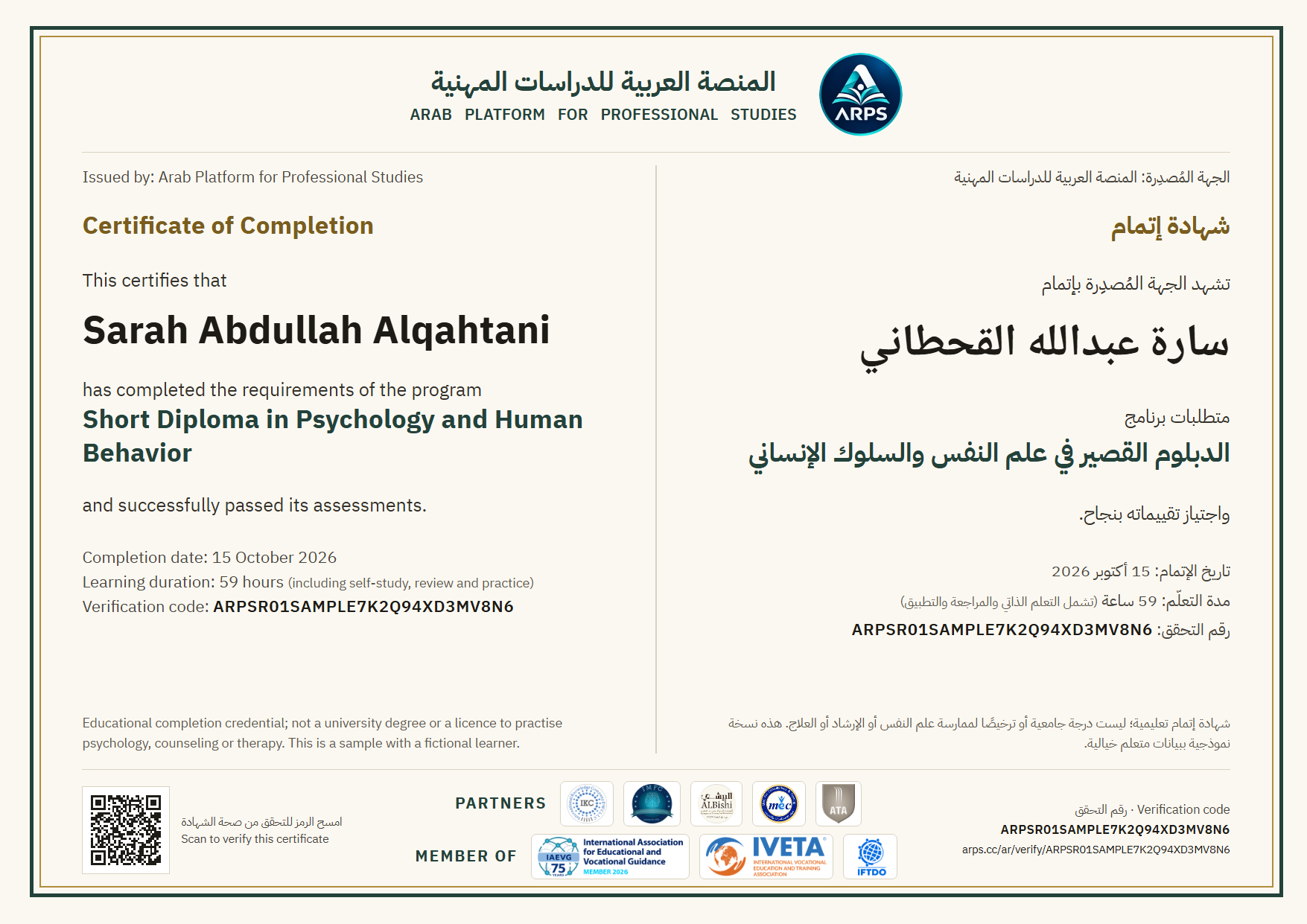
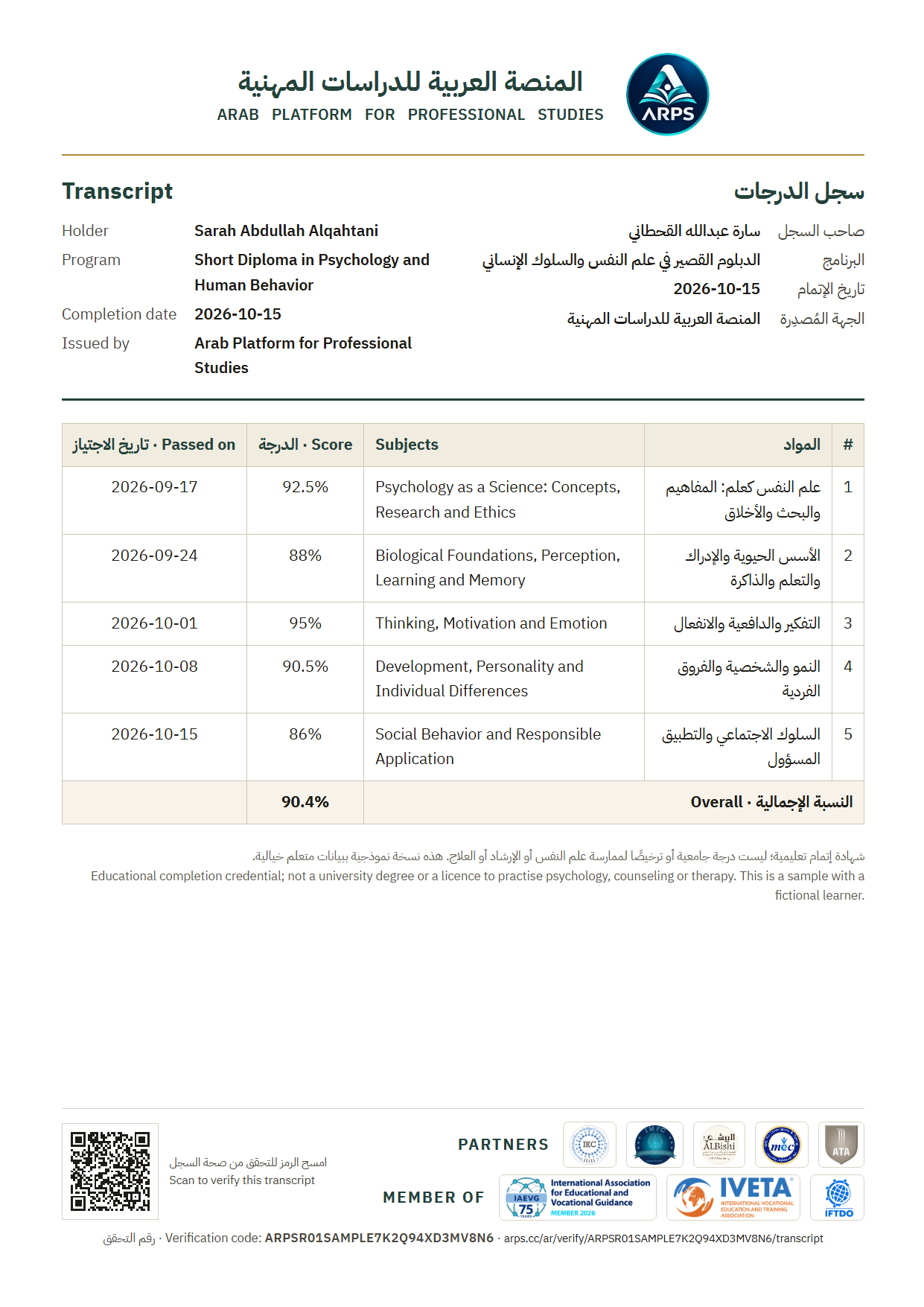
A sample from a real program in this track: Short Diploma in Psychology and Human Behavior. The learner, scores and dates are fictional; opens in a new window.
Disclaimer: Training completion, not a university degree or professional translator licence.
Program questions
Do I need previous translation work?
No. The course starts with brief and meaning before moving into terminology, interfaces and revision; general Arabic and English reading ability is needed.
Will I learn one localization product?
Training resources resemble common localization work, but the course does not certify a particular tool or claim that sample files were imported into a live product.
What is the final subject deliverable?
A bilingual multimodal project for a fictional cultural visit: an audio guide, wayfinding text, plain-language instructions and image alternatives, with a shared fact table and recorded checks.
Does this qualify me as a certified translator?
It is a foundational training completion credential, not a sworn-translator status, licence or endorsement from cited institutions.
How is each subject assessed?
Each lesson has a short check and each subject has a separate summative result in the transcript. The central pass policy applies at delivery.
Show all (7)
Is Short Diploma in Translation and Localization free, and do I get a certificate?
Yes. Short Diploma in Translation and Localization is free on ARPS: every lesson, exercise and assessment is free, the first subject is open to read without an account, and the program is available in Arabic and English. Issuing a certificate is optional and has a published fee; it is a training completion certificate showing you passed the program's assessments, recognised by most private-sector organisations in the Gulf states and most Arab countries, and it strengthens your CV; confirming that a specific organisation accepts it remains your responsibility.
What other names is Short Diploma in Translation and Localization known by?
The subject of this program is also known as: translation, localization, l10n. Learners usually find it by searching for: translation course, localization course, how to become a translator, free translation course.
A short diploma in English for work, built around real professional tasks: writing clear messages, participating in meetings, summarising information, giving presentations and negotiating with accurate, respectful language. The focus is workplace use, not an external certificate exam.
This diploma studies how media messages and film scenes are constructed and how different audiences may read them. Six subjects progress from source and representation to shot, sound and edit, then to a short scene plan, a revision when contrary evidence arrives and a documentary capstone.
Turn product or process evidence into documentation that helps a defined reader complete a task. Build a reader brief and source ledger, write procedures, examples, and change notes, then check accuracy, accessibility, and limits before handoff.
9 subjects
36 lessons
52 hours
Free
Next step: a professional certification or a mini-master
Programs in the same domain that prepare you for an international certification exam or form a professional mini-master, also free.