Short Diploma in Emergency Management is a free program on ARPS, the Arab Platform for Professional Studies. A five subject short diploma connecting risk, preparedness, coordination, communication and recovery through applied cases. It concludes with a supply-distribution continuity capstone. Across five subjects, you separate risk evidence from assumptions, design testable preparedness, document response decisions and resources, communicate actionable information, and.
Important notice: Independent learning with an internal completion credential only; no university degree, professional licence or endorsement by cited organizations.
Compare plausible emergency scenarios without mistaking impact for probability and document uncertainty.
From lesson 1, readable now without an account: Risk components and evidence
An emergency management decision needs a more precise question than which hazard is largest. Identify the hazardous event, what lies in its path, the conditions that could increase its effects, and the capacities that could reduce harm. In UNDRR terminology, exposure means that people or assets are located in a hazard-prone area. A flood map alone does not tell us how many people would need help, and a population count alone does not tell us who is within the mapped area. Specify the unit, location and date of each count before comparing places.
Use a risk register with columns for the event and scenario, geographic footprint, exposed people and assets, vulnerability factors, existing capacities, data quality and feasible action. A hazard can cause harm; exposure identifies what is in its path; vulnerability identifies conditions that make an affected element more susceptible; capacity covers resources and relationships that can manage the risk. These are different observations. Do not add them into a single numerical score without a stated and calibrated model. A qualitative ranking can guide an initial investigation, but it is not an annual probability or a measured expected loss.
Before setting a priority, test whether the comparison is valid. The map for A may be newer than the map for B, and the household counts may come from different dates. Record the source, date, geographic definition and status of each value: estimate or observation. If the footprints are not comparable, the difference between 120 and 80 cannot be interpreted as a difference in risk alone. Obtain a common footprint or label the ranking provisional. Also separate people present at the time of an event from usual residents. Occupancy of the health building may change during the day. A prompt check with its responsible officer can improve an egress decision, while technical review of the map is still needed. This discipline makes the register a revisable working tool instead of a misleading final number.
A free account saves your progress and takes you straight to lesson 1.
Program facts
Study fee
Free
subjects
6
lessons
24
Estimated time
69.5 hours
Content last reviewed
Access period
60 days
Study language
Arabic and English
About the program
Across five subjects, you separate risk evidence from assumptions, design testable preparedness, document response decisions and resources, communicate actionable information, and plan recovery from verified needs. Cases and figures are hypothetical. You compare options, complete independent exercises and take an assessment in each subject. The capstone connects minimum service, supply, record reconciliation and a transition pilot through four practical worksheets.
Practical relevance
Lessons produce registers, tables, messages and decisions with worked solutions that state units, denominators, assumptions and limits.
Why this program
It connects the decision chain from risk description through improvement review.
Career relevance
It supports shared working language for plans, situation reports and needs registers, without replacing field training or licensing.
Career paths this program serves
This program is a step on the paths of the following occupations. Open a path to see its other programs in study order.
Distinguish hazard, exposure, vulnerability and capacity to justify risk priorities.
Draft preparedness triggers, roles and resources, then test the plan in an exercise.
Build a common operating picture, operational objectives and a documented resource handover.
Write actionable risk messages, test their reach and correct rumours with minimal personal data.
Separate damage from needs, schedule recovery and turn a review into verifiable improvements.
Learning outcomes (24)
Distinguish hazard, exposure, vulnerability and capacity in a neighbourhood description and produce a risk register with sound units.
Compare plausible emergency scenarios without mistaking impact for probability and document uncertainty.
Choose risk reduction measures and outcome indicators under a constrained budget.
Write emergency plan assumptions, triggers, roles and dependencies.
Calculate usable evacuation and shelter resources with access constraints.
Design and evaluate a tabletop exercise with observable injects and corrective actions.
Build a timestamped common operating picture that separates verified and unverified reports.
Set operational period objectives, tasks, safety controls and escalation criteria.
Resolve competing resource requests and document handover between shifts.
Draft an actionable risk message with verified facts, uncertainty and update time.
Test message access and use community feedback to revise delivery.
Correct a circulating claim while minimizing personal data.
Separate asset damage, service interruption and needs in a rapid assessment.
Sequence recovery work by dependencies and verify outcomes.
Integrate after action findings into owned, testable improvements.
Align footprint and observation time before comparing exposure, then record changed dependencies, uncertainty and the next verification decision.
Match arrivals to usable capacity, accessibility, water, lighting and staffing before a conditional opening decision.
Distinguish task completion, resource release and request closure, then hand over risks, constraints and ownership to the next period.
Preserve the authorized protective action, version and next update across fallback channels while separating sending, receipt and understanding.
Triage overlapping needs under limited capacity with an auditable criterion and a privacy-preserving correction route.
Define the minimum service and allocate supply batches
Test supply alternatives and reserve limits
Reconcile paper distribution records after reconnection
Transfer service in stages and test the fallback
Who it is for
This program suits beginning emergency management learners, community service staff who need a shared language for risk and response, and people who review plans, messages or needs registers in a learning setting. Administrative support teams can practice separating verified information from assumptions and explaining decisions. It does not confer authority to command a real incident or replace local procedures.
Prerequisites
You should be able to read instructional text in Arabic or English, perform simple percentages and time calculations, and write a short evidence based decision. General familiarity with community services helps but is not required. Allow time to complete the case worksheets, compare options and check your work against the solutions. No field authority or advanced prior experience is assumed.
What it does not offer
This is not authorization to command an incident, perform licensed work or approve an organization specific plan.
Emergency priorities begin by separating a hazardous event from the people and assets in its footprint, then examining vulnerability, capacity and evidence quality. Keep household and person counts in separate units, and never turn a qualitative impact label into an annual probability. A scenario tests a conditional chain: water may accumulate, a service may fail, and its backup may prove insufficient. Change one link at a time to see whether the decision moves. In the generator case, 40 minutes of demonstrated capacity against 90 required leaves a 50-minute gap, not a rainfall probability. Compare risk-reduction options by cost, dependencies and accessible use, then measure the result experienced by visitors rather than counting activities. The 30-, 40- and 25-unit teaching package costs 95 and leaves five, subject to drainage and route tests. Every initial ranking must retain its source, date and uncertainty so new evidence can revise it.
4 lessons · 10.5 hours
Risk components and evidence2 hours
Scenarios, likelihood and impact2 hours
Risk reduction and outcome indicators2 hours
Updating a risk register when evidence and footprints conflict1 hours
Subject 2
Preparedness and readiness
Preparedness plans turn assumptions into testable conditions: does backup power feed the required entrance, and can the duty list actually reach an alternate officer? An activation trigger has an observable signal, checking owner and escalation action rather than a vague claim that a crisis has worsened. Planned occupancy of 90 in the teaching case differs from the 73 people counted at the time. For transport, accessible seats are included within total seats; do not promise repeated trips that miss the decision window. Two vehicles carry 36 of 42 people and only three of six accessible-seat needs in one load. Their second load would arrive at minute 90, beyond the 75-minute limit. A tabletop exercise can reveal these dependencies through timed injects and observable evidence. Its improvement actions need a named owner and a retest result, not merely a meeting or revised document.
4 lessons · 10 hours
Emergency plan triggers and roles1.5 hours
Evacuation resources and access2 hours
Tabletop exercise and corrective actions1.5 hours
Opening a reception centre against verified services and access1 hours
Subject 3
Response and operational coordination
A common operating picture supports decisions when each report retains its location, time, source and verification status. A west-entrance photograph showing pedestrian access does not disprove a report that the east is closed to vehicles. A newer count of 52 rather than 48 does not establish four net arrivals. Turn the picture into period objectives with deadlines, evidence and owners, then assign resources without double-booking a team. In the exercise, two reconnaissance tasks overlap by 30 minutes, requiring another team or a changed objective and escalation. When the stated electrical-isolation limit moves from 16:45 to 16:25, a pump whose earliest start is 16:38 is 13 minutes late for that objective. Shift handover records the original decision, new evidence, still-unserved request and next update. It preserves the knowledge available at each time rather than rewriting history after the result is known.
4 lessons · 10 hours
Common operating picture1.5 hours
Operational period objectives2 hours
Resource allocation and handover2 hours
Closing an operational period with safe unresolved-request handover57 min
Subject 4
Communication and community protection
A risk message states whom it concerns, what is verified, what remains unknown, the authorized action and the next update. Pedestrian access does not permit vehicle routing. A correction needs a dated version rather than silent deletion of an earlier message. Test three distinct links: reach, comprehension and ability to act. In one training sample, 50 of 80 people saw the message and 12 of those 50 misunderstood the vehicle restriction; misunderstanding among viewers was 24%, not a population rate. A second sample cannot isolate the wording effect because the people, location and text changed. If a request sheet containing personal data is exposed, contain it promptly while checking a road rumor on a separate track. Eleven of 38 late requests are about 29% of requests, not people. Changing the interpretation of that indicator cannot make confirmed data exposure optional to address.
4 lessons · 10 hours
Actionable risk message2 hours
Message reach and community feedback2 hours
Rumour correction and data minimization2 hours
Keeping an accessible warning consistent when a channel fails57 min
Subject 5
Recovery and learning
Recovery assessment separates asset damage from service disruption and human need, while keeping requests, households and people distinct. The training centre logged 52 requests from 36 households; 12 water-delivery requests were later traced to seven households. Request count is not a household count. Nine households without an adequate alternative among 20 convenience visits describe the visited sample, not the neighborhood. Restoration dependencies may run in parallel or sequence. Forty minutes of electrical work and 60 of pump repair can run together before a 20-minute test, 45-minute sample and ten-minute message approval. The earliest conditional announcement is 135 minutes from the start, not the sum of all job durations. A failed test changes the path and any promise. An after-action review ties each gap to evidence, owner, deadline and retest, judging a shift decision by evidence available then rather than facts learned later. Urgent needs remain with support services until resolved.
4 lessons · 12 hours
Damage and needs assessment2 hours
Recovery dependencies and outcomes2 hours
After action improvement review3.5 hours
Prioritizing recovery support and checking equity without double counting1 hours
Subject 6
Household-supply distribution continuity project
The capstone combines four worksheets: minimum service, supply, issue reconciliation and transition testing. They retain commitments, owned exceptions and accessibility, using fictional data before handover.
4 lessons · 22.5 hours
Define the minimum service and allocate supply batches4.5 hours
Test supply alternatives and reserve limits4.5 hours
Reconcile paper distribution records after reconnection4.5 hours
Transfer service in stages and test the fallback4.5 hours
Subjects unlock in sequence as you progress.
Strengths
Risk evidence leads to an explicit priority decision.
Preparedness plans are tested with tabletop observations.
Operational and resource logs retain evidence provenance.
Messages distinguish knowns from unknowns and test reach.
Recovery and review yield traceable actions.
Evidence basis
Concepts use primary UNDRR, FEMA, WHO, IFRC, ICRC and UNDP guidance with original instructional cases.
Reference organizations
UNDRR
FEMA
WHO
IFRC
ICRC
UNDP
Methodology
Original instruction, worked case, independent exercise and separate assessment per subject.
How the route works
Short Diplomas are relatively comprehensive learning pathways that cover a major subject through five connected learning subjects and structured assessments, with a diploma transcript available with the credential.
Self-paced sequential study. Content unlocks progressively and each subject combines reading, examples, exercises, knowledge checks, and assessment.
Build integrated knowledge in a major subject.
Study through five clear, connected learning subjects.
Complete a defined assessment for each subject.
Receive a diploma transcript showing subjects and results when the credential is issued.
Assessment
Each Short Diploma contains five subjects, each with an approved assessment. A sixth final exam is not required when the five assessments adequately cover the learning outcomes.
Assessment attempts: 2 per assessment, 7 days apart
The pass mark is announced before the program is published.
Certificate
Successful completion makes the learner eligible for the Short Diploma certificate and Diploma Transcript under the credential policy.
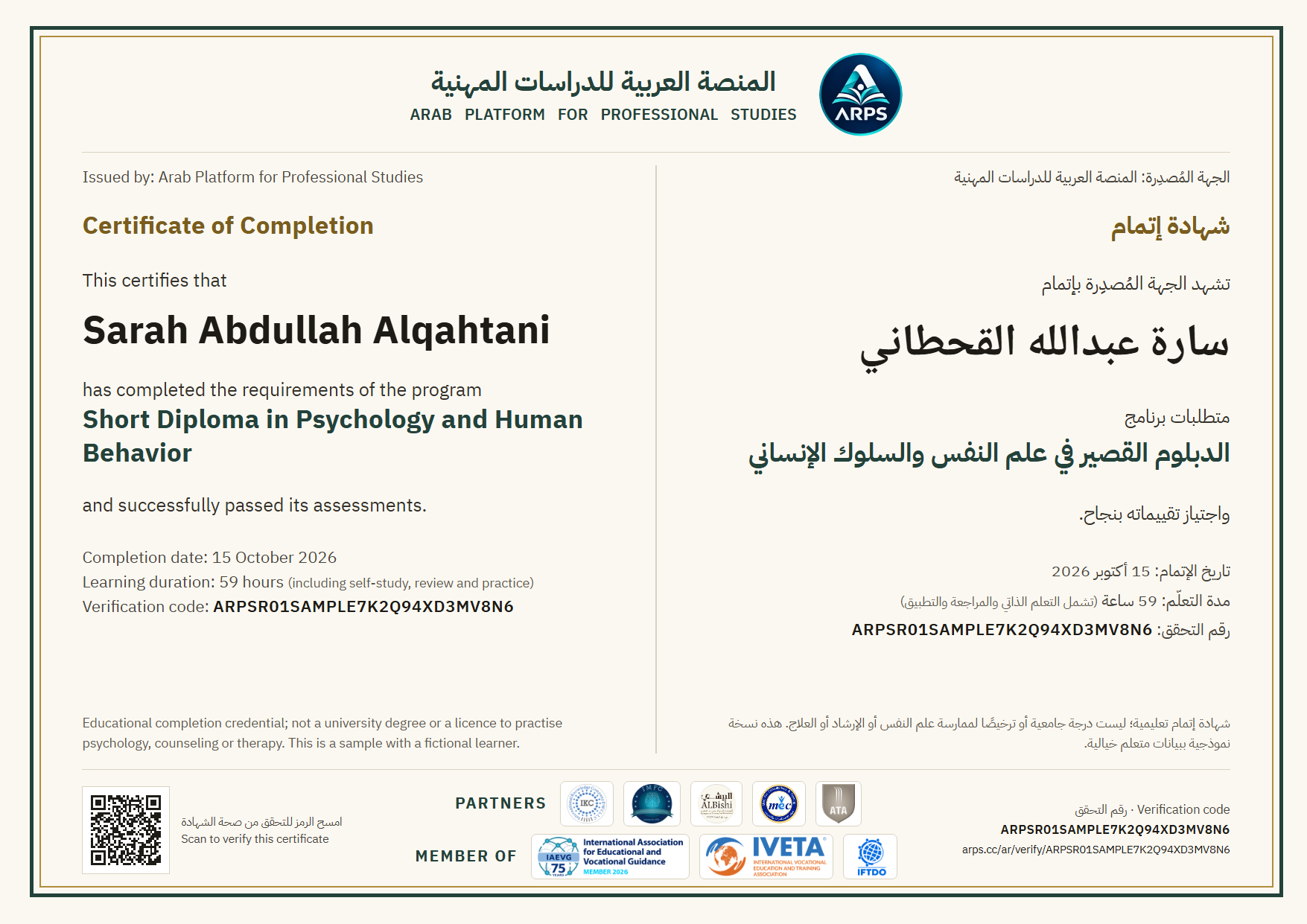
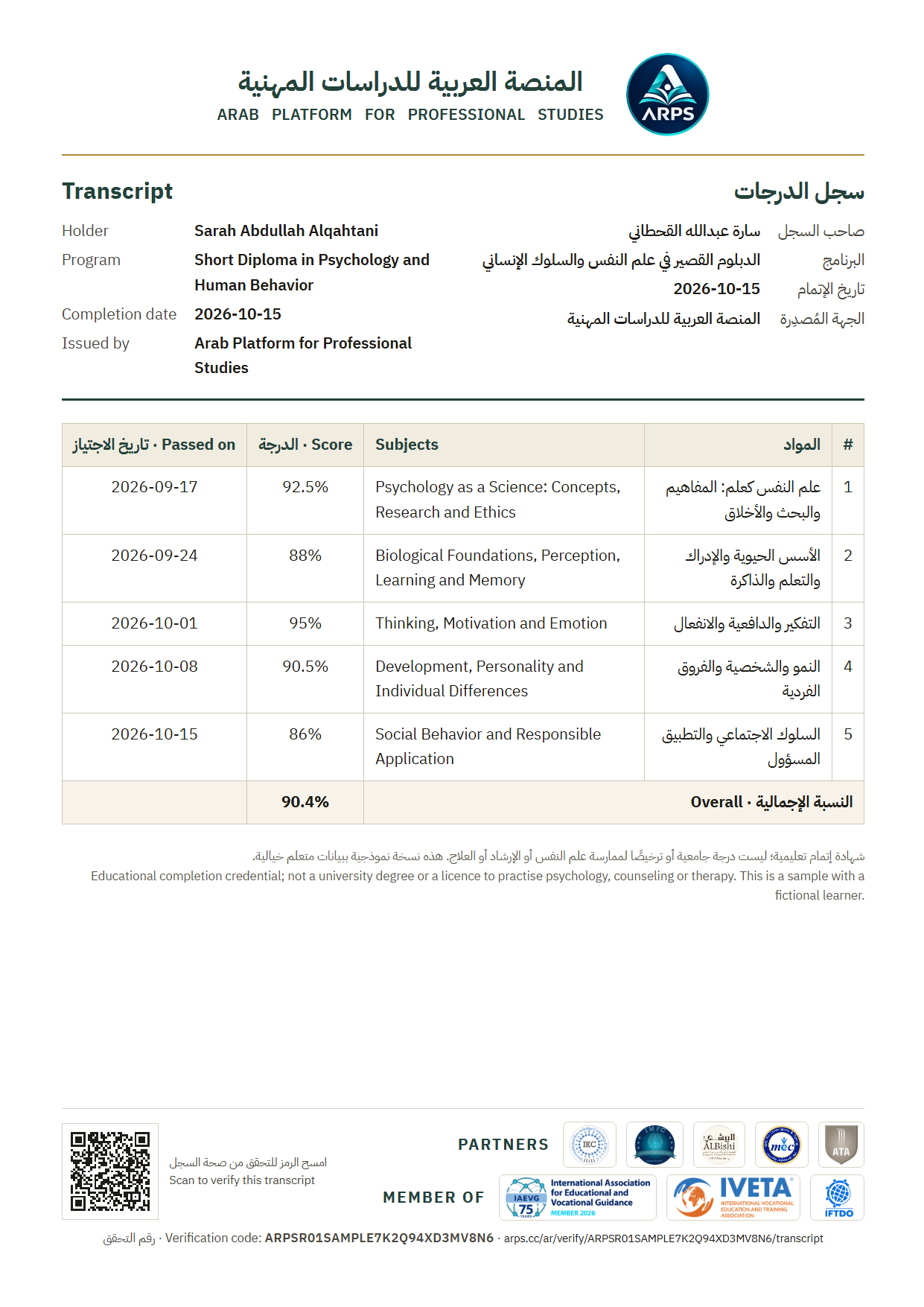
A sample from a real program in this track: Short Diploma in Psychology and Human Behavior. The learner, scores and dates are fictional; opens in a new window.
Disclaimer: Training completion, not a university degree or professional licence.
Program questions
Are the cases real incidents?
No. Case figures and settings are invented for instruction and do not describe a real city or agency.
Is prior experience required?
No; basic calculation and concise writing are useful.
How is progress checked?
Each lesson has worked practice and a short check, followed by a separate subject assessment.
What do the exercises produce?
A decision register, resource table, message or improvement plan according to the lesson.
Do cases apply unchanged to every city?
No. Local evidence and authority must be checked before applying a case decision elsewhere.
Show all (7)
Is Short Diploma in Emergency Management free, and do I get a certificate?
Yes. Short Diploma in Emergency Management is free on ARPS: every lesson, exercise and assessment is free, the first subject is open to read without an account, and the program is available in Arabic and English. Issuing a certificate is optional and has a published fee; it is a training completion certificate showing you passed the program's assessments, recognised by most private-sector organisations in the Gulf states and most Arab countries, and it strengthens your CV; confirming that a specific organisation accepts it remains your responsibility.
What other names is Short Diploma in Emergency Management known by?
The subject of this program is also known as: emergency management, disaster management, crisis management. Learners usually find it by searching for: short courses emergency management, short course in disaster management, short course in disaster risk management, short course crisis management, emergency preparedness course.
Learn to frame, analyze and evaluate risks, then prepare controls and readiness for a bounded service. Fictional data lead to a risk register, continuity card, exercise and documented corrective action within a specialist role.
This short diploma connects market-research design with consumer-behavior interpretation and evidence-bounded decisions. Six subjects progress from the research question through sampling, measurement, analysis, choice journeys, testing, and recommendation, ending with an applied market-research capstone.
6 subjects
24 lessons
62.5 hours
Free
Next step: a professional certification or a mini-master
Programs in the same domain that prepare you for an international certification exam or form a professional mini-master, also free.